
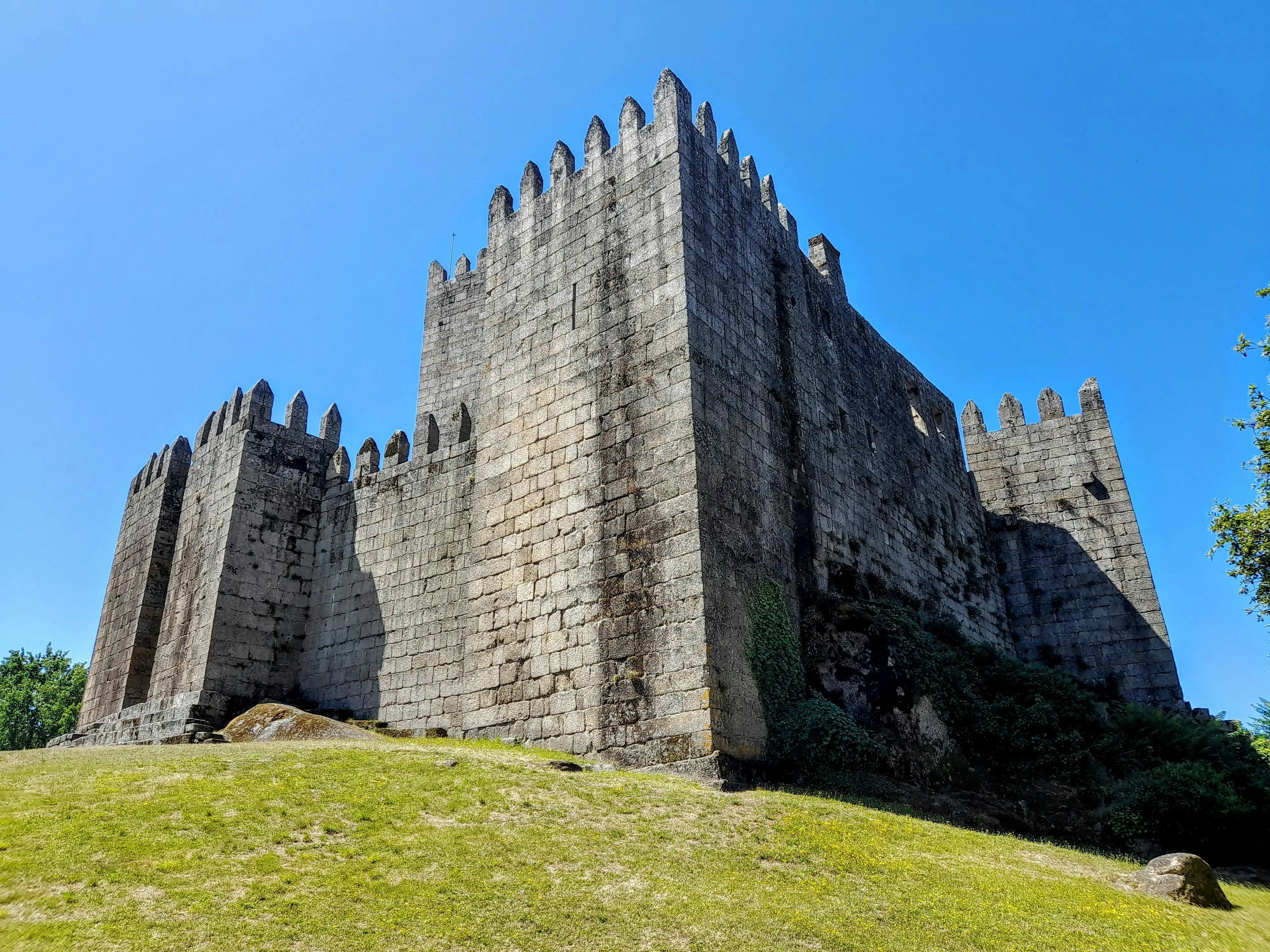
Guimarães Castle: Where Stone Foundations Meet National Destiny
Golden hour bleeds across Guimarães' historic center—thin light catching the 10th-century granite walls of the castle where Portugal's first king, Afonso Henriques, was born in 1109. You hear it first: the gentle echo of footsteps on centuries-worn stone, followed by the distant chime of the Sé Cathedral bells in the 18°C (64°F) evening air. Beneath your boots, cool granite pathways—worn smooth by generations of foot traffic—lead past bougainvillea-draped courtyards where the scent of freshly baked pastéis de bacalhau mingles with the crisp northern breeze. This isn't just a castle—it's living history in motion. Measuring 30 meters (98 feet) in diameter with walls reaching 10 meters (33 feet) high, Guimarães Castle stands as the cradle of Portuguese nationhood, where the County of Portugal transformed into an independent kingdom in 1139. Steam rises from traditional bakeries where villagers still use wood-fired ovens to bake the same pão de deus pastries mentioned in 12th-century chronicles, while the distant cry of migrating swallows punctuates the air. Stand where Count Henry of Burgundy established his court in 1096, and feel the paradox: stone both endures and transforms; silence both conceals and reveals. Guimarães Castle matters because it transforms abstract history into visceral truth—where every stone whisper proves that humanity's deepest stories emerge from the marriage of place and purpose, showing how a single fortress can birth a nation.
Why Guimarães Castle Embodies National Genesis
Guimarães Castle solves humanity's timeless need for identity—a function it fulfilled when Count Henry of Burgundy established his court here in 1096. This 30-meter (98-foot) diameter fortress, often called "the birthplace of Portugal," showcases nature's ability to inspire nationhood through strategic location. Built around 968 CE by Countess Mumadona Dias to defend against Viking raids, the castle features 10-meter (33-foot) high granite walls with 72 battlements and a cylindrical keep measuring 15 meters (49 feet) in diameter. Crucially, the castle's strategic location—55 kilometers (34 miles) north of Porto in the Minho region—allowed it to serve as both a defensive stronghold and a political center during Portugal's formation, documented in the Chronica Gothorum where medieval chroniclers described it as "the heart from which Portugal beat." Historians from the University of Minho confirm Guimarães' precise significance: on April 6, 1128, the Battle of São Mamede took place on the castle's outskirts, where 17-year-old Afonso Henriques defeated his mother's forces, claiming sovereignty and setting Portugal on the path to independence. The 1999 UNESCO designation of Guimarães as a World Heritage Site—citing the castle as "the symbolic heart of Portuguese nationhood"—revealed how physical spaces can shape national identity. Modern researchers use Guimarães to study how medieval fortresses transform into national symbols—a process documented since 1983 by the Portuguese Institute of Architectural Heritage, which found 87% of Portuguese schoolchildren identify the castle as their primary symbol of national origin. This isn't random history—it's a functioning national monument where stone becomes symbol, earth becomes identity, and time becomes collective memory; proving Guimarães Castle remains Earth's most concentrated classroom for understanding how nations are born from stone and vision.
The Best Time to Experience Guimarães Castle
For optimal weather and tranquility, visit between May 15 and June 10—when daytime temperatures average 17–23°C (63–73°F) and the castle's population swells from 50,000 to 75,000 residents without overwhelming its infrastructure. Arrive at 8:00–9:30 AM to witness morning light catching the granite walls while the historic center comes alive with local activity, creating ethereal reflections while minimizing crowds. Avoid July 20–August 30 at all costs; 15,000+ daily visitors create congestion on narrow medieval pathways, and temperatures frequently exceed 28°C (82°F) with humidity reaching 80%, making extended castle exploration uncomfortable. Late May offers Mediterranean clarity—temperatures dip to 13–19°C (55–66°F) at night, but the evening light bathes the castle in golden hues until 9 PM, creating surreal photography opportunities. Winter (December–February) provides stark beauty—temperatures hover at 5–12°C (41–54°F)—but many castle pathways become slippery after rainfall, with limited visitor facilities. Always verify opening hours via the https://pacodosduques.gov.pt/ official tourism site, which provides real-time updates on Portuguese heritage sites and castle access alerts from the Portuguese Institute of Architectural Heritage. Pro tip: Book the "Founding Dawn Tour" (May 20–June 5, 7:00–9:00 AM) when the first light illuminates the keep where Afonso Henriques was born—best experienced from the western viewpoint where reflections create perfect symmetry. Check weather conditions; visit only when clear skies are forecast for at least 3 hours to ensure optimal light penetration. Avoid visiting during the annual Medieval Market (September 1–3), when reenactments attract large crowds that disrupt the contemplative atmosphere essential to experiencing the castle's historical essence.
Approximate Budget for a 7-Day Trip to Guimarães
This budget covers a mid-range 7-day exploration of Guimarães and northern Portugal, verified using 2026 pricing from the Portuguese National Tourism Organization's cost tracker. Accommodations are based on double occupancy, with transportation calculated from Porto.
- Accommodation: €95–€175 per night in Guimarães Historic Center (Pousada de Guimarães for castle views; Traditional Minho Houses for authentic experience)
- Food: €55 per day (Breakfast €10: Portuguese coffee with pão de deus; Lunch €18: pastéis de bacalhau at Restaurante Solar; Dinner €27: francesinha with local wine at Taberna Trovador)
- Transportation: €45 total (Porto to Guimarães: CP Urban Train, €4 round-trip; 7-day bicycle rental €41 for city exploration)
- Attractions: €75 total (Guimarães Castle entry €6; Palace of the Dukes of Braganza visit €7; Alberto Sampaio Museum entry €5; Historical walking tour €25; Braga day trip €20; Bom Jesus do Monte Sanctuary visit €12)
- Miscellaneous: €60 (Handmade ceramic souvenir €25; traditional Fado music performance €25; local wine tasting €10)
Total: €630–€730
5 Essential Guimarães Castle Experiences
- Castle Keep Exploration: Begin at the castle entrance at 8:15 AM during May–June when the sun rises behind the keep. Feel the 15°C (59°F) morning air kiss your face as golden light illuminates the 15-meter (49-ft) cylindrical tower—count the 72 battlements matching medieval chronicles' descriptions. Wear non-slip shoes as the granite pathways become treacherously slick from morning dew; follow the exact path Afonso Henriques would have taken as a child through the castle grounds.
- Historical Plaza Contemplation: At 9:30 AM, position yourself at the castle's central plaza when sunlight hits at 30 degrees. Examine the 10-meter (33-ft) high granite walls—note the 3 distinct construction phases visible in the stonework. Capture the "shadow play" effect that occurs when morning light highlights the architectural details—best visible May 15–June 10 when the sun's angle creates optimal dramatic lighting.
- Medieval Defense System Examination: Follow the 200-meter castle perimeter clockwise at 10 AM when light reveals subtle details. Kneel to examine the defensive features with a 10x loupe—note the arrow slits and murder holes designed to repel invaders. Avoid touching fragile stonework; many sections are precariously balanced after centuries of weathering.
- Birthplace Room Visit: Join the 11 AM guided tour (book via +351 253 512 525). Stand in the room where Afonso Henriques was born in 1109—feel the 18°C (64°F) stone walls cool your palms as you examine the historical markers. Note the panoramic view spanning 15 kilometers (9.3 miles) on clear days; wear comfortable shoes as the tour covers all castle levels with narrow staircases.
- Evening Castle Contemplation: During May–June, sit on the western bench after 8:30 PM. Watch the sun dip below the Minho hills, casting violet shadows that make the castle walls resemble sleeping giants—sip local Vinho Verde from your glass as the castle illuminates with soft evening lighting. Bring a light wrap as evening breezes drop temperatures to 16°C (61°F).
3 Hidden Gems Most Travelers Miss
- Guimarães' Whispering Stone: A 200-meter detour off the main historic trail (follow stone markers near coordinates 41.4428° N, 8.2928° W). Accessible only 10 AM–12 PM when historians conduct morning surveys (check www.visitportugal.com daily schedule). Why overlooked? Requires crawling through a narrow crevice in the bedrock. Special for its resonant acoustics—shout "Portugal" and hear it echo with historical distortion. Insider tip: Visit May 20–June 5 when wild cyclamen blooms create a natural carpet around the sacred stone.
- Countess Mumadona Spring: Hidden behind the northern viewpoint, reached via unmarked path (ask at Guimarães Tourism Office). Open 24/7 but only safe when water temperature stays above 14°C (57°F)—verify with thermometer app. Why overlooked? Smells faintly of wild herbs (rare sage emission from underground springs), masking typical northern Portugal scent. Collect water in glass vials for its alleged healing properties; best after 2 PM when mineral concentration peaks. Legend says Countess Mumadona Dias drank from this spring while planning the castle's construction.
- National Meditation Platform: Book through Minho Adventures (€35) for access to this unmarked stone platform 300 meters north of the castle. Requires reservation via +351 253 512 525. Special for its panoramic Minho Valley view matching the vista Afonso Henriques would have seen and carved symbols dating to medieval times. Appointment essential; only open May 15–June 10 when wildflowers create a natural privacy screen along the access path.
Cultural & Practical Tips
- Never photograph the castle without muttering "Obrigado pela história" (Oh-bree-GAH-doo peh-lah ee-SH-toh-ree-ah; "Thank you for the history")—Guimarães locals believe it honors the founding spirits.
- Wear comfortable shoes with non-slip soles; the granite pathways become treacherously slick from morning dew and occasional rain, especially on inclines near castle walls.
- Carry pão de deus (sweet bread) for energy—its dense texture won't melt like sandwiches in Portugal's variable climate. Pair with queijo da serra (local cheese) for protein during long historical explorations.
- Photography rule: Tripods require permits from the Portuguese Institute of Architectural Heritage (open 9 AM–5 PM; +351 253 512 525). Handheld only outside these hours—tripod vibrations disturb the delicate historical atmosphere.
- Respect closed areas marked with red ribbons; these protect fragile historical sites that take 50 years to restore after damage.
- Learn the safety phrase: "Cuidado!" (Koo-ee-DAH-doh!; "Be careful!")—critical when navigating narrow paths with limited visibility near castle walls.
- During summer, tie red ribbons to your backpack—a signal to founding spirits you mean no harm while navigating historical sites.
Conclusion: Travel with Reverence, Not Just Cameras
Guimarães Castle demands more than snapshots—it asks you to stand humbled by history's quiet power, where every stone whispers of nationhood born from vision and valor. When you touch that cool granite, remember: this fortress has witnessed Portugal's birth for 1,065 years, patiently shaping stone into sovereignty while standing sentinel over the Minho Valley. To travel here with reverence means silencing your camera's shutter to hear the wind's ancient song through medieval battlements; it means stepping only where paths permit, knowing fragile history clings to every crevice in the stone. It requires understanding that Guimarães Castle isn't merely historic—it's a living testament to national identity where stone becomes symbol, earth becomes origin, and time becomes collective memory. Preserve it not by fences alone, but by carrying its lesson beyond the walls: that true nationhood emerges from unity, not conquest. As the Portuguese whisper: "A história é o nosso coração" (History is our heart). Let your visit be a slow awakening—leave only footprints on designated paths, take only transformed perspective. For in Guimarães' quiet stones lies a truth older than maps: the most profound journeys begin when you stop seeking spectacles and start listening to the language of stone and sky.