
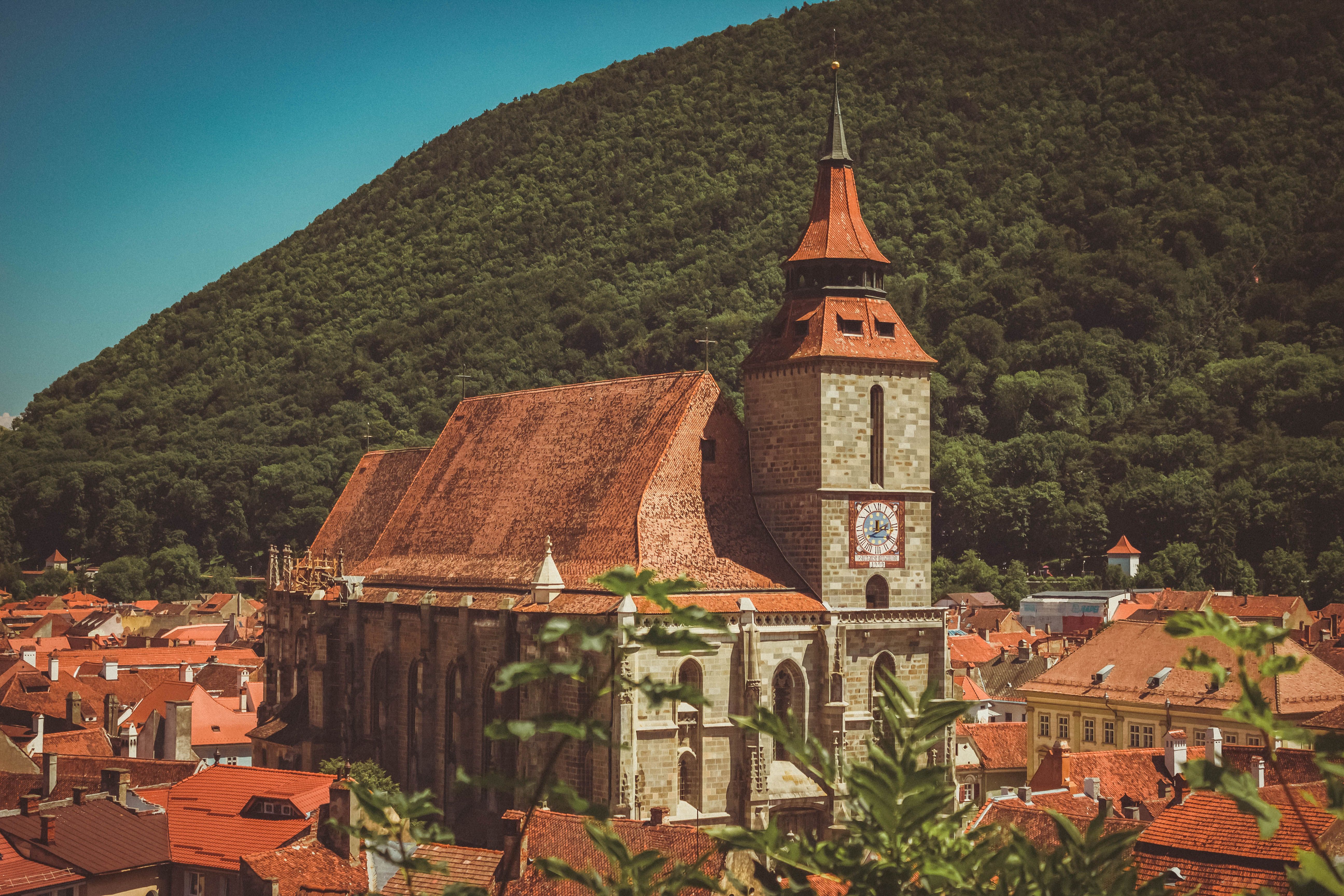
Brașov Black Church: Where Gothic Grandeur Meets Transylvanian Soul
Golden light spills across the soot-darkened sandstone façade of the Black Church as morning mist lifts from Brașov's Council Square, revealing a Gothic masterpiece whose 65-meter tower pierces the Transylvanian sky like a prayer made stone. You stand before the western portal of Biserica Neagră, a Lutheran cathedral built between 1383 and 1477 by Saxon settlers who sought to craft a spiritual beacon worthy of their prosperous trading city. The air carries the scent of aged wood from interior pews, beeswax from centuries of candlelight, and the distant aroma of covrigi—traditional Romanian pretzels—drifting from market stalls below. This is Southeastern Europe's largest Gothic church, a sanctuary where 119 Anatolian carpets hang like woven prayers beneath vaulted ceilings, where the largest mechanical organ in Romania—boasting 4,000 pipes and a sound that fills the 89-meter nave—still echoes with Bach and Brahms, and where every shadow on the blackened walls tells the story of the Great Fire of 1689 that gave the church its enduring name. Standing here, with the Carpathian Mountains rising beyond the red-tiled roofs of Brașov's historic center, you understand why this church has anchored faith and community for over five centuries: it reminds us that some of humanity's most enduring sanctuaries are those that absorb both light and darkness, that transform tragedy into beauty, and that invite silence not as emptiness but as a vessel for contemplation.
Why Brașov Black Church Embodies Gothic Resilience
The Black Church represents one of Central Europe's most compelling narratives of faith, commerce, and cultural synthesis—a Gothic cathedral that solved the fundamental need of Brașov's medieval Saxon community to create a spiritual and civic landmark worthy of their role as guardians of the Carpathian trade routes. Construction began in 1383 on the site of an earlier Romanesque basilica, progressing over nearly a century under the direction of master builders who blended French Gothic verticality with Germanic structural pragmatism. The church's distinctive dimensions—89 meters in length, 38 meters in width, and a nave rising 24 meters to its vaulted ceiling—made it the largest ecclesiastical building between Vienna and Constantinople, a statement of both piety and prosperity.
The technical mastery behind the Black Church lies in its adaptive engineering. Builders employed flying buttresses to support the high vaulted ceiling while allowing expansive stained-glass windows to flood the interior with light—a challenge in a region prone to seismic activity. The church's walls, up to 2.5 meters thick in defensive sections, were constructed from local sandstone quarried from the nearby Tâmpa Mountain, chosen for its durability and workability. The tower, completed in 1477, originally served as a watchtower for the city, its height providing strategic visibility across the Burzenland valley.
The church earned its evocative name after the Great Fire of 1689, when flames from a neighboring building blackened the sandstone façade—a discoloration that proved impossible to remove and became an enduring symbol of resilience. Today, the Black Church fulfills multiple needs: preserving one of Europe's finest collections of Oriental carpets (119 Anatolian pieces donated by Saxon merchants), housing a historic organ built by Carl Buchholz in 1839 with 4,000 pipes and mechanical action, and serving as an active Lutheran parish that welcomes approximately 300,000 visitors annually. It stands as a testament to how faith communities transform adversity into identity, and how stone, once scorched, can become sacred.
The Best Time to Experience Brașov Black Church
The optimal window for visiting the Black Church stretches from May 15 through September 30, when temperatures in Brașov range from 17–26°C (63–79°F) during daytime hours, creating ideal conditions for exploring the church's interior and walking the historic center. For the clearest light and most comfortable walking conditions, plan your visit between June 10 and September 15, when humidity levels drop and afternoon thunderstorms become less frequent. Early morning visits between 8:30–10:00 AM offer the dual advantage of softer light filtering through stained-glass windows and significantly fewer crowds, as most tour groups from Bucharest arrive after 10:30 AM.
Late spring (May through June) brings blooming flowers in Brașov's public gardens and lush green Carpathian slopes, though temperatures can dip to 11–17°C (52–63°F) in early mornings. Autumn (mid-September through October) offers spectacular foliage as beech and oak forests surrounding the city turn brilliant shades of gold and crimson, with comfortable temperatures of 13–21°C (55–70°F) and dramatically fewer visitors after the summer peak.
Avoid visiting during Romanian national holidays—particularly June 1 (Great Union Day) and August 15 (Assumption Day)—when domestic tourism peaks and waiting times can exceed 45 minutes. Also skip the last week of October if you prefer quiet reflection, as the church hosts Reformation Day commemorations that limit general access. Winter visits (November through March) offer a different atmosphere with fewer crowds and occasional snow creating a genuinely Gothic ambiance, but heating is minimal inside the historic structure and some exterior areas close for safety. The church is closed on December 25–26 and January 1–2 for religious observances.
Approximate Budget for a 7-Day Trip
Exploring the Brașov Black Church and the broader Transylvania region requires modest financial planning, as Romania remains significantly more affordable than Western European destinations while offering exceptional cultural and historical value. The following budget assumes a comfortable mid-range travel style with quality accommodations, regional Romanian cuisine, and comprehensive exploration of the Black Church, nearby fortresses, and surrounding Carpathian attractions over seven days.
- Accommodation: €40–€75 per night for a double room in Brașov historic center (boutique guesthouses and three-star hotels); mountain-view pensions €48–€82 per night; budget hostels from €23–€36 per person
- Food: €21–€33 per day (breakfast €5–€8 at accommodation with coffee, pastries, and eggs; lunch €7–€11 for traditional Romanian dishes like sarmale or mămăligă with brânză at local restaurants; dinner €9–€14 for grilled meats, ciorbă soup, or trout at regional restaurants)
- Transportation: Train from Bucharest to Brașov €15 round-trip (2.5 hours scenic mountain route); local bus within Brașov €2 per day; taxi from station to historic center €6 one-way; parking near Black Church €3 per day if driving
- Attractions: Black Church entry €4 (18 RON); organ concert €8 (35 RON); Brașov Council Tower entry €3; nearby Bran Castle day trip €18 transport + €12 entry; Peleș Castle excursion €22 transport + €13 entry; Rope Street (Strada Sforii) entry €2
- Miscellaneous: Authentic Transylvanian crafts and souvenirs €10–€27; local wine and țuică €6–€10 per evening; travel insurance €22 for the week; guidebook €9; bottled water and snacks €11
Total estimated cost for 7 days: €455–€680 per person (depending on accommodation choices and dining preferences)
5 Essential Brașov Black Church Experiences
- Join the Morning Historical Tour: Reserve the 9:00 AM guided tour (€4 entry includes audio guide), when angled morning light illuminates the church's Gothic vaults and historic carpet collection. The 60-minute self-guided exploration reveals the church's evolution from medieval parish to cultural landmark: original 15th-century stone carvings, the 1689 fire scars on exterior walls, and the remarkable collection of 119 Anatolian carpets donated by Saxon merchants between the 15th and 18th centuries. Stand beneath the vaulted ceiling to appreciate the acoustic engineering that allows the organ's sound to fill the 89-meter nave. Photography without flash is permitted in most areas; bring a wide-angle lens to capture the vertical drama of the Gothic interior. Download the official app beforehand for detailed exhibit descriptions in English, German, French, and Romanian.
- Listen to the Historic Organ: Dedicate 30 minutes to experiencing the Carl Buchholz organ, built in 1839 and restored in 1999—one of Europe's largest mechanical-action organs with 4,000 pipes and four manuals. Organ recitals occur Tuesday and Saturday at 11:00 AM (€8 / 35 RON), featuring works by Bach, Brahms, and Romanian composers. Arrive 15 minutes early to secure seating near the nave's center, where the sound resonates most fully. The experience provides a tangible connection to the church's living musical heritage—a tradition that has echoed through these vaults for nearly two centuries.
- Explore the Anatolian Carpet Collection: Allow 25 minutes to study the church's extraordinary collection of Oriental carpets, displayed along the nave walls and in side chapels. These 119 pieces—primarily 15th- to 18th-century Anatolian rugs—represent one of Europe's finest accumulations of Islamic textile art, donated by Brașov's Saxon merchants who traded with Ottoman territories. Visit between 10:00–11:30 AM when natural light from the stained-glass windows illuminates the intricate geometric patterns and deep reds of the wool dyes. Informational panels explain the historical trade routes that brought these treasures to Transylvania; audio guides provide additional context on weaving techniques and symbolic motifs.
- Climb the Tower for Panoramic Views: Ascend the church's 65-meter tower via the narrow spiral staircase (258 steps) for breathtaking views of Brașov's historic center and the surrounding Carpathians. Tower access is included with entry; allow 20 minutes for the climb and descent. Visit between 3:00–5:00 PM when afternoon light creates dramatic shadows across the red-tiled roofs below. The viewpoint reveals the geometric precision of Brașov's medieval street plan and the forested slopes of Tâmpa Mountain rising behind the city. Bring a telephoto lens to capture distant peaks; wear sturdy shoes as the stone steps are uneven and can be slippery.
- Attend an Evening Concert: During summer months (June–August), the Black Church hosts chamber music performances featuring works by Romanian and European composers. Tickets (€10–€18 / 45–80 RON) sell out weeks in advance; book online at www.brasovtourism.eu. Arrive 30 minutes early to explore the church by candlelight before the performance. The acoustics, enhanced by the vaulted ceiling and stone walls, create an intimate listening experience that connects you directly to the spiritual and artistic heritage preserved within these walls.
3 Hidden Gems Most Travelers Miss
- Secret Sacristy Frescoes: This small chamber behind the main altar, accessible only via guided request at the church office, features 15th-century frescoes depicting scenes from the life of Saint Bartholomew—the church's patron saint. Access requires advance arrangement (+40 268 411 470); tours run Wednesday and Friday at 2:00 PM (€3 supplement). The sacristy is overlooked because it is not included in standard tours, but the reward is witnessing original medieval artwork rarely seen by the public. Photography prohibited to protect fragile pigments; allow 15 minutes for contemplative viewing. The frescoes' vibrant blues and reds, preserved by the chamber's stable microclimate, offer a glimpse into the artistic vision of Brașov's Gothic founders.
- Schei District Wooden Church: This 18th-century Orthodox church, located 1.2 kilometers southeast of the Black Church in Brașov's historic Schei neighborhood, features traditional Transylvanian wooden architecture and original iconostasis rarely visited by international tourists. Access via the blue-marked walking path from Council Square (15-minute walk through cobblestone streets); the church is open daily 9:00 AM–5:00 PM with free entry (donations appreciated). The site is overlooked because most visitors focus exclusively on the Gothic center, but the reward is authentic insight into Romanian Orthodox spirituality and folk craftsmanship. Visit between 3:00–5:00 PM when afternoon light illuminates the interior icons. Dress modestly (shoulders and knees covered); photography permitted without flash in exterior areas only.
- Church Bell Tower Mechanism Tour: By special arrangement, visitors can observe the historic clockwork mechanism that operates the Black Church's bells—a 19th-century engineering marvel maintained by local craftsmen. This experience, limited to six guests per session and requiring advance booking (office@brasovtourism.eu), reveals the intricate gears, weights, and levers that have marked Brașov's hours since 1845. Sessions run Thursday mornings at 10:00 AM (May–September); cost €7 per person includes a demonstration and small commemorative booklet. The mechanism room is overlooked because it serves specialized interest groups primarily, but the experience offers tangible insight into the technical heritage that sustains the church's living presence. Photography permitted with permission; wear closed-toe shoes for safety.
Cultural & Practical Tips
- Respect the Sacred Space: The Black Church remains an active Lutheran parish. Maintain quiet voices inside the nave, avoid photography during services, and follow all posted guidelines about restricted areas. Dress modestly (shoulders and knees covered) as a sign of respect for the church's spiritual function.
- Learn Basic Romanian Phrases: While church staff and many Brașov residents speak English and German, knowing a few Romanian phrases enhances your experience: "Bună ziua" (BOO-nah ZEE-wah) means "Good day"; "Mulțumesc" (mool-tsoo-MESK) means "Thank you"; "Vă rog" (vah ROHG) means "Please"; "Unde este toaleta?" (OON-deh yes-teh twah-LEH-tah) means "Where is the restroom?"
- Prepare for Variable Interior Conditions: The church's historic structure means minimal heating in winter and limited cooling in summer. Dress in layers year-round; bring a light scarf even in July as stone interiors remain cool. The organ recitals can make the nave feel warmer due to body heat—remove outer layers before seating.
- Carry Cash (Romanian Lei): While the church ticket office accepts cards, smaller vendors, rural facilities, and parking attendants often operate on cash only. The currency is Romanian leu (RON), with an approximate exchange rate of 4.9 RON to €1. ATMs are available throughout Brașov historic center but not inside the church itself.
- Photography Guidelines: Tripods are permitted in the nave but not during organ recitals or guided tours where they obstruct other visitors. Flash photography is prohibited throughout interior spaces to protect historic textiles, frescoes, and woodwork. Drone use requires written permission from Brașov municipal administration—contact info@brasovtourism.eu at least two weeks in advance.
- Weather Preparedness: Brașov's mountain climate changes rapidly—pack layers even in summer, including a lightweight waterproof jacket. Afternoon thunderstorms are common from June through August; if you hear thunder while exploring outdoor areas, seek shelter in the church arcade or nearby covered walkways. Check the forecast at the Brașov tourist information center before starting your visit.
- Accessibility Considerations: The Black Church's ground floor and main nave are wheelchair-accessible via a ramp at the southern entrance. However, the tower climb, sacristy, and some side chapels involve stairs without elevator access. Contact the visitor center (+40 268 411 470) at least 48 hours in advance to arrange alternative routes or virtual tour access for mobility-impaired visitors.
Conclusion: Travel with Reverence, Not Just Curiosity
The Black Church endures not because it showcases Gothic architecture, but because it invites us to listen—to the silence between organ notes, to the stories woven into Anatolian carpets, to the weight of centuries carried in soot-darkened stone. When you stand in that vaulted nave, tracing the journey from medieval parish to living monument, you participate in a continuum of faith and craftsmanship that stretches from Saxon builders to your own moment of wonder. But with that privilege comes responsibility: to tread softly in spaces that shelter both prayer and history, to respect the delicate balance between preservation and access, to let the church's authentic heritage remind you that true beauty emerges when communities honor both tradition and transformation. The bells will continue to mark Brașov's hours long after we've departed—let our presence here be measured not in photographs taken, but in the reverence we carry forward, the respect we show to living sanctuaries, and the willingness to slow down long enough to hear what silence has to teach.