
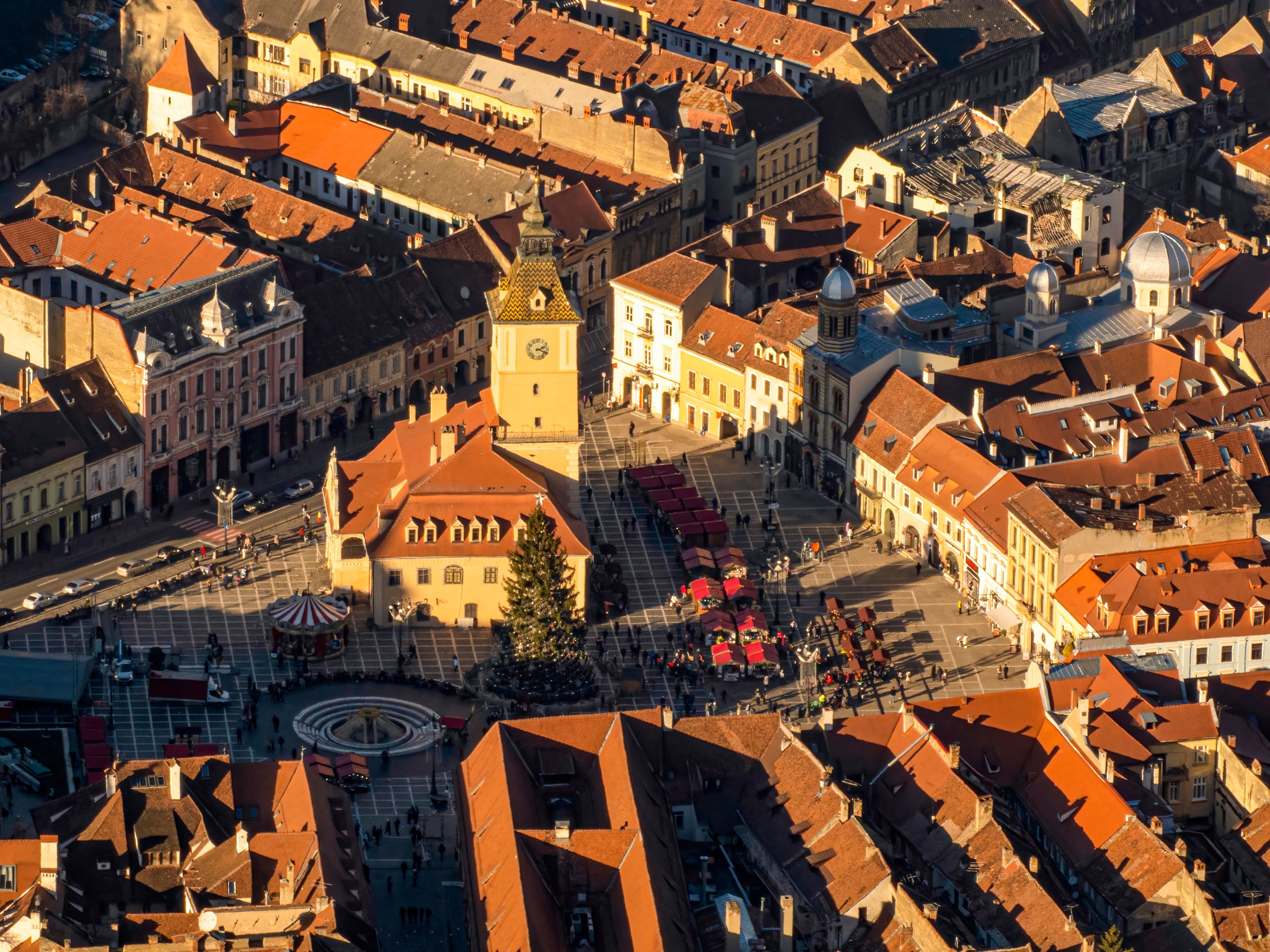
Council Square: Where Medieval Commerce Meets Transylvanian Mountain Soul
Golden light spills across the cobblestones of Council Square as morning mist lifts from Brașov's historic heart, revealing a marketplace where colorful baroque façades rise like painted sentinels around a 100-meter-by-80-meter plaza that has echoed with merchants' calls since the 14th century. You stand before the ochre walls of Casa Sfatului—the Council House built in 1420 and rebuilt in baroque style in 1776—where the scent of fresh covrigi (traditional Romanian pretzels) mingles with the crisp mountain air and the distant chime of bells from the nearby Black Church. This is Piața Sfatului, Brașov's civic soul, a square where Saxon traders once weighed wool and spices beneath Gothic arcades, where Romanian peasants bartered mountain cheese and honey, and where today's visitors trace the footsteps of centuries of cultural exchange. The air hums with the gentle murmur of café conversations, the rhythmic clip-clop of horse-drawn carriages on cobblestones, and the soft rustle of leaves from linden trees planted along the perimeter. Standing here, with the forested slopes of Tâmpa Mountain rising 400 meters behind the square and the Carpathian peaks visible beyond red-tiled roofs, you understand why this plaza has anchored community life for over six hundred years: it reminds us that some of humanity's most enduring public spaces are those that welcome both commerce and contemplation, that transform stone and timber into stages for the daily theater of human connection.
Why Council Square Embodies Transylvanian Heritage
Council Square represents one of Southeastern Europe's most intact examples of medieval urban planning—a public space that solved the fundamental need of Brașov's diverse communities to create a neutral ground where Saxon merchants, Romanian villagers, and Hungarian nobles could conduct trade, celebrate festivals, and govern their shared city. First documented in records from 1364, the square was designed according to Germanic market-town principles: a rectangular plaza oriented east-west to maximize sunlight, surrounded by uniform building plots with ground-floor arcades for commerce and upper floors for residence, and anchored by the Council House at its northern edge—a symbol of civic authority accessible to all.
The technical mastery behind Council Square's enduring appeal lies in its adaptive architecture. Buildings were constructed with thick stone foundations to withstand seismic activity common in the Carpathian region, while wooden upper stories provided flexibility for interior modifications. The cobblestone surface, originally laid in the 15th century and restored in 2008 using traditional techniques, features a subtle crown for drainage that has prevented flooding for centuries. The square's dimensions—approximately 8,000 square meters—were calculated to accommodate weekly markets of up to 2,000 people while maintaining clear sightlines to the Council House balcony, where proclamations were read to assembled citizens.
Today, Council Square fulfills multiple needs: preserving one of Transylvania's finest examples of medieval urban design, hosting cultural events that celebrate Brașov's multicultural heritage, and providing visitors with a tangible connection to the daily rhythms of historic European life. The square welcomes approximately 500,000 visitors annually, serving as both a living museum of architectural evolution and a vibrant public space where past and present converge in the simple act of gathering.
The Best Time to Experience Council Square
The optimal window for visiting Council Square stretches from May 15 through September 30, when temperatures in Brașov range from 17–26°C (63–79°F) during daytime hours, creating ideal conditions for exploring the square's outdoor cafés and walking the historic center. For the clearest light and most comfortable walking conditions, plan your visit between June 10 and September 15, when humidity levels drop and afternoon thunderstorms become less frequent. Early morning visits between 8:00–9:30 AM offer the dual advantage of softer light for photography and significantly fewer crowds, as most tour groups from Bucharest arrive after 10:00 AM.
Late spring (May through June) brings blooming linden trees along the square's perimeter and lush green Carpathian slopes, though temperatures can dip to 11–17°C (52–63°F) in early mornings. Autumn (mid-September through October) offers spectacular foliage as beech and oak forests surrounding the city turn brilliant shades of gold and crimson, with comfortable temperatures of 13–21°C (55–70°F) and dramatically fewer visitors after the summer peak.
Avoid visiting during Romanian national holidays—particularly June 1 (Great Union Day) and August 15 (Assumption Day)—when domestic tourism peaks and the square can become congested with festival crowds. Also skip the last week of December if you prefer quiet exploration, as the Christmas market attracts up to 10,000 daily visitors despite cold weather. Winter visits (November through March) offer a different atmosphere with fewer crowds and occasional snow creating a fairy-tale ambiance, but outdoor cafés operate on reduced schedules and some exterior areas close for safety.
Approximate Budget for a 7-Day Trip
Exploring Council Square and the broader Brașov region requires modest financial planning, as Romania remains significantly more affordable than Western European destinations while offering exceptional cultural and historical value. The following budget assumes a comfortable mid-range travel style with quality accommodations, regional Romanian cuisine, and comprehensive exploration of the square, nearby attractions, and surrounding Carpathian experiences over seven days.
- Accommodation: €40–€75 per night for a double room in Brașov historic center (boutique guesthouses and three-star hotels); square-view pensions €52–€88 per night; budget hostels from €23–€36 per person
- Food: €21–€33 per day (breakfast €5–€8 at accommodation with coffee, pastries, and eggs; lunch €7–€11 for traditional Romanian dishes like sarmale or mămăligă with brânză at square-side restaurants; dinner €9–€14 for grilled meats, ciorbă soup, or trout at regional restaurants)
- Transportation: Train from Bucharest to Brașov €15 round-trip (2.5 hours scenic mountain route); local bus within Brașov €2 per day; taxi from station to Council Square €6 one-way; parking near square €3 per day if driving
- Attractions: Council Square access free; Black Church entry €4 (18 RON); Council House museum €3 (14 RON); Brașov Council Tower entry €3; nearby Rope Street (Strada Sforii) entry €2; Tâmpa Mountain cable car €8 round-trip; Bran Castle day trip €18 transport + €12 entry
- Miscellaneous: Authentic Transylvanian crafts and souvenirs €10–€27; local wine and țuică €6–€10 per evening; travel insurance €22 for the week; guidebook €9; bottled water and market snacks €11
Total estimated cost for 7 days: €455–€680 per person (depending on accommodation choices and dining preferences)
5 Essential Council Square Experiences
- Join the Morning Historical Walking Tour: Reserve the 9:00 AM guided tour of Council Square and surrounding historic center (€12), when angled morning light illuminates the baroque façades and cobblestone details. The 90-minute tour reveals the square's evolution from medieval market to civic heart: original 15th-century building foundations, the Council House's baroque reconstruction in 1776, and the subtle engineering of the cobblestone drainage system. Stand at the square's center to appreciate the geometric precision of the rectangular layout and the harmonious color palette of ochre, cream, and terracotta that defines Brașov's architectural identity. Photography without flash is permitted throughout; bring a wide-angle lens to capture the full sweep of the plaza. Book at least 48 hours in advance via www.brasovtourism.eu.
- Climb the Council House Tower: Dedicate 25 minutes to ascending the Council House's 30-meter tower (€3 / 14 RON), which offers panoramic views of Council Square, the Black Church, and the forested slopes of Tâmpa Mountain. The climb involves 85 narrow stone steps; visit between 10:00–11:30 AM when natural light filters through tower windows to illuminate historic exhibits on Brașov's municipal history. The viewpoint reveals the geometric precision of Brașov's medieval street plan and the red-tiled roofs stretching toward the Carpathians. Bring a telephoto lens to capture distant peaks; wear sturdy shoes as the stone steps are uneven and can be slippery.
- Sample Traditional Covrigi at Dawn: Experience Council Square's living culinary heritage by visiting the covrigi vendors who set up at 7:00 AM near the square's eastern edge. These traditional Romanian pretzels—twisted dough glazed with sesame or poppy seeds and baked in wood-fired ovens—have been a Brașov staple since the 16th century. Purchase a warm covrig (€1 / 5 RON) and enjoy it while watching the square awaken: shopkeepers opening shutters, café staff arranging outdoor tables, and locals greeting one another in Romanian, German, and Hungarian. The experience provides a tangible connection to the daily rhythms that have sustained this marketplace for centuries.
- Attend an Evening Cultural Performance: During summer months (June–August), Council Square hosts free outdoor concerts, folk dance performances, and theater productions on weekend evenings. Events typically begin at 7:00 PM; arrive by 6:30 PM to secure viewing positions near the Council House fountain. The acoustics of the enclosed square create an intimate atmosphere for performances, while the illuminated baroque façades provide a dramatic backdrop. Check the Brașov tourism website for the current schedule; no tickets required for most events. The experience combines cultural enrichment with the simple pleasure of gathering in a historic public space.
- Photograph the Square at Blue Hour: Position yourself at the square's southwestern corner at 8:00–9:00 PM in summer, when the setting sun has faded but artificial lighting creates a magical ambiance. The composition—colorful baroque buildings illuminated by warm streetlights with the dark silhouette of Tâmpa Mountain in the background—captures the essence of Transylvanian evening charm. Bring a tripod for long exposures; the square's cobblestones reflect ambient light beautifully. Visit on weekdays for minimal foot traffic; the fountain area provides a stable platform for camera setup.
3 Hidden Gems Most Travelers Miss
- Historic Cellar Museums: Beneath several buildings surrounding Council Square lie preserved medieval cellars now operating as small museums showcasing Brașov's archaeological heritage. Access via the "Under Brașov" tour (€8 / 35 RON), which includes three cellar sites with original 14th-century stone vaulting, medieval pottery displays, and explanations of historic urban infrastructure. Tours run Tuesday–Saturday at 11:00 AM and 3:00 PM; meeting point at the tourist information center on the square's northern edge. The cellars are overlooked because entrance is discreet, but the reward is tangible insight into the engineering that sustained medieval Brașov. Photography permitted without flash; allow 45 minutes for the complete tour.
- Schei District Wooden Church: This 18th-century Orthodox church, located 1.2 kilometers southeast of Council Square in Brașov's historic Schei neighborhood, features traditional Transylvanian wooden architecture and original iconostasis rarely visited by international tourists. Access via the blue-marked walking path from Council Square (15-minute walk through cobblestone streets); the church is open daily 9:00 AM–5:00 PM with free entry (donations appreciated). The site is overlooked because most visitors focus exclusively on the Gothic center, but the reward is authentic insight into Romanian Orthodox spirituality and folk craftsmanship. Visit between 3:00–5:00 PM when afternoon light illuminates the interior icons. Dress modestly (shoulders and knees covered); photography permitted without flash in exterior areas only.
- Secret Garden Courtyard: Behind the unassuming façade of the building at Council Square number 18 lies a restored 17th-century merchant's courtyard featuring original stone arches, a working fountain, and seasonal flower displays. Access via the small doorway marked "Grădina Ascunsă" (Hidden Garden); open daily 10:00 AM–6:00 PM with free entry. The courtyard is overlooked because the entrance is subtle and unmarked from the square, but the reward is a peaceful oasis where you can sit on stone benches and listen to the fountain's gentle murmur while surrounded by centuries-old architecture. Best visited between 2:00–4:00 PM when dappled sunlight filters through linden branches. No facilities; bring water if staying longer than 20 minutes.
Cultural & Practical Tips
- Respect the Public Space: Council Square remains a living civic center, not merely a tourist attraction. Maintain respectful noise levels, dispose of waste in designated bins, and avoid obstructing pedestrian pathways with photography equipment. The square hosts local events and daily commerce—trust staff guidance about temporary restrictions.
- Learn Basic Romanian Phrases: While many Brașov residents speak English and German, knowing a few Romanian phrases enhances your experience: "Bună ziua" (BOO-nah ZEE-wah) means "Good day"; "Mulțumesc" (mool-tsoo-MESK) means "Thank you"; "Vă rog" (vah ROHG) means "Please"; "Unde este toaleta?" (OON-deh yes-teh twah-LEH-tah) means "Where is the restroom?"
- Prepare for Variable Mountain Weather: Brașov's climate can shift rapidly—pack layers even in summer, including a lightweight waterproof jacket. Afternoon thunderstorms are common from June through August; if you hear thunder while exploring outdoor areas, seek shelter in the Council House arcade or nearby covered walkways. Check the forecast at the Brașov tourist information center before starting your visit.
- Carry Cash (Romanian Lei): While larger restaurants and shops accept cards, market vendors, small cafés, and parking attendants often operate on cash only. The currency is Romanian leu (RON), with an approximate exchange rate of 4.9 RON to €1. ATMs are available throughout Brașov historic center but not inside historic buildings.
- Photography Guidelines: Tripods are permitted in the square but not during events or in narrow alleyways where they obstruct pedestrian flow. Flash photography is discouraged inside historic buildings to protect artifacts and textiles. Drone use requires written permission from Brașov municipal administration—contact info@brasovtourism.eu at least two weeks in advance.
- Accessibility Considerations: Council Square's cobblestone surface can be challenging for wheelchairs and mobility devices. The tourist information center offers free wheelchair loans (advance reservation recommended); contact +40 268 411 470 at least 48 hours in advance. Many ground-floor shops and cafés have step-free access; upper floors of historic buildings typically involve stairs without elevator access.
- Market Etiquette: If purchasing crafts or food from square vendors, engage politely and ask permission before photographing their wares. Bargaining is not customary for fixed-price items but may be appropriate for handmade crafts—approach negotiations with respect and a smile. A friendly "Mulțumesc" upon purchase is always appreciated.
Conclusion: Travel with Presence, Not Just Passage
Council Square endures not because it showcases architectural grandeur, but because it invites us to participate in the simple, profound act of gathering—a plaza where six centuries of human connection have taught that public spaces thrive when they welcome both commerce and contemplation, both stranger and neighbor. When you stand on those cobblestones, tracing the footsteps of merchants, musicians, and families who have shared this space across generations, you participate in a continuum of community that stretches from medieval markets to your own moment of presence. But with that privilege comes responsibility: to tread lightly on historic surfaces, to respect the delicate balance between preservation and daily life, to let the square's authentic rhythm remind you that true travel is not about collecting sights but about connecting with place. The cobblestones will continue to echo with footsteps long after we've departed—let our presence here be measured not in photographs taken, but in the presence we carry forward, the respect we show to living heritage, and the willingness to slow down long enough to hear what community has to teach.