
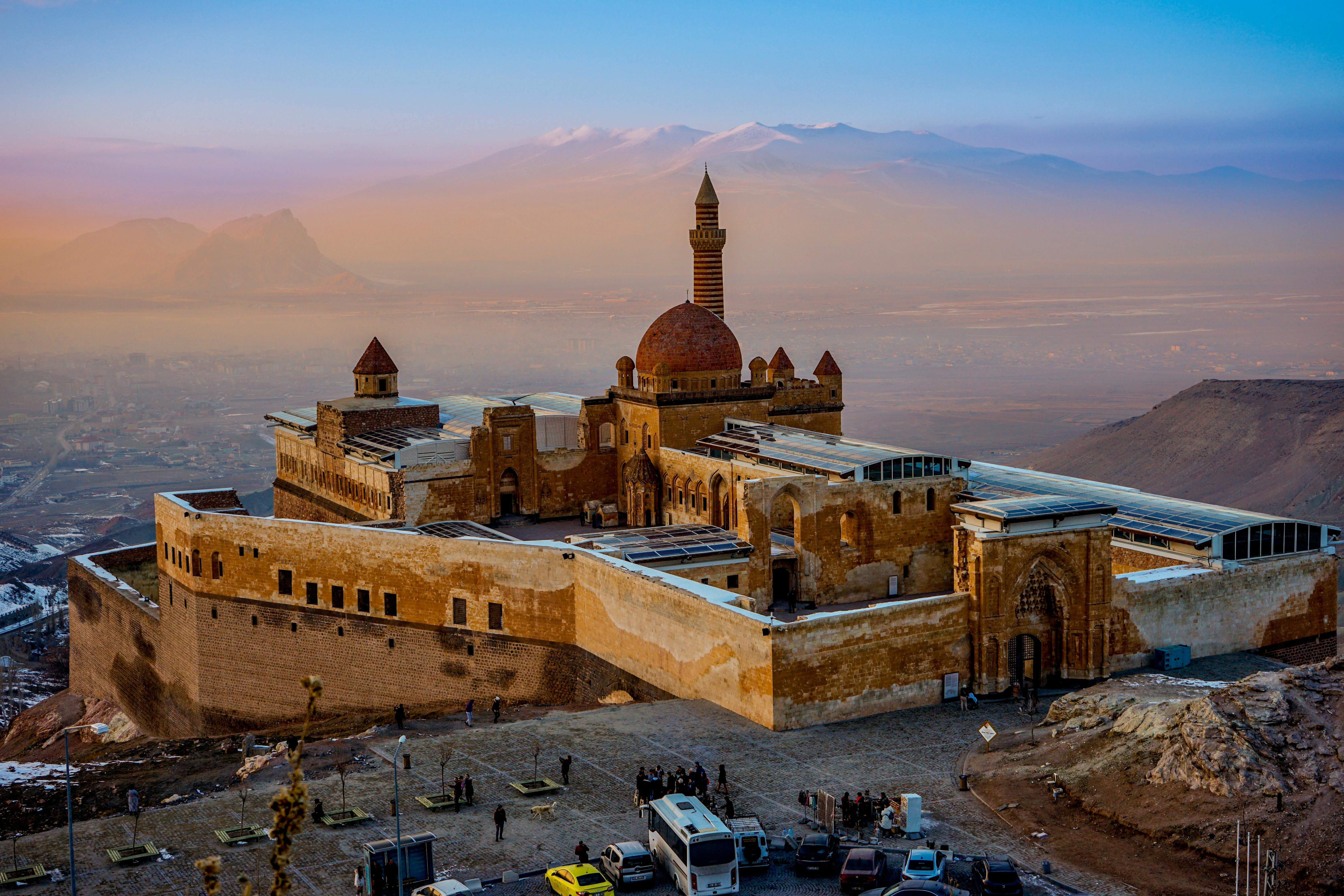
Ishak Pasha Palace: Where Ottoman Grandeur Meets the Shadow of Ararat
The late afternoon sun bathes the rugged slopes of the Tendürek Mountains in liquid gold as you approach Ishak Pasha Palace, perched dramatically at 1,900 meters elevation overlooking the vast Ararat plain. The air carries the scent of wild thyme, sun-warmed limestone, and distant woodsmoke from shepherd camps scattered across the high plateau. Before you rises an architectural marvel that seems to grow from the very rock beneath it—a sprawling complex of 116 rooms, courtyards, a mosque, and hamam, all crafted from distinctive pink and gray local stone. Intricate carvings of floral motifs, geometric patterns, and calligraphic inscriptions adorn doorways and arches, while the distant silhouette of Mount Ararat looms on the horizon, its snow-capped peak glowing pink in the dying light. You hear only the whisper of wind through stone corridors, the distant bleating of sheep, and your own footsteps echoing on ancient flagstones. This palace matters because it embodies the extraordinary synthesis of cultures that defined eastern Anatolia—Ottoman, Persian, Armenian, and Georgian influences fused into a single, breathtaking statement of power, artistry, and adaptation to a challenging landscape. To walk its courtyards is to step into a world where empires met, where art transcended borders, and where human ambition carved beauty from the bones of the earth.
Why Ishak Pasha Palace Embodies Cultural Synthesis in Stone
Ishak Pasha Palace represents far more than an opulent residence—it embodies the extraordinary capacity of eastern Anatolian architecture to synthesize diverse cultural traditions into a cohesive, breathtaking whole. Constructed over nearly a century, beginning around 1685 and completed in 1784 under the patronage of the Çıldır-Atabeg family, particularly Ishak Pasha who gave the palace its name, this complex solved fundamental challenges of high-altitude living: extreme temperature fluctuations, defensive security on a vulnerable border, and the expression of political power through monumental architecture.
The engineering achievements are remarkable. The palace features walls up to 1.2 meters thick, constructed from local volcanic limestone that provides exceptional thermal mass—keeping interiors cool during summer days exceeding 30°C (86°F) and warm during winter nights that can drop below -20°C (-4°F). The sophisticated heating system employed hypocaust technology, with channels beneath marble floors circulating warm air from central furnaces. Water management was equally advanced: cisterns carved into bedrock stored up to 150,000 liters, while stone channels directed rainwater from rooftops to gardens and baths. The palace's layout—two main courtyards flanked by administrative quarters, residential wings, and service areas—demonstrates sophisticated understanding of spatial hierarchy and functional zoning.
What makes Ishak Pasha Palace unique is its architectural syncretism. Ottoman classical elements—pointed arches, muqarnas vaulting, Iznik-style tilework—blend seamlessly with Persian decorative motifs, Armenian stone-carving techniques, and Georgian structural innovations. The mosque features a single elegant dome and slender minaret; the harem displays exquisite hand-painted ceilings and mother-of-pearl inlays; the throne room showcases carved stone niches and calligraphic panels in Arabic, Persian, and Ottoman Turkish. This fusion wasn't accidental but deliberate: the palace's builders drew on the finest craftsmen from across the region to create a monument that proclaimed both local identity and imperial ambition. Ishak Pasha Palace stands as a testament to the creative possibilities that emerge when cultures meet, collaborate, and compete in the service of beauty.
The Best Time to Experience Ishak Pasha Palace
To experience Ishak Pasha Palace at its most atmospheric, plan your visit between May 10–June 15 or September 15–October 20, when daytime temperatures range from 15-24°C (59-75°F) and the high plateau blooms with wildflowers or glows with autumn gold. During these windows, you'll enjoy comfortable conditions for exploring the extensive complex without the intense summer heat or the bitter cold that characterizes this exposed mountain location.
For optimal photography of the pink limestone facades and Mount Ararat views, arrive at key viewpoints at 7:30–9:00 AM when morning light strikes the eastern courtyards, or 5:00–6:30 PM during golden hour when the entire palace transforms into warm amber tones. The stone's color shifts dramatically throughout the day—from pale rose at dawn to deep copper at sunset—making timing crucial for capturing its full beauty.
Avoid the peak summer period of June 20–August 25 when temperatures can exceed 32°C (90°F) on the exposed plateau with minimal shade. While the altitude provides some relief, the relentless sun and lack of tree cover make extended exploration uncomfortable. Winter months (November–March) bring harsh conditions: temperatures drop to -20°C to -5°C (-4°F to 23°F), snow frequently covers the site, and access roads from Doğubayazıt may close due to weather. The palace is beautiful in snow but requires special preparation and may have limited access.
Approximate Budget for a 7-Day Trip
Visiting Ishak Pasha Palace requires basing yourself in Doğubayazıt, the nearest town located 8 kilometers away, with day trips to the palace and surrounding attractions. The following budget assumes moderate travel style—comfortable local hotels, authentic regional dining, and a mix of public transportation and occasional private transfers. Prices are listed in euros for international travelers, though Turkey uses the Turkish Lira (₺).
- Accommodation: €22–€42 per night in Doğubayazıt town center. Budget pensions start at €18; boutique hotels with Ararat views run €45-70. Staying in Doğubayazıt provides better amenities while keeping the palace within a 15-minute drive.
- Food: €11-17 per day total. Breakfast: €3-4 for traditional Turkish breakfast with menemen, cheese, olives, and çay. Lunch: €3-5 for regional specialties like kaymak (clotted cream), Ağrı honey, and Turkish pide at local esnaf lokantası. Dinner: €5-9 for sit-down meals featuring Ağrı kebab, baklava, and ayran.
- Transportation: Round-trip flight to Erzurum or Van airports from Istanbul: €52-118. Airport shuttle to Doğubayazıt: €8. Local dolmuş within town: €0.40 per ride. Taxi to Ishak Pasha Palace: €6 round-trip. Car rental: €29/day.
- Attractions: Ishak Pasha Palace entrance: €6. Noah's Ark site (nearby): €8. Guided historical tour of the palace: €32. Traditional carpet weaving demonstration: €10.
- Miscellaneous: Handwoven Doğubayazıt kilim: €25-95. Local Ağrı honey: €7/jar. Traditional copper coffee pot: €14-38. Stone-carved souvenir replicas: €12-32.
Total 7-Day Budget: €355–€520 per person (excluding international flights to Turkey)
7 Essential Ishak Pasha Palace Experiences
- Explore the Main Courtyard at Dawn: Arrive at the palace opening time (8:00 AM) and enter through the monumental gate into the first courtyard. The space features a central fountain, arcaded walkways, and intricate stone carvings depicting floral motifs and geometric patterns. Walk the perimeter to examine the blind arches and muqarnas decoration; note how morning light streams through the eastern arches, illuminating the pink limestone. Spend at least 20 minutes here, observing how the architectural proportions create a sense of harmony and grandeur.
- Photograph the Palace Facade with Mount Ararat: Position yourself on the terrace overlooking the Ararat plain at 6:30 AM to capture the palace's distinctive silhouette against the distant snow-capped peak of Mount Ararat. Use a telephoto lens to compress the perspective, making the mountain appear closer to the palace. The pink limestone glows amber in early light, creating a stunning contrast with Ararat's white summit. This iconic view is best captured in spring or autumn when atmospheric conditions are clearest.
- Discover the Harem Quarters: Enter the private residential wing reserved for the palace women, featuring some of the finest decorative arts in the complex. The rooms display hand-painted ceilings with floral motifs, mother-of-pearl inlays on wooden panels, and delicate lattice windows that filter light into soft patterns. Visit between 10:00 AM–12:00 PM when natural light enters through the windows to illuminate the intricate details. Note the sophisticated ventilation system that maintained comfortable temperatures year-round.
- Experience the Palace Mosque: Enter the elegant mosque within the complex, featuring a single dome, slender minaret, and interior decorated with Iznik-style tiles and calligraphic panels. The mihrab (prayer niche) is carved from a single block of marble with intricate geometric patterns. If you visit during one of the five daily prayer times, observe quietly from the entrance—non-Muslims are welcome to view the architecture but should not enter the prayer area during worship. The acoustics are remarkable; speak softly to hear your voice resonate beneath the dome.
- Walk the Palace Ramparts: Climb to the upper terraces and defensive walls that encircle the complex, offering panoramic views of the Ararat plain, the Tendürek Mountains, and the distant border with Iran. The ramparts feature arrow slits, watchtowers, and strategic vantage points that demonstrate the palace's dual role as residence and fortress. Visit at 5:00 PM when the afternoon light casts long shadows across the stonework and the plain below glows golden. Bring a jacket—the elevation means wind can be brisk even in summer.
- Examine the Hamam's Engineering: Explore the palace bath complex, a masterpiece of Ottoman hydraulic engineering. The hamam features the traditional sequence of rooms—cold, warm, and hot chambers—with marble floors heated by a hypocaust system beneath. The central dome's star-shaped openings create dramatic light patterns that shift throughout the day. Visit mid-morning (10:00–11:30 AM) when sunlight penetrates the oculus to illuminate the steam-filled air. Note the sophisticated water channels that directed fresh water to basins and drains.
- Contemplate the Throne Room: Enter the ceremonial hall where Ishak Pasha received guests and conducted affairs of state. The room features a raised platform, carved stone niches for displaying treasures, and walls adorned with calligraphic panels in Arabic, Persian, and Ottoman Turkish. The space demonstrates the palace's role as a center of political power and cultural patronage. Arrive at 2:00 PM when afternoon light illuminates the intricate carvings. Spend time reading the translations of inscriptions that speak of justice, wisdom, and divine favor.
3 Hidden Gems Most Travelers Miss
- The Underground Passages: Beneath the main palace complex, a network of stone-lined tunnels and storage chambers once served as service areas, emergency exits, and cool storage for provisions. Most visitors overlook these spaces because they're not prominently signposted. Access: Ask a guide at the entrance about "yeraltı geçitleri" (underground passages); entry requires supervision and may have limited hours. The passages maintain a constant 12-14°C (54-57°F) year-round and feature ventilation shafts carved into the bedrock. Bring a flashlight and wear sturdy shoes—the floors can be uneven. Allow 20 minutes to explore.
- The Garden Terraces: On the southern slope below the main palace, terraced gardens once grew roses, fruit trees, and medicinal herbs, irrigated by a sophisticated channel system fed by mountain springs. Today, wildflowers and hardy shrubs have reclaimed the terraces, creating a peaceful spot with panoramic views. Access: From the palace exit, follow the path south for 200 meters to the garden area. Best visited in late afternoon (4:00–6:00 PM) when the light is soft and temperatures are cooler. Bring water and a camera—the wildflowers in May-June are spectacular. No entrance fee; respect the fragile ecosystem by staying on paths.
- The Rock-Cut Tombs: On the northern slope of the hill, ancient rock-cut tombs predate the palace by centuries, offering a glimpse into earlier burial traditions of the region. These simple chambers, carved directly into the volcanic tufa, feature arched entrances and interior niches for offerings. Most visitors miss them because they're away from the main tourist circuit. Access: From the palace parking area, follow the trail north for 300 meters. The tombs are unmarked but visible from the path. Best photographed mid-morning (9:00–11:00 AM) when side-lighting reveals the carved details. No entrance fee; allow 15 minutes to explore respectfully.
Cultural & Practical Tips
- Respect the Sacred Space: Ishak Pasha Palace includes an active mosque and holds cultural significance for local communities. Speak quietly throughout the complex, especially in religious areas. Dress modestly—shoulders and knees should be covered when entering the mosque. Remove shoes before entering carpeted prayer areas. Don't climb on fragile structures or touch decorative carvings—the oils from hands accelerate stone erosion.
- Photography Guidelines: Photography is permitted throughout the site, but drone photography requires advance permission from provincial authorities (contact: agri.kultur@ktb.gov.tr). Tripods are allowed but must not obstruct pathways. The best light for photography is early morning (7:30–9:30 AM) and late afternoon (5:00–7:00 PM); avoid midday when harsh overhead light flattens the stone textures.
- Essential Phrases: "Teşekkür ederim" (teh-shek-kür eh-deh-rim) = Thank you; "İshak Paşa Sarayı nerede?" (ee-shak pah-shah sah-rah-yuh neh-reh-deh) = Where is Ishak Pasha Palace?; "Ne kadar?" (neh kah-dar) = How much?; "Hoş geldiniz" (hosh gel-din-iz) = Welcome.
- Physical Preparedness: Exploring the palace involves walking 1-2 kilometers on uneven stone paths, climbing stairs, and navigating narrow corridors. The site is at 1,900 meters elevation and largely unshaded. Wear sturdy, closed-toe shoes with good grip. Carry at least 1.5 liters of water per person—there are limited facilities on-site. The palace is partially wheelchair-accessible in the courtyards but not in upper levels or narrow passages.
- Weather Considerations: The high plateau creates extreme conditions: summer temperatures can exceed 32°C (90°F) with intense sun; winter brings temperatures below -20°C (-4°F) and heavy snow. The site is exposed with minimal shade or shelter. In summer, start early (8:00 AM) and take midday breaks; in winter, visit only between 11:00 AM–3:00 PM when temperatures are mildest. Wind is constant—bring a windbreaker even in summer.
- Border Area Awareness: Ishak Pasha Palace is located near the Turkish-Iranian border. While the palace itself is fully accessible, be aware of signage regarding restricted zones. Photography of military installations is prohibited. Carry identification at all times. The border is clearly marked; respect all barriers and instructions from site staff.
- Understand the Context: Ishak Pasha Palace represents a complex history of power, culture, and adaptation. Approach the site with curiosity about its multicultural heritage and respect for the communities who maintain it today. Consider hiring a local guide who can explain the architectural significance and historical context. Listen to multiple perspectives about the palace's legacy and preservation.
Conclusion: Travel with Reverence, Not Just Checklists
Ishak Pasha Palace invites you to do more than photograph pink stone against a dramatic mountain backdrop. This is a place to stand where viziers once governed, where craftsmen carved beauty from local rock, where cultures met and merged in a celebration of human creativity. When you walk through courtyards that have echoed with footsteps for centuries, when you trace the intricate carvings that blend Ottoman, Persian, and Armenian traditions, when you gaze toward Mount Ararat that has watched over this landscape since time immemorial, you participate in a meditation on legacy and impermanence that transcends any single lifetime.
Travel to Ishak Pasha Palace with reverence for the craftsmanship that shaped these stones, for the cultures that converged in its arches and courtyards, for the resilience that preserved this site through centuries of change. Respect the fragility of the limestone—soft enough to carve into exquisite patterns, hard enough to withstand harsh mountain weather, but vulnerable to careless touch and environmental stress. Understand that the silence you cherish depends on the restraint of every visitor who comes after you. Let the mountain wind slow your pace, let the weight of history humble your expectations, and let the beauty of this synthesis remind you that the most enduring architectures are those that honor both human ambition and the land that sustains us.