
Karkonosze Mountains: Where Alpine Majesty Meets Borderland Harmony
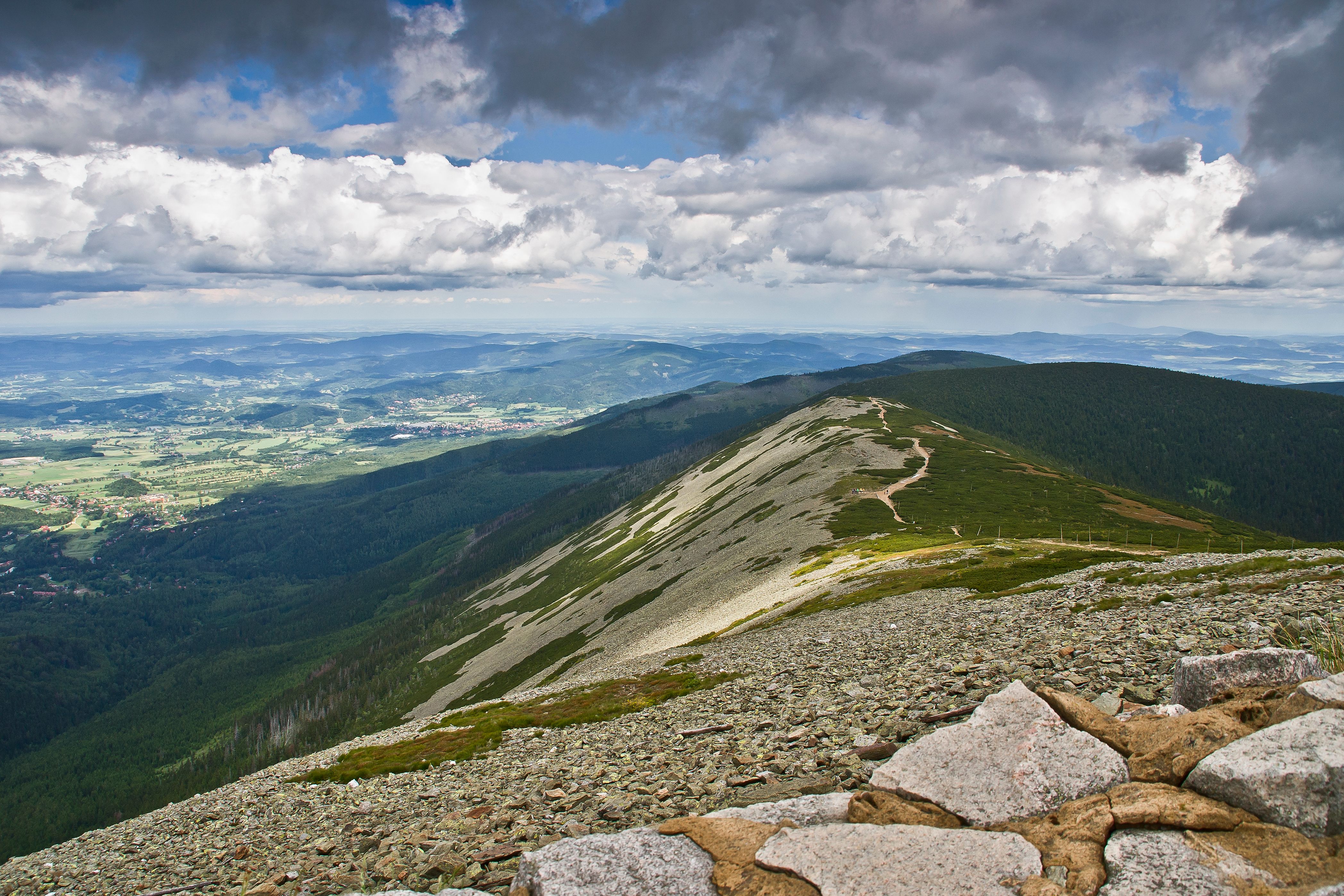
Golden hour light spills across the ridgeline of the Karkonosze Mountains—Poland's highest range where the scent of mountain herbs mingles with the mineral freshness of glacial lakes. The air carries the soft crunch of gravel beneath your boots on ancient shepherd paths, the distant call of eagles circling above the peaks, and the gentle murmur of Polish and Czech conversations that have echoed through these valleys since the Middle Ages. You hear the rhythmic clanging of cowbells from distant pastures, the soft rustle of wind through centuries-old dwarf mountain pine forests, and beneath it all, the profound silence that honors the wild landscape that has existed largely unchanged for millennia. This isn't merely a mountain range—it's a living chronicle of Central European ecology, where 60 kilometers of continuous ridgeline create one of Europe's most distinctive alpine landscapes, and where every bend in the trail reveals a new perspective of forest meeting open meadow. Standing on the summit of Sněžka (1,603 meters), you connect with the same geological legacy that has drawn visitors since the 19th century, where history breathes through the daily rhythm of hiking, wildlife observation, and quiet contemplation along ancient border paths. This place matters because it represents nature's quiet triumph over human intervention—a fragile ecosystem where two nations collaborate to protect a shared wilderness, reminding us of our responsibility to preserve these precious spaces for future generations.
Why Karkonosze Mountains Embodies Cross-Border Harmony
Karkonosze Mountains represent far more than scenic beauty—it embodies one of Europe's most remarkable examples of international conservation cooperation, where natural processes created a distinctive alpine landscape spanning national borders. Formed approximately 300 million years ago during the Variscan orogeny, this region spans 560 square kilometers with 26 peaks exceeding 1,300 meters in elevation, creating one of Central Europe's most continuous mountain ridges. The mountains solved a fundamental ecological challenge: how to maintain a self-sustaining ecosystem that preserves ancient biodiversity while coexisting with human communities across two nations. Built through natural geological processes, the landscape features distinctive glacial cirques, tarns (mountain lakes), and the famous "krkonošské trávníky" (Karkonosze meadows) that support rare plant species found nowhere else in Poland or the Czech Republic. What makes Karkonosze unique is its cross-border character: unlike many European mountain regions managed separately by different nations, this ecosystem functions according to natural processes with coordinated protection—only 5% of the landscape is developed, with strict preservation regulations that protect both natural and cultural heritage across the Polish-Czech border. The mountains' strategic location at the intersection of multiple biogeographical regions created a biodiversity hotspot where species from northern, southern, eastern, and western Europe converge—a delicate balance that has existed since the last Ice Age. Today, Karkonosze Mountains stand as one of Europe's most significant natural treasures, where the constant interplay between natural processes and binational conservation efforts creates a dynamic wilderness that continues to shape our understanding of transboundary ecological management—a testament to the enduring power of nature when given space to follow its own rhythms across political boundaries.
The Best Time to Experience Karkonosze Mountains
To experience Karkonosze Mountains at its most atmospheric, plan your visit between May 20–June 15 or September 10–October 15, when daytime temperatures range from 10–18°C (50–64°F) and the surrounding landscape blooms with spring wildflowers or glows with autumn colors. During these windows, you'll enjoy comfortable conditions for hiking, wildlife observation, and photography without summer's humidity or winter's extreme cold. For optimal photography of the alpine ridges and glacial lakes, arrive at 5:30–7:30 AM when morning light illuminates the mountain slopes, revealing the distinctive landscape while the valleys remain filled with morning mist. Alternatively, visit at 5:30–7:00 PM during golden hour when warm light filters through the ancient beech forests, creating dramatic shadows across the landscape where wildlife often emerges. You should firmly avoid July 15–August 25 when temperatures can exceed 22°C (72°F), the popular trails become congested with tour groups, and the intense midday sun diminishes the visual impact of the delicate alpine vegetation. For visitor information, trail maps, and educational resources, visit karkonosze.pl.
Approximate Budget for a 7-Day Trip
Visiting Karkonosze Mountains requires basing yourself in one of the charming mountain towns with easy access to trails. The following budget assumes moderate travel style—comfortable mountain guesthouses, authentic Polish and Czech cuisine, and a mix of hiking and occasional transportation. Prices are listed in Polish Złoty (PLN) with euro equivalents for international travelers (1 EUR ≈ 4.3 PLN in 2026).
- Accommodation: 110–260 PLN (26–60€) per night in Karpacz, Szklarska Poręba, or Harrachov. Budget mountain hostels start at 55 PLN; mid-range guesthouses run 260–480 PLN (60–112€).
- Food: 55–85 PLN (13–20€) per day total. Breakfast: 18–28 PLN for traditional śniadanie with jajecznica, local cheese, and fresh bread. Lunch: 25–40 PLN for regional specialties at a milk bar like Karczma Pod Snieżką. Dinner: 45–75 PLN for sit-down meals featuring mountain mushrooms, game dishes, and craft beer.
- Transportation: Local bus: 3.40 PLN (0.80€) for 20 minutes; one-day pass: 16 PLN (3.70€); taxi from Wrocław: ~150 PLN (35€); bike rental: 40–60 PLN (9–14€) per day.
- Attractions: Karkonosze National Park entry: 25 PLN (5.80€); Museum of the Karkonosze Mountains: 20 PLN (4.70€); Panorama Wagon cable car: 45 PLN (10.50€); Guided wildlife tour: 60 PLN (14.00€).
- Miscellaneous: Hiking equipment rental: 50–90 PLN (12–21€); educational books: 40–130 PLN (9–30€); transportation to/from Wrocław: 40–80 PLN (9–19€).
Total 7-Day Budget: 2,500–3,800 PLN (580–885€) per person (excluding international flights)
7 Essential Karkonosze Mountains Experiences
- Hike to Sněžka Summit: Navigate the 12-kilometer trail to Sněžka (1,603 meters), the highest peak in the Czech Republic and Poland's highest mountain. The route offers constantly changing perspectives of the distinctive alpine landscape with panoramic views of the surrounding ridges. Visit mid-week (Tuesday–Thursday) for fewer hikers; free; allow 8 hours; wear sturdy hiking boots.
- Explore the glacial lakes of Špindlerův Mlýn: Walk across one of Europe's most spectacular high-altitude lake systems, where centuries of glacial processes created a series of interconnected tarns. The gentle slopes connect you to the geological forces that shaped this landscape. Best experienced mid-morning (10:00 AM–12:00 PM) when lighting enhances the water's clarity; entry 15 PLN; allow 120 minutes; wear water-resistant clothing.
- Photograph the sunrise over Szrenica: Position yourself on the eastern slopes to capture the iconic view of the sun rising over the ridge with forested peaks in the foreground. The elevated vantage points along the trails offer perfect perspectives for both wide-angle landscapes and detailed close-ups. Visit during early morning (5:00–7:00 AM) for optimal lighting; free; allow 45 minutes; wide-angle lens recommended.
- Visit the Museum of the Karkonosze Mountains: Explore exhibits on the cultural heritage of the mountain communities, featuring remarkable displays on traditional mountain life, crafts, and the complex history of this border region. Visit mid-week (Tuesday–Thursday) when guides provide detailed historical context; entry 20 PLN; allow 75 minutes.
- Taste Traditional Mountain Cuisine: Sample authentic dishes at restaurants like Karczma Pod Snieżką: try bryndza cheese, mountain mushrooms, and regional specialties that connect you to centuries of culinary tradition. Best experienced during lunch (12:00–2:00 PM); budget 45–75 PLN per meal.
- Join a Cross-Border Hiking Tour: Experience guided hiking that crosses the Polish-Czech border, showcasing how conservation efforts work across national boundaries. The park's experienced guides know the best locations for experiencing the shared ecosystem. Events typically begin at 7:00 AM; tickets 70 PLN; book online to secure spots; allow 180 minutes.
- Discover the Hidden Waterfalls: Join a specialized tour focusing on the region's lesser-known waterfalls, revealing cascades often overlooked by casual visitors. Knowledgeable guides demonstrate the hydrological systems that shape the mountain landscape. Tours typically begin at 9:00 AM; tickets 65 PLN; allow 150 minutes; book online to secure spots.
3 Hidden Gems Most Travelers Miss
- The Secret Observation Point at Luční hora: Tucked away in the northern section of Luční hora, this secluded meadow features rare alpine flowers and panoramic views often missed by visitors focused on the main trails. Most visitors miss it because it requires navigating a narrow path only accessible on foot. Access: Reachable via the red trail from Špindlerův Mlýn; best visited mid-morning (10:00 AM–12:00 PM) when wildflowers are most vibrant. No additional fee; allow 90 minutes; bring botanical guide.
- The Hidden Czech-Polish Border Marker: Hidden along the western edge of the main ridge, this lesser-known historical marker features original inscriptions from the 19th century often overlooked by visitors focused on the main viewpoints. Often overlooked because it's not marked on standard tourist maps. Access: Located 2 kilometers north of Sněžka; visit early morning (6:00–8:00 AM) when lighting enhances the inscriptions. No additional fee; allow 30 minutes; bring binoculars.
- The Moonlight Path Along the Mountain Stream: This lesser-known evening walking route follows the northern bank of the mountain stream where strategically placed trees create dramatic moonlight effects on the water's surface. Most visitors leave before dusk, missing this serene experience. Access: Available during evening hours; best visited on clear nights with full moon. No additional fee; allow 75 minutes; bring a flashlight and wear quiet footwear.
Cultural & Practical Tips
- Respect the Fragile Ecosystem: Karkonosze Mountains is a protected natural area—stay on marked trails to avoid disturbing wildlife habitats. The alpine ecosystem takes decades to recover from damage; what might seem like a small shortcut can cause lasting harm to sensitive vegetation.
- Essential Polish/Czech Phrases: "Dzień dobry" (jen doh-brih) = Good day; "Děkuji" (dyeh-kooyee) = Thank you; "Proszę" (proh-sheh) = Please/You're welcome; "Hory" (hoh-rih) = Mountains. Locals appreciate respectful efforts in both languages.
- Mountain Strategy: Book cross-border tours well in advance, especially for wildlife observation. Visit the higher elevation trails early in your trip when energy levels are highest for hiking.
- Photography Guidelines: Photography is permitted throughout the mountains. In protected areas, avoid using flash that could disturb wildlife. Respect nesting birds by maintaining distance.
- Weather Preparedness: Karkonosze experiences alpine climate: summer highs reach 20°C (68°F); winter lows drop to -20°C (-4°F). The mountains can be windy and rainy year-round; carry waterproof clothing even in summer.
- Accessibility Notes: The mountain trails have no accessibility features due to natural terrain. Some villages offer adapted accommodations; contact local tourism offices in advance for specific accessibility information.
- Combine with Nearby Sites: Enhance your Karkonosze visit with nearby attractions: Giant Mountains National Park (Czech side, 30 minutes), Jizera Mountains (45 minutes), and the Wrocław Old Town (90 minutes). A regional perspective enriches understanding of Central Europe's mountain landscapes.
Conclusion: Travel with Cross-Border Understanding, Not Just Recreation
Karkonosze Mountains invites you to do more than photograph alpine ridges against mountain vistas. This is a place to stand where geological forces shaped the land beneath your feet across national boundaries, where the delicate balance between human recreation and ecological preservation creates a model for sustainable tourism across borders, where the rhythmic pulse of wildlife connects you to natural time measured in centuries rather than moments. When you navigate the same trails trodden by generations of Polish and Czech hikers, when you feel the mountain breeze that has carried the hopes and dreams of visitors since the 19th century, when you experience the dramatic contrast between the forested slopes and open alpine plateaus that defines this unique ecosystem, you participate in a legacy that transcends tourism. Travel to Karkonosze with reverence for the natural forces that created this fragile ecosystem, for the conservationists who protect it across national boundaries, for the communities that balance hospitality with preservation on both sides of the border. Respect the fragility of mountain environments—every footprint off-trail, every piece of litter left behind, disrupts a balance measured in decades rather than moments. Understand that the pristine beauty you cherish depends on the mindfulness of every visitor who comes after you, regardless of which side of the border they visit from. Let the mountains' harmonious design humble your understanding, let its ecological significance deepen your compassion, and let the convergence of land, life, and international cooperation remind you that the most profound journeys are those that transform recreation into responsibility for the natural world we've been entrusted to protect across all boundaries.