
Madeira Funchal Cable Car: Where Atlantic Clouds Meet Botanical Grandeur
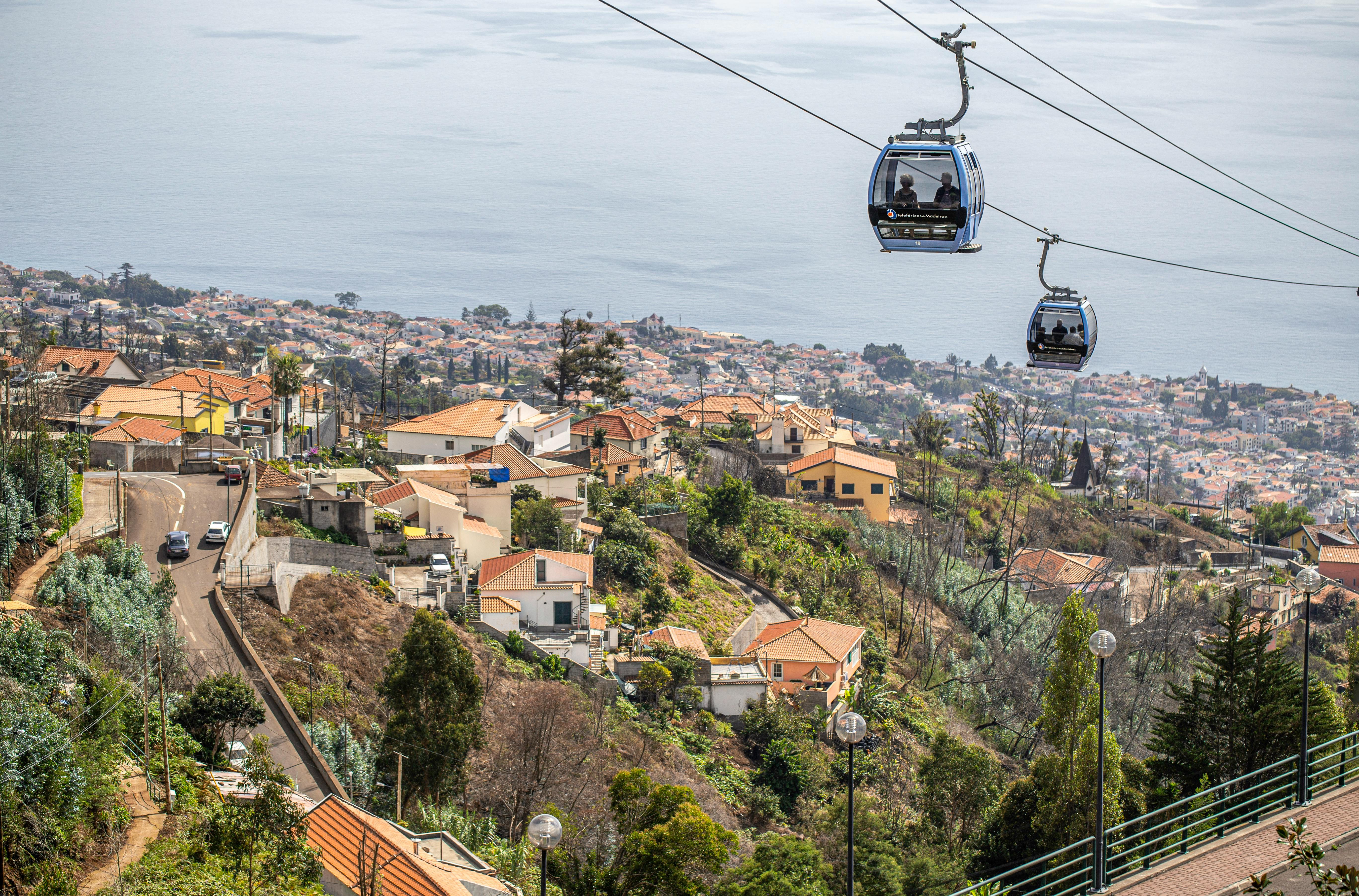
The morning light slants low across Funchal's harbour—amber and honeyed—catching the hulls of fishing boats rocking in the gentle swell. You hear it before you see it: a low, rhythmic hum of steel cables threading through pulleys 80 meters above the ground. The first cabin emerges from the base station on Almirante Reis Street, its translucent floor revealing a patchwork of terracotta rooftops, bougainvillea cascades, and the dark João Gomes river gorge cutting through the city's fabric like a wound healed over with ferns and laurel trees. The air smells of salt and iodine, undercut by the green sweetness of endemic Estrelicia—the bird-of-paradise flower—rising from the Quintas below. Suspended between the Atlantic Ocean and the jagged peaks of the Encumeada range, the Madeira Funchal cable car carries you upward through layers of climate, colour, and centuries of agricultural history in a silent, 15-minute ascent that renders the island's dramatic topography suddenly, breathtakingly legible. This is not merely transport. It is a slow unwinding of Madeira's story—one vertical meter at a time.
Why the Funchal Cable Car Embodies Engineering Poetry
When Austrian engineering firm Doppelmayr completed the Teleférico do Funchal in November 2000, it solved a problem that had vexed visitors and residents alike for over a century: how to traverse the 560-meter (1,837-foot) vertical rise from Funchal's sea-level old town to the hillside parish of Monte without navigating a labyrinth of narrow, winding roads carved into cliff faces. The system stretches 3,218 meters (2 miles) across 89 support pylons, threading a corridor that earlier engineers deemed impassable. Each of the 39 cabins—welded from lightweight aluminium and fitted with 6-millimetre tempered glass floors—accommodates eight passengers and operates on a continuous loop system capable of moving 1,200 people per hour. The cable itself is 42 millimetres in diameter, wound from galvanized steel strands capable of bearing 14 tonnes of tension per running meter.
Yet the engineering achievement transcends raw statistics. The cable car was conceived not as a standalone attraction but as a functional link in a broader mountain transport network that includes the historic Monte toboggan run—wicker sleds guided by carreiros since the 1850s—and the former Monte Palace rack railway that operated from 1893 to 1943. By following a route that parallels the old railway's trajectory, the cable car creates a palimpsest: modern gondolas gliding above the ghosts of steam-powered carriages. The pylons were deliberately sited to avoid disturbing mature trees in the João Gomes Ecological Park, and the cabins' low-profile design minimises wind resistance—critical in a corridor where trade winds accelerate through the gorge at speeds exceeding 40 km/h (25 mph). The result is infrastructure that serves rather than dominates, a rare achievement in an era of spectacle-driven engineering.
The Best Time to Experience the Funchal Cable Car
The optimal window for riding the cable car spans April 12–June 8, when Madeira's spring bloom reaches its crescendo and the Atlantic trade winds settle into a predictable afternoon rhythm. During this period, morning temperatures at the base station hover between 18–21°C (64–70°F), while the Monte terminus sits 3–4 degrees cooler at 15–17°C (59–63°F). Arrive between 8:00–9:15 AM—the cabins begin running at 8:30 AM in shoulder season—to claim a cabin with minimal queuing and to photograph the gardens below in the soft eastward light before the midday haze settles over the city.
Avoid July 15–August 28, when cruise ship deployments peak and waiting times routinely exceed 45 minutes at the base station. December 20–January 6 presents a secondary crowding challenge during the Funchal fireworks festival, though the elevated vantage point for New Year's Eve pyrotechnics is extraordinary if you secure tickets weeks in advance. For the most atmospheric rides, target late October 1–November 10, when morning fog pools in the João Gomes gorge and the cable car enters clouds between pylons 34 and 47—a disorienting, almost spectral passage that locals call o véu da serra, the mountain's veil.
Approximate Budget for a 7-Day Trip
Pricing reflects mid-range travel for two adults based on current rates in Funchal's historic centre and Monte parish, excluding international flights. All figures are quoted in Euros and assume advance online bookings where available.
- Accommodation: €85–€140 per night in the Zona Velha (Old Town) or São Martinho neighbourhood—characteristic guesthouses with ocean-view balconies and breakfast included
- Food: €62 per day for two (breakfast €8 at a local pastelaria—two bifanas and galão coffee; lunch €18—shared espetada beef skewers with garlic bread at a Monte roadside grill; dinner €36—grilled espada scabbardfish with banana and paired with Dão red at a Funchal marina restaurant)
- Transportation: Cable car round trip €18 per person (€36 total); Horários do Funchal bus 21 (Funchal–Monte direct) €1.95 per ride; SAM bus 105 (Monte–Eira do Serrado) €2.50 per ride; airport transfer via AeroBus €5 per person each way
- Attractions: Monte Palace Tropical Garden €15 per person; Madeira Botanical Garden €7 per person; Blandy's Wine Lodge tour €16 per person; Monte toboggan descent €25 for two passengers sharing one sled; CR7 Museum €8 per person
- Miscellaneous: €45 total—bottle of 10-year-old Blandy's Madeira wine (€22 from the lodge shop); hand-embroidered Madeira tablecloth from A Arte da Borda workshop (€18); local SIM card with 5 GB data (€5)
Total for 7 days (two adults): approximately €1,340–€1,680
6 Essential Funchal Cable Car Experiences
- Ride the translucent-floor cabin at departure: Request cabin number 7 or 8 at the base station—these are typically equipped with full glass bottoms. As you lift off Almirante Reis, look straight down onto the 17th-century Sé Cathedral's terracotta tiles and the geometric patterns of the painted doors along Rua de Santa Maria. The sensation of floating over living rooftops triggers a visceral thrill that no photograph captures.
- Photograph the João Gomes gorge from mid-cable: Between pylons 22 and 31, the cabin crosses the deep ravine at its widest point—180 meters (590 feet) across with a 90-meter (295-foot) drop to the riverbed. Shoot downward at a 45-degree angle with a wide-angle lens to frame the emerald canopy of the ecological park against the grey basalt cliff walls.
- Descend via the Monte toboggan: After disembarking at Monte, locate the toboggan start point 200 meters east of the cable car station on Caminho do Monte. Two carreiros in straw boaters guide your wicker sled down 2 kilometers (1.2 miles) of cobbled road to Livramento. The ride takes approximately 10 minutes and reaches speeds of 38 km/h (24 mph) on straight sections. Hold the rope handles firmly—the sleds have no brakes.
- Walk the Monte Palace Tropical Garden labyrinth: Enter through the garden's east gate (included with cable car return ticket at a discount). Follow the red-tile path to the Japanese garden section, where a central koi pond reflects the surrounding cycads and 200-year-old olive trees imported from Andalusia. The tiled panels depicting Portuguese exploration history line the lower terraces—allow 90 minutes for the full circuit.
- Eat poncha at a Monte bar: Stop at Bar do Parque on Travessa da Quinta do Monte, where a third-generation bartender mixes poncha—aguardente de cana (sugarcane rum), honey, and freshly squeezed lemon—using a wooden muddler called a caralhinho. Served in a stemmed glass, it delivers an uncompromising kick tempered by floral sweetness. One is sufficient; two is ambitious.
- Return at dusk for the city lights: Board the last downhill cabin at approximately 5:30 PM (confirm seasonal closing). As the cabins descend, Funchal's waterfront illuminates in a crescent of amber and white, the marina lights mirrored in the harbour, and the dark mass of the ocean extends to an invisible horizon. The transition from the quiet, darkened gardens of Monte to the glowing city below is the cable car's most cinematic moment.
3 Hidden Gems Most Travelers Miss
- Quinta das Cruzes Museum Garden: Located 400 meters downhill from the cable car base station on Calçada do Pico, this 16th-century nobleman's estate houses a modest collection of Madeiran furniture and silver, but the real revelation is its walled garden. Orchid specimens collected from the island's laurisilva forest bloom in shaded stone alcoves, and a carved basalt mermaid fountain dating to 1585 sits in a corner overlooked by most visitors. Open Tuesday–Saturday, 10:00 AM–12:30 PM and 2:00–5:00 PM. Admission €5.
- Levada dos Tornos trailhead from Monte: Most cable car visitors turn toward the tropical garden, but a 15-minute walk west on Caminho do Furão leads to the start of Levada dos Tornos—a 12-kilometer (7.5-mile) irrigation channel walk that traces the mountainside above Funchal with virtually no foot traffic in the first 3 kilometers. The path is narrow (0.7 meters) and bordered by hydrangea hedges in summer. No guide required; follow the blue-and-yellow trail markers. Start before 9:00 AM to avoid afternoon cloud cover.
- Igreja de Nossa Senhora do Monte: This baroque church sits 300 meters uphill from the cable car terminus, accessed via a stone staircase of 174 steps. Emperor Charles I of Austria-Hungary is buried in its crypt—he died in exile on Madeira in 1922. The interior features a gilded altarpiece carved from Madeiran cedar. Most visitors are unaware of its existence because it is set back from the main tourist thoroughfare behind the Café do Monte. Open daily 9:00 AM–6:00 PM. Free entry.
Cultural & Practical Tips
- Learn basic Portuguese courtesy: "Bom dia" (good morning, pronounced bohng DEE-ah) and "Obrigado" (thank you, oh-bree-GAH-doo—use obrigada if you are a woman). Madeirans are warm and unhurried; a greeting before any transaction is expected.
- Photography inside the cable car cabins produces reflections on the glass. Press your phone or camera lens directly against the floor panel for clear downward shots; for side views, use a dark cloth draped over your head and the lens to eliminate glare.
- The cable car operates in rain and wind up to 50 km/h (31 mph), but service is suspended without advance notice during gusts exceeding this threshold. Check the station's digital display before purchasing tickets—refunds are not issued for weather suspensions once you board.
- Wear layers, even in summer. The temperature differential between the base and Monte stations can reach 6°C (11°F), and the cabins are not climate-controlled. A light windbreaker is sufficient year-round.
- Madeira's tap water is safe and excellent, drawn from mountain springs. Bring a refillable bottle and fill it at the free fountain outside the Monte cable car station—it is fed from the Levada do Norte channel.
- Respect the levada paths: never walk on the channel walls themselves (they are slippery and the water rights are legally protected), stay on the marked trail, and do not divert water flow. Fines for levada damage can reach €500.
- Tipping in Madeira is appreciated but not obligatory. Round up restaurant bills to the nearest €5 or leave 5–8% for exceptional service. Cable car operators do not accept tips.
Conclusion: Travel with Reverence, Not Just Itinerary
The Madeira Funchal cable car delivers you from the harbour to the mountains in fifteen quiet minutes—but what matters is whether you let those minutes alter your understanding of the island beneath you. Too many riders treat the ascent as a scenic checklist item: photograph, disembark, move on. Slow down. Watch how the bougainvillea gives way to tree heath, how the stone terraces narrow and steepen, how the ocean recedes from a surrounding presence to a distant silver line. Madeira's levada builders carved channels through impossible rock faces over four centuries to sustain life on these slopes; the cable car, for all its modern engineering, merely traces the contour of that ancient persistence. When you step out at Monte, carry the awareness that you have crossed not just altitude but time—rising from a 21st-century city into a landscape shaped by generations of hands that planted, irrigated, and tended against every logical odds. Travel here not to collect views but to witness what devotion to a difficult place looks like from above.