
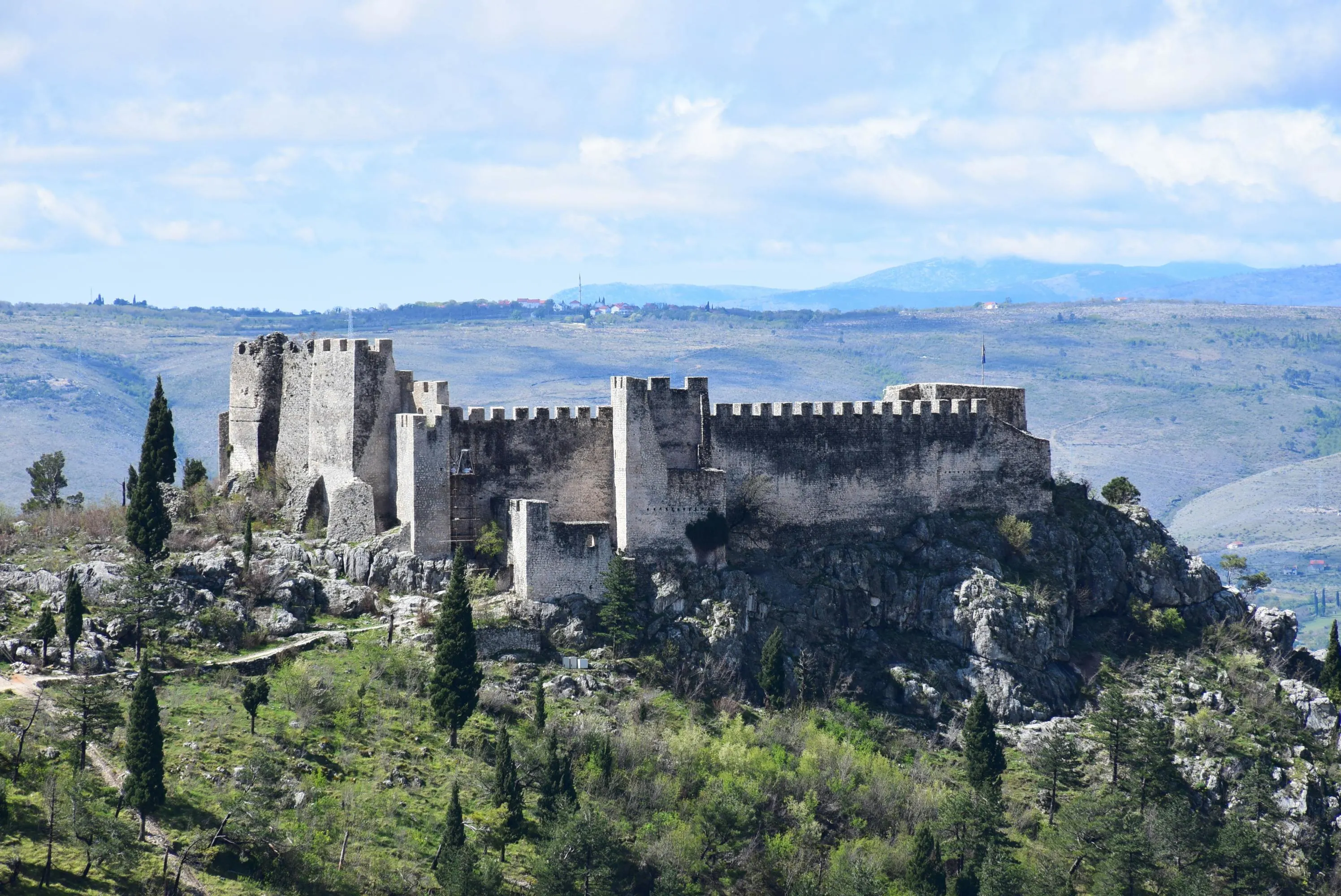
Marvão Hilltop Fortress: Where Impregnable Granite Meets Serra de São Mamede Clouds
Dawn breaks over the Alentejo plain, and the Marvão hilltop fortress emerges from a churning sea of fog like the prow of a colossal stone ship. You stand on the wind-scoured battlements, 860 meters (2,822 feet) above sea level, listening to the sharp, whistling breeze slice through the narrow arrow slits. The air tastes intensely of wild rosemary, damp earth, and cold granite. Below, the village’s whitewashed houses cling desperately to the steep escarpment, their terracotta roofs catching the first slanted rays of sunlight. The sheer scale of the surrounding walls—hewn directly from the living rock of the mountain and stretching over 650 meters (2,133 feet) in perimeter—creates an intimidating, vertical fortress that feels less built than violently carved from the earth. The Marvão hilltop fortress matters because it stands as a perfectly preserved testament to medieval paranoia; it is an architectural marvel where the raw geology of the Serra de São Mamede was weaponized to create an absolutely impenetrable border stronghold, ensuring that the turbulent history of Portugal’s frontier remains etched permanently into the sky.
Why Marvão Hilltop Fortress Embodies Defensive Perfection
The Marvão hilltop fortress embodies defensive perfection because it solved the ultimate military problem of the Middle Ages: surviving a prolonged siege on an exposed, hostile frontier. Commissioned by King Dinis in the early fourteenth century to secure Portugal’s volatile eastern border against repeated Castilian incursions, the structure had to be entirely self-sufficient and visually terrifying. Master masons solved this by carving the fortress directly into the granite spine of the mountain, eliminating the traditional, vulnerable weak point of any castle—the foundation. The outer defensive walls measure a staggering 2.5 meters (8 feet) thick at the base, constructed from massive, uncut granite ashlars fitted together entirely without mortar. This dry-stone engineering technique allowed the walls to flex and absorb the kinetic impact of early cannon fire without fracturing. Inside the perimeter, the complex features a massive, roofless cistern carved 6 meters (20 feet) deep into the solid bedrock, engineered to harvest rainwater and sustain a garrison of hundreds for months without external supply. The central keep, or Torre de Menagem, rises as a purely vertical cylinder with walls tapering slightly inward toward the summit—a sophisticated structural trick that deflects projectiles rather than absorbing their blunt force. Every narrow, winding street in the village below acts as an extension of this military architecture, funneling any breached attackers into a deadly, converging gauntlet before they could even reach the upper citadel. This seamless integration of civilian habitation into a military defensive network makes Marvão a singular triumph of tactical urban planning.
The Best Time to Experience Marvão Hilltop Fortress
To experience the Marvão hilltop fortress in its most mystical state, plan your visit between April 15 and May 30. During this precise window, the surrounding Serra de São Mamede Natural Park is carpeted in vivid wildflowers, and daytime temperatures hover between 15°C and 22°C (59°F–72°F)—perfect for climbing the steep, exposed stone staircases without breaking a sweat. Arrive precisely between 8:30 and 9:30 AM. At this early hour, a temperature inversion often pushes the morning mist below the fortress walls, allowing you to walk the ramparts suspended above a literal sea of white clouds. Additionally, the spring wildflowers, including vibrant yellow gorse and purple lupines, frame the stone walls in spectacular color. You should firmly avoid August 1 through August 20. During these weeks, the Alentejo sun pushes temperatures past 38°C (100°F), the stone walls radiate blistering heat late into the evening, and the narrow village streets become suffocatingly crowded with day-trippers. For current fog forecasts, castle museum hours, and local festival schedules, consult the official municipal tourism website at www.cm-marvao.pt. Checking this resource ensures you secure access to the restricted upper battlements and experience the fortress cloaked in the atmospheric isolation that makes it truly unforgettable.
Approximate Budget for a 7-Day Trip
Estimating costs for a cultural immersion into the Marvão hilltop fortress requires factoring in the highly affordable, rustic nature of the Alentejo region. The pricing methodology here reflects the low-cost, high-value reality of rural Portuguese tourism, where world-class historical sites carry only nominal entry fees, and local agricultural products keep dining costs exceptionally reasonable compared to coastal resorts.
- Accommodation: €50–€75 per night (a restored stone cottage in the historic village center, featuring panoramic valley views and a traditional Alentejo chimney)
- Food: €30 per day (Breakfast €3 for a strong bica espresso and local sheep cheese; Lunch €10 for a porco preto black pork sandwich at a village tavern; Dinner €17 for a rich açorda alentejana—bread, garlic, and cilantro soup with poached eggs—at a family-run restaurant)
- Transportation: €25 total (€18 for a round-trip Rede Expressos bus ticket from Lisbon to Portalegre; €7 for a regional taxi from Portalegre up the mountain to Marvão)
- Attractions: €10 total (€6 for the Marvão Museum located inside the castle keep; €4 for the Church of Santa Maria)
- Miscellaneous: €15 total (a jar of local chestnut honey, a hand-painted ceramic tile, and craft beer from a village market)
Total: €510–€685
7 Essential Marvão Hilltop Fortress Experiences
- Walk the Cloud-Level Battlements: Begin at the main gate and trace the perimeter of the upper citadel. The wind howls fiercely at this altitude. Press your hands against the cold, rough-hewn granite blocks; notice the strategic placement of the arrow slits angled perfectly to cover the sheer cliff faces below without exposing the defenders to return fire.
- Descend into the Subterranean Cistern: Locate the heavy iron door near the Governor’s House. Step into the damp, echoing darkness of the ancient water reservoir. The acoustics amplify every drop of condensation falling from the vaulted ceiling, creating a haunting, subterranean symphony that emphasizes the profound isolation of a medieval siege.
- Climb the Torre de Menagem: Ascend the narrow, worn spiral staircase of the central keep. The stone steps are deeply eroded in the center from centuries of armored boots. Reach the summit for a vertigo-inducing, 360-degree panorama stretching endlessly across the Spanish border and the vast Alentejo plains.
- Explore the Castle Museum: Enter the former barracks inside the fortress walls. Examine the collection of ancient iron culverins and medieval armor. The thick stone walls keep the interior remarkably cool, offering a silent, atmospheric respite from the harsh mountain sun.
- Photograph the Porta da Vila: Walk down to the village’s main gate. Frame your shot looking up through the narrow, tunnel-like archway. The whitewashed houses seem to stack impossibly high, funneling your gaze directly toward the impenetrable fortress towers looming above.
- Watch the Sunset from the Pillory: Stand beside the sixteenth-century stone pillory in the main square as dusk falls. The fading light turns the massive granite walls a deep, bruised purple, while the valley below plunges into absolute, silent darkness.
- Feel the Weight of the Iron Cannon: Locate the line of rusted iron culverins positioned along the western battlement. Run your fingers over the cold, pockmarked metal; feel the raised ridges where molten iron was cast around a central mold. Imagine the deafening roar that once billowed from these muzzles.
3 Hidden Gems Most Travelers Miss
- The Northern Watchtower (Torre do Forno): Situated on the far northern edge of the battlements, this ruined tower is missed because the path leading to it is overgrown and requires ducking under a low stone archway. To access it, walk past the main keep and follow the crumbling perimeter path until it narrows. It offers the most dramatic, unobstructed view of the sheer cliff face dropping away into Spanish territory.
- The Jewish Quarter Steps: Tucked behind the main parish church, this network of steep, narrow alleyways is routinely ignored by visitors who stick to the main tourist thoroughfare. To find it, walk through the arched stone passage beside the church and immediately turn left. The labyrinthine steps feature carved mezuzah niches hollowed out directly into the doorposts—small, rectangular indentations bearing silent witness to a thriving medieval Sephardic community.
- The Santa Maria Church Altarpiece: Located in the village center, this small church is often overlooked by tourists fixated on the fortress walls. To access it, walk past the main square and look for the unassuming wooden door. Inside, you will find a stunning, gold-leafed Baroque altarpiece that violently contrasts with the austere, militaristic aesthetic of the rest of the hilltop town.
Cultural & Practical Tips
- Wear shoes with aggressive rubber grip; the ancient granite paths of the village and fortress are polished smooth by centuries of foot traffic and become lethally slippery when exposed to morning dew or light rain.
- Drive with extreme caution; the single road leading up the mountain to Marvão features blind, hairpin turns without guardrails, and local drivers navigate them with startling speed.
- Learn basic Portuguese phrases to show respect to the elderly residents: say "Bom dia" (good morning, pronounced "bom dee-ah") when entering a shop, and use "Com licença" (excuse me, pronounced "com lee-sen-sa") when passing locals on the narrow sidewalks.
- Bring a heavy jacket regardless of the season; the extreme altitude creates a microclimate where temperatures at the fortress are routinely 8 to 10 degrees Celsius cooler than the plains below, even in mid-summer.
- Photography is unrestricted on the outer walls, but use a wide-angle lens to capture the dramatic scale of the landscape; standard lenses will fail to convey the terrifying vertical drop of the cliff faces.
- Carry cash in small denominations; while the museum accepts cards, the village bakeries and taverns deep within the fortified walls often operate on a cash-only basis.
- Be highly respectful of private property; many of the ancient stone doorways open directly into the homes of local residents. Never block a doorway to take a photograph, and always avoid peering into open windows.
Conclusion: Travel with Historical Empathy, Not Just Sightseeing
The Marvão hilltop fortress demands far more from visitors than a quick drive up the mountain; it requires a physical engagement with the harsh realities of frontier life. When you climb the worn steps of the keep, feeling the biting wind that historically froze invading soldiers, you honor the immense labor required to build this sanctuary. Mindful travel here means resisting the urge to treat the village as a mere picturesque backdrop. It means pausing in the damp cistern to acknowledge the terror of a prolonged siege, and respecting the quiet, aging population that still calls this isolated peak home. By walking softly through the narrow streets, spending your euros in local taverns, and finding the forgotten Jewish quarter, you actively participate in keeping the mountain’s history alive. Let the unyielding granite remind you that true resilience is forged in isolation. In a fortress built to keep the world out, the greatest respect you can pay is to simply slow down and listen to the wind.