
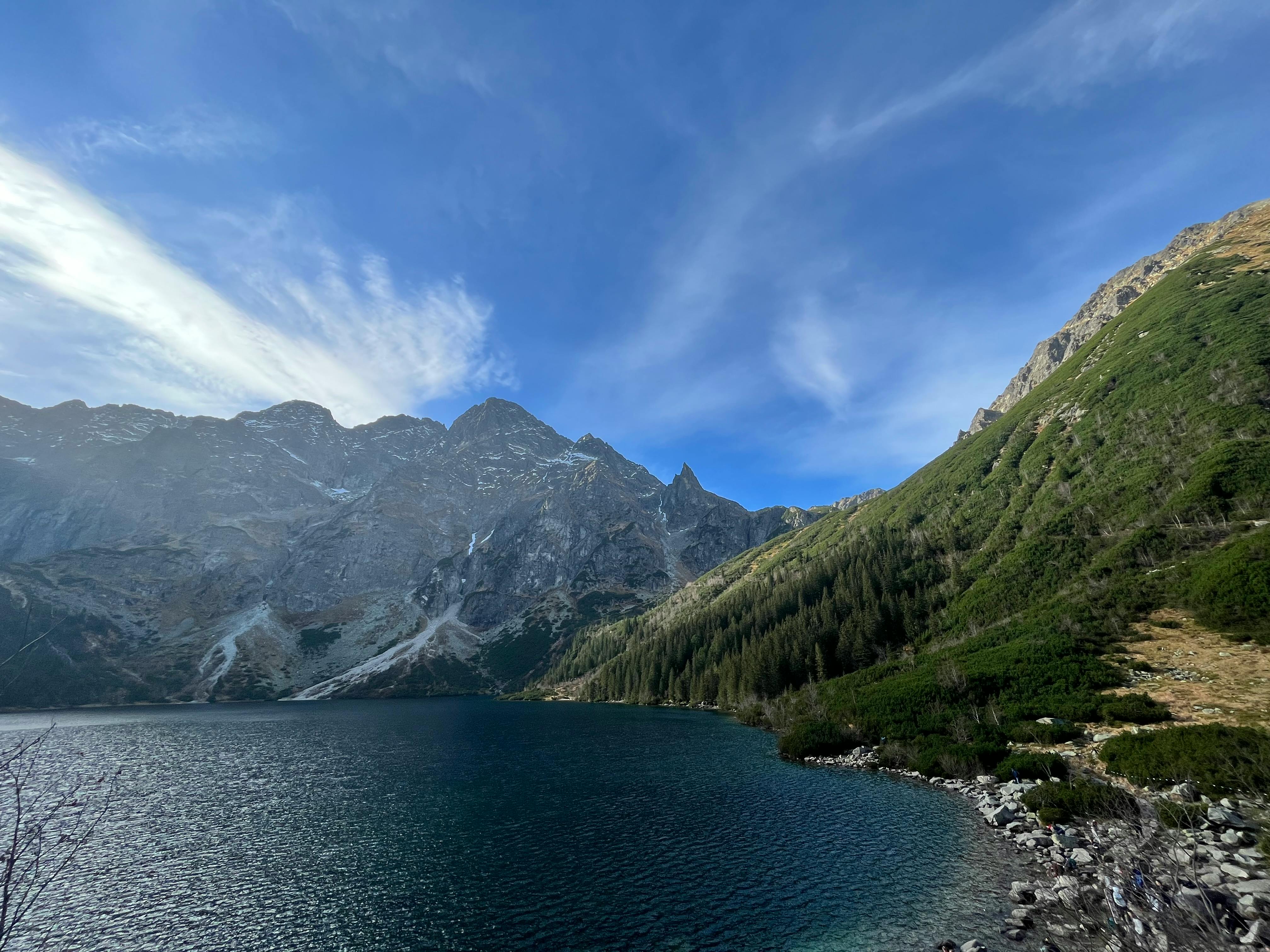
Morskie Oko Lake: Where Alpine Waters Meet Mountain Majesty
Early morning mist curls across the glassy surface of Morskie Oko—Poland's largest and fourth-deepest mountain lake, nestled 1,395 meters above sea level in the heart of the Tatra National Park. The air carries the crisp scent of pine forest and cold mountain water as you stand on the rocky shore, watching the first rays of sunlight transform the 50.8-meter-deep waters from midnight blue to liquid sapphire. You hear the gentle lap of waves against weathered stones, the distant call of alpine birds echoing from the 2,503-meter summit of Rysy, and the quiet crunch of fellow travelers' footsteps on the trail that winds through centuries-old spruce forest. This isn't merely a lake—it's a natural masterpiece sculpted by glaciers 10,000 years ago, where crystal-clear waters mirror snow-dusted peaks, and where the silence speaks of geological time measured in millennia rather than moments. Walking this shoreline, you connect with the same landscape that inspired Polish Romantic poets and European aristocrats who traveled here in the 19th century. This place matters because it offers a rare window into alpine ecosystems preserved through careful stewardship, where natural beauty and scientific significance converge in a single, breathtaking panorama that reminds us of nature's enduring power and delicate balance.
Why Morskie Oko Embodies Alpine Perfection
Morskie Oko represents far more than scenic beauty—it embodies the extraordinary geological processes that shaped the Tatra Mountains while maintaining ecological integrity through changing political landscapes. Formed during the last glacial period approximately 10,000 years ago, the lake's distinctive elongated shape (1,079 meters long and 356 meters wide) reveals its glacial origins, carved by ice moving from south to north through the Rysy massif [[14]]. The lake solved a fundamental ecological challenge: how to maintain water quality and biodiversity in a high-altitude environment with minimal human impact. Fed by mountain streams and springs rather than surface runoff, Morskie Oko's waters remain exceptionally clear with visibility reaching 10 meters below the surface—a rarity among mountain lakes. The surrounding area features a carefully preserved ecosystem where native species like the Tatra chamois, alpine newt, and endemic mountain plants thrive under strict conservation measures. What makes Morskie Oko unique is its scientific significance: designated as a Ramsar wetland of international importance, the lake serves as a natural laboratory for studying climate change impacts on alpine environments. Unlike many mountain lakes altered by human activity, Morskie Oko remains largely pristine thanks to its protected status within Tatra National Park since 1954—a testament to conservation efforts that balance accessibility with preservation [[22]]. The lake's name ("Eye of the Sea") derives from an old belief that subterranean channels connected it to the Black Sea, reflecting centuries of local folklore intertwined with scientific curiosity.
The Best Time to Experience Morskie Oko Lake
To experience Morskie Oko at its most atmospheric, plan your visit between June 10–July 5 or September 5–October 10, when daytime temperatures range from 8–18°C (46–64°F) and the mountains bloom with summer wildflowers or glow with autumn colors [[11]]. During these windows, you'll enjoy comfortable conditions for hiking, photography, and contemplation without the congestion of peak summer or winter's extreme conditions. For optimal photography of the lake reflecting surrounding peaks, arrive at 7:00–8:30 AM when morning light strikes the eastern slopes, illuminating mountain details with soft, directional illumination while the water surface remains glassy calm. Alternatively, visit at 5:00–6:30 PM during golden hour when warm light transforms limestone into amber tones and creates dramatic reflections on the lake surface. You should firmly avoid July 15–August 25 when afternoon thunderstorms become frequent, trail congestion peaks, and the reflective quality of the water diminishes due to wind and increased visitor numbers. For trail conditions, weather updates, and conservation information, visit tpn.pl [[8]].
Approximate Budget for Visiting Morskie Oko Lake
Visiting Morskie Oko requires basing yourself in Zakopane with transportation to the trailhead. The following budget assumes moderate travel style—comfortable mountain accommodations, authentic highland cuisine, and appropriate hiking gear. Prices are listed in Polish Złoty (PLN) with euro equivalents for international travelers (1 EUR ≈ 4.3 PLN in 2026) [[19]].
- Accommodation: 150–300 PLN (35–70€) per night in Zakopane. Budget guesthouses start at 80 PLN; mid-range mountain lodges run 300–600 PLN (70–140€) [[26]].
- Food: 50–75 PLN (12–17€) per day. Breakfast: 15–25 PLN for traditional highland meal with oscypek cheese and bread. Lunch: 25–40 PLN for zupa grzybowa (mushroom soup) at mountain huts. Dinner: 40–70 PLN for sit-down meals featuring bigos and pierogi [[21]].
- Transportation: Zakopane to trailhead bus: 4 PLN (0.90€) one-way; taxi to trailhead: 25–40 PLN (5.80–9.30€); Tatra National Park entry: 22 PLN (5.10€) standard, 35 PLN (8.10€) with audio guide [[26]].
- Attractions: Morskie Oko lake access: included with park entry; High Mountain Hut (Schronisko nad Morskim Okiem): 35 PLN (8.10€) meal; Boat ride on lake: 25 PLN (5.80€) [[13]].
- Miscellaneous: Waterproof hiking gear: 120–300 PLN (28–70€); traditional wooden souvenir: 50–150 PLN (11.60–34.90€); smoked oscypek cheese: 20–40 PLN (4.60–9.30€) [[22]].
Total 3-Day Visit Budget: 950–1,700 PLN (220–395€) per person (excluding international flights and main accommodation)
5 Essential Morskie Oko Experiences
- Hike the Traditional Trail from Palenica Białczańska: Begin your journey at the trailhead near Palenica Białczańska (1,000 meters elevation) for the 7.6-kilometer, 2.5-hour hike to the lake. The well-marked path winds through ancient spruce forest, across wooden bridges spanning mountain streams, and along rocky outcrops with panoramic views. Visit mid-morning (9:00 AM–11:00 AM) when morning mist clears; wear sturdy hiking boots; bring water and layers.
- Photograph the Reflections at Dawn: Position yourself on the eastern shore at first light to capture the mirror-like reflection of Rysy peak in the calm lake waters. The 1,395-meter elevation creates atmospheric conditions where morning mist rises from the water surface, adding ethereal quality to photographs. Visit during June or September for clearest reflections; use a polarizing filter to enhance water clarity; tripod recommended.
- Visit the High Mountain Hut for Traditional Cuisine: Stop at Schronisko nad Morskim Okiem, the historic mountain hut established in 1874, to sample authentic highland dishes like oscypek (smoked sheep cheese), kwaśnica (sauerkraut soup), and krupnik (honey liqueur). The hut's terrace offers panoramic lake views. Best experienced midday (12:00–2:00 PM) when hot meals are served; budget 35–55 PLN per meal.
- Explore the Underwater World with a Glass-Bottom Boat: Take a guided boat tour on the lake's surface to view the underwater landscape through glass panels. The exceptional water clarity (visibility up to 10 meters) reveals ancient glacial formations and native aquatic plants. Visit mid-week (Tuesday–Thursday) when crowds are lighter; tours available May–October; 25 PLN per person; allow 30 minutes.
- Hike to the Lesser-Known Viewpoint at Czarny Staw: Continue beyond Morskie Oko to Czarny Staw (Black Lake), a smaller, deeper lake with dramatic mountain backdrop. The 1.5-hour extension offers solitude and different perspectives of the same mountain range. Visit early afternoon (1:00–3:00 PM) for optimal lighting; wear sturdy shoes; bring water; allow 3 hours total.
3 Hidden Gems Most Travelers Miss
- The Whispering Rocks of Rysy Slope: Tucked away on the western slope of Rysy mountain, these unusual rock formations create natural acoustic phenomena where whispers travel clearly across 30 meters of distance. Most visitors miss it because it requires a 45-minute detour from the main lake trail. Access: From Morskie Oko, follow the blue trail toward Rysy for 1.2 km; best visited mid-morning (10:00 AM–12:00 PM) when fewer crowds allow for acoustic experiments. No additional fee; allow 45 minutes; wear sturdy shoes.
- The Secret Waterfall Behind the Lake: Hidden behind the northern end of Morskie Oko, a small but picturesque waterfall cascades down a rocky face into the lake's feeder stream. Most tourists overlook it because the viewing spot requires climbing a short, unmarked path. Access: From the High Mountain Hut, follow the lake's northern shore for 300 meters; best visited after rainfall when flow is strongest. No additional fee; allow 20 minutes.
- The Alpine Meadow at Hala Ornak: Located 30 minutes beyond Morskie Oko on the trail to Czarny Staw, this high-altitude meadow bursts with wildflowers from June–August and offers uninterrupted views of the lake below. Most visitors turn back at the lake, missing this serene spot. Access: Continue past Morskie Oko on the red trail; best visited mid-week for solitude. No additional fee; allow 60 minutes; bring water.
Cultural & Practical Tips
- Respect the Protected Environment: Morskie Oko lies within Tatra National Park—do not feed wildlife, stay on marked trails, and carry out all trash. The fragile alpine ecosystem takes decades to recover from damage.
- Essential Polish Phrases: "Dzień dobry" (jen doh-brih) = Good day; "Dziękuję" (jen-koo-yeh) = Thank you; "Proszę" (proh-sheh) = Please; "Szczęśliwej drogi" (shchents-lee-yeh druh-gee) = Safe travels. Locals appreciate respectful efforts.
- Hiking Strategy: Check weather conditions daily at the Tatra National Park office in Zakopane. The trail to Morskie Oko is well-marked but can be slippery when wet—wear proper footwear. Consider hiring a certified mountain guide for extended hikes.
- Photography Guidelines: Photography is permitted throughout the area. In the national park, flash photography is prohibited near wildlife. Tripods require care on narrow mountain paths; avoid obstructing trails.
- Weather Preparedness: Mountain weather is unpredictable: summer highs reach 18°C (64°F) but can drop to 5°C (41°F) with sudden rain; winter lows reach -20°C (-4°F). Pack layers, waterproof gear, and sturdy footwear regardless of season.
- Accessibility Notes: The 7.6-kilometer trail to Morskie Oko features steep, uneven terrain unsuitable for wheelchairs. The trail is accessible to moderately fit hikers but requires approximately 2.5 hours one-way. No alternative access is available.
- Combine with Nearby Sites: Enhance your visit with nearby attractions: Czarny Staw (Black Lake, 1.5 hours beyond Morskie Oko), Giewont Mountain (iconic peak visible from the lake), or the scenic route to Morskie Oko via Gubałówka Hill. A regional perspective enriches understanding of the Tatra ecosystem.
Conclusion: Travel with Reverence, Not Just Checklists
Morskie Oko invites you to do more than photograph crystal-clear waters against snow-capped peaks. This is a place to stand where glaciers carved beauty from stone, where centuries of careful stewardship have preserved ecological balance, where the quiet persistence of nature speaks louder than human voices. When you hike the same trail trodden by Romantic poets and pioneering naturalists, when you gaze upon waters that reflect the same mountains seen by Tatra shepherds centuries ago, when you feel the mountain air that has shaped ecosystems for millennia, you participate in a legacy that transcends tourism. Travel to Morskie Oko with reverence for the geological forces that created this masterpiece, for the conservation efforts that protect it from overuse, for the delicate balance that allows native species to thrive. Respect the fragility of alpine ecosystems—every footprint off-trail, every piece of litter left behind, disrupts a balance measured in centuries rather than moments. Understand that the pristine beauty you cherish depends on the mindfulness of every visitor who comes after you. Let the lake's reflective surface humble your perspective, let its geological history deepen your understanding, and let the convergence of water, stone, and sky remind you that the most profound journeys are those that connect us to the enduring power of nature.