
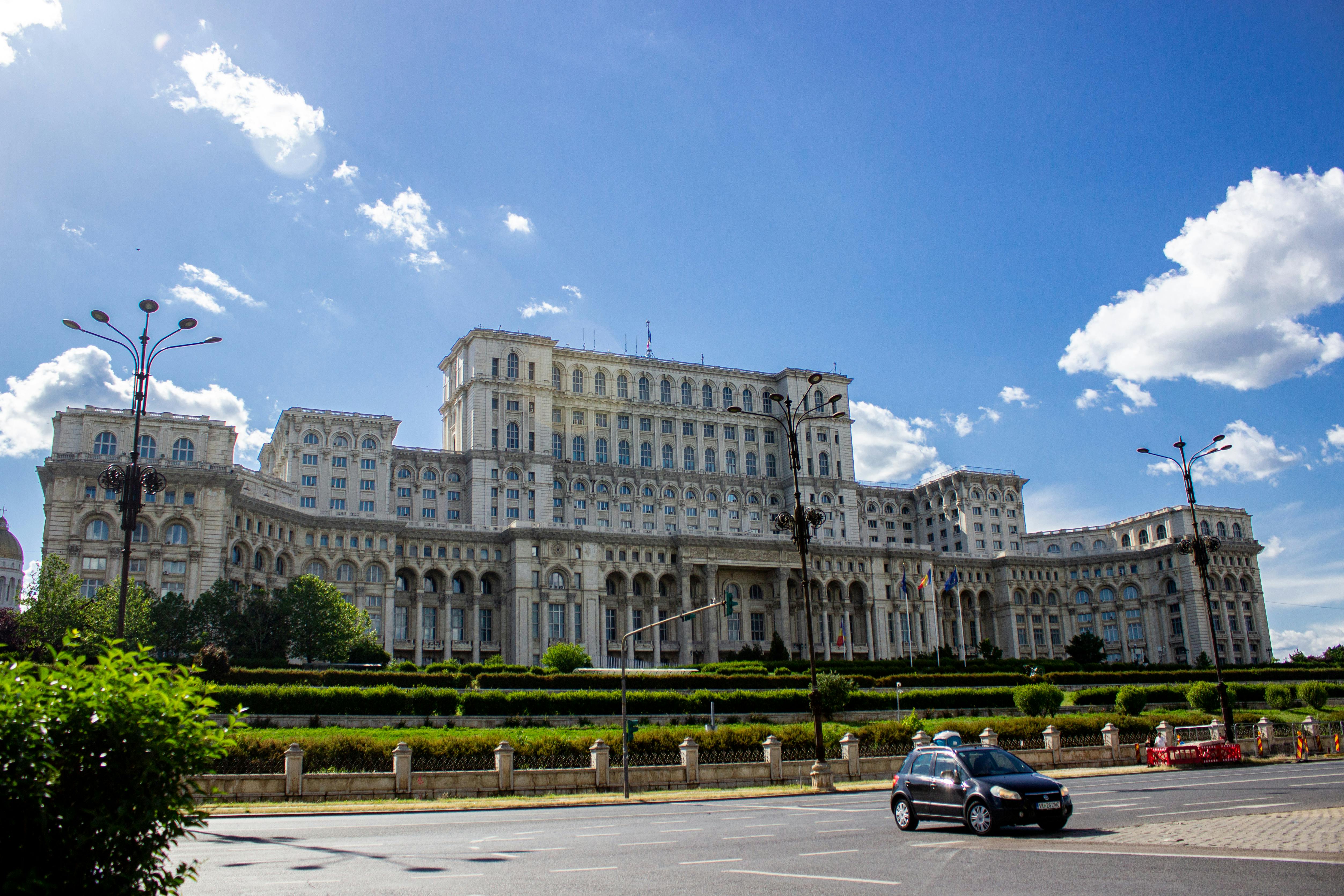
Palace of Parliament: Where Monumental Ambition Meets Romanian Historical Memory
Golden light spills across the cream-colored marble façade of the Palace of Parliament as morning mist lifts from Bucharest's Bulevardul Unirii, revealing a structure so vast it seems to defy human scale—270 meters long, 240 meters wide, and rising 84 meters above the city like a monument carved from the very soul of a nation in transition. You stand before the grand entrance of Palatul Parlamentului, a building conceived in 1984 by Nicolae Ceaușescu as the "House of the People" and completed in 1997 as Romania emerged from decades of communist rule—a palace where 1,100 rooms span 365,000 square meters of floor space, where 30 halls echo with the footsteps of history, and where eight underground levels shelter secrets of a regime that sought to immortalize itself in stone. The air carries the scent of polished Romanian marble, aged oak from Transylvanian forests, and the faint aroma of coffee from the parliamentary café, while the distant hum of Bucharest traffic mingles with the quiet murmur of visitors crossing the vast marble foyer. Standing here, with the building's neoclassical columns rising like sentinels and the Carpathian foothills visible beyond the city's sprawl, you understand why this palace has provoked awe, controversy, and reflection for four decades: it reminds us that some of humanity's most enduring structures are those that embody both the heights of ambition and the weight of consequence, where stone becomes a canvas for the complex story of a people finding their voice after silence.
Why Palace of Parliament Embodies Architectural Ambition
The Palace of Parliament represents one of the world's most extraordinary exercises in architectural scale and political symbolism—a building that solved the fundamental challenge of creating a seat of power worthy of Ceaușescu's vision while inadvertently becoming a testament to the complexities of post-communist transformation. Construction began on June 25, 1984, under the direction of architect Anca Petrescu and a team of 700 architects and 20,000 workers, who labored around the clock for 13 years to complete what would become the second-largest administrative building in the world after the Pentagon. The palace's staggering dimensions—270 meters in length, 240 meters in width, and 84 meters in height—required engineering solutions that pushed the boundaries of 1980s construction technology: reinforced concrete foundations extending 30 meters deep to support 4.2 million tons of structure, a steel framework weighing 18,000 tons, and a façade clad in Romanian marble, limestone, and oak sourced from every corner of the country.
The technical mastery behind this colossal undertaking lies in its integration of traditional craftsmanship with industrial-scale production. Over 1,000 artisans carved decorative elements from marble quarried in Rușchița, while crystal chandeliers weighing up to 2,500 kilograms were crafted in Buzău workshops. The interior features 30 reception halls, 1,100 rooms, and eight underground levels—including a nuclear bunker and extensive parking—connected by 23 kilometers of corridors and 1,600 windows. Every material was chosen to showcase Romanian resources: walnut from Maramureș, cherry wood from Bucovina, and carpets woven in Oltenia, creating a building that is simultaneously a monument to national pride and a cautionary tale about the costs of unchecked ambition.
Today, the Palace of Parliament fulfills multiple needs: housing the Romanian Parliament's Chamber of Deputies and Senate, serving as a venue for international conferences and cultural events, and offering visitors a tangible connection to Romania's journey from dictatorship to democracy. The building welcomes approximately 150,000 visitors annually, functioning as both a working government complex and a museum of architectural excess—a reminder that stone, once laid, carries the weight of the intentions that placed it there.
The Best Time to Experience Palace of Parliament
The optimal window for visiting the Palace of Parliament stretches from May 15 through September 30, when temperatures in Bucharest range from 20–30°C (68–86°F) during daytime hours, creating ideal conditions for exploring the building's grand halls and walking the surrounding boulevards. For the clearest light and most comfortable walking conditions, plan your visit between June 10 and September 15, when humidity levels drop and afternoon thunderstorms become less frequent. Early morning tours between 9:00–10:30 AM offer the dual advantage of softer light for photography and significantly fewer crowds, as most tour groups arrive after 11:00 AM.
Late spring (May through June) brings blooming trees along Bulevardul Unirii and pleasant temperatures for outdoor exploration, though mornings can dip to 14–18°C (57–64°F). Autumn (mid-September through October) offers comfortable temperatures of 16–24°C (61–75°F) and dramatically fewer visitors after the summer peak, with golden light enhancing the palace's marble façade.
Avoid visiting during Romanian national holidays—particularly June 1 (Great Union Day) and December 1 (Great Union of 1918)—when the palace hosts official ceremonies that limit public access. Also skip the last week of December if you prefer quiet exploration, as the building focuses on parliamentary sessions and holiday events. Winter visits (November through March) offer a different atmosphere with fewer crowds, but outdoor photography suffers from limited daylight and some exterior areas close for maintenance. The palace is closed on December 25–26 and January 1–2 for religious observances.
Approximate Budget for a 7-Day Trip
Exploring the Palace of Parliament and the broader Bucharest region requires modest financial planning, as Romania remains significantly more affordable than Western European destinations while offering exceptional cultural and historical value. The following budget assumes a comfortable mid-range travel style with quality accommodations, regional Romanian cuisine, and comprehensive exploration of the palace, nearby attractions, and surrounding experiences over seven days.
- Accommodation: €45–€82 per night for a double room in Bucharest city center (boutique guesthouses and three-star hotels); palace-view hotels €65–€110 per night; budget hostels from €25–€40 per person
- Food: €22–€35 per day (breakfast €5–€8 at accommodation with coffee, pastries, and eggs; lunch €8–€12 for traditional Romanian dishes like sarmale or mămăligă with brânză at local restaurants; dinner €9–€15 for grilled meats, ciorbă soup, or freshwater fish at regional restaurants)
- Transportation: Train from major European cities to Bucharest varies; local metro/bus day pass €3; taxi from airport to palace €25 one-way; parking at palace €4 per day if driving
- Attractions: Palace of Parliament standard tour €10 (45 RON); premium tour with Senate chamber €18 (80 RON); National Museum of Contemporary Art entry €5; Village Museum entry €4; Arcul de Triumf entry €3; nearby Bran Castle day trip €35 transport + €12 entry
- Miscellaneous: Authentic Romanian crafts and souvenirs €12–€32; local wine and țuică €6–€11 per evening; travel insurance €24 for the week; guidebook €10; bottled water and snacks €13
Total estimated cost for 7 days: €485–€720 per person (depending on accommodation choices and dining preferences)
5 Essential Palace of Parliament Experiences
- Join the Morning Standard Tour: Reserve the 9:00 AM guided tour (€10 / 45 RON), when angled morning light illuminates the palace's grandest chambers and neoclassical details. The 60-minute tour reveals the building's evolution from communist monument to democratic institution: the Union Hall with its 16-meter-high ceiling and crystal chandelier weighing 2,500 kilograms, the Nicolae Bălcescu Hall featuring hand-carved walnut paneling, and the vast marble foyer where 100 columns rise 14 meters to a coffered ceiling. Stand beneath the central dome to appreciate the acoustic engineering that allows speeches to carry across the 30-meter-wide hall. Photography without flash is permitted in designated areas; bring a wide-angle lens to capture the vertical drama of the interior spaces. Book at least 48 hours in advance via www.cic-palatulparlamentului.ro.
- Explore the Premium Tour with Senate Chamber: Dedicate 90 minutes to the premium guided tour (€18 / 80 RON), which includes access to the Senate chamber and additional reception halls not featured on the standard route. This tour reveals the palace's political dimensions: the chamber where Romanian senators debate legislation, the diplomatic reception rooms where international agreements are signed, and the private apartments once reserved for Ceaușescu. Visit between 10:30–12:00 PM when natural light filters through the palace's 1,600 windows to illuminate the intricate woodwork and marble inlays. Audio guides available in English, French, German, Spanish, and Romanian; allow extra time for questions about Romania's political transition.
- Walk the Grand Staircase at Golden Hour: After the afternoon tour, ascend the palace's monumental central staircase, where 200 marble steps rise beneath a vaulted ceiling adorned with gold leaf and crystal fixtures. Visit between 5:00–6:30 PM in summer when the setting sun streams through the western windows to bathe the staircase in amber light. The perspective—looking up at the soaring columns and ornate balustrades—captures the essence of neoclassical grandeur. Bring a telephoto lens to compress the vertical drama; a tripod is permitted on landings but not on stairs where it obstructs other visitors.
- Visit the National Museum of Contemporary Art: Located within the palace's west wing, this museum (entry €5) features rotating exhibitions of Romanian and international contemporary art that provide a striking contrast to the building's monumental architecture. Allow 45 minutes to explore the collection, which often includes works that engage critically with the palace's history and symbolism. Visit between 2:00–4:00 PM when natural light from the museum's skylights illuminates the artworks. The experience provides essential context for understanding how contemporary Romanian artists reinterpret the legacy of communist-era monuments.
- Photograph the Palace from Unirii Square: Position yourself at the center of Piața Unirii at 7:00–8:30 AM in summer, when morning mist often curls around the palace's towers and the rising sun creates dramatic side-lighting on the marble façade. The composition—palace columns framed by the symmetrical boulevard with fountains in the foreground—captures the essence of Bucharest's neoclassical ambition. Bring a polarizing filter to enhance sky contrast and a tripod for long exposures; the square's open space provides stable footing for camera setup. Visit on weekdays for minimal foot traffic.
3 Hidden Gems Most Travelers Miss
- Underground Bunker Tour: This specialized experience, accessible only via special arrangement through the palace administration, offers a rare glimpse into the eight underground levels that include a nuclear bunker, extensive parking, and service tunnels. Access requires advance booking (+40 21 317 11 11) and security clearance; tours run monthly on the first Saturday at 10:00 AM (€25 / 110 RON supplement). The bunker is overlooked because it serves security functions primarily, but the reward is tangible insight into the Cold War mentality that shaped the palace's design. Photography prohibited for security reasons; allow 60 minutes for the complete tour. Wear comfortable shoes as the underground corridors involve extensive walking on concrete surfaces.
- Rooftop Terrace Viewpoint: This restricted observation area, located on the palace's ninth floor and accessible only via guided request, offers panoramic views of Bucharest's skyline and the Carpathian foothills rarely seen by international tourists. Access via the premium tour with advance notice; the terrace is open daily 11:00 AM–3:00 PM weather permitting. The site is overlooked because it requires special arrangement, but the reward is a unique perspective on the palace's relationship to the city it dominates. Visit between 2:00–4:00 PM when atmospheric clarity is typically highest. Bring binoculars to spot distant landmarks; dress warmly as the rooftop is exposed to wind even in summer.
- Artisan Workshop Demonstration: By special arrangement, visitors can observe the palace's in-house restoration workshop, where craftsmen maintain the building's marble, woodwork, and crystal fixtures using traditional techniques. This experience, limited to six guests per session and requiring advance booking (office@cic-palatulparlamentului.ro), reveals the ongoing craftsmanship that preserves the palace's artistic heritage. Sessions run Thursday mornings at 10:00 AM (May–September); cost €8 per person includes a demonstration and small commemorative booklet. The workshop is overlooked because it serves operational rather than tourist functions, but the experience offers tangible insight into the skilled labor that sustains monumental architecture.
Cultural & Practical Tips
- Respect the Working Government Building: The Palace of Parliament remains an active seat of Romanian democracy. Maintain quiet voices in exhibition spaces, follow all posted photography guidelines, and trust staff guidance about restricted areas. Security screening is mandatory; allow 20 minutes for bag checks and metal detector passage.
- Learn Basic Romanian Phrases: While palace staff speak English and French, knowing a few Romanian phrases enhances your experience: "Bună ziua" (BOO-nah ZEE-wah) means "Good day"; "Mulțumesc" (mool-tsoo-MESK) means "Thank you"; "Vă rog" (vah ROHG) means "Please"; "Unde este toaleta?" (OON-deh yes-teh twah-LEH-tah) means "Where is the restroom?"
- Prepare for Extensive Walking: The palace's 23 kilometers of corridors require comfortable footwear. Tours cover approximately 3 kilometers of walking on marble and stone surfaces; allow 60–90 minutes for the standard tour. The building's climate control maintains comfortable temperatures year-round, but bring a light layer as interior spaces can feel cool.
- Carry Cash (Romanian Lei): While the palace ticket office accepts cards, smaller vendors, rural facilities, and parking attendants often operate on cash only. The currency is Romanian leu (RON), with an approximate exchange rate of 4.9 RON to €1. ATMs are available throughout Bucharest city center but not inside the palace itself.
- Photography Guidelines: Tripods are permitted in designated areas but not during guided tours where they obstruct other visitors. Flash photography is prohibited throughout interior spaces to protect historical textiles, woodwork, and artwork. Drone use requires written permission from palace administration—contact office@cic-palatulparlamentului.ro at least two weeks in advance.
- Weather Preparedness: Bucharest weather changes rapidly—pack layers even in summer, including a lightweight waterproof jacket. Afternoon thunderstorms are common from June through August; if you hear thunder while exploring outdoor areas, seek shelter in the palace arcade or nearby covered walkways. Check the forecast at the Bucharest tourist information center before starting your visit.
- Accessibility Considerations: The palace's ground floor and main exhibition spaces are wheelchair-accessible via ramps and elevators. However, upper floors and some historic chambers involve stairs without elevator access. Contact the visitor center (+40 21 317 11 11) at least 48 hours in advance to arrange alternative routes or virtual tour access for mobility-impaired visitors.
Conclusion: Travel with Understanding, Not Just Awe
The Palace of Parliament endures not because it showcases architectural grandeur, but because it invites us to grapple with complexity—a building where ambition and consequence, power and memory, stone and story converge to tell a tale that transcends simple judgment. When you stand in those marble halls, tracing the journey from communist monument to democratic institution, you participate in a continuum of reflection that stretches from the workers who laid each stone to your own moment of contemplation. But with that privilege comes responsibility: to approach the site with intellectual curiosity rather than sensationalist expectation, to respect the delicate balance between preservation and progress, to let the palace's authentic heritage remind you that true understanding emerges when we examine both the heights of human achievement and the weight of historical consequence. The columns will continue to rise long after we've departed—let our presence here be measured not in photographs taken, but in the understanding we carry forward, the respect we show to layered narratives, and the willingness to slow down long enough to hear what both ambition and memory have to teach.