
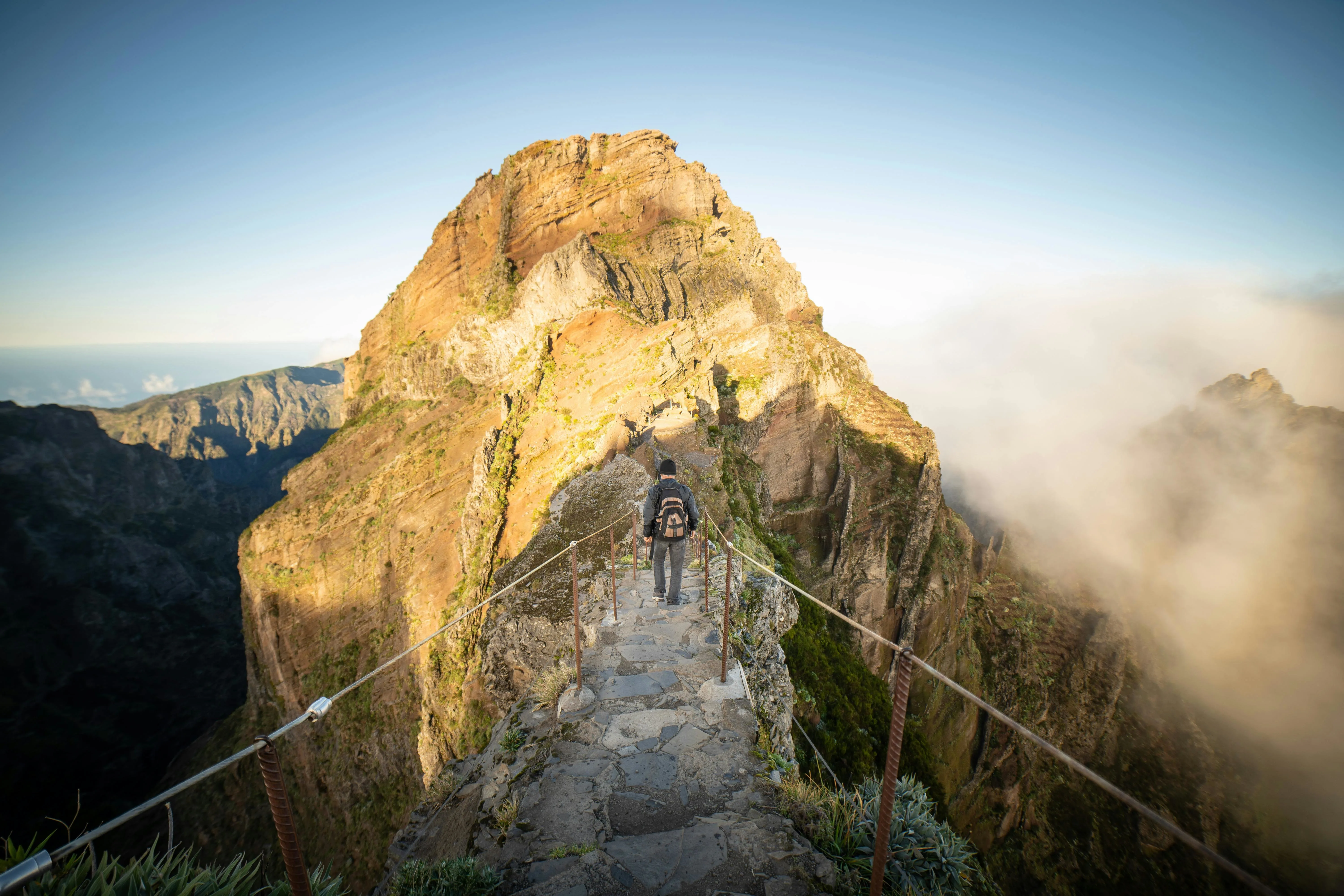
Pico do Arieiro Sunrise: Where Atlantic Dawn Meets Volcanic Peaks
The air bites at 7°C (45°F) as you stand at 1,818 meters (5,965 feet) above the Atlantic, your breath visible in the pre-dawn darkness. Around you, headlamps bob like fireflies against the volcanic rock—fellow pilgrims gathered at Madeira's third-highest peak, waiting for the moment when night surrenders to day. The wind carries the scent of heather and eucalyptus from the valleys far below, where the island still sleeps. At 6:47 AM, the first amber rays breach the eastern horizon, painting the cloud sea in shades of rose and tangerine. The light cascades across jagged peaks, illuminating the dramatic ridge that connects to Pico Ruivo—Madeira's roof at 1,862 meters. This isn't merely a sunrise; it's a daily resurrection of one of Europe's most spectacular mountain theaters, a moment that has drawn seekers to these volcanic heights since Portuguese navigators first claimed this Atlantic jewel in 1419. Pico do Arieiro matters because it offers something increasingly rare: pure, unmediated communion with nature's grandeur.
Why Pico do Arieiro Sunrise Embodies Madeiran Majesty
Rising from the Atlantic like a dragon's spine, Pico do Arieiro represents the geological soul of Madeira—a volcanic island born from submarine eruptions approximately 5 million years ago. The peak itself stands at 1,818 meters (5,965 feet), making it the island's third-highest point, yet it remains the most accessible summit where visitors can drive directly to the top via the ER103 mountain road. This accessibility solved a fundamental problem: how to share Madeira's dramatic high-altitude landscapes with those unable to undertake multi-hour treks, while still preserving the raw power of the mountain experience.
The infrastructure tells a story of thoughtful engineering. In 1998, the regional government completed a paved parking area and viewing platform capable of accommodating 40 vehicles, with safety barriers positioned along the most exposed edges. The military installed a radar station here in the 1990s, recognizing the peak's strategic vantage point over 360 degrees of Atlantic airspace. Today, the Instituto das Florestas e Conservação da Natureza (IFCN) manages the site as part of the Madeira Natural Park, which gained UNESCO Biosphere Reserve status in 2020.
What makes this sunrise extraordinary is the phenomenon of the mar de nuvens—sea of clouds—that forms when trade winds push moist Atlantic air against Madeira's central mountain range. The clouds pool in valleys at 1,200-1,500 meters, creating a surreal white ocean beneath your feet while you stand in crystalline air above. On clear days, visibility extends 80-100 kilometers, revealing the Desertas Islands to the southeast and, impossibly, the silhouette of Porto Santo Island 43 kilometers away. Approximately 150,000 visitors annually make the dawn pilgrimage, with numbers peaking during summer months when clear skies prevail 78% of mornings.
The Best Time to Experience Pico do Arieiro Sunrise
The sweet spot for witnessing this spectacle falls between May 20 and July 15, then again from September 5 to October 20. During these windows, you'll experience temperatures between 12-16°C (54-61°F) at sunrise, with cloud-clear skies occurring on roughly 7 out of 10 mornings. The sun rises between 6:15-7:30 AM depending on the season—arrive 45 minutes before official sunrise to secure parking and position yourself for the pre-dawn color show.
Winter months (November-February) present challenges: temperatures plunge to 3-7°C (37-45°F), fog obscures views on 60% of mornings, and the ER103 road occasionally closes due to ice or high winds. Summer afternoons bring crowds—avoid arriving after 8:30 AM between June-August when tour buses descend and parking becomes impossible. The absolute worst period: late December through early January, when winter storms create dangerous driving conditions and visibility drops below 50 meters.
For real-time weather conditions, road status, and webcams showing current visibility, consult though driving the winding ER103 in complete darkness requires confidence and a vehicle with good headlights.
Approximate Budget for a 7-Day Trip
Madeira offers exceptional value for a European island destination, with costs significantly lower than mainland Portugal's major cities. This breakdown assumes a mid-range travel style with comfortable accommodations, local dining, and a rental car—essential for reaching Pico do Arieiro and exploring the island's dispersed attractions.
- Accommodation: €55-€95 per night for a double room in a traditional quinta (country estate) or three-star hotel in Funchal's Old Town or Lido area
- Food: €30-40 per day total
- Breakfast: €4-7 (coffee, fresh bread, and local cheese at a pastelaria)
- Lunch: €10-13 (espada sandwich or bolo do caco with garlic butter)
- Dinner: €16-20 (graped espetada beef skewers or fresh tuna with wine)
- Transportation:
- Rental car (7 days, manual transmission): €180-240 total
- Fuel (approximately 300km): €45-55
- Funchal airport parking: €8 per day
- Cable car (Funchal to Monte): €17 round-trip
- Attractions:
- Pico do Arieiro: Free (parking included) >Pico Ruivo guided hike: €45-65
- Levada walks (self-guided): Free
- Monte Palace Tropical Garden: €12.50
- Wine lodge tour and tasting: €10-15
- Thermal layers for sunrise (if not packed): €35-50
- Local honey and bolo de mel: €15
- Poncha tastings: €12-18
Total estimated cost for 7 days: €780-1,050 per person (excluding international flights)
7 Essential Pico do Arieiro Sunrise Experiences
- The Classic Dawn Vigil: Depart Funchal by 5:30 AM, navigating the serpentine ER103 through complete darkness. The 40-minute drive climbs 1,400 meters through 47 hairpin turns—drive slowly and use pullouts to let faster local vehicles pass. Arrive by 6:15 AM to claim a parking spot and hike the 15-minute trail to the main viewing platform. Watch as the sky transitions from indigo to violet to burning orange, then witness the moment when sunlight first touches the eastern peaks while you remain in shadow—a phenomenon called alpenglow that lasts approximately 8 minutes.
- The Pico Ruivo Summit Hike: After sunrise, embark on the legendary 5.6-kilometer trail connecting Pico do Arieiro to Pico Ruivo (Madeira's highest point). This challenging route takes 3-4 hours one-way, traversing three dramatic peaks via tunnels carved through volcanic rock and exposed ridgelines with 500-meter drop-offs. Start by 7:30 AM to complete the hike before afternoon clouds roll in. Bring 2 liters of water, warm layers, and a headlamp for the unlit tunnels.
- Stargazing Before Dawn: On moonless nights, arrive at 4:00 AM to experience one of Europe's darkest skies. The absence of light pollution reveals the Milky Way arching overhead, with visibility so clear you can spot the Andromeda Galaxy with naked eyes. The radar station's red warning lights create an eerie contrast against the star field. Bring a red-light headlamp to preserve night vision.
- Sunset Photography Session: While sunrise draws crowds, sunset at Pico do Arieiro offers equally dramatic light with one-tenth the visitors. Arrive at 6:00 PM in summer (4:30 PM in winter) to capture the golden hour as shadows stretch across the central massif. The western exposure creates spectacular side-lighting on the rock formations.
- Traditional Breakfast at Achada do Teixeira: After sunrise, drive 25 minutes to the Pico Ruivo trailhead at Achada do Teixeira, where a small café serves poncha (traditional rum drink) and bolo de caco to hikers. The outdoor terrace offers panoramic views while you refuel. Open 8:00 AM-5:00 PM daily.
- Full Moon Sunrise: Check lunar calendars and plan your visit when a full or near-full moon sets as the sun rises—you'll witness both celestial bodies sharing the sky for 10-15 magical minutes. This occurs approximately 3-4 days before and after each full moon.
- Wildlife Observation: Bring binoculars to spot Madeira's endemic birds: the Zino's petrel (one of the world's rarest seabirds) nests in cliffs near the summit, while Berthelot's pipits flit among the rocks. The rare Madeira firecrest—Europe's smallest bird—sometimes appears near the parking area. Dawn is the optimal viewing time.
3 Hidden Gems Most Travelers Miss
- Pico das Torres: This lesser-known peak (1,851 meters) sits between Pico do Arieiro and Pico Ruivo but receives perhaps 5% of the visitors. Access requires a detour on the PR1 trail—add 45 minutes to your hike but gain solitude and 360-degree views without crowds. The rocky summit features a small stone shelter built in 1952 by mountain shepherds. No facilities exist, so bring all supplies.
- Ermida de Nossa Senhora da Conceição: Tucked 2 kilometers below Pico do Arieiro along the ER103, this tiny 17th-century chapel sits at 1,600 meters elevation. The whitewashed building with blue trim offers a perfect foreground for sunrise photography with the peak looming behind. Access requires a 10-minute walk from the roadside pullout (coordinates: 32.7389°N, 16.9234°W). Visit 7:00-8:00 AM for the best light; the chapel door opens only during Sunday mass at 11:00 AM.
- Fanal Forest Dawn: While everyone rushes to Pico do Arieiro, the ancient laurel forest at Fanal (1,400 meters) offers mystical sunrise experiences 20 minutes away by car. The 500-year-old trees emerge from morning fog like something from a fairy tale. Arrive at 7:00 AM when the first light filters through the canopy. Park at the designated area (free) and follow the PR14 levada walk for 20 minutes into the forest's heart. This UNESCO World Heritage site remains crowd-free even in peak season.
Cultural & Practical Tips
- Respect the mountain: Madeirans view these peaks with deep reverence—never litter, stay on marked trails, and speak quietly at sunrise. The mountain is considered sacred ground, not merely a tourist attraction.
- Layer clothing strategically: Temperatures swing dramatically: 7°C (45°F) at dawn, warming to 18°C (64°F) by 10:00 AM. Wear moisture-wicking base layers, insulating fleece, and windproof outer shell. Gloves and a warm hat are essential year-round.
- Drive defensively: The ER103 features blind curves, no guardrails in sections, and frequent fog. Use pullouts to let faster vehicles pass, never stop in the road for photos, and honk before blind corners. Locals drive this road daily at high speed—yield to them.
- Photography etiquette: Ask permission before including other visitors in your sunrise photos. Many come for spiritual reflection, not to be photographed. Tripods are allowed but don't block the viewing platform during peak moments.
- Essential Portuguese phrases: "Bom dia" (bohm DEE-ah = good morning), "Obrigado/a" (oh-bree-GAH-doo/dah = thank you), "Com licença" (kohm lee-SEN-sah = excuse me), "Está lindo!" (esh-TAH LEEN-doo = it's beautiful!).
- Weather reality check: Mountain weather changes in minutes. Check the Instituto Português do Mar e da Atmosfera (IPMA) forecast at ipma.pt before departing. If winds exceed 60 km/h or visibility drops below 100 meters, postpone your visit—the experience isn't worth the danger.
- Altitude awareness: While 1,818 meters rarely causes altitude sickness, some visitors experience mild headaches or shortness of breath. Ascend slowly, stay hydrated, and descend if symptoms worsen. The oxygen level is approximately 80% of sea level.
Conclusion: Travel with Reverence, Not Just Photos
The Pico do Arieiro sunrise demands more than your presence—it asks for your reverence. As you stand on this volcanic summit, watching light resurrect the Atlantic islands from darkness, remember that you're witnessing a moment that has unfolded identically for millions of years, long before humans arrived and long after we're gone. The mountain doesn't need your Instagram post; it deserves your respect.
Responsible travel here means leaving no trace, speaking softly, and recognizing that this sacred space belongs first to Madeira's people and their ancestors who revered these peaks as the domain of gods. It means supporting local guides, buying from neighborhood pastelarias, and understanding that your visit impacts a fragile ecosystem where endemic species cling to existence. The carreiros of tradition may not guide sleds here, but the mountain has its own guardians—the park rangers, the meteorologists, the shepherds who still graze sheep on high plateaus.
Slow down. Breathe the thin air deeply. Watch the entire sunrise without checking your phone once. Let the experience sink into your bones rather than rushing to the next viewpoint. When you descend, carry not just photographs but a commitment to preserve these wild places for the next pilgrim who arrives in darkness, seeking light. That's the difference between seeing a sunrise and truly witnessing it.