
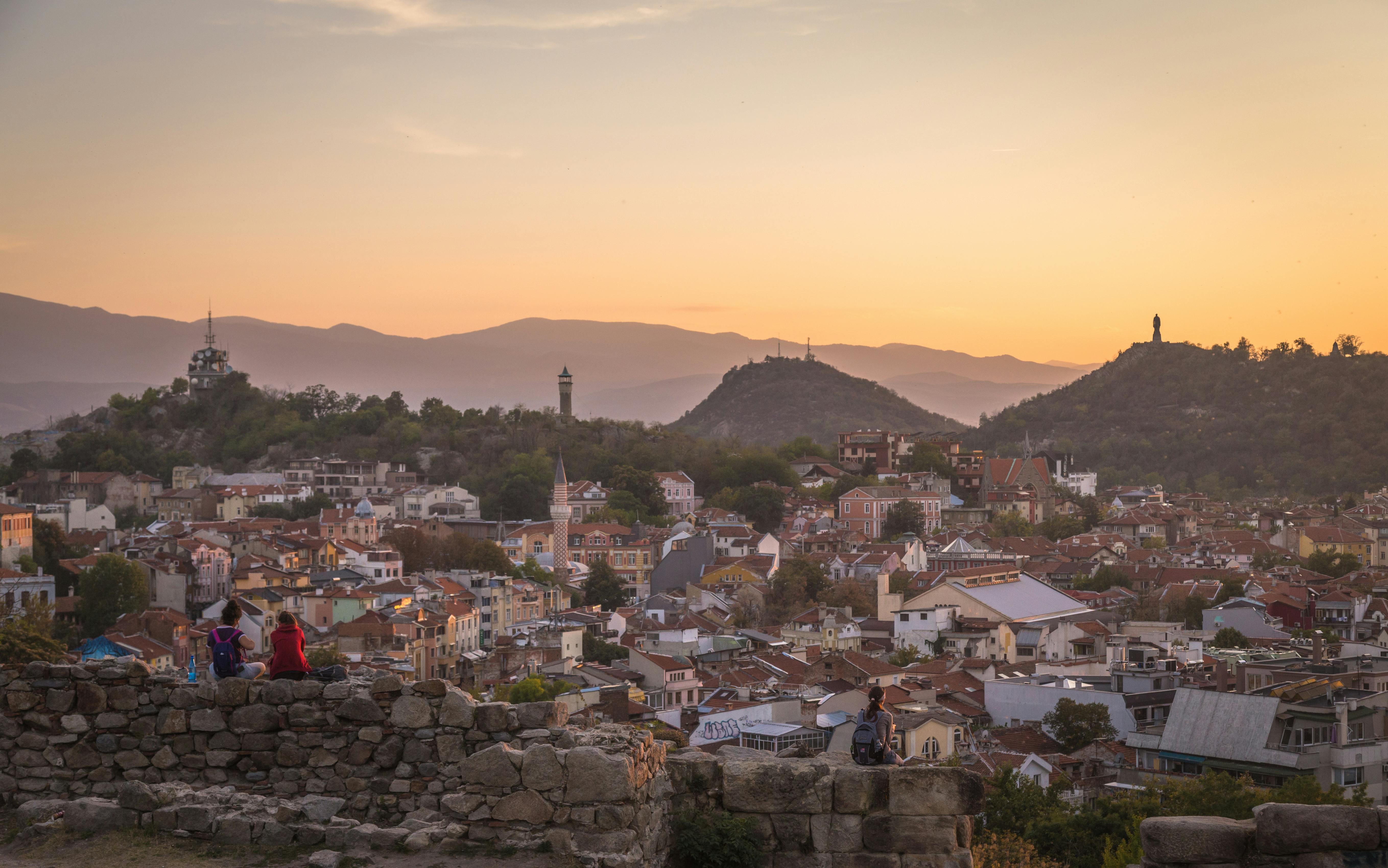
Plovdiv Old Town: Where Thracian Stones Meet Revival Colors
The cobblestones gleam underfoot, polished by two thousand years of sandals, boots, and the occasional stiletto. You round a corner on Saborna Street, and suddenly you are face-to-face with a teal-and-terracotta mansion—its upper floor projecting boldly over the street, supported by wooden struts carved like lace. This is Plovdiv's Old Town, a 35-hectare architectural preserve spread across three hills—Nebet Tepe, Taksim Tepe, and Dzhambaz Tepe—where six millennia of continuous habitation have left their mark in stone and paint . Above you, the 2nd-century Roman Theatre of Philippopolis climbs the hill, its 28 concentric marble rows still hosting performances on summer nights . Below, the Hisar Kapia gate—a medieval fortress entrance built atop Roman foundations—creaks open to a labyrinth of Revival-era mansions . The air smells of roasted peppers from a hidden tavern and the faint, dusty sweetness of antique icons drying in a gallery window. This is not a museum; it is a living city, where Thracian tribes, Roman emperors, Ottoman beys, and Bulgarian revivalists all left their fingerprints on the same stone.
Why Plovdiv Old Town Embodies Layered Civilizations
The hills of Plovdiv have never known silence. Thracians first fortified Nebet Tepe in the 6th century BC, and their water reservoir—a 300,000-liter cistern carved into the southwestern slope—still holds rainwater today . The Romans arrived in 46 AD, renaming the city Trimontium ("Three Hills") and building a forum, an odeon, and a stadium 180 meters long, whose curved northern end still emerges from beneath the main pedestrian street . The Ancient Theatre, constructed in the 2nd century under Emperor Trajan, seated 7,000 spectators and lay buried for 1,500 years before excavation began in 1972 . After the Ottoman conquest in the 14th century, Plovdiv became a commercial hub for the European provinces of the Empire, and wealthy Bulgarian merchants built symmetrical mansions blending Balkan tradition with Viennese Baroque. The Balabanov House (early 19th century) and the Hindliyan House (1835–1840) represent the "Plovdiv symmetrical urban house"—a uniquely Bulgarian interpretation of European neoclassicism, with ornately carved ceilings, hand-painted floral murals, and projecting upper floors called "erkeri" that shade the narrow streets below . UNESCO recognized the Old Town's significance through its inclusion in the "Ancient City of Plovdiv" reserve, and the European Union named Plovdiv a European Capital of Culture in 2019. The hills solved a problem that plagues most historic cities—how to preserve a living heritage without turning it into a theme park—by simply continuing to inhabit it.
The Best Time to Experience Plovdiv Old Town
Plan your exploration between May 18 and June 25 or September 5 and October 15. During these windows, daytime temperatures average 22°C to 27°C (72°F to 81°F)—perfect for walking the cobblestone hills without overheating . The best time of day is 7:30–10:00 AM, when the summer sun illuminates the facades of Hindliyan House and the streets are empty of day-trippers from Sofia . For photographers, the "golden hour" begins at 5:30 PM in autumn and 6:30 PM in summer, when the light turns the Revival-era facades to molten gold. Avoid July 15 to August 15—the "Tourist High Season"—when hotel rates peak at 189 BGN per night (double the September average of 106 BGN) and the Ancient Theatre's steps are packed from 10:00 AM onward . Also avoid late November through February, when temperatures drop to 0°C to 5°C (32°F–41°F) and the outdoor cafes on the main pedestrian street close their terraces. For up-to-date museum hours and event schedules, consult: www.visitplovdiv.com .
Approximate Budget for a 7-Day Trip (Plovdiv + Day Trips)
This budget assumes five nights in a Plovdiv Old Town boutique hotel and two nights exploring the surrounding region. Prices in Bulgarian Lev (BGN) and Euros for convenience (1 BGN ≈ €0.51).
- Accommodation: 80–200 BGN per night – Boutique hotels near the Old Town: Villa Flavia Heritage Boutique Hotel (from 206 BGN / US$103) ; Gallery 37 Powered by ASTON (from 178 BGN / US$89) ; HillHouse Plovdiv (from 174 BGN / US$87) . Budget option: Old Town Apartment on Mitropolit Panaret Street (from approximately 100 BGN) .
- Food: 45–80 BGN per day – Breakfast: 6-10 BGN for banitsa (cheese pastry) and coffee at Danov House ; Lunch: 15-20 BGN for a Shopska salad and soup at Supar Bar ; Dinner: 25-35 BGN for a traditional meal at Rahat Tepe (with panoramic views) or a three-course dinner in the Kapana district for approximately 40 BGN per person . Local beer (Kamenitza or Zagorka): 4 BGN for 0.5L .
- Transportation: 30–60 BGN total – Plovdiv is walkable, but taxis from the train station to the Old Town cost 5-8 BGN. Bus to the Bachkovo Monastery (day trip): 5 BGN each way. Parking in the Old Town (if driving): 6 BGN per day .
- Attractions: 30–50 BGN total – Combined ticket for 5 Old Town sights (Balabanov House, Hindliyan House, Nedkovich House, Ethnographic Museum, and Icon Gallery): 15 BGN . Individual entry: 5-8 BGN per house. Ancient Theatre entry: 5 BGN .
- Miscellaneous: 60 BGN – Handcrafted kopanica (traditional Bulgarian rug) from the Ethnographic Museum shop: 30 BGN; rose oil product from the Kapana district: 20 BGN; bottle of local Mavrud wine: 15 BGN .
Total estimated budget for 7 days (excluding flights): 800–1,600 BGN (approx. €410–820 / $440–880).
7 Essential Plovdiv Old Town Experiences
- Climb Nebet Tepe at Sunset: The northernmost hill holds Plovdiv's oldest human traces—a Thracian citadel from the 3rd century BC and fragments of Byzantine fortress walls . Start the climb from the Hisar Kapia gate at 6:30 PM in summer. The 15-minute ascent rewards you with a 360-degree view of Plovdiv's seven hills, the 300,000-liter Thracian water reservoir, and the Rhodope Mountains fading purple on the horizon. Bring water; there are no vendors at the top.
- Tour the Hindliyan House's Hand-Painted Walls: Built between 1835 and 1840 by an unknown master, this is the most richly decorated house in the Old Town . Chirpan masters Moka and Mavridi spent six months painting floral garlands, still lifes, and landscape compositions on every wall—inside and outside. The "Cloud Room" on the upper floor features a painted sky ceiling with angels peeking through faux clouds. Entry included in the 15 BGN combined ticket .
- Photograph the Nedkovich House's Lace-Like Exterior: Built in 1863, this mansion has the most exuberant exterior decoration in the Old Town . Its carved wooden struts and floral medallions are so intricate that locals call it "the house with the lace." Inside, the ground floor preserves original ceiling carvings untouched by restoration—a rarity among Plovdiv's museums . Open Monday–Friday 9:00 AM–5:30 PM; individual entry 5 BGN .
- Sit in the Ancient Theatre's Marble Rows: Built in the 2nd century AD, this 28-row theatre seats 7,000 spectators and remains one of the world's best-preserved Roman performance spaces . Arrive at 8:00 AM when it opens, before the tour groups. Walk to the top row and look down. The stage's blue marble came from a quarry 150 kilometers away—an engineering feat in its own right. Still used for concerts and plays, the theatre's acoustics let you hear a whisper from the stage even in the highest seats.
- Walk Through Hisar Kapia at Midday: This medieval eastern gate—built directly atop a 2nd-century Roman foundation—is one of Plovdiv's most photographed symbols . Pass through the stone arch at 12:00 PM, when the sun illuminates the ancient cobblestones and the shadow of the old fortress wall falls across the Orthodox church next door. A round tower from Emperor Justinian's reign (5th–6th century AD) sits just south of the gate, partially excavated to reveal its original stonework.
- Worship in the Church of St. St. Constantine and Elena: The oldest Orthodox church in Plovdiv stands on the site of a 4th-century Christian basilica . Rebuilt in 1832 with Ottoman permission, its three-nave basilica measures 26 by 18 meters (85 by 59 feet). The gilt iconostasis, completed in 1836, features magnificent baroque carvings and two rows of icons by Bulgarian Renaissance masters. Below the altar, a rectangular Roman tower once served as an ossuary—you can see its stones through a glass floor panel.
- Hunt for Antiques on Stramna Street (Folk Art Street): Known locally as "the street of folk arts and crafts," this narrow lane descends from the Old Town into the Kapana district . Atelier owners sell hand-woven rugs, antique icons (legitimate ones—look for the export stamp), and copper cooking vessels hammered the same way for 400 years. The best shop is the corner at 11 Tsanko Lavrenov Street, open 10:00 AM–6:00 PM. Negotiate politely; a 10% discount is reasonable.
3 Hidden Gems Most Travelers Miss
- The 1,500-Year-Old Fortress under the Church: Most tourists visit the Church of St. St. Constantine and Elena, but few notice the glass floor panel inside. Below the altar lie the foundations of a rectangular Roman tower built during the reign of Emperor Justinian the Great (527–565 AD), later converted into an ossuary . The tower's 1.8-meter-thick walls are visible through the glass, along with fragments of medieval frescoes. Ask the church warden for access; they will usually unlock a side door for a small donation (2 BGN).
- The 300,000-Liter Thracian Water Reservoir: Nebet Tepe's summit holds a Thracian water reservoir carved into the southwestern slope in the 3rd century BC . Its volume—300,000 liters (79,000 gallons)—was enough to sustain the entire citadel during sieges. The reservoir is unmarked; follow the dirt path from the northeastern corner of the Nebet Tepe archaeological complex. Look for a rectangular depression filled with rainwater after storms. That is the reservoir—still holding water 2,300 years after it was carved.
- The Katya Bakalova House's Secret Courtyard: While Bayatova House (a national cultural monument) draws the crowds, the adjacent Bakalova House (a local monument) hides a secret: an enclosed courtyard with a fully preserved 18th-century stone fountain . Both houses were restored in 2008 via a UNESCO/Japanese Trust Fund project. The courtyard is sometimes locked, but the caretaker at Bayatova House will open it upon request. Inside, the sound of dripping water echoes off 300-year-old stone walls—the quietest spot in the Old Town.
Cultural & Practical Tips
- Wear Sturdy Shoes—the Cobblestones Are Slippery: Plovdiv's Old Town is paved with river boulders called "pavachi." When wet (or even slightly damp), they are treacherous. Ankle-supporting shoes are essential. High heels are not merely impractical—they are dangerous. Locals wear sneakers or leather boots year-round.
- Essential Bulgarian for the Old Town: "Blagodarya" (blah-go-DAH-rya) means thank you—use it liberally. "Molia" (MO-lya) is please. When entering a shop or café, say "Dobar den" (DO-bar DEN)—good day. For the price, ask "Kolko struva?" (KOL-ko STROO-va).
- Photography Guidelines in Museums: Inside the house-museums (Balabanov House, Hindliyan House, Nedkovich House), photography without flash is usually permitted, but tripods are banned. The Ethnographic Museum has a stricter policy—ask at the entrance. In the Ancient Theatre, you can shoot freely, but drones are prohibited without a permit from the Ministry of Culture (a 30-day application process).
- Cash is Prevalent in Smaller Museums: While major attractions and restaurants accept cards, the ticket booth for the combined 5-sight pass (15 BGN) and individual house entries prefer cash . The best antique shops on Stramna Street do not accept cards at all. ATMs are available on the main pedestrian street (Saborna), but carry at least 50 BGN in small denominations.
- Lunch Hour Closures: Plan Ahead: Many smaller museums and house-museums close for lunch between 1:00 PM and 2:00 PM. The main Tourist Information Center (1 Dr. Stoyan Chomakov Street) remains open 9:00 AM–5:30 PM year-round and can confirm same-day hours .
- Residential Etiquette: Many buildings in the Old Town are still private residences—look for a brass plaque indicating a museum. Do not peer into windows of unmarked houses, and keep your voice low on residential streets after 9:00 PM. The residents of the Old Town have lived here for generations; they are not exhibits.
- Hydration & Shade: The three hills offer little shade during summer afternoons. The temperature on the cobblestones can reach 45°C (113°F) on a sunny July day. Carry at least 1 liter of water per person. The best spots for a shaded break: the courtyard of Balabanov House (free to enter), the benches under the plane trees at Hisar Kapia, and the cafe at the Ethnographic Museum.
Conclusion: Travel with Curiosity, Not Just a Checklist
Plovdiv's Old Town does not reveal itself to the hurried. Its layers—Thracian cisterns beneath Roman walls beneath Ottoman gates beneath Revival mansions—require patience and a willingness to look twice. When you sit on the marble steps of the Ancient Theatre at sunset, you are sitting where a Roman merchant watched a play in 200 AD. When you run your hand along the carved wooden struts of Hindliyan House, you are touching the work of masters who painted paradise on plaster because they believed their city would survive. Do not rush. Get lost in the cobblestone labyrinth behind the Hisar Kapia gate. Buy a banitsa from the bakery on Tsanko Lavrenov Street and eat it on the wall of Nebet Tepe, watching the lights of modern Plovdiv flicker on below. The hills have watched empires rise and fall; they will wait for you. The least you can offer is your full attention.