
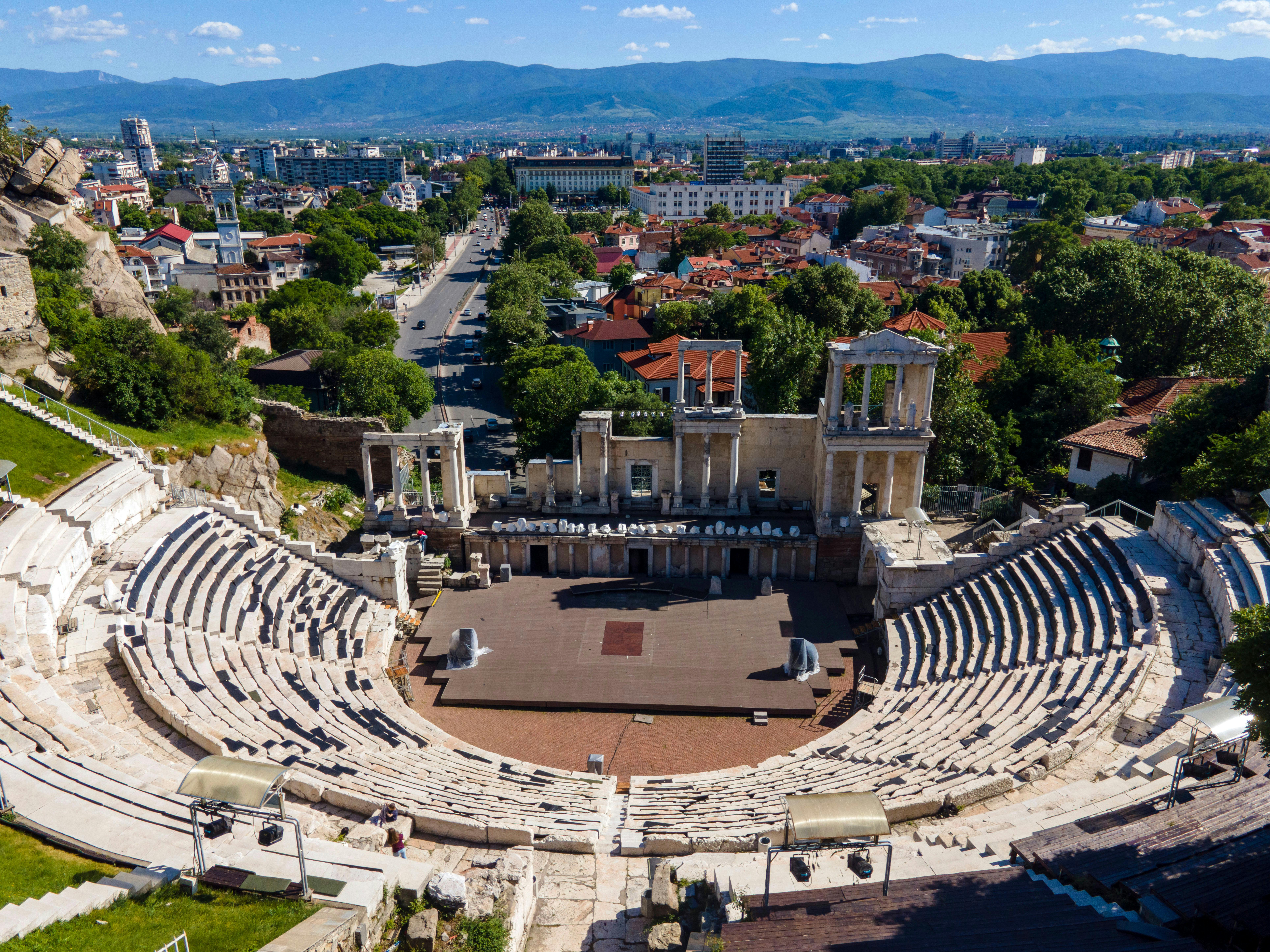
The Roman Amphitheater of Plovdiv: Where Trajan's Marble Meets Rhodope Sunsets
You climb the worn stone steps of "Kapana" district, and then—the hills part. Before you, 28 concentric rows of white marble ripple down a natural slope, framing a stage that has stood for 1,900 years. The ancient Theatre of Philippopolis—built during Emperor Trajan's reign between 98 and 117 AD—greets you not as a museum piece but as a living stage, still hosting operas and rock concerts beneath the Bulgarian sky . Its 7,000 seats face south toward the Rhodope Mountains, and when you sit on the warm marble, you can hear a whisper from the orchestra pit, 26.64 meters (87 feet) below . Behind you, the three hills of Plovdiv's Old Town cascade toward modern apartment blocks—a visual timeline of 6,000 years of habitation. The theatre was uncovered only in 1972, when a landslide peeled back 4.5 meters of earth to reveal one of the world's best-preserved Roman performance spaces . Today, you can sit where Roman magistrates once watched gladiators, then walk 150 meters to a cafe serving craft beer. This is not a ruin. This is a dialogue between empires.
Why the Roman Theatre Embodies Thracian Resilience
The theatre solved a problem that has plagued Plovdiv for millennia: how to gather thousands of people for spectacle and governance. Built during the reign of Emperor Trajan (98–117 AD), when the city was called Trimontium—"Three Hills"—the structure served dual purposes . By day, it hosted the provincial assembly of Thracia, where city council members and magistrates inscribed their names on marble seats reserved for dignitaries . By night, it transformed into an entertainment venue, staging plays, gladiatorial contests, and musical performances. The semi-circular auditorium, carved directly into the slope of Dzhambaz Tepe, required no external support for its lower rows—a triumph of Roman engineering that exploited the natural topography . The outer radius of seats, however, needed vaulted substructures and retaining walls, creating hidden corridors that still survive beneath the stage. The theatre was deliberately sacked in the 5th century during Attila the Hun's campaigns, then buried under 1,500 years of silt and debris . Its rediscovery in 1972—triggered by a landslide that exposed the upper tiers—launched the largest archaeological excavation in Bulgaria's modern history, involving the removal of approximately 4.5 meters (15 feet) of accumulated earth . Today, the theatre functions as a performance venue once again, bridging the gap between ancient acoustical engineering and contemporary culture .
The Best Time to Experience the Roman Theatre
Plan your visit during May 18 through June 25 or September 5 through October 15, when daytime temperatures range from 15°C to 25°C (59°F to 77°F)—perfect for exploring the open-air structure . The best time of day is 8:30–10:00 AM, immediately after opening at 9:30 AM (April–October), when the morning light illuminates the marble seats and you can photograph without tour groups . For the most dramatic photography, return at 5:30–6:30 PM, when the setting sun turns the Rhodope Mountains purple and the marble glows gold. Avoid July 15 through August 15, when temperatures hit 30–35°C (86–95°F) and the stone seats become uncomfortably hot . Also avoid weekends in June and September, when the theatre hosts evening performances and daytime crowds swell. The theatre closes earlier in winter: from November through March, hours are 9:00 AM–5:30 PM . For current performance schedules and ticket prices, consult: https://www.oldplovdiv.bg/.
Approximate Budget for a 7-Day Trip (Plovdiv Focus)
This budget assumes seven nights anchored in Plovdiv, with day trips to nearby attractions. Plovdiv offers exceptional value for a European city of its cultural weight. Prices in Bulgarian Lev (BGN) and Euros (1 BGN ≈ €0.51).
- Accommodation: 80–200 BGN per night – Hotel Odeon sits just 150 meters from the theatre and offers baroque-style rooms from approximately 149 BGN (€76) per night . Bell Hostel, a 5-minute walk away, offers dorm beds from 34 BGN (€17) per night . Ramada by Wyndham Plovdiv Trimontium (4-star) averages 114 BGN (€58) per night .
- Food: 45–80 BGN per day – Breakfast: 6-10 BGN for banitsa and coffee at a local bakery; Lunch: 15-20 BGN for Shopska salad and soup; Dinner: 25-40 BGN for traditional Bulgarian meal at a restaurant in the Kapana district (try the kavarma or grilled meats). Local beer (Kamenitza): 3-4 BGN for 0.5L.
- Transportation: 30–60 BGN total – Plovdiv's centre is highly walkable. Taxi from the train station to the Old Town costs 5-8 BGN. For day trips (Bachkovo Monastery or Hisarya mineral springs), buses cost 5-10 BGN each way .
- Attractions: 12–30 BGN total – Roman Theatre entry: approximately 6 BGN (€3) for standard ticket . Combined ticket for the theatre plus the Roman Odeon and other nearby sites: approximately 12 BGN (€6). Roman Odeon (1st century AD): separate entry approximately 3 BGN .
- Miscellaneous: 60 BGN – Handcrafted kopanica (traditional Bulgarian rug) from the Kapana artisan district: 30 BGN; bottle of local Mavrud wine: 15 BGN; rose oil product: 20 BGN.
Total estimated budget for 7 days (excluding flights): 750–1,500 BGN (approx. €380–770 / $410–830).
7 Essential Roman Theatre Experiences
- Sit on the 28 Marble Rows at Opening Time: Arrive at 9:30 AM when the gates open. Choose a seat in the upper diazoma (the horizontal walkway dividing the seating tiers) for the best panoramic view. Run your hand across the marble—it is the same stone Roman officials touched two millennia ago. The theatre's diameter measures 82 meters (269 feet) across its outer curve, making it one of the largest Roman theatres in the Balkans .
- Test the Theatre's Legendary Acoustics: Have a friend stand on the orchestra floor (the semi-circular stage area measuring 26.64 meters in diameter) and whisper toward the seats. The horseshoe design and the marble's reflective properties carry sound with startling clarity—you can hear every word from the top row without any amplification. Roman engineers understood acoustics well before modern physics described them .
- Photograph the "Keyhole" View of Plovdiv: From the top tier of seats, frame your shot through the stone archway at the theatre's northeastern corner. This angle captures the stage, the Rhodope Mountains in the distance, and the dome of the Old Town's Orthodox church in one composition. Sunset (5:30–6:30 PM, depending on season) yields the most dramatic light. No tripods allowed during performances, but daytime photography is unrestricted .
- Attend a Summer Evening Performance: Between June and September, the theatre hosts the Plovdiv Opera, rock concerts, and the International Folklore Festival. Tickets range from 20–60 BGN (€10–30) depending on the event. Unlike most ancient sites, this one does not close at sunset—it comes alive. Check the Visit Plovdiv website for the 2026 summer program .
- Tour the Hypogeum (Reserved Guided Tours Only): Most visitors never see what lies beneath the stage. The hypogeum—a network of tunnels and chambers—once held actors, props, and possibly animals awaiting their cue. Guided tours that include hypogeum access are offered occasionally; ask at the ticket booth. The underground spaces are unpolished: rough stone, low light, and the musty smell of 1,900-year-old engineering .
- Find the Inscribed Magistrate Seats: On several marble seats in the lower tiers (closest to the orchestra), you will find carved Greek inscriptions naming city council members and magistrates. Look for the section marked "ΒΟΥΛΗ"—the Boule, or city council. These inscriptions proved the theatre also served as the meeting place for the provincial assembly of Thracia, a dual purpose unique among Roman theatres .
- Visit the Roman Odeon (5-Minute Walk): Built at the end of the 1st century AD, this smaller, roofed theatre once served as the seat of the city council . It is often overlooked by tourists rushing to the main theatre. The Odeon is partially reconstructed, but its intimate scale (approximately 350 seats) offers a different perspective on Roman civic life. Entry is approximately 3 BGN, often included in a combined ticket.
3 Hidden Gems Most Travelers Miss
- The Backstage Inscription Wall: Behind the stage building (the scaenae frons), along the western exterior wall, you will find original Roman inscriptions carved directly into the stone. These include dedications to Emperor Trajan and records of building repairs. Most visitors exit through the main gate without circling the structure. Take two extra minutes to walk around—the inscriptions are unmarked and unprotected, a quiet conversation with the 2nd century.
- The 4th-Century Amphitheater of Hisarya: A 45-minute drive from Plovdiv, the town of Hisarya (ancient Diocletianopolis) contains a 4th-century amphitheater with an arena measuring 765 square meters . Built by Emperor Diocletian, who valued the region's mineral springs, this smaller amphitheater is almost always empty of tourists. Its oval shape and intact vomitoria (entrance tunnels) offer a more intimate ruin experience. Buses from Plovdiv's South Station run hourly; entry is free .
- The Theatre's Medieval Graveyard: During excavations in 1972, archaeologists discovered that the upper tiers of the theatre had been used as a medieval Christian cemetery after the structure was abandoned in the 5th century. Several skeletal remains and simple stone crosses are now displayed in the small, unmarked museum room adjacent to the theatre's ticket office. Ask the attendant to unlock it—they will usually oblige. Admission is included in your ticket, but no signage directs you there.
Cultural & Practical Tips
- Footwear Warning: Marble is Slippery. The marble steps of the theatre are polished by 1,900 years of use. When wet (or even slightly damp from morning dew), they become treacherous. Wear sturdy, rubber-soled shoes. Leather-soled dress shoes and high heels are not merely impractical—they are dangerous. Locals wear sneakers even to evening performances.
- Photography Rules Are Flexible—With Exceptions. During daytime visiting hours, photography without flash is permitted throughout the theatre, including the stage area. Tripods are allowed only before 10:00 AM and after 4:00 PM to avoid obstructing other visitors. During evening performances, photography is strictly forbidden after the curtain rises—enforced by ushers who will confiscate your phone until intermission.
- Essential Bulgarian for Your Visit: "Blagodarya" (blah-go-DAH-rya) means thank you. "Molia" (MO-lya) is please. To ask for a theatre ticket, say "Edin bilet za teatar, molia" (EH-deen bee-LET za TAY-ah-tar, MO-lya). For the price, ask "Kolko struva?" (KOL-ko STROO-va).
- Cash is Preferred at the Ticket Booth: The main theatre entrance accepts credit cards, but the smaller Roman Odeon and the combined ticket booth for the "Ancient Plovdiv" pass (which includes the theatre, Odeon, and Forum) prefer cash . ATMs are available on the main pedestrian street (Saborna), 200 meters downhill.
- Avoid the Midday Heat in Summer: The marble seats absorb heat throughout the morning and radiate it until late afternoon. Between June and August, the stone surface temperature can reach 45°C (113°F). Do not visit between 12:00 PM and 2:00 PM unless you plan to stand. If you must visit at midday, sit on the north-facing section of the upper tier, which remains in shadow.
- Evening Performances Require Advance Booking: The theatre's summer season (June–September) includes the Plovdiv Opera Festival, rock concerts, and theatrical productions. Tickets for popular events sell out two to three weeks in advance. Book through the theatre's official ticket office (located at 4 Tsar Ivaylo Street, open daily 10:00 AM–5:00 PM) or via the Visit Plovdiv website . Dress code is "smart casual"—shorts and flip-flops are not admitted to evening performances.
- Respect the Active Venue: Unlike most archaeological sites, this theatre is not a sterile museum. When performances are scheduled, the stage is rigged with lighting and sound equipment. Do not climb onto the stage or behind the scaenae frons (the permanent stage backdrop). These areas are restricted for performer safety, with fines up to 200 BGN for trespassing.
Conclusion: Travel with Awe, Not Just Ambition
The Roman Theatre of Philippopolis will not reveal its secrets to those who rush. You can walk through, snap a photo of the 28 marble rows, and check it off your list within twenty minutes—but you will miss the point entirely. Sit instead. Choose a seat near the upper diazoma, just as a Roman provincial governor would have done. Close your eyes. Listen to the whisper travel up from the stage, amplified by 1,900-year-old acoustics. Watch the shadows of the Rhodope Mountains lengthen across the orchestra floor. Consider this: the same stones that hosted gladiators and emperors now host a teenager texting during a rock concert. That continuity—the unbroken thread between Trajan's engineers and today's sound technicians—is the real wonder. When you leave, stay on the marked paths, do not carve your name into the marble, and carry your trash to the bins at the entrance. The theatre has survived Attila's Huns, 1,500 years of burial, and a landslide that accidentally revealed it. It will outlive us all. The least we owe it is our full attention.