
Rila Monastery: Where Frescoed Arcades Meet Balkan Spirituality
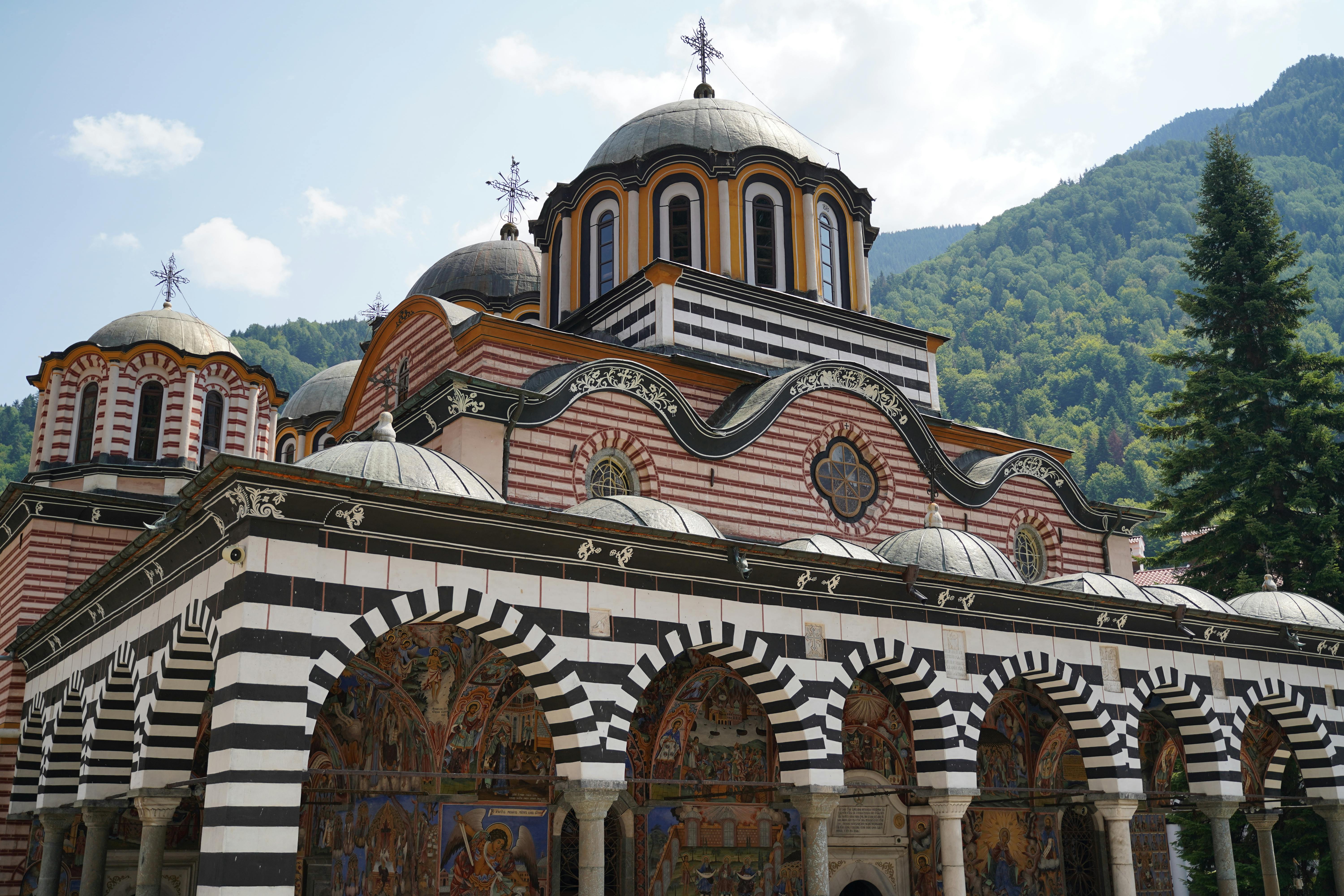
The key turns in the heavy wooden door, and you step from the gravel path into another century. Before you, a courtyard explodes in color—arcade after arcade of black, white, and terracotta frescoes, a visual symphony across 8,800 square meters of cloister walls . Morning light filters through the arcades, illuminating the faces of saints, prophets, and Bulgarian martyrs who stare down from every arch. The air smells of ancient stone, beeswax candles, and the faint, sweet smoke of frankincense. A monk in a black cassock glides silently across the cobblestones, disappearing into the shadow of the Hrelja Tower—a 23-meter (75-foot) medieval fortress built between 1334 and 1335. This is the Rila Monastery, the spiritual heart of Bulgaria, founded in the 10th century by the hermit Ivan Rilski . For five centuries of Ottoman rule, this complex was the keeper of Bulgarian language, faith, and identity—a sacred ark floating on a sea of occupation. It whispers a truth that history books cannot: that stone and paint can preserve a people's soul.
Why Rila Monastery Embodies the Bulgarian Renaissance
The monastery began as an ascetic's refuge. In the 930s, Ivan Rilski—a hermit seeking solitude—settled in a cave 1,147 meters (3,763 feet) up the Rila Mountains . Disciples gathered, and by the 10th century, a monastic community had formed. The complex served as a spiritual and cultural stronghold through Bulgaria's golden age, only to be plundered and nearly destroyed after the Ottoman conquest in the late 14th century. The monastery persevered, receiving special privileges from Ottoman authorities who recognized its importance to Christian subjects. Then came the disaster of 1833: on January 13, a fire broke out during the night, destroying almost completely the residential quarters . The monastery rebuilt, between 1834 and 1860, in the style now known as the Bulgarian National Revival. Three master builders—Alexi from the village of Rila, Milenko from Radomir, and Pavel from Krimin—led the unprecedented construction . The main church rose between 1834 and 1837, its architect a master named Peter Ivanovich . UNESCO inscribed the monastery in 1983, noting that the reconstruction "imparted Slavic cultural values" and symbolized the Bulgarian Renaissance. The monastery did not just survive—it rose again, painting its resurrection across every archway.
The Best Time to Experience Rila Monastery
Plan your pilgrimage between June 6 and September 16, when the mountain air is kindest . During this window, daytime temperatures average 23°C to 27°C (73°F to 81°F), with July reaching average highs of 27°C (81°F) and lows of 14°C (57°F) . The best time of day is 6:30–9:00 AM, just after the monastery opens, when the arcades glow in golden morning light and you can photograph the frescoes without tour groups . For a winter pilgrimage, target late January to mid-February, when the monastery is snow-dusted and the temperature hovers around -5°C to 3°C (23°F–37°F)—but check road conditions in advance. The shoulder months of May and September offer pleasant temperatures around 18°C (64°F) with fewer visitors. Avoid late October through November, when fog and rain obscure the mountain views. For liturgy schedules and closure dates, consult: www.rilskimanastir.org .
Approximate Budget for a 7-Day Trip (Sofia + Monastery Overnight)
This budget assumes five nights in Sofia and two nights at the monastery's doorstep. Prices in Bulgarian Lev (BGN) and Euros for convenience (1 BGN ≈ €0.51).
- Accommodation: 60–180 BGN per night – In Sofia, a mid-range hotel in the Oborishte neighborhood costs 80–120 BGN. Near the monastery, Rilets Resort & Spa offers rooms from approximately 150 BGN (€75) per night ; The School Hotel, a 10-minute drive from the monastery, provides unique rooms with private bathrooms from approximately 100 BGN .
- Food: 40–60 BGN per day – Breakfast: 6-10 BGN for banitsa and coffee; Lunch: 15-20 BGN for mekitsa (fried dough) and yogurt at the monastery bakery; Dinner: 25-35 BGN for fresh trout from the Rila River or traditional kavarma at a local tavern . Holy water is available inside the church for 1 BGN per bottle .
- Transportation: 40–200 BGN total – Bus from Sofia to Rila (from Ovcha Kupel station): 15 BGN each way, journey time 2.5 hours. Group shuttle tour from Sofia: 80-120 BGN round-trip including guide . Private transfer: 150-200 BGN.
- Attractions: 8–15 BGN total – Rila Monastery main complex: Free entry . History Museum (inside the monastery): 8-10 BGN (€4–5) . Hrelja Tower: 8 BGN. Photography permit (if desired): Check at entrance.
- Miscellaneous: 60 BGN – Handmade icon reproduction from the monastery shop: 30 BGN; bottle of Rila honey: 15 BGN; donation candle: 2 BGN; mekitsa from the bakery: 3 BGN.
Total estimated budget for 7 days (excluding flights): 900–1,600 BGN (approx. €460–820 / $500–880).
7 Essential Rila Monastery Experiences
- Walk the Stripe-Shadowed Arcades at Dawn: Enter the courtyard just after the 6:30 AM opening . The eastern arcade catches the first light, illuminating its famous black-and-white geometric frescoes. Run your hand along the stone pillars—cool and polished by a thousand pilgrims' palms. Each arch frames a saint, each fresco tells a story. This is the monastery's most photographed corridor for a reason. Give yourself 20 minutes here, alone with the rhythm of light and stripe.
- Stand Before the Hrelja Tower (1334–1335): This 23-meter (75-foot) retaining fortress is the oldest surviving structure in the complex . Its stone walls are thick, pierced by narrow arrow slits. Inside, the small chapel holds 14th-century frescoes—among Bulgaria's oldest. A bell tower was added in 1844. Climb to the top for a panoramic view of the Rila Mountains. It survived the 1833 fire because it was built of stone, not wood. Stand at its base, look up, and feel the weight of nearly 700 years.
- Witness the Rafail Cross in the Museum: Most visitors rush past the museum, but it holds one of the world's most astonishing works of art. The Rafail Cross—carved by a monk named Rafail using fine chisels, small knives, and even lentils—depicts 104 religious scenes and 650 tiny figures on a single piece of wood measuring 81 by 43 centimeters (32 by 17 inches) . It took him more than 12 years to complete his work, finished in 1802. Legend says Rafail lost his eyesight afterward from the strain.
- Light a Candle in the Birth of the Virgin Church: The main church, built between 1834 and 1837, features a central gold-plated iconostasis carved from wild cherry wood by master artisans from Samokov and Bansko . An enormous low-hanging chandelier decorated with ostrich eggs hangs above. The smell is intoxicating: old wood, wax, and heavy sweet incense. Purchase a thin beeswax candle (2 BGN) from the booth. Light it for the living on the left candelabra and for the departed on the right .
- Tour the Hidden Magernitsa (Monastic Kitchen): Many visitors miss this hidden space, tucked behind the western arcade. The old kitchen contains enormous copper cauldrons where monks once prepared meals for hundreds of pilgrims. On a guided tour, you can access the monastery's "secret and lesser-known spaces"—including centuries-old guest rooms and quiet corridors where monks once lived and worked . The sense of ancient, daily labor is palpable.
- Hike to the Cave of Saint Ivan Rilski: A 20- to 30-minute uphill walk from the monastery leads to the hermit's original cave dwelling . The path is steep but rewards you with a sweeping view of the Rila Valley and a profound sense of pilgrimage. This is where Bulgarian Orthodoxy began—in silence and solitude, far from the world.
- Photograph the Frescoes by Zahari Zograf: The exterior frescoes are richly colored scenes of Bible parables, including blood-curdling illustrations of punishments awaiting sinners—demons gobbling the damned whole, lassoing sinners into hell . Some are autographed by Zahari Zograf, the most eminent painter of the Bulgarian National Revival, who completed the wall paintings around 1846 . The western arcade offers the most dramatic afternoon light.
3 Hidden Gems Most Travelers Miss
- The Old Monks' Cemetery (Cemetery Church): Tucked behind the main courtyard near the monastery ossuary, this small cemetery contains the graves of 19th-century monks who died during the National Revival period. The cemetery church of the Presentation of the Virgin dates from the early 17th century and features beautiful frescoes from 1795. Most tourists rush past on their way to the souvenir shop. Sit on the low stone wall and listen—the only sounds are wind in the pines and the distant clang of the monastery bell. It is the quietest corner of the complex .
- The Orlitsa Metochion (Hospitality House): The first thing pilgrims see as they enter Rila Mountain is the Orlitsa metochion, which for almost five centuries has been receiving visitors coming from the western parts of Bulgaria . In 1469, the Church of St. Peter and Paul was built here to lay the relics of Saint Ivan Rilski after they had been returned to the monastery. The 1491 frescoes inside are a hidden treasure. Most tourists drive past without stopping—but a 10-minute detour offers a glimpse of monastic hospitality unchanged for 500 years.
- The Rila River Trout Pools: A 15-minute walk downhill from the monastery (follow the signs toward the river), you will find small, man-made pools where monks raise freshwater trout. The water is crystal-clear, fed by mountain springs. In summer, you can picnic beside the pools. No formal access is required—just follow the footpath from the monastery's southern gate. Most visitors never leave the courtyard, but this short walk offers a glimpse of the monastery as a working farm, not just a museum. Local taverns serve trout fresh from these very pools .
Cultural & Practical Tips
- Dress Code is Strictly Enforced: Both men and women must cover from collarbone to knee—no shorts, sleeveless tops, or revealing clothing . The guards at the entrance will deny access if you are improperly dressed. Carry a large scarf in your bag; it serves as a skirt wrap or shoulder cover. These rules apply inside the church and the main courtyard.
- Photography Rules: Inside the main church, photography is strictly prohibited—Bulgarian Orthodox tradition considers it a violation of sacred space . Outside, you are free to shoot, but avoid flash or tripods. The fine for interior photography can be steep, and guards are vigilant. Instead, buy a postcard from the shop (2 BGN) to remember the interior.
- Cash is Non-Negotiable: The monastery bakery, the small icon shop, and the candle stall do not accept credit cards . The nearest ATM is in the town of Rila, 20 km away. Bring at least 50 BGN in small denominations for candles, snacks, and donations.
- Essential Bulgarian for Pilgrims: Learn "Blagodarya" (blah-go-DAH-rya)—thank you—and you will receive warm smiles. For please, "Molia" (MO-lya). To greet a monk, say "Sveti Bog" (SVET-ee BOKE), meaning "Holy God"—a traditional monastic greeting.
- Arrive Early to Beat the Crowds: The monastery opens at 6:30 AM . Tour buses from Sofia begin arriving around 10:30 AM, bringing crowds that fill the courtyard. The golden hours of early morning (before 9:00 AM) offer the best light and the most serene atmosphere.
- Road Conditions in Winter: The 117-km (73-mile) drive from Sofia to Rila is scenic but steep. From November to March, snow chains are required, and the road may close after heavy snowfall. Call the monastery's office (+359 705 422 08) before driving in winter .
- Respect the Active Monastery: Rila Monastery is still a functioning religious community—monks live, pray, and work here . Keep your voice low in residential areas. Do not enter doorways marked with a simple cross; they lead to private cells. If you see a monk praying, do not interrupt or photograph them.
Conclusion: Travel with Devotion, Not Just a Passport Stamp
Rila Monastery is not a stop on a checklist. It is a pilgrimage into Bulgaria's scarred and resilient heart. When you walk the arcades at dawn, you are following the footsteps of monks who copied manuscripts by candlelight during 500 years of foreign rule. When you light a candle, you join a chain of prayer unbroken for eleven centuries. The frescoes outside the church do not just decorate—they teach, telling biblical stories to a population that once could not read. To travel here is to slow down. Put the camera away for an hour. Sit in the cemetery's silence. Eat your mekitsa without rushing. The monastery asks nothing of you except presence and respect. In return, it offers a glimpse of what endures when everything else is stripped away: faith, painted in black and white and gold, arch after arch after arch—and a carved wooden cross so intricate that its maker sacrificed his sight to complete it.