
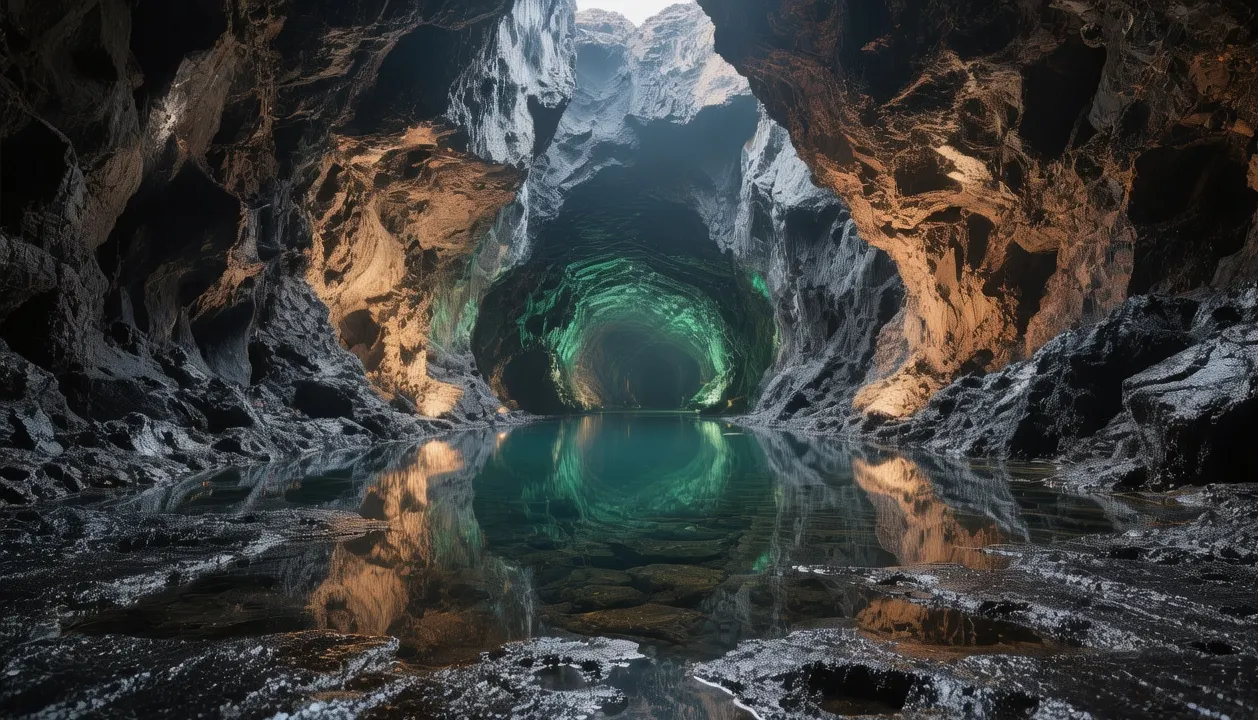
São Vicente Caves: Where Volcanic Tunnels Meet Madeiran Geological Memory
The air inside carries a cool, mineral scent—17°C (63°F) year-round—as your footsteps echo softly against smooth basalt walls polished by ancient lava flows. You stand within a volcanic tunnel formed 890,000 years ago, when molten rock from the Paul da Serra plateau surged toward the Atlantic, its outer surface cooling into a crust while liquid fire continued flowing beneath, leaving behind hollow tubes now accessible via a 700-meter underground trail. Soft amber lighting reveals the ceiling's rippled texture, frozen waves of stone that once carried rivers of fire at 1,200°C (2,192°F). Your guide's voice, hushed to preserve the cavern's atmosphere, explains how these parallel lava tubes—some reaching 6 meters (20 feet) in height—represent one of Portugal's most accessible windows into planetary formation. This isn't merely a cave tour; it's a journey through deep time, where every curve in the rock tells a story of eruption, flow, and cooling that shaped Madeira itself. The São Vicente Caves matter because they transform abstract geological concepts into tangible experience, allowing visitors to walk inside the island's volcanic soul while supporting conservation of a fragile subterranean ecosystem.
Why São Vicente Caves Embody Madeiran Geological Heritage
The São Vicente Caves represent one of Europe's most accessible examples of primary volcanic infrastructure, formed during a massive effusive eruption approximately 890,000 years ago when basaltic lava flowed from Madeira's central highlands toward the northern coast [[1]]. As the outer layer of the lava stream cooled upon contact with air, it solidified into a roof while molten rock continued flowing beneath; when the eruption ceased and the remaining lava drained toward the sea, it left behind a network of hollow tubes—nature's perfect volcanic tunnels. The system comprises eight parallel lava tubes extending over 1,000 meters total, with individual chambers reaching heights of 5-6 meters (16-20 feet) and widths varying between 3-8 meters [[13]].
Local residents first discovered the caves in 1885 while excavating agricultural terraces, but the site remained largely inaccessible to the public until October 1, 1996, when the Regional Government of Madeira opened the Volcanism Centre and Caves of São Vicente following extensive engineering to ensure visitor safety while preserving geological integrity [[14]]. The project required careful installation of non-invasive lighting systems, climate-controlled ventilation to maintain the caves' natural 95% humidity, and reinforced walkways that hover 30 centimeters above the original lava floor to prevent erosion from foot traffic. Today, guided tours accommodate groups of up to 25 visitors, with departures every 30 minutes in multiple languages, ensuring both educational value and minimal environmental impact.
The caves solve a fundamental need: making Madeira's complex volcanic history accessible without compromising fragile subterranean ecosystems. The adjacent Volcanism Centre features interactive exhibits explaining plate tectonics, magma formation, and the specific geological events that created the island, using 3D projections and tactile models to engage diverse learning styles. Approximately 120,000 visitors annually explore the tunnels, generating revenue that funds ongoing conservation research and supports the small community of São Vicente. The site stands as a model of sustainable geo-tourism, where education, preservation, and economic development intersect beneath the earth's surface.
The Best Time to Experience São Vicente Caves
Because the caves maintain a constant internal temperature of 17°C (63°F) and 95% humidity year-round, external weather has minimal impact on the underground experience. However, optimal visiting conditions occur during May 15 through June 30 and September 1 through October 25, when north-coast temperatures range between 19-24°C (66-75°F) and rainfall averages just 30-45mm monthly. Arrive between 10:30-11:30 AM or 3:00-4:00 PM to avoid peak tour-group arrivals, which typically cluster around 2:00 PM when cruise excursions disembark.
Winter months (December-February) present logistical challenges: the ER101 coastal road to São Vicente can experience fog or landslides after heavy rain, potentially delaying travel from Funchal. Summer afternoons (July-August) bring higher surface temperatures—up to 28°C (82°F)—making the caves' cool interior especially appealing, but also attracting larger crowds that may require advance booking. Avoid visiting on December 25, when the facility closes entirely, and note that guided tours operate on a fixed schedule with the final entry at 6:00 PM daily [[40]].
For real-time opening status, tour availability, and accessibility information, visit https://grutasecentrodovulcanismosaovicente.com/, the official tourism portal maintained by the Regional Tourism Board of Madeira. The website provides links to current cave conditions and contact details for the Volcanism Centre (+351 291 842 404) should you need to confirm guided tour times or arrange visits for mobility-impaired travelers. The facility remains open daily from 10:00 AM to 7:00 PM except December 25, with guided cave tours lasting approximately 30 minutes and departing every half-hour [[56]].
Approximate Budget for a 7-Day Trip
Northern Madeira, including São Vicente, offers excellent value with costs moderately lower than Funchal. This breakdown assumes a mid-range travel style with comfortable accommodations, authentic local dining, and a rental car—recommended for accessing the caves and exploring the island's dispersed northern attractions.
- Accommodation: €50-€90 per night for a double room in a family-run pensão or three-star hotel in São Vicente village or nearby Porto Moniz
- Food: €28-38 per day total
- Breakfast: €4-7 (coffee, fresh bolo do caco, and local cheese at a village café)
- Lunch: €9-12 (lapas grelhadas—grilled limpets, or espada sandwich with garlic butter)
- Dinner: €15-19 (fresh grilled fish or espetada skewers with local vinho da Madeira)
- Transportation:
- Rental car (7 days, manual transmission): €170-230 total
- Fuel (approximately 300km for northern exploration): €45-55
- Public bus (Rodoeste route 139): €3.20 per ride from Funchal
- Taxi from Funchal: €35-45 one-way
- Attractions:
- São Vicente Caves guided tour: €8 adults, €6 children (5-14) and seniors (65+), free under 5 [[30]]
- Volcanism Centre multimedia exhibits: Included with cave ticket
- Levada do Moinho hike: Free
- Porto Moniz natural pools: €3
- Whale watching excursion: €55-75
- Miscellaneous:
- Light jacket for cave visit (if not packed): €25-40
- Local honey and bolo de mel: €14
- Poncha tastings: €10-15
Total estimated cost for 7 days: €760-1,030 per person (excluding international flights)
7 Essential São Vicente Caves Experiences
- Guided Cave Tour with Geology Focus: Join the English-language guided tour departing every 30 minutes, where specialized guides explain the formation of lava tubes, the cooling process of basalt, and the specific volcanic events that created Madeira. The 30-minute underground walk covers 700 meters of accessible tunnel, with stops at key geological features like flow bands, gas bubbles frozen in stone, and mineral deposits. Listen for the guide's explanation of how the caves' constant 17°C (63°F) temperature results from the insulating properties of volcanic rock [[52]].
- Volcanism Centre Interactive Exhibits: After your cave tour, spend 45-60 minutes exploring the adjacent multimedia center, where 3D projections simulate magma movement beneath the earth's crust and tactile models allow you to feel different rock types. The "Birth of an Island" film uses surround sound to recreate the sensory experience of a volcanic eruption. Visit the earthquake simulator (optional, €2 supplement) to understand seismic activity in the Atlantic region.
- Photography Session at Cave Entrance: Position yourself at the cave entrance 15 minutes before your tour to capture the dramatic contrast between the bright northern coast and the dark tunnel mouth. The modern architectural elements—glass panels and steel walkways—create striking geometric compositions against the ancient basalt. Use a tripod if permitted; flash photography is prohibited inside to protect the cave environment.
- Coastal Walk to São Vicente Village: After your cave visit, stroll the 800-meter path from the Volcanism Centre to São Vicente's harbor, passing traditional palheiros (thatched-roof houses) and terraced banana plantations. The route offers panoramic views of the north coast and opportunities to photograph fishing boats against dramatic cliffs. Allow 30 minutes each way; the path is paved and suitable for most mobility levels.
- Traditional Lunch at Harbor Restaurants: Dine at Restaurante O Molhe or Adega São Vicente, both offering terrace seating with ocean views and menus featuring the day's fresh catch. Order espada preto (black scabbardfish) prepared with passion fruit or banana—a Madeiran specialty—and pair with local vinho da Madeira. Expect to pay €16-22 per person for a complete meal; reservations recommended for groups.
- Levada do Moinho Extension: Combine your cave visit with a gentle 3-kilometer walk along the Levada do Moinho, an irrigation channel carved into the hillside above São Vicente. The flat, shaded path takes approximately 90 minutes round-trip and passes traditional water mills still used to grind corn. Start at 4:00 PM after your cave tour for soft afternoon light and cooler temperatures.
- Sunset at Ponta Delgada: Drive 10 minutes west from São Vicente to Ponta Delgada, a tiny fishing hamlet with a natural swimming pool and dramatic coastal views. Arrive at 6:30 PM in summer (5:00 PM in winter) to watch the sun dip below the horizon while waves crash against volcanic rock. The location offers exceptional photography opportunities with minimal crowds compared to more famous Madeira viewpoints.
3 Hidden Gems Most Travelers Miss
- Quinta do Furão Vineyard Visit: Perched 600 meters above São Vicente, this family-owned estate produces high-altitude wines from volcanic soil and offers tastings with panoramic north-coast views. The Silva family has cultivated Verdelho and Sercial grapes here since 1947, using traditional methods adapted to Madeira's steep terrain. Visit Tuesday-Saturday 10:00 AM-5:00 PM; tastings cost €8 and include three wines plus local cheese. Call +351 291 842 156 to arrange a visit; the drive features spectacular hairpin turns.
- Ermida de Nossa Senhora da Piedade: This tiny 16th-century chapel sits on a hillside 1.2 kilometers northeast of the caves, accessible via an unmarked footpath beginning behind the village cemetery. The whitewashed building houses a wooden statue of the Virgin carved from a single piece of cedar in 1623 and offers panoramic views of the volcanic landscape that formed the caves below. Visit between 4:00-5:30 PM for golden light; the chapel door opens only during Sunday mass at 11:00 AM, but the exterior viewpoint remains accessible.
- Ribeira da Janela River Gorge: At the eastern edge of São Vicente, where Madeira's longest river cuts through volcanic rock, a narrow gorge offers tide pooling and freshwater springs that bubble up through black sand. Access from the river parking area (follow signs for "Ribeira da Janela"); walk 10 minutes downstream to reach the most secluded pools. Visit 2 hours before low tide for optimal exploration; the freshwater springs create natural foot baths locals claim soothe tired muscles after hiking.
Cultural & Practical Tips
- Cave etiquette: Speak quietly inside the tunnels to preserve the atmosphere for other visitors and minimize disturbance to the cave's delicate ecosystem. Never touch the basalt walls—oils from skin can accelerate mineral degradation over time. Follow your guide's instructions regarding group positioning on narrow walkways.
- Appropriate clothing: Wear closed-toe shoes with good traction—the cave floor, while paved, can be slippery due to constant humidity. Bring a light jacket or sweater; the 17°C (63°F) temperature feels cooler after exposure to Madeira's warmer surface climate.
- Photography guidelines: Flash photography is prohibited inside the caves to protect mineral formations and avoid disturbing other visitors. Tripods require prior permission from staff (+351 291 842 404). Exterior photography is unrestricted; the best light for cave-entrance shots occurs 1 hour after sunrise or before sunset.
- Essential Portuguese phrases: "Bom dia" (bohm DEE-ah = good morning), "Obrigado/a" (oh-bree-GAH-doo/dah = thank you), "Quanto custa?" (KWAN-too KOOSH-tah = how much?), "Está fascinante!" (esh-TAH fah-see-NAHN-teh = it's fascinating!).
- Accessibility information: The Volcanism Centre is fully wheelchair-accessible, but the cave tour involves stairs and uneven surfaces unsuitable for mobility devices. Staff can arrange alternative experiences for visitors unable to enter the tunnels; contact the centre in advance to discuss options.
- Weather considerations: Northern Madeira receives more rainfall than the south—always pack a light rain jacket even on sunny days. If the ER101 road experiences fog or landslides, allow extra travel time from Funchal; check IPMA weather forecasts at ipma.pt before departing.
- Booking recommendations: While walk-in tours are usually available, weekends and cruise-ship days may require advance reservation. Call +351 291 842 404 or book through visitmadeira.pt to secure your preferred time slot, especially for non-Portuguese language tours.
Conclusion: Travel with Wonder, Not Just Wonderment
The São Vicente Caves ask something deeper than your curiosity—they invite your wonder at forces that shaped a planet long before humans walked its surface. As you trace your fingers near (but not on) basalt walls that once carried rivers of fire, remember that you're experiencing time measured not in years but in geological epochs, where a single cooling lava flow represents centuries of planetary transformation. These tunnels matter because they make the abstract tangible, transforming complex science into visceral understanding while generating resources to protect fragile subterranean ecosystems.
Responsible travel here means recognizing that these caves are not merely an attraction but a living laboratory where ongoing research helps scientists understand volcanic processes worldwide. It means respecting photography restrictions, speaking softly, and understanding that your visit supports conservation efforts preserving this heritage for future generations. The guides who lead you through the darkness aren't just narrators—they're stewards of knowledge, passing down understanding of the forces that created the island you explore above.
Slow down. Feel the cool, mineral-scented air. Listen to the silence that has filled these tunnels for nearly a million years. When you emerge into daylight, carry not just photographs of rippled stone but a renewed sense of humility before planetary forces that continue shaping our world. That's the difference between touring a cave and truly connecting with the earth's deep memory.