
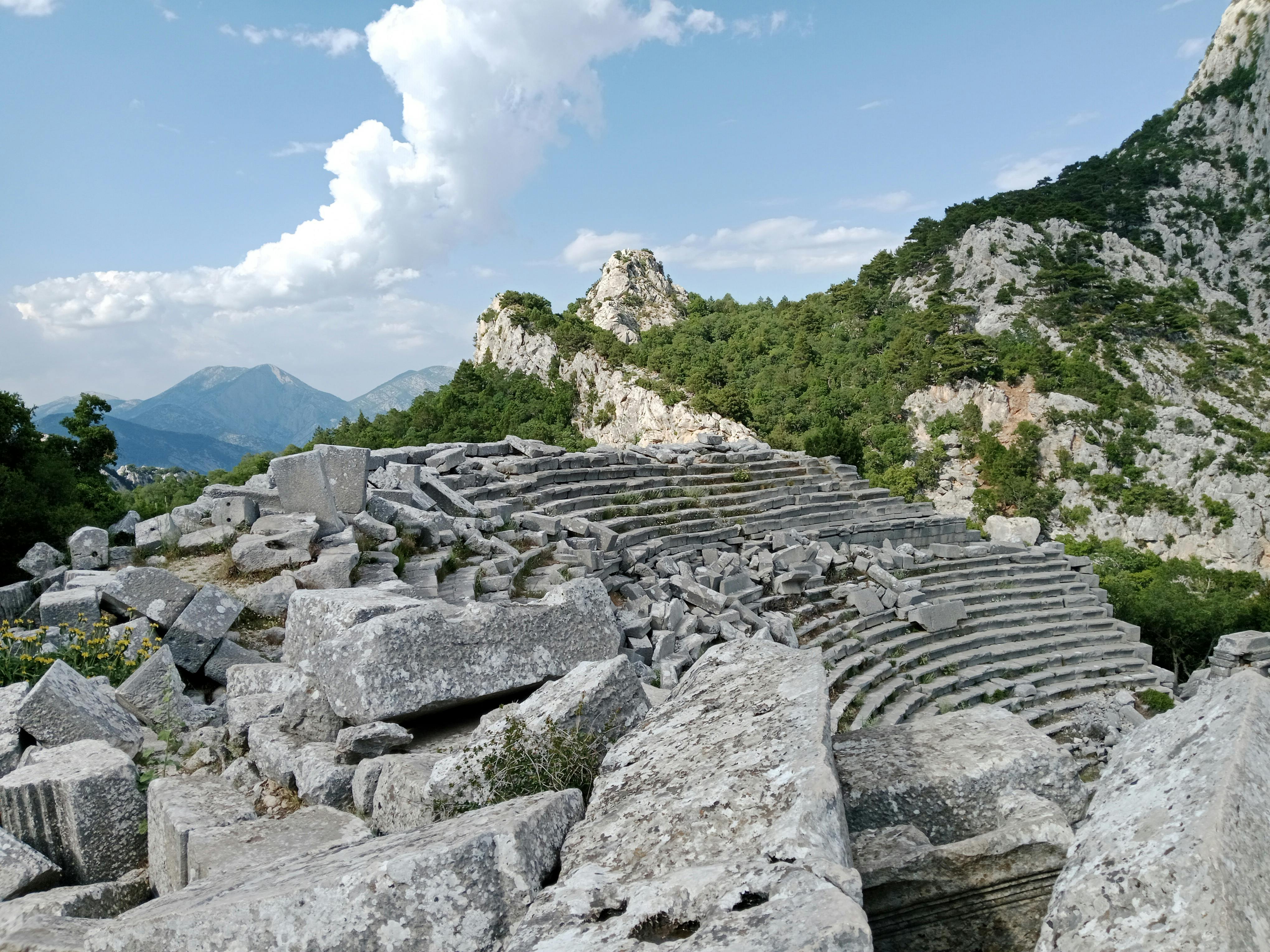
Termessos Mountain Ruins: Where Ancient Stone Meets Cloud-Capped Peaks
First light breaks through mist-shrouded pines as you climb a stone path carved into the Taurus Mountains, where the air grows crisp at one thousand fifty meters above sea level. You've arrived at Termessos mountain ruins—the "Eagle's Nest" of antiquity, a Pisidian city perched so precariously among rocky peaks that even Alexander the Great abandoned his siege in 333 BCE rather than scale its defenses. The scent of wild thyme and resinous pine fills your lungs, while the distant cry of golden eagles echoes off limestone cliffs that rise three hundred meters above the ancient theater. You stand before a semicircular cavea seating four thousand two hundred spectators, its stone rows cascading down a mountainside with views stretching to the Mediterranean coast forty kilometers away. This place matters because it preserves one of antiquity's most dramatic encounters between human ambition and nature's grandeur—a city where ruins aren't curated behind barriers but emerge organically from forest and rock, inviting you to discover history not as a spectator but as an explorer tracing footsteps through a landscape that has defied conquest for over two millennia.
Why Termessos Mountain Ruins Embody Defiant Wilderness
Termessos mountain ruins represent one of Anatolia's most extraordinary archaeological achievements, solving the ancient challenge of building a prosperous city in terrain so rugged it became an impregnable fortress. Founded by the Pisidians—a fierce mountain people distinct from coastal Pamphylians—Termessos flourished from the fourth century BCE through the Byzantine era, its strategic elevation protecting trade routes while deterring invaders. The city's layout reflects ingenious adaptation to extreme topography: structures follow natural contours rather than imposing rigid grids, cisterns capture mountain rainfall to sustain populations during sieges, and defensive walls incorporate sheer cliffs as natural barriers.
The engineering behind Termessos reveals sophisticated understanding of mountain construction: the theater, carved directly into the slope at an elevation of one thousand fifty meters, uses the mountainside itself as structural support, while its acoustic design allows voices on stage to carry clearly despite wind and elevation. Stone blocks weighing several tons were quarried locally and fitted without mortar—a technique that has allowed walls, temples, and tombs to withstand earthquakes and erosion for over two thousand years. The agora, temples to Zeus and Artemis, and an elaborate necropolis of rock-cut tombs demonstrate how Termessos blended Pisidian traditions with Hellenistic architectural influences.
Beyond its military significance, Termessos fulfilled critical cultural functions: it served as a religious center where mountain deities were venerated alongside Greek gods, a trading hub connecting coastal ports with inland Anatolia, and a symbol of indigenous resistance that inspired neighboring communities. The Turkish Ministry of Environment designated the surrounding area as Güllük Dağı-Termessos National Park in 1970, protecting both archaeological remains and the unique montane ecosystem of endemic flora and fauna. Scientific excavations by Turkish and international teams since 1937 have uncovered approximately forty percent of the ancient city, revealing insights about Pisidian society, mountain agriculture, and defensive architecture. Today, Termessos mountain ruins serve as both an open-air museum and a wilderness sanctuary—where visitors experience history not in isolation but intertwined with the wild beauty that made this city unconquerable.
The Best Time to Experience Termessos Mountain Ruins
Timing your visit to Termessos mountain ruins dramatically affects accessibility, comfort, and photographic opportunities. The optimal window stretches from April 20–May 28 and September 15–October 22, when air temperatures range between 16–24°C (61–75°F) at elevation and mountain wildflowers bloom among the ruins. During these shoulder seasons, trails remain dry, visibility from the theater exceeds fifty kilometers on clear days, and visitor numbers stay manageable at approximately two hundred to four hundred daily rather than the eight hundred to twelve hundred seen in peak summer. Arrive at the site between 8:30–10:00 AM when morning light illuminates the theater beautifully and before afternoon clouds often gather over the peaks.
Avoid July 15 through August 25 absolutely: temperatures at lower elevations soar to 34–41°C (93–106°F), though Termessos remains cooler at 26–32°C (79–90°F), the steep ascent becomes strenuous in heat, and afternoon thunderstorms can make stone paths treacherously slippery. Midday visits between 11:00 AM and 3:00 PM during peak season prove challenging—intense sun on exposed stone creates glare, and finding shade for rest becomes difficult. Winter months (November through March) bring cooler air temperatures of 5–12°C (41–54°F) at elevation, occasional snow that may close access roads, and reduced daylight hours; however, the site remains stunningly beautiful for photography with dramatic cloud formations and solitary exploration opportunities.
The site operates daily with seasonal hour adjustments. For current opening times, trail conditions Note that admission typically costs €6–€8, and the steep climb to the theater requires moderate fitness; visitors with mobility challenges may enjoy the lower ruins and museum without ascending to the main archaeological zone.
Approximate Budget for a 7-Day Trip
Exploring Termessos mountain ruins and the surrounding Antalya region offers exceptional value for adventure seekers and cultural travelers. This budget assumes moderate comfort—mid-range accommodation with mountain or sea views, fresh Turkish and Mediterranean cuisine, local transportation, site entrance fees, and selective guided experiences. Prices reflect 2026 rates for travelers seeking authentic archaeological adventures without luxury resort pricing.
- Accommodation: €40–€75 per night in Antalya city center or Konyaaltı (boutique hotels with pool and traditional breakfast; budget pensions from €22, upscale heritage hotels from €120)
- Food: €23–€36 per day (breakfast €4—Turkish kahvaltı spread with cheeses, olives, tomatoes, honey, börek; lunch €7–€10—gözleme, grilled chicken dürüm, or meze platter at mountain cafes; dinner €12–€22—fresh sea bass, lamb tandır, or vegetarian options with local wine)
- Transportation: €58 total (Antalya Airport to city center via Havataş: €4 each way; local tram to Termessos departure point: €2 per ride; taxi to national park entrance: €15; bicycle rental: €7/day; optional car rental for exploring: €30/day)
- Attractions: €78 total (Termessos ruins entrance: €8; guided mountain hike: €20; Antalya Museum: €6; Düden Waterfalls tour: €15; Perge ancient city: €10; Aspendos Theater: €10; national park shuttle: €9)
- Miscellaneous: €42 (hiking poles rental €8, Turkish evil eye charm €6, local honey and herbs €12, reef-safe sunscreen €7, travel insurance prorated €9)
Total: €430–€600 for 7 days (excluding international flights to Antalya)
7 Essential Termessos Mountain Ruins Experiences
- Climb to the theater at sunrise: Begin your ascent by 8:00 AM when the path is cool and morning light creates dramatic shadows on ancient stone. The climb from the entrance to the theater involves approximately three hundred steps over uneven terrain—allow forty-five minutes at a steady pace. Upon reaching the cavea, pause to absorb panoramic views stretching from the Mediterranean coast to snow-capped Taurus peaks. Test the acoustics by speaking softly on stage; notice how sound carries clearly despite mountain winds. This experience rewards patience with solitude and photography opportunities free of crowds.
- Explore the agora's mountain setting: Descend from the theater to the ancient marketplace, where stone foundations and scattered columns reveal Termessos's commercial heart. The agora's elevated position—overlooking valleys and peaks—demonstrates how Pisidian planners prioritized defense without sacrificing civic function. Look for the remains of stoas (covered walkways) where merchants once sold mountain herbs, wool, and timber. Visit between 10:00 AM–12:00 PM when angled light illuminates carved details on column bases and altar stones.
- Visit the Temple of Zeus Solymeus: Follow the path uphill from the agora to the sanctuary dedicated to Zeus Solymeus, the mountain deity uniquely venerated at Termessos. The temple's foundations and scattered column drums sit on a rocky outcrop with commanding views of the surrounding peaks. Look for votive inscriptions in Greek and Pisidian languages that reveal the syncretic religious practices of this mountain community. Allow twenty minutes to appreciate how sacred architecture harmonizes with natural rock formations.
- Walk the ancient defensive walls: Trace the fortification circuit that made Termessos unconquerable—massive limestone blocks fitted without mortar, incorporating sheer cliffs as natural barriers. The walls extend approximately four kilometers around the city's perimeter, with watchtowers positioned at strategic vantage points. Visit between 3:00–5:00 PM when golden light bathes the stonework and you can photograph the walls against dramatic mountain backdrops. Bring water and wear sturdy shoes; sections include steep ascents and loose gravel.
- Discover the rock-cut necropolis: Beyond the main ruins, a path leads to Termessos's elaborate cemetery where elite families commissioned tombs carved directly into limestone cliffs. These fourth-century BCE monuments feature relief carvings depicting banquets, warriors, and mythological scenes. The necropolis offers intimate encounters with Pisidian funerary art and panoramic views of the valley below. Visit during mid-morning when sunlight illuminates carved details without harsh shadows. Allow thirty minutes to explore this peaceful, often-crowd-free area.
- Photograph the theater with mountain backdrop: Position yourself on the theater's upper tiers for compositions that capture the stone seating cascading down the mountainside with pine forests and rocky peaks framing the scene. The best lighting occurs during golden hour (5:00–7:00 PM in summer) when warm light enhances the contrast between limestone and evergreen. Bring a polarizing filter to reduce haze and deepen sky tones. This iconic view has defined Termessos for photographers since the first cameras reached these peaks.
- Hike the nature trails beyond the ruins: Güllük Dağı-Termessos National Park offers marked trails extending beyond the archaeological zone into pristine montane forest. Follow the red-blazed path for two kilometers to a viewpoint overlooking the entire ancient city nestled among peaks. The trail passes endemic flora including Taurus cedar and mountain orchids, with opportunities to spot golden eagles and Chukar partridges. Allow two hours round-trip, carrying water and wearing layers—mountain weather changes rapidly.
3 Hidden Gems Most Travelers Miss
- The underground cistern system: Beneath the agora, a network of rock-cut cisterns captured and stored mountain rainfall to sustain Termessos during sieges and dry seasons. Most visitors never access these chambers because they require asking site staff for "sarnıçlar" (cisterns) directions and descending a narrow stone staircase. The largest cistern measures approximately fifteen meters long and five meters deep, with waterproof plaster still visible on walls. Visit during midday when natural light penetrates the entrance, revealing the engineering sophistication that allowed this mountain city to thrive. Bring a flashlight for darker sections and wear shoes with grip—stone steps can be slippery.
- The hermit's cave chapel: High on the eastern ridge, a small Byzantine-era chapel carved into a limestone overhang offers solitary meditation with breathtaking views. This site remains overlooked because signage is minimal and access requires a twenty-minute scramble from the main path. Ask guards for "keşiş mağarası" (hermit's cave) directions. Inside, faint frescoes depicting saints and biblical scenes remain visible on plastered walls. Visit between 4:00–6:00 PM when afternoon light illuminates the chapel's interior and you can photograph the structure against sunset skies. Bring water and wear sturdy shoes; the path includes loose scree sections.
- The wildflower meadow viewpoint: Beyond the necropolis, a lesser-known trail leads to a high meadow where endemic mountain flowers bloom from April through June. This spot remains overlooked because it lacks formal signage and requires asking staff for "çiçeklik tepesi" (flower meadow hill) directions. The viewpoint offers panoramic vistas of Termessos nestled among peaks, with opportunities to photograph rare orchids, cyclamen, and Taurus poppies. Visit between 9:00–11:00 AM when morning light enhances flower colors and mountain haze remains minimal. Bring a macro lens for close-up botanical photography and respect protected flora by staying on designated paths.
Cultural & Practical Tips
- Wear appropriate hiking footwear: Termessos's mountain terrain features uneven limestone paths, ancient stone steps worn smooth over millennia, and loose gravel sections. Sturdy hiking shoes or boots with ankle support and grip are essential; avoid sandals or smooth-soled shoes. The climb to the theater involves approximately three hundred steps with elevation changes.
- Prepare for mountain weather: Temperatures at one thousand fifty meters elevation can be 8–12°C cooler than coastal Antalya. Dress in layers and bring a windproof jacket—even in summer, afternoon breezes can feel chilly. Carry at least 1.5 liters of water per person; no refill stations exist on the mountain paths.
- Respect archaeological preservation: Termessos mountain ruins are protected under Turkish cultural heritage law. Never climb on fragile stonework, touch carved reliefs, or remove fragments—oils from skin accelerate deterioration and violations carry fines up to ₺2,000 (approximately €60). Stay behind barriers and respect roped-off conservation areas.
- Learn essential Turkish phrases: "Merhaba" (mehr-hah-bah—hello), "Teşekkür ederim" (teh-shek-kür eh-deh-rim—thank you), "Termessos nerede?" (ter-meh-sos neh-reh-deh—where is Termessos?), "Su nerede?" (soo neh-reh-deh—where is the water?), and "İyi günler" (iy-ee gün-ler—good day). Even basic efforts earn warm responses from park staff and local vendors.
- Photography guidelines: General photography is permitted throughout Termessos ruins. Tripods require permission from site staff—usually granted for non-commercial use. When photographing other visitors, especially Turkish families, always ask "Fotoğraf çekebilir miyim?" (foh-toh-raf cheh-keh-bee-leer mee-yim—may I take a photo?). Avoid using flash inside enclosed chambers where it can disturb other visitors.
- Plan for seasonal trail conditions: Spring (April–May) offers wildflower blooms, comfortable temperatures, and excellent photographic light but occasional rain showers. Autumn (September–October) provides stable weather, fewer crowds, and golden-hour lighting ideal for photography. Summer visits require early morning arrival (before 9:00 AM) to avoid afternoon heat and potential thunderstorms. Winter months see reduced accessibility but offer dramatic snowy landscapes for experienced hikers.
- Combine with coastal attractions: Termessos sits within forty minutes of Antalya's old harbor, Perge ruins, and Aspendos Theater. Purchase a combined museum card (€25) for discounted entry to multiple archaeological sites. This allows you to experience mountain and coastal history in one trip while optimizing travel time and costs.
Conclusion: Travel with Wonder, Not Just Checklists
Termessos mountain ruins don't surrender their deepest magic to hurried visitors ticking boxes on an itinerary. They reward those who pause to feel the weight of history in stone fitted without mortar, who listen for eagles circling above a theater where ancient voices once echoed, who understand that this mountain city represents a profound dialogue between human resilience and nature's grandeur. When you stand where Alexander the Great turned back, where Pisidian families carved tombs into living rock, where wildflowers bloom among ruins untouched by mass tourism, you're participating in an experience that transcends ordinary sightseeing.
Responsible travel here means honoring Termessos's fragile wilderness—staying on marked trails to protect endemic flora, supporting local guides who share Pisidian heritage, leaving no trace beyond footprints on ancient paths, and recognizing that your presence is a privilege granted by mountains that have defied conquest for millennia. This city has survived earthquakes, empires, and time itself—a balance worth preserving through mindful choices. Come not just to capture the perfect photograph, but to understand that wonder isn't consumed—it's cultivated, one respectful step, one moment of pure presence, one connection to Earth's enduring stories at a time.