
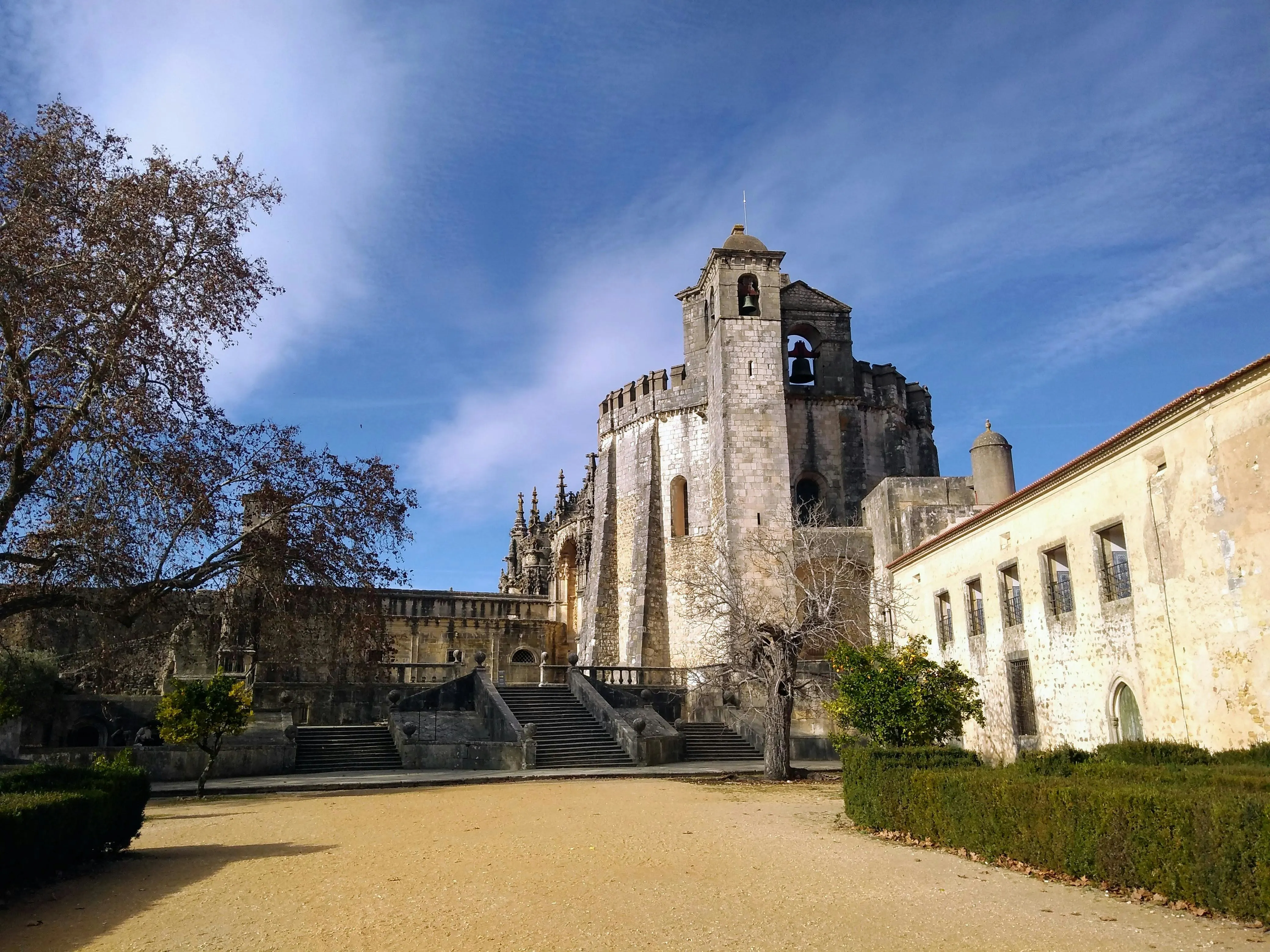
Tomar Convent of Christ: Where Templar Mystique Meets Lush Ribatejo Landscapes
Morning light filters through the dense canopy of the Nabão River valley, illuminating the colossal limestone bastions of the Tomar Convent of Christ. You walk across the drawbridge, your footsteps echoing against the massive, 6-meter (20-foot) thick castle walls. The air smells sharply of damp earth, ancient stonework, and the blooming jacaranda trees that frame the outer ramparts. Inside the central courtyard, a profound silence envelops you, broken only by the rustle of leaves and the distant call of swallows. Ahead stands the architectural marvel of the Charola—a sixteen-sided, drum-like rotunda that served as the spiritual epicenter for warrior monks. Spanning over 450 meters (1,476 feet) of interconnected cloisters, corridors, and battlements, this sprawling complex rises organically from the hillside. The Tomar Convent of Christ matters because it is not merely a static monument; it is a living, stone-carved palimpsest detailing the dramatic transition from the austere, secretive world of the Knights Templar to the extravagant, globally ambitious era of the Portuguese Age of Discovery.
Why Tomar Convent of Christ Embodies Templar Ingenuity
The Tomar Convent of Christ embodies Templar ingenuity because it was engineered to solve a highly specific, dual-purpose problem: providing an impenetrable military fortress while simultaneously creating a secluded, spiritually resonant sanctuary. Commissioned in the twelfth century by Grand Master Gualdim Pais, the structure had to secure the volatile southern Tagus frontier against Moorish incursions. The military solution is visible in the formidable castle keep, featuring walls constructed from compacted local limestone and mortar, designed to absorb the impact of early siege weaponry. However, the true architectural genius lies in the Charola. Modeled directly after the Church of the Holy Sepulchre in Jerusalem, this polygonal rotunda solved the logistical problem of defending a holy space; its thick, windowless lower walls functioned as an impenetrable defensive tower, allowing knights to hear Mass in total security while remaining battle-ready. When the Templars were dissolved and the Order of Christ was established in the fourteenth century, the site’s purpose shifted from militaristic defense to maritime administration. Under the patronage of Henry the Navigator in the early fifteenth century, the convent became the administrative epicenter for Portuguese overseas expansion. Master architects like Diogo de Arruda were brought in to expand the site, solving the spatial problem of adding light and grandeur to a dark, austere fortress by punctuating the walls with massive, intricately carved windows.
The Best Time to Experience Tomar Convent of Christ
To experience the Tomar Convent of Christ in its most atmospheric state, plan your visit between April 12 and May 25. During this specific window, the surrounding Ribatejo region is brilliantly green, and daytime temperatures remain a comfortable 17°C–22°C (63°F–72°F)—ideal for walking the vast, shadeless castle ramparts without physical discomfort. Arrive precisely between 9:00 and 10:30 AM. At this early hour, the angled sunlight streams directly through the famous Manueline window, casting perfectly formed, nautical-themed shadows across the stone floor of the chapter house, and the sprawling cloisters remain entirely free of tourist chatter. You should firmly avoid August 1 through August 20. During these weeks, summer heat pushes temperatures past 35°C (95°F), the reflective white limestone creates a blinding glare, and dense international tour groups turn the intimate Charola into a congested corridor. For current restoration updates, precise Mass schedules, and combined ticket information, consult the official municipal tourism portal at www.cm-tomar.pt. Checking this resource ensures you avoid unexpected closures of the upper cloisters and secure the deeply contemplative encounter with medieval architecture that this sacred space fundamentally demands.
Approximate Budget for a 7-Day Trip
Estimating costs for a cultural immersion into the Tomar Convent of Christ requires factoring in the highly favorable pricing of the Portuguese Central Region. This budget reflects a mid-range traveler prioritizing historical engagement and regional gastronomy over modern luxury.
- Accommodation: €55–€80 per night (a restored nineteenth-century guesthouse in the historic center, featuring traditional azulejo tiles and views of the Nabão River)
- Food: €35 per day (Breakfast €4 for a strong bica espresso and a local pastel de nata; Lunch €12 for a bifana—spicy pork cutlet sandwich—at a bustling downtown tavern; Dinner €19 for a hearty portion of cabrito assado [roast kid goat] paired with a robust regional wine)
- Transportation: €18 total (€14 for a round-trip Rede Expressos bus ticket from Lisbon to Tomar; €4 for a local taxi from the bus station to the castle hill)
- Attractions: €12 total (€6 for the standard Tomar Convent of Christ entrance ticket; €4 for the Museu dos Fósforos [Matchbox Museum]; €2 for the Museu Luso-Hebraico Abraham Zacuto)
- Miscellaneous: €25 total (a bottle of local olive oil, a hand-painted ceramic tile depicting the Templar cross, and an illustrated historical guidebook)
Total: €605–€810
6 Essential Tomar Convent of Christ Experiences
- Stand inside the Charola: Step through the heavy wooden doors into the sixteen-sided rotunda. Look up to see the stunning, gilded late Gothic vaulting painted with vibrant biblical scenes. Run your fingers along the cool, austere Romanesque columns; the sensory contrast between the dark, fortress-like ground floor and the painted, celestial ceiling perfectly encapsulates the duality of the warrior-monk.
- Decode the Manueline Window: Walk to the western exterior of the church and stand before the iconic window. Trace the intricate stone carvings with your eyes: twisted ropes, coral branches, armillary spheres, and chains. This masterpiece of late Gothic architecture was designed to symbolize Portugal’s global maritime dominance, with every carved element representing a specific aspect of oceanic navigation.
- Walk the Castle Ramparts: Climb the steep stone stairs to the top of the medieval battlements. Feel the persistent Ribatejo breeze against your face as you walk the 400-meter (1,312-foot) perimeter. The panoramic view from the keep sweeps over the red-tiled roofs of Tomar and the lush agricultural plains, offering a tactical understanding of why the Templars chose this defensible hilltop.
- Get lost in the Cloister of John III: Wander through this massive, two-story Renaissance courtyard. Notice the sheer mathematical precision of the classical arches, which stand in stark, deliberate contrast to the ornate, chaotic Manueline style found elsewhere. The lower level features elegant Tuscan columns, while the upper gallery boasts intricate Ionic capitals.
- Explore the Cloister of the Washing: Locate the smaller, Gothic cloister built under the reign of King Manuel I. Pause at the central fountain; this structure was historically used for the ritual washing of monks' feet. The delicate, tracery stonework here feels much more intimate and human-scale than the grandiose additions that followed.
- Descend into the Medieval Cistern: Find the unassuming door leading down into the subterranean water reservoir. The air drops dramatically in temperature, and the acoustics shift to a profound, echoing resonance. The massive, cruciform vaulting resting on sturdy central pillars is a breathtaking, often overlooked feat of hydraulic engineering designed to sustain the castle during prolonged sieges.
3 Hidden Gems Most Travelers Miss
- Aqueduto dos Pegões: Located 6 kilometers (3.7 miles) northwest of the convent, this massive sixteenth-century aqueduct is a hidden gem missed because it requires a car or a strenuous bicycle ride to reach. To access it, drive along the N113 road and park at the designated pull-off near the village of Pegões. The structure features 180 arches stretching across the valley in perfect geometric isolation, offering incredible, crowd-free photography opportunities.
- Mata Nacional dos Sete Montes: Situated directly behind the convent walls, this dense, romantic forest is overlooked because tourists rarely think to walk backward through the main gate. To find it, exit the castle and turn right up the cobblestone path. The forest contains winding trails, hidden grottos, and the mock-Gothic ruins of the Casa da Convivência, providing a shaded, mystical retreat from the sun-exposed castle.
- The Green Window (Janela Verde): Located inside the upper gallery of the Cloister of King John III, this specific architectural detail is missed because visitors are rushing toward the famous Manueline window outside. Look for a small, exquisitely carved green-tinted limestone window framing a perfect view of the interior garden. Its delicate, Renaissance proportions make it a favorite study subject for architecture students.
Cultural & Practical Tips
- Maintain respectful silence inside the Charola; the convent is an active religious site, and the circular acoustics amplify even the softest whispers, easily disrupting the sacred atmosphere for other visitors.
- Wear shoes with thick rubber soles; the original limestone flagstones in the cloisters and castle stairs have been worn smooth by centuries of foot traffic and become treacherously slippery when exposed to morning dew or light rain.
- Learn basic Portuguese courtesies to show respect: say "Bom dia" (good morning, pronounced "bom dee-ah") to the ticket attendants, and use "Obrigado" (thank you, pronounced "oh-bree-gah-doo") when leaving the museum.
- Photography using tripods or flash is strictly prohibited inside the church and cloisters to protect the delicate pigment of the sixteenth-century ceiling paintings and prevent tripping hazards in crowded corridors.
- Pack a wide-brimmed hat and carry at least one liter of water; the castle ramparts and upper cloisters offer zero shade, and the intense reflection off the white limestone during summer months rapidly accelerates dehydration.
- Be aware that the site is partially closed on Mondays; while the outer castle walls remain accessible, the interior church, chapter house, and specific cloisters are locked, so always verify operating hours before making the journey from Lisbon.
Conclusion: Travel with Historical Empathy, Not Just Sightseeing
The Tomar Convent of Christ demands far more from its visitors than a passive, camera-ready stroll through ancient courtyards; it requires a conscious engagement with the profound ideological shifts encoded in stone. When you choose to trace the transition from the stark, defensive Romanesque walls of the Templars to the exuberant, nautical carvings of the Manueline era, you are physically walking the timeline of a nation's evolution. Mindful travel here means resisting the urge to simply photograph the famous window and move on. It means pausing in the silent, subterranean cistern to acknowledge the immense manual labor required to sustain a medieval fortress, or standing in the Charola to contemplate the paradox of warriors kneeling in the dark. By respecting the site’s sacred boundaries, moving quietly through the cloisters, and spending time in the surrounding forest, you actively participate in the preservation of this architectural marvel. Let the layered stonework remind you that true historical understanding cannot be rushed. In a convent built across centuries, the greatest privilege you can claim is the patience to simply stand still and listen to the echoes of the past.