
Troy: Where Legendary Stone Walls Meet the Winds of the Dardanelles
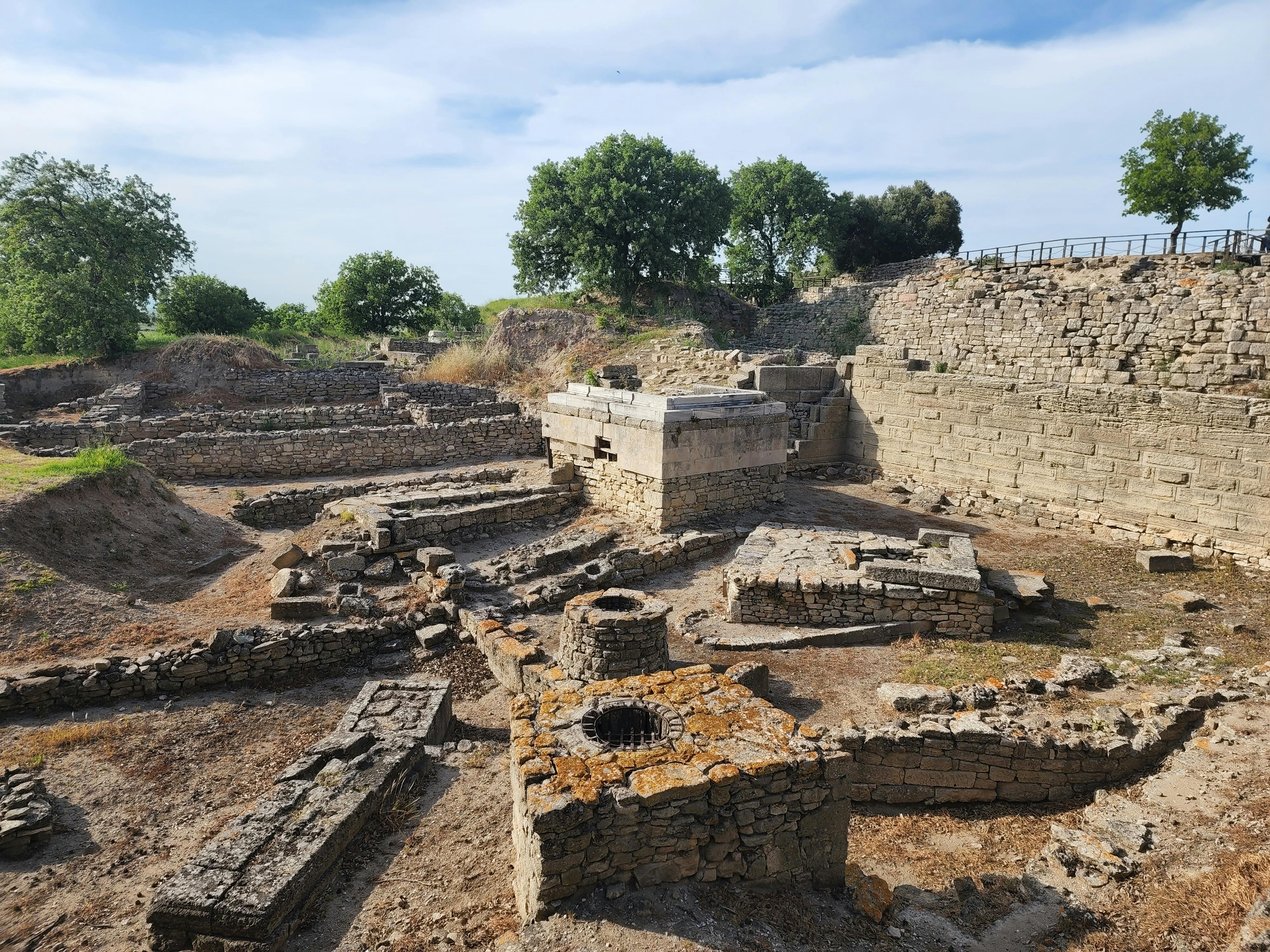
The late afternoon sun casts long shadows across weathered limestone as you stand atop Hisarlık hill at Troy, where the legendary city of Homer's Iliad rises from the earth in nine distinct archaeological layers spanning over four millennia. The air carries the scent of wild thyme, sun-baked stone, and the distant salt spray from the Dardanelles Strait just 5 kilometers away. You hear the whisper of wind through ancient fortification walls, the soft crunch of gravel beneath your feet, and the distant call of seagulls circling above the Aegean horizon. Before you stretches a landscape where myth and history converge: the massive stone walls of Troy VI (circa 1700-1250 BCE) rising 6 meters high, the iconic wooden horse replica standing sentinel near the entrance, and the exposed foundations of temples, houses, and defensive towers that witnessed the rise and fall of civilizations. This UNESCO World Heritage Site matters because it embodies humanity's enduring fascination with the stories that shape our understanding of courage, loss, and destiny—a place where archaeology illuminates legend, where every stone whispers tales of heroes and gods, and where travelers can walk the very ground that inspired one of literature's greatest epics.
Why Troy Embodies the Intersection of Myth and Archaeology
Troy represents far more than an archaeological excavation—it embodies the extraordinary convergence of literary legend, historical discovery, and cultural memory that has captivated humanity for nearly three millennia. First settled around 3000 BCE and continuously inhabited through nine distinct layers until its final abandonment in the Byzantine period, this site solved fundamental challenges of ancient urban planning: defensive fortification against maritime raiders, water management in a semi-arid coastal environment, and strategic control of the Dardanelles Strait—a critical chokepoint connecting the Aegean Sea to the Black Sea.
The engineering achievements are remarkable. The massive fortification walls of Troy VI, constructed from locally quarried limestone blocks fitted without mortar, rise 6 meters high and extend 550 meters around the citadel's perimeter. These walls feature distinctive sloping bases designed to deflect siege weapons and earthquake damage—a sophisticated understanding of structural engineering for the Bronze Age. The famous "Scaean Gate," mentioned in Homeric tradition, measures 3.5 meters wide and was flanked by towers that provided overlapping fields of fire for defenders. Excavations revealed a complex water management system: terracotta pipes channeled spring water to cisterns capable of storing 50,000 liters, while drainage channels protected foundations from winter rains.
What makes Troy unique is its layered narrative: German archaeologist Heinrich Schliemann's controversial excavations beginning in 1870 brought global attention to the site, though modern archaeology has refined his interpretations. Today, nine distinct settlement layers are visible—Troy I (3000-2600 BCE) through Troy IX (Roman period)—with Troy VIIa (circa 1200 BCE) most closely associated with the legendary Trojan War. This convergence of literary tradition, archaeological evidence, and ongoing scholarly debate—where Homer's poetry meets scientific methodology, where legend illuminates history—creates a destination that invites travelers to contemplate how stories shape our understanding of the past and how the past continues to shape our stories.
The Best Time to Experience Troy
To experience Troy at its most atmospheric, plan your visit between April 15–June 10 or September 20–October 25, when daytime temperatures range from 18-26°C (64-79°F) and the archaeological site is framed by blooming wildflowers or golden autumn light. During these windows, you'll enjoy comfortable conditions for exploring exposed ruins, photography, and walking the 2-kilometer site circuit without summer's intense heat or winter's chill.
For optimal photography of stone walls and landscape views, arrive at 7:30–9:00 AM when morning light strikes the eastern fortifications at an angle that emphasizes texture and depth. Alternatively, visit at 5:00–6:30 PM during golden hour when warm light transforms limestone into amber tones and long shadows accentuate architectural details. The stone's appearance shifts dramatically throughout the day—from pale gray at dawn to warm copper at sunset—making timing crucial for capturing its full sculptural beauty.
Avoid the peak summer period of June 25–August 20 when temperatures can exceed 35°C (95°F) on the exposed hilltop, making exploration uncomfortable and causing harsh overhead light that flattens architectural details. While summer offers reliable weather, intense sun diminishes the visual drama of the ruins. Winter months (November–March) bring temperatures of 5-12°C (41-54°F) during the day but can drop to -2°C (28°F) at night; rain makes stone pathways slippery, and occasional strong winds from the Dardanelles can reduce visibility.
Approximate Budget for a 7-Day Trip
Visiting Troy requires basing yourself in Çanakkale city (30 kilometers away) or nearby towns, with day trips to the archaeological site and surrounding Troad region. The following budget assumes moderate travel style—comfortable local hotels, authentic regional dining, and a mix of public transportation and occasional private transfers. Prices are listed in euros for international travelers, though Turkey uses the Turkish Lira (₺).
- Accommodation: €28–€52 per night in Çanakkale city center near the waterfront. Budget pensions start at €23; boutique hotels with Dardanelles views run €55-80. Staying in Çanakkale provides better amenities while keeping Troy within a 40-minute drive.
- Food: €13-20 per day total. Breakfast: €4-6 for traditional Turkish breakfast with menemen, local cheese, olives, and çay. Lunch: €4-7 for regional specialties like Çanakkale kebabı, fresh fish from the strait, and Turkish pide at local esnaf lokantası. Dinner: €6-10 for sit-down meals featuring Aegean herbs, baklava, and ayran.
- Transportation: Round-trip flight to Çanakkale Airport from Istanbul: €58-125. Airport shuttle to city center: €3. Local dolmuş within Çanakkale: €0.50 per ride. Bus or taxi to Troy: €8 round-trip. Car rental: €32/day.
- Attractions: Troy archaeological site entrance: €12. Troy Museum: €8. Assos (Behramkale) day trip: €25. Guided historical tour: €35. Boat tour of Dardanelles: €18.
- Miscellaneous: Handwoven Çanakkale ceramics: €25-75. Local olive oil: €8/bottle. Replica Trojan artifacts: €12-35. Regional guidebook: €10.
Total 7-Day Budget: €405–€590 per person (excluding international flights to Turkey)
7 Essential Troy Experiences
- Walk the Fortification Walls at Dawn: Arrive at Troy at 7:30 AM when the site opens and the morning light illuminates the massive limestone walls of Troy VI. Walk the 550-meter perimeter to examine the distinctive sloping bases designed to deflect siege weapons. Use a magnifying glass or phone zoom to appreciate the precision of stone fitting without mortar. The quiet early hours offer unparalleled photography opportunities before tour groups arrive. Allow 45 minutes to fully appreciate the engineering sophistication of Bronze Age defensive architecture.
- Explore the Nine Archaeological Layers: Follow the marked pathway that reveals Troy's stratigraphy—from the earliest settlement (Troy I, 3000 BCE) to the Roman city (Troy IX). Each layer tells a story: Troy II's royal palace with its monumental gate, Troy VI's impressive fortifications, Troy VIIa's evidence of destruction circa 1200 BCE. Visit between 9:00–11:00 AM when directional light emphasizes the depth of excavation trenches. Bring a site map or audio guide to contextualize what you're seeing.
- Visit the Iconic Wooden Horse: Photograph the full-scale replica of the Trojan Horse near the site entrance—a powerful symbol that connects legend to landscape. While not historically accurate to Bronze Age technology, the sculpture serves as a tangible link to Homer's epic. Best photographed at 5:00–6:30 PM when golden light creates dramatic shadows. Use this as an opportunity to reflect on how myth and archaeology interact in our understanding of the past.
- Explore the Troy Museum: Visit the modern museum opened in 2018, located 3 kilometers from the archaeological site. The museum houses artifacts excavated from Troy across nine layers, including pottery, jewelry, tools, and architectural fragments. Interactive displays explain excavation history and scholarly debates. Entry: €8. Open 8:30 AM–7:30 PM (summer). Allow 90 minutes to absorb the collections and contextualize your site visit.
- Contemplate from the Citadel Summit: Climb to the highest point of the archaeological site for panoramic views across the Troad plain toward the Dardanelles Strait and the Greek island of Bozcaada. This vantage point reveals why Troy's location was strategically vital: control of maritime traffic between Aegean and Black Seas. Visit at 4:00–5:30 PM when afternoon light bathes the landscape in warm tones. Bring water and sun protection—the summit is fully exposed.
- Study the Scaean Gate Area: Examine the excavated foundations near the traditional location of the Scaean Gate, mentioned in the Iliad as the entrance through which Hector departed for his final battle. While the exact identification remains debated, the area features well-preserved stone foundations and defensive towers. Visit mid-morning (10:00 AM–12:00 PM) when light illuminates architectural details. Reflect on how literary tradition and archaeological evidence converge at this evocative location.
- Walk the Processional Way: Follow the ancient pathway that connected the lower city to the citadel, lined with remnants of houses, workshops, and public buildings. The 800-meter route offers insight into daily life in Bronze Age Troy. Look for stone foundations, pottery fragments, and drainage channels that reveal urban planning sophistication. Best explored late afternoon (3:00–4:30 PM) when softer light emphasizes textures. Wear sturdy shoes—the path is uneven.
3 Hidden Gems Most Travelers Miss
- The Ancient Harbor Remains: Tucked in a depression on the site's eastern edge, partially buried sediment layers mark where Troy's Bronze Age harbor once connected to a now-silted branch of the Scamander River. Most visitors overlook this feature because it's not prominently signposted. Access: From the main pathway, follow the unmarked trail eastward for 200 meters. Look for exposed sediment layers and pottery fragments indicating maritime activity. Best examined mid-morning (9:00–11:00 AM) when light reveals subtle topographical features. No entrance fee; allow 20 minutes to explore respectfully.
- The Schliemann Trench: Near the site's center, a deep excavation trench cut by Heinrich Schliemann in the 1870s reveals dramatic stratigraphy—but also demonstrates the destructive methods of early archaeology. This controversial feature offers a tangible lesson in how archaeological practice has evolved. Access: From the main pathway, look for signage indicating "Schliemann's Trench." Best viewed midday (12:00–2:00 PM) when overhead light illuminates the exposed layers. Reflect on the balance between discovery and preservation in archaeological ethics.
- The Byzantine Church Foundations: On the site's northern slope, stone foundations and mosaic fragments mark a 5th-century CE Christian church built atop earlier Trojan ruins—a powerful symbol of cultural layering. Most tourists miss it because it's away from the main circuit. Access: From the citadel summit, follow the path northward for 150 meters. Best photographed late afternoon (4:00–5:30 PM) when side-lighting emphasizes mosaic details. This feature reveals how sacred spaces were reimagined across millennia.
Cultural & Practical Tips
- Respect Archaeological Integrity: Troy is an active research site as well as a tourist destination. Stay on marked pathways to protect unexcavated areas. Do not touch or remove stones, pottery fragments, or other artifacts—every piece contributes to ongoing scholarship. Speak quietly to maintain the contemplative atmosphere that honors the site's significance.
- Photography Guidelines: Photography is permitted throughout the site, but tripods require care not to obstruct pathways or damage fragile surfaces. Drone photography requires advance permission from provincial authorities (contact: canakkale.kultur@ktb.gov.tr). The best light for architectural photography is early morning (7:30–9:30 AM) and late afternoon (5:00–7:00 PM).
- Essential Phrases: "Teşekkür ederim" (teh-shek-kür eh-deh-rim) = Thank you; "Truva nerede?" (troo-vah neh-reh-deh) = Where is Troy?; "Ne kadar?" (neh kah-dar) = How much?; "Hoş geldiniz" (hosh gel-din-iz) = Welcome.
- Physical Preparedness: Exploring Troy involves walking 2 kilometers on uneven stone paths, gentle slopes, and exposed terrain. The site is largely unshaded. Wear sturdy, closed-toe shoes with good grip. Carry at least 1.5 liters of water per person. The site is partially accessible but not fully wheelchair-friendly due to historic stone steps and uneven surfaces.
- Weather Considerations: The Troad region experiences Mediterranean climate: summer temperatures can exceed 35°C (95°F) with intense sun; winter brings temperatures near freezing and occasional rain. The site offers minimal shade—bring sun protection, water, and layers regardless of season. Strong winds from the Dardanelles are common; secure loose items and dress in wind-resistant layers.
- Understand the Context: Troy represents complex intersections of myth, history, and national identity for both Turkey and Greece. Approach the site with curiosity about ongoing scholarly debates and respect for multiple cultural perspectives. Consider hiring a licensed guide who can explain archaeological methods and contextualize Homeric tradition.
- Combine with Regional Sites: Enhance your Troy visit with nearby attractions: the ancient city of Assos (Behramkale) with its Temple of Athena (45 minutes drive), the scenic Dardanelles Strait with WWI memorials, and Çanakkale's vibrant waterfront. A regional perspective enriches understanding of Troy's strategic and cultural significance.
Conclusion: Travel with Reverence, Not Just Checklists
Troy invites you to do more than photograph ancient stones against a dramatic landscape. This is a place to stand where Bronze Age artisans fitted limestone without mortar, where legendary heroes may have walked, where Heinrich Schliemann's spade first revealed layers of human history. When you trace fortification walls with your eyes, when you contemplate the convergence of Homer's poetry and archaeological evidence, when you gaze toward the Dardanelles that witnessed millennia of maritime history, you participate in a meditation on memory and meaning that transcends any single lifetime.
Travel to Troy with reverence for the craftsmanship that shaped these stones, for the cultures that rose and fell on this hill, for the scholars who continue to unlock its secrets. Respect the fragility of exposed archaeology—four millennia of weathering have softened edges, and every touch accelerates erosion. Understand that the contemplative silence you cherish depends on the restraint of every visitor who comes after you. Let the weight of history humble your expectations, let the landscape's beauty slow your pace, and let the convergence of myth and science remind you that the most profound journeys are those that deepen our understanding of how stories shape our world—and how the world shapes our stories.