
Tsarevets Fortress: Where Royal Stone Meets Bulgarian Resurrection
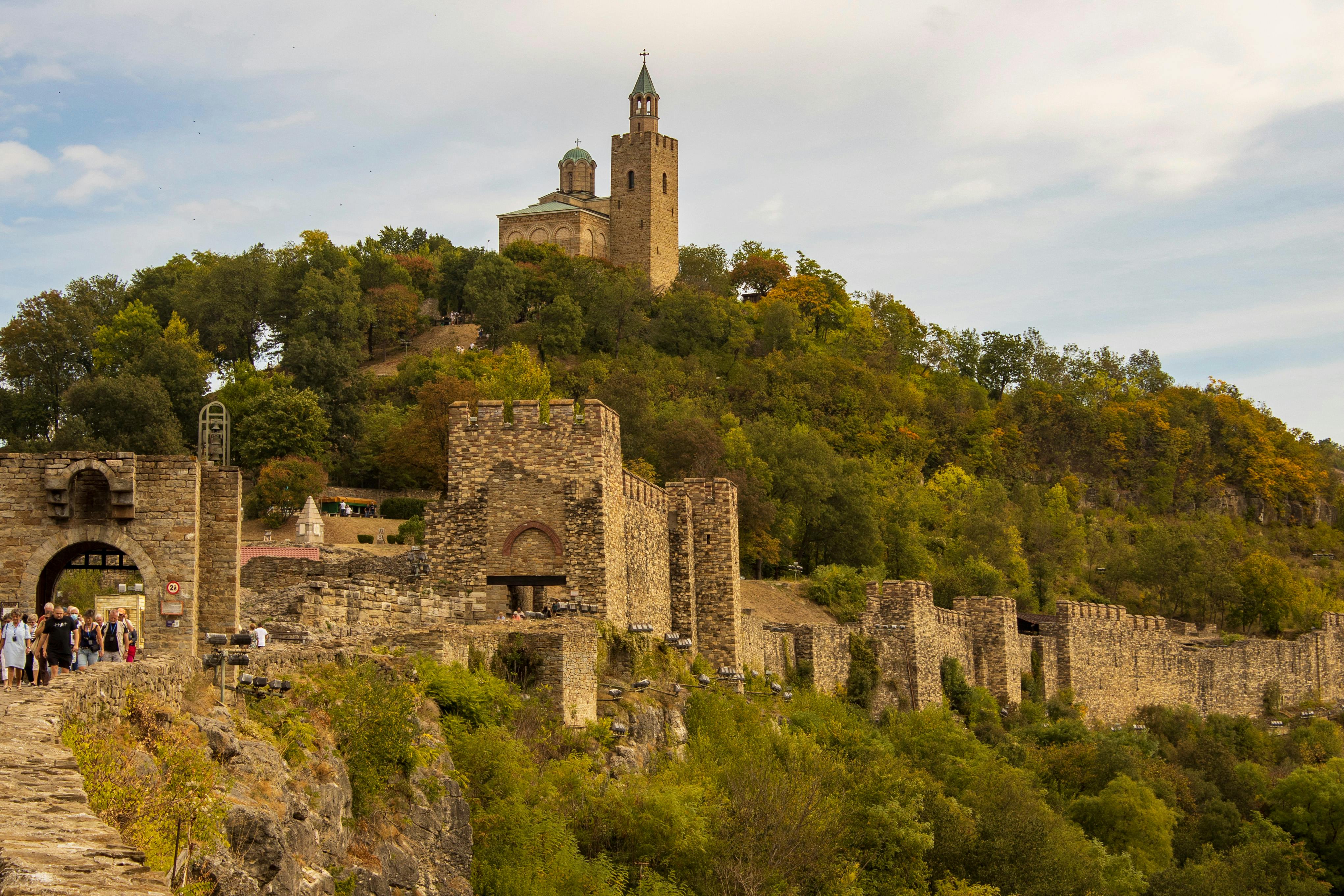
The stone walls rise from the ridge like the spine of a sleeping giant, their 3.6-meter thickness a silent declaration of power. You cross the drawbridge—the main gate's original mechanism long gone, but the narrow rock massif beneath your feet still a natural moat—and step into the courtyard of Tsarevets . Below, the Yantra River carves a dramatic U-shaped loop around the hill, a liquid fortress wall that has protected this citadel since the 2nd millennium BC . Here, between 1185 and 1393, twenty-two Bulgarian tsars ruled an empire that rivaled Constantinople itself . The throne hall, the royal chambers, the palace church—all once stood on this 4,872-square-meter plateau at the hill's crest . Today, the 206-meter (676-foot) summit still hums with the ghost of empire. The bells of the reconstructed Patriarchal Cathedral ring out across Veliko Tarnovo, just as they did when Asen I declared this hill the capital of the Second Bulgarian Empire. This is not a ruin. This is a resurrection carved in stone .
Why Tsarevets Embodies the Second Bulgarian Empire
The fortress solved a problem that faced every medieval ruler: how to turn a hill into an unbreachable capital. Its builders chose well. Tsarevets sits on a natural acropolis, surrounded on three sides by the Yantra River, accessible only by a narrow rock bridge that once featured a drawbridge and three fortified gates . The fortress walls, restored throughout the 20th century, reach up to 3.6 meters (12 feet) thick in some sections . Inside, archaeologists have uncovered 470 residential buildings, 23 churches, and four monasteries—a medieval city compressed onto a single hill . The Royal Palace occupied the central plateau: 4,872 square meters containing the throne room, a palace church, and the tsar's private chambers . On the summit stood the Patriarchate, a 3,000-square-meter complex crowned by the Cathedral of the Ascension of the Lord . The Ottomans besieged Tsarevets for three months in 1393 before finally breaching its walls on July 17, burning the city and ending the Bulgarian Empire . The fortress lay in ruins for nearly 500 years. Restoration began in 1930 and culminated in 1981, opening on the 1,300th anniversary of the Bulgarian state .
The Best Time to Experience Tsarevets Fortress
Plan your imperial pilgrimage between June 15 and September 15, when the fortress basks in temperatures of 22°C to 28°C (72°F to 82°F). The best time of day is 8:00–10:00 AM, when the fortress opens at 8:00 AM and the morning light illuminates the Yantra River's curves before the crowds arrive . For photographers, the "golden hour" before sunset (6:00–7:30 PM in summer) paints the stone walls in shades of amber and rose. Do not miss the evening Sound and Light Show, held on summer evenings (typically May–October, select nights at 9:00 PM or later), when the entire fortress is bathed in laser projections synced to dramatic music and narration . The best viewing spot is the square in front of the main gate or the terrace of Hotel Meridian Bolyarski. Avoid August weekends, when the fortress can feel overwhelmed with visitors. Winter visits (November–March) offer solitude but biting cold (0°C to 5°C / 32°F–41°F) and abbreviated hours—the fortress closes at 4:30 PM. For current show schedules and opening hours, consult: www.tsarevets.eu.
Approximate Budget for a 7-Day Trip (Veliko Tarnovo + Day Trips)
This budget assumes six nights in Veliko Tarnovo, with the fortress as the centerpiece. Veliko Tarnovo offers exceptional value for a European cultural destination. Prices in Bulgarian Lev (BGN) and Euros (1 BGN ≈ €0.51).
- Accommodation: 30–90 BGN per night – Budget: Hostel Mostel on ul. Yordan Indzheto offers dorm beds from approximately 30 BGN (€15) including breakfast and dinner pasta, a 5-minute walk from the fortress . Mid-range: Hotel Akvaya (40 Luben Karavelov Str.) offers double rooms from approximately 90 BGN (€45) with fortress views . Splurge: Hotel Studio on Ivan Asen I Square offers rooms from approximately 140 BGN (€70) with panoramic fortress views .
- Food: 35–60 BGN per day – Breakfast: 5-10 BGN for banitsa and coffee; Lunch: 12-18 BGN in the Varusha district's traditional mehanas (taverns); Dinner: 20-25 BGN for grilled meats, shopska salad, and local wine. Homemade breakfasts are included at Hostel Mostel and many guesthouses .
- Transportation: 30–50 BGN total – Veliko Tarnovo's old town is walkable. From the bus station to the fortress, taxi: 5-8 BGN. Day trip to Arbanassi village (UNESCO churches): local bus #10 or 15-minute taxi: 5 BGN each way. Parking at the fortress base: approximately 6 BGN per day.
- Attractions: 25–45 BGN total – Tsarevets Fortress entry: approximately 10 BGN (€5) for adults, discounted for seniors/students . Panoramic elevator inside the cathedral bell tower: additional 4 BGN (€2) . SS. Forty Martyrs Church (near the fortress entrance): 6 BGN. Sound and Light Show: There's no separate ticket; watch from the square for free, or book a restaurant table with a view .
- Miscellaneous: 50 BGN – Handmade ceramic plate from the artisan shops on Gurko Street: 20 BGN; bottle of local Mavrud wine: 15 BGN; Tsarevets fortress souvenir magnet: 5 BGN; traditional "katmi" (pancake) from a street vendor: 5 BGN.
Total estimated budget for 7 days (excluding flights): 650–1,200 BGN (approx. €330–610 / $360–660).
7 Essential Tsarevets Fortress Experiences
- Cross the Drawbridge Where Empires Began: Enter through the main western gate—the only access point to the fortress. Stand on the narrow rock massif and imagine the three fortified gates and drawbridge that once barred entry to Ottoman armies. The gate was reconstructed in 1930, the first step in Tsarevets's resurrection . Take a moment to look back across the chasm. You are entering as royalty once did.
- Climb to the Patriarchal Cathedral (Holy Ascension of God): Ascend to the hill's highest point—the 206-meter summit where the cathedral stands. The exterior is traditional Bulgarian Revival, but the interior is anything but. Painted in 1985 in a striking modernist style, the frescoes depict conventional Christian subjects alongside the glorious and tragic moments of the Second Bulgarian Empire in dark, dramatic tones . This is not your grandmother's Orthodox church—it is an art installation about national trauma.
- Stand on Execution Rock (Prohodna Rock): At the northern tip of the fortress, a rocky outcropping juts over the Yantra River. This was the "Execution Rock," where traitors were pushed to their deaths into the gorge below. In 1300, Tsar Theodore Svetoslav executed Patriarch Joachim here—throwing him from the cliff for alleged conspiracy . The view is beautiful. The history is brutal. Stand at the edge and reflect on medieval justice.
- Ride the Panoramic Elevator Inside the Bell Tower: Inside the Patriarchal Cathedral, a modern elevator ascends the bell tower for 4 BGN . The 60-second ride delivers you to a viewing platform with the most spectacular panorama of Veliko Tarnovo, the Yantra River's dramatic S-curve, and the surrounding hills. Worth every stotinka, especially at sunset.
- Walk the Fortress Walls to Baldwin's Tower: Follow the southeastern wall to Baldwin's Tower, a 1930 reconstruction modeled after the medieval tower in Cherven . This is the spot where Latin Emperor Baldwin I of Constantinople was imprisoned and died as a prisoner of Tsar Kaloyan. Inside, there are mock medieval weapons—axes, swords, and crossbows—for playful photo opportunities .
- Hunt the Lizards Among the Ruins: On sunny summer days, the stone walls of Tsarevets come alive. Hundreds of small lizards bask on the warm rocks, darting into crevices as visitors approach. Look carefully along the southern wall near the palace foundations. The fortress's visitor signs even warn: "Watch out for small lizards on sunny days" . This is the most charming wildlife encounter in Bulgarian archaeology.
- Watch the Sound and Light Show from the Square: On summer evenings (typically Tuesday, Thursday, Saturday, and Sunday nights at 9:00 PM or 10:00 PM, depending on season), the fortress transforms. Lasers in red, blue, green, and yellow wash over the walls while bells toll and recorded narration tells the story of Bulgaria's rise and fall . The best free viewing spot is the square directly in front of the main gate. Arrive 30 minutes early to claim a spot.
3 Hidden Gems Most Travelers Miss
- The 5th-Century Byzantine City of Zikideva: Before the Bulgarians, before the Slavs, there was a Byzantine settlement on this hill. Near the end of the 5th century AD, the Byzantines built a city tentatively identified as Zikideva on the same strategic promontory . Its foundations lie beneath the medieval structures—unmarked, unheralded. To see the oldest stones, walk to the northeastern slope where the wall meets exposed bedrock. The masonry changes from medieval to Roman at a visible seam. You are standing on 1,500 years of continuous fortification.
- The Underground Tunnels beneath the Royal Palace: The 4,872-square-meter Royal Palace complex—with its throne room, palace church, and royal residential chambers—once stood at the hill's center . Beneath it, a network of service tunnels allowed servants to move without being seen. The entrances are now bricked off for safety, but one remains visible on the eastern side of the palace foundations. Peer through the iron grate—you can see the arched stone ceiling descending into darkness, 700 years old.
- The Fresco of the Burning Lions inside the Cathedral: Among the striking modernist frescoes inside the Patriarchal Cathedral, look for the image of lions engulfed in flames. This represents the fall of Veliko Tarnovo to the Ottomans in 1393—the moment when the Bulgarian Empire died. The lions are Bulgaria's national symbol; their burning is an image of national tragedy. Most visitors rush past, drawn to the brighter images of saints. Stop here. The painter's grief is palpable, even without context.
Cultural & Practical Tips
- Wear Sturdy, Non-Slip Shoes: The fortress's paths are original medieval stone—uneven, worn smooth by centuries, and treacherous when wet. Several sections have broken steps and unfenced drops . High heels are dangerous; even sandals are unwise. Proper walking shoes or hiking boots with good grip are non-negotiable.
- Sun Protection Is Essential in Summer: The fortress offers almost no shade . The sun reflecting off the stone walls can be brutal even on relatively cool days. Wear a hat, sunglasses, and SPF 50 sunscreen. Bring at least 1 liter of water per person. There are vending machines near the cathedral, but they are often empty on crowded days .
- Essential Bulgarian for Your Visit: "Blagodarya" (blah-go-DAH-rya)—thank you. "Molia" (MO-lya)—please. To ask the price, "Kolko struva?" (KOL-ko STROO-va). The fortress guards and ticket sellers speak limited English; these phrases will help.
- Photography Rules Are Relaxed—Except Inside the Cathedral: Throughout the fortress grounds, photography without flash is permitted and encouraged. Inside the Patriarchal Cathedral, photography is allowed, but tripods are banned, and flash is prohibited. The frescoes are sensitive to light. The panoramic elevator allows photos from the platform. Drone flights over the fortress are prohibited without a permit from the Ministry of Culture.
- Cash Is Accepted, Cards Are Hit or Miss: The main ticket booth at the main gate accepts credit cards. The panoramic elevator inside the cathedral and the small souvenir kiosk inside the fortress accept cash only. Bring at least 20 BGN in small denominations (5s and 10s) for add-ons. The nearest ATM is in the town center, a 15-minute walk from the fortress .
- Allow a Minimum of Two to Three Hours: The fortress is vast. A hurried visit takes 90 minutes; a proper exploration with stops for photos, the cathedral, Baldwin's Tower, and Execution Rock requires 2.5 to 3 hours. The walk from the main gate to the cathedral at the summit takes 15–20 minutes each way . Do not attempt to "do" Tsarevets in an hour.
- The QR Codes Do Not Work—Read Before You Go: Multiple visitor reviews complain that the fortress's QR codes for audio guides are non-functional . Read a brief history of the Second Bulgarian Empire before you arrive—or hire a guide at the entrance (available for approximately 40 BGN for a 90-minute tour). The fortress has limited interpretive signage in English.
Conclusion: Travel with Reverence, Not Just a Checklist
Tsarevets is not a theme park. It is a mausoleum and a monument, a place where 470 medieval homes once housed a nation's elite, and where 23 churches once rang bells that are now silent. When you walk the walls, you are walking where Tsar Kaloyan imprisoned a Latin emperor and where Tsar Theodore Svetoslav threw a disobedient patriarch to his death. When you stand in the Patriarchal Cathedral, you are standing beneath frescoes painted not with religious devotion but with national grief—the lions of Bulgaria burning, the fall of an empire rendered in modern art. The fortress asks you to slow down. Watch the lizards scatter across the stones. Stand at Execution Rock and look down at the river 50 meters below. Count the 400 residential foundations and imagine the lives they held. Do not carve your name into the 3.6-meter walls; they have survived five centuries of Ottoman rule and three months of siege. They will outlive your graffiti. Touch the stone, yes. But leave only footprints, take only photographs, and carry with you the weight of an empire that burned but refused to disappear.