
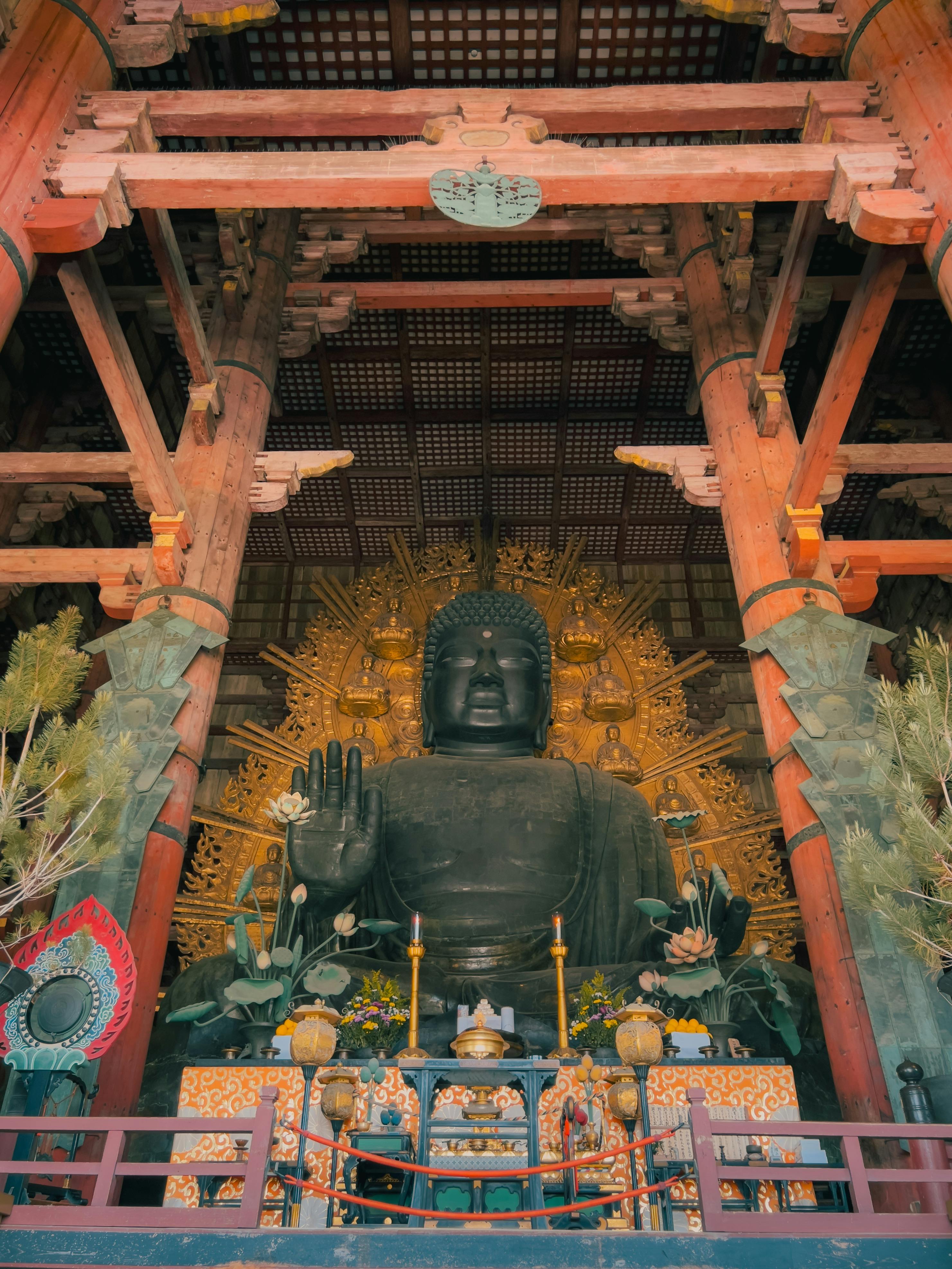
Nara's Great Buddha: Where Divine Bronze Meets Ancient Cedar
The air inside the Daibutsu-den smells of aged wood and incense—a fragrance seven centuries in the making. Sunlight filters through the latticed windows, catching the golden patina of a face that has watched empires rise and fall. You crane your neck upward, past the colossal hands draped in serenity, past the spiral curls numbering 966, until your gaze meets half-closed eyes 1.02 meters (3 feet 4 inches) wide. This is Birushana Butsu, the cosmic Buddha, weighing 500 tonnes (550 short tons) and standing 14.98 meters (49 feet 2 inches) tall. The 16 silver mirrors encircling his halo catch the light like scattered stars. Around you, the rustle of visitors fades into reverent silence. You are standing inside the world's largest wooden building, beneath Japan's most ambitious act of faith—a bronze prayer cast against epidemics, earthquakes, and the chaos of the eighth century.
Why Todai-ji Embodies Imperial Faith and Fire
In 743 CE, Japan was crumbling. A smallpox epidemic between 735 and 737 CE had killed nearly a third of the population, followed by crop failures, famine, and a rebellion led by Fujiwara no Hirotsugu. Emperor Shōmu, having moved his capital four times in a decade, believed only divine intervention could save his nation. His solution was audacious: a colossal bronze Buddha, protected by a hall grander than any in Asia. The Emperor declared that the people themselves would build it—and they responded. According to temple records, more than 2,600,000 people contributed rice, wood, metal, cloth, or labor. Some 350,000 workers labored directly on the statue itself, casting it in eight separate parts over three years. The bronze required most of Japan's copper production; the gold leaf covering the 48 lacquered cinnabar pillars was imported at staggering cost. Today's hall—rebuilt in 1709 after fires destroyed the originals in 1180 and 1567—still spans 57 meters (187 feet) wide, 50 meters (160 feet) deep, and 49 meters (161 feet) tall. Until 1998, it was the largest wooden structure on Earth.
The Best Time to Experience the Great Buddha
Nara rewards those who plan around light and crowds. For the ideal experience—cool temperatures and soft morning light illuminating the Buddha's face—target October 15–November 15 (autumn foliage) or March 20–April 10 (cherry blossoms). During these windows, average temperatures range from 10°C to 21°C (50°F to 70°F), making the walk from Nara Station pleasant. Arrive at the temple gates by 7:30 AM (opening time) to experience the Daibutsu-den with only a handful of visitors. Avoid mid-June through late July—the rainy season brings 185 mm (7.3 inches) of precipitation and humidity exceeding 75%. Also skip August 10–15 (Obon week) when domestic tourists flood Nara, and January 1–3 for New Year's crowds. Winter (December–February) offers crisp, clear air with temperatures between 2°C and 9°C (36°F to 48°F), but the shorter daylight limits photography..
Approximate Budget for a 7-Day Trip (Nara Focus)
Nara is remarkably affordable compared to Kyoto or Tokyo. This budget assumes a solo traveler or couple basing themselves in Nara rather than day-tripping from Kyoto, which allows evening access to temples and quieter mornings. Prices are in US dollars for international travelers; ¥100 ≈ $0.67 USD at current exchange.
- Accommodation: $40–$70 USD per night for budget hostels (Yuzan Guesthouse: $25/dorm bed), $70–$110 for mid-range hotels near Kintetsu Nara Station.
- Food: $20–$48 USD per day. Breakfast (convenience store onigiri + coffee: $5), Lunch (kakinoha-zushi persimmon leaf sushi: $10–$15), Dinner (local chagayu tea porridge or udon: $10–$20).
- Transportation: $6–$10 USD daily. Nara's highlights are walkable; a 1-day bus pass costs ¥500 ($3.30). From Kyoto to Nara: ¥720 ($4.80) one way on JR Miyakoji Rapid Service (35 minutes).
- Attractions: Todai-ji Great Buddha Hall: ¥600 ($4.00). Todai-ji Museum: ¥500 ($3.30). Kasuga Taisha Shrine: Free (inner sanctuary ¥500). Nara National Museum: ¥700 ($4.65).
- Miscellaneous: ¥200 ($1.30) for shika senbei (deer crackers)—a non-negotiable expense for the park's 1,200 friendly deer.
Total Estimated 7-Day Budget (excluding international flights): $550 – $950 USD
7 Essential Todai-ji Experiences
- Pass Through the Nandaimon Gate: Before you even reach the Buddha, stop beneath the Great South Gate. Flanking the entrance stand two 8.5-meter-tall (28-foot) wooden guardians—Ungyo (mouth closed) and Agyo (mouth open). Carved in 1203 by the master sculptor Unkei and his workshop, these Nio protectors have stood guard for over 800 years. Notice the tension in their wooden muscles, the inlaid crystal eyes that seem to follow you.
- Stand Before the Daibutsu's Finger: Inside the Great Buddha Hall, walk around the left side of the statue. You'll find an opening beneath the platform. For ¥100, you can light a candle and pass through a hollow pillar whose interior is said to be the same diameter as the Buddha's nostril. Legend claims those who squeeze through receive enlightenment in their next life—or at least a memorable photo.
- Visit at 7:30 AM Opening: The temple opens at 7:30 AM (November–February: 8:00 AM). Arrive 15 minutes early to watch the monks open the massive wooden doors. The morning light angles directly onto the Buddha's face, illuminating the spiral curls and the golden halo's 16 smaller Buddha figures—each 2.4 meters (8 feet) tall. You will have the hall nearly to yourself until 9:00 AM.
- Explore the Todai-ji Museum: Most visitors skip the modern museum just east of the main hall. This is a mistake. Here you will find artifacts from the original eighth-century temple, including fragments of the ancient bronze lotus petals and detailed models showing how the eight castings were assembled. The museum also houses treasures from the Shosoin Repository, a UNESCO-listed log-storehouse built in 756 CE using the azekura construction method of stacked triangular logs.
- Walk the Nigatsu-do Terrace: Climb the stone steps east of the main hall to the Nigatsu-do (February Hall). At sunset, this wooden balcony offers a panoramic view of Nara city, with the Great Buddha Hall's curved roof below. The Omizutori ceremony here each March—involving giant torches—has been held continuously since 752 CE, the year of the Buddha's eye-opening ceremony.
- Touch the Bronze Lotus Petal: Outside the Daibutsu-den's right side, a 3-meter (10-foot) bronze lotus petal lies on the ground—an original fragment from the 752 CE statue, damaged in the 1180 fire that consumed the first hall. Run your palm across its textured surface. You are touching metal that was molten when the Tang Dynasty still ruled China and Charlemagne had just been crowned.
- Feed the Deer at Sunrise: Before entering the temple grounds, stop at Nara Park. The 1,200 wild sika deer are considered sacred messengers of the gods. Purchase shika senbei (¥200) from one of the many vendors. Bow to a deer before offering the cracker—they have learned to bow back. Visit at dawn (6:00–7:00 AM) when the deer are most active and the park is empty.
3 Hidden Gems Most Travelers Miss
- Shinyakushiji Temple's Eleven-Headed Kannon: Located a 12-minute walk southeast of Todai-ji, this 8th-century temple receives a fraction of the crowds. Inside its main hall stands Japan's oldest surviving Eleven-Headed Kannon statue, carved from a single block of wood in 733 CE. The surrounding Twelve Heavenly Generals—clay statues with fierce, expressive faces—are National Treasures. Insider tip: Visit on a weekday afternoon; you may be the only person in the hall.
- The Underground Museum Path at Kofuku-ji: Most tourists photograph Kofuku-ji's five-story pagoda (third tallest in Japan at 50.1 meters/164 feet) and leave. Few descend into the National Treasure Museum's basement gallery, where an archaeological excavation has been preserved in situ. You walk on glass above 8th-century foundation stones and drainage channels, with holographic projections showing how the original complex appeared. Insider tip: The basement is only open 10:00 AM–4:00 PM; combined ticket with the main museum costs ¥900.
- Naramachi's Merchant Houses: A 15-minute walk south of Todai-ji lies Naramachi (Nara Town), the city's former merchant district. Here, narrow alleys pass between traditional machiya townhouses with lattice windows and clay walls. Visit the Kosugi House, a restored Edo-period sake brewery now a free museum. Insider tip: On Saturdays and Sundays, many private owners open their courtyards to the public—look for small "Open Garden" signs in Japanese (開園).
Cultural & Practical Tips
- Etiquette: Never touch the Buddha statue—security cameras monitor constantly. At the incense burner before the main hall, wave the smoke toward your body to purify your health. Remove sunglasses and hats when facing the Buddha as a sign of respect.
- Phrase: Learn "Shika senbei o kudasai" (Shee-kah sen-bay oh koo-dah-sai) — "Deer crackers, please." The vendors at Nara Park will smile at your effort. For a blessing: "Gokigen'you" (Go-kee-gen-yoh), a formal Nara greeting preserved from the Heian period.
- Photography Rules: No tripods or monopods inside the Daibutsu-den—the crowds and wooden floors pose safety risks. Flash photography is prohibited because the light damages ancient pigments on the lotus pedestal. The best photo spot is outside the Nandaimon gate at 4:30 PM, when the setting sun silhouettes the guardians.
- Deer Safety: The deer may bow, but they are wild animals. Keep your backpack zipped; they have learned to open snaps. Do not tease them with crackers—they will nip. If a deer becomes aggressive, raise both hands above your head (the signal that you have no food).
- What to Wear: The Daibutsu-den is not heated or cooled. In winter, temperatures inside match the outdoors (as low as 0°C/32°F). Summer humidity makes the hall feel like a sauna (30°C/86°F with 75% humidity). Wear layers, bring water, and wear comfortable walking shoes—you will cover at least 8 kilometers (5 miles) exploring the complex.
- Cash is King: Many small temples, shrine shops, and food stalls in Nara do not accept credit cards. Withdraw ¥5,000–¥10,000 ($33–$66) at the 7-Eleven near Kintetsu Nara Station before entering the park.
- A Special Note on the 2026 Antenna: Starting April 2026, free Wi-Fi will be installed throughout Nara Park and Todai-ji grounds as part of the city's "Smart Heritage" initiative. Look for the signs with the deer logo to connect without using mobile data.
Conclusion: Travel with Presence, Not Just Pictures
It would be easy to spend twenty minutes at the Great Buddha: walk in, tilt your phone upward, capture the bronze face, and leave. But the Daibutsu is not a monument to be checked off—it is a 500-tonne prayer cast in metal. When you stand at the base of the lotus pedestal, you are standing where 10,000 monks gathered in 752 CE for the eye-opening ceremony, where Emperor Shōmu's wife donated 10,000 mirrors to the temple treasury, where generations rebuilt this hall from ash after war and earthquake. The deer bowing on the lawn, the cicadas buzzing in July, the weight of the bronze above you—these are the textures of living history. Slow down. Let your eyes trace the halo's 87-foot diameter. Listen to the echo of your footsteps on stone that has carried pilgrims for thirteen centuries. Travel here not to see a statue, but to receive its silent blessing—a reminder that even in devastation, faith builds cathedrals of wood and bronze, and they endure.