
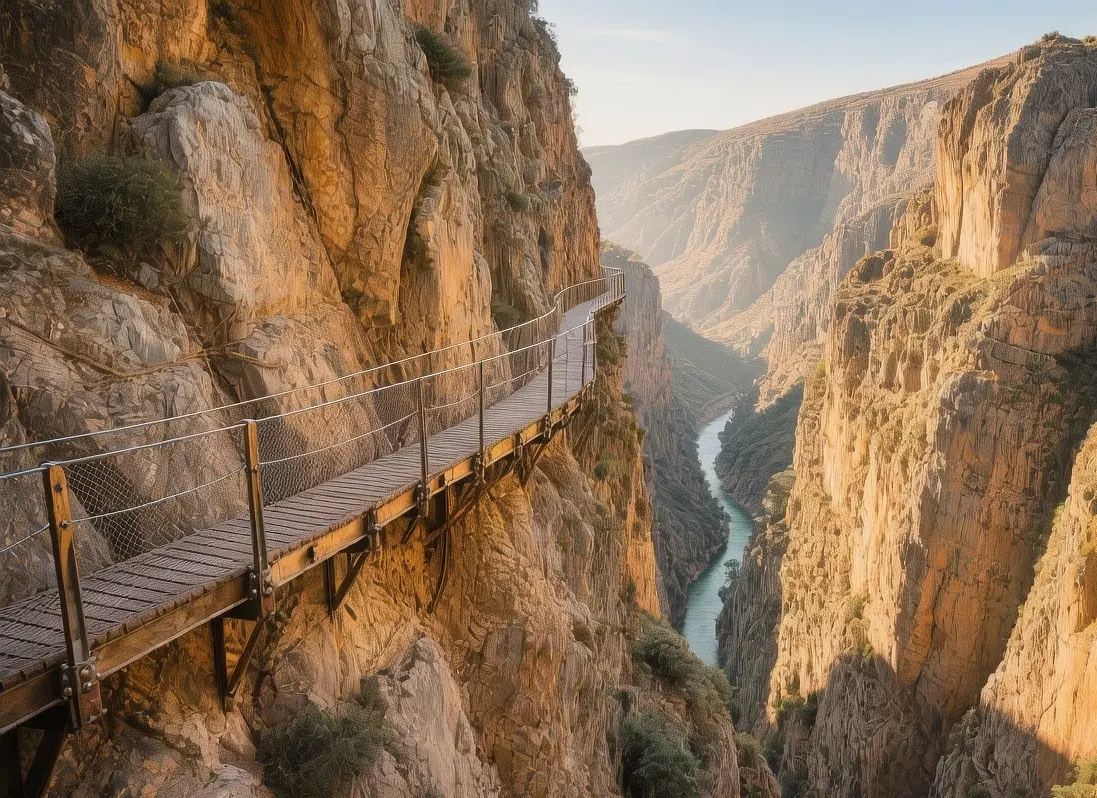
Caminito del Rey Cliffside Walkway Meets Andalusian Gorge
The wind whistles through the limestone canyon—a sharp, whistling gust that has swept through the Desfiladero de los Gaitanes for millennia. You stand at the entrance to the Caminito del Rey, where the air smells of pine and heated rock; the turquoise waters of the Guadalhorce River flow 100 meters below your feet. This is not merely a walkway but a resurrected engineering marvel, originally built between 1901 and 1905 to transport workers between hydroelectric plants, now restored and reopened in 2015 as one of Europe's most spectacular hiking experiences. You hear the distant echo of water cascading through the gorge; the murmur of fellow hikers preparing for the 7.7-kilometer journey; the silence of the vertical limestone walls rising 300 meters on either side. In 2026, as adventure tourism surges globally, the Caminito del Rey remains a testament to human ingenuity and nature's grandeur—a place where engineering ambition meets geological wonder, demanding you look down to feel the vertigo of the past and up to appreciate the cathedral-like cliffs that have stood sentinel for millions of years.
Why Caminito del Rey Embodies Engineering Resurrection
The Caminito del Rey represents one of the most dramatic engineering resurrections in modern tourism history, solving the critical need to preserve a dangerous industrial heritage while creating safe public access to one of Andalusia's most spectacular natural landscapes. Originally constructed between 1901 and 1905 by King Alfonso XIII's engineer Rafael Benjumea, the walkway was designed to transport workers and materials between the Chorro Falls and Gaitanejo hydroelectric plants. The original structure consisted of narrow concrete paths bolted to the vertical limestone walls, with sections suspended 100 meters above the Guadalhorce River gorge.
After decades of deterioration that earned it the nickname "world's most dangerous walkway," the path was closed in 2001 following several fatal accidents. The €9 million restoration project, completed in 2015, involved installing 2,900 meters of new wooden boardwalks anchored to the cliff face with stainless steel supports, while preserving 1,300 meters of the original concrete path. The engineering challenge was immense: how to create a safe walking experience 100 meters above a river gorge while maintaining the dramatic vertical experience. The solution features safety railings 1.2 meters high, non-slip decking, and controlled access limiting visitors to 50 people per hour. This integration of industrial heritage, natural beauty, and modern safety standards makes the Caminito del Rey not merely a hiking trail but a living museum of early 20th-century engineering, where every step tells a story of resurrection from danger to accessibility.
The Best Time to Experience Caminito del Rey
For the optimal Caminito del Rey experience, target May 15–June 20 or September 10–October 25, when temperatures range between 18–28°C (64–82°F) and the light is clear for photography. The walkway opens at 9:00 AM daily; arrive at the control center by 8:30 AM to complete the safety briefing and equipment check before your assigned time slot. Morning entries between 9:00–11:00 AM offer the best lighting for photography as the sun illuminates the eastern cliff faces, while afternoon entries between 2:00–4:00 PM provide cooler temperatures and softer light. Spring coincides with wildflower blooms along the gorge, causing demand to increase 40–60%; book tickets three months in advance as daily capacity is limited to 500 visitors.
Avoid July 15–August 25 unless you tolerate extreme heat; temperatures regularly exceed 35°C (95°F), making the exposed walkway uncomfortably hot with minimal shade. The lack of ventilation in the gorge exacerbates the heat. Winter months (December–February) bring mild weather (10–18°C / 50–64°F) but occasional rain can make the wooden boardwalks slippery, and the walkway closes during high winds exceeding 50 km/h. The path is closed on Mondays for maintenance; verify current status at www.caminitodelrey.info or contact the control center at info@caminitodelrey.info (+34 952 456 636). Weekday mornings typically see the lowest visitor density, allowing for clearer photography of the gorge without crowds obstructing your shots.
Approximate Budget for a 7-Day Trip (2026)
The Caminito del Rey region offers excellent value for adventure travelers, with costs generally 20–30% lower than Málaga city. The following budget assumes mid-range comfort with a focus on outdoor experiences and local culture, based on 2026 pricing with approximately 3.5% inflation from 2025 figures. Estimates include stays in nearby towns like Álora or Ardales for easy access to the walkway and other Andalusian attractions.
- Accommodation: €60–€120 per night for a double room in a casa rural or boutique hotel in Álora or Ardales; luxury options with gorge views command €150–€300 per night
- Food: €35–€55 per day—breakfast €5–€8 (café con leche and tostada), lunch €12–€20 (menú del día including migas, salad, and local wine), dinner €18–€28 (tapas selection including jamón ibérico and pescaíto frito)
- Transportation: Flight to Málaga Airport: €80–€200 round-trip from European cities; train from Málaga to Álora: €5 (45 minutes); taxi from Álora station to Caminito control center: €15; regional car rental: €35 per day; shuttle bus: €8 round-trip
- Attractions: Caminito del Rey entry: €10; El Chorro reservoir boat tour: €15; Gaitanejo viewpoint: free; Ardales castle: €4; guided hiking tour: €35
- Miscellaneous: Hiking gear rental €20; local wine €7–€18 per bottle; hornazo pastry €8; artisan ceramics €25–€60; hiking poles €15
Total estimated cost for 7 days: €750–€1,200 per person (based on double occupancy; solo travelers should add 35–45% for single supplements)
7 Essential Caminito del Rey Experiences
- Walk the Suspended Boardwalk: Traverse the 2,900 meters of wooden walkways bolted to the vertical cliff face. The path hangs 100 meters above the Guadalhorce River. Visit at 9:00 AM opening time to experience the walkway before crowds obscure the views. The boards creak slightly underfoot—a reminder of the height. Allow 3–4 hours for the full 7.7-kilometer route. This is the iconic Caminito del Rey experience; do not rush the moment.
- Photograph the Gorge Walls: Capture the vertical limestone cliffs rising 300 meters on either side. The rock formations display millions of years of geological history. Visit between 10:00 AM–12:00 PM when lighting accentuates the striations. The turquoise water below contrasts with the grey stone. Bring a wide-angle lens to capture the scale. This reveals the geological wonder of the gorge.
- Visit the Original Path Sections: Examine the preserved 1,300 meters of original 1905 concrete walkway. The deteriorated sections demonstrate why restoration was necessary. Visit at 2:00 PM when the guide explains the engineering history. The contrast between old and new is striking. Audio guides available in six languages for €3. Allow 15 minutes to appreciate the restoration work.
- Cross the Suspension Bridge: Walk across the final suspension bridge connecting the two sides of the gorge. The bridge sways slightly in the wind. Visit in late afternoon when the light is soft. The view extends down the entire gorge. Entry is included with the ticket. This provides the most dramatic perspective of the walkway.
- Explore El Chorro Reservoir: Visit the reservoir at the northern end of the walkway. The turquoise water reflects the surrounding cliffs. Visit at 4:00 PM when the temperature cools. Boat tours available for €15. It reveals the purpose of the original hydroelectric infrastructure. This demonstrates the industrial heritage of the area.
- Hike the Access Trail: Walk the 1.5-kilometer access path from the control center to the walkway entrance. The trail winds through pine forest and offers preview views of the gorge. Visit at 8:30 AM before your assigned entry time. The hike takes 20 minutes. It builds anticipation for the main experience. This reveals the natural beauty surrounding the walkway.
- Attend the Safety Briefing: Participate in the mandatory 10-minute safety presentation before entering. The staff explains emergency procedures and proper behavior on the walkway. Visit at your assigned time slot. Helmets are provided free of charge. It ensures a safe experience for all visitors. This demonstrates the professional management of the site.
3 Hidden Gems Most Travelers Miss
- Gaitanejo Viewpoint: Located 2 kilometers from the northern exit at Ardales, this viewpoint offers panoramic views over the entire gorge system. Entry is free; open 24 hours. It is often overlooked as visitors focus on the walkway. The perspective allows you to see the walkway clinging to the cliffs from above. Contact: +34 952 456 636. Visit early morning for photography without crowds. The view reveals the full scale of the engineering feat.
- El Chorro Train Station: A 10-minute walk from the northern exit, this historic station features original 1900s architecture and serves as a museum. Entry: €3; open 10:00 AM–6:00 PM. It is often overlooked by tourists rushing to return to Málaga. The station displays photographs of the walkway's construction. Contact: +34 952 456 636. Visit mid-morning when light illuminates the exhibits. The perspective allows you to understand the industrial heritage.
- Ardales Castle Ruins: Located 5 kilometers from the walkway at Ardales, these 10th-century Moorish ruins offer stunning views over the reservoir. Entry: €4; open 10:00 AM–6:00 PM. It is often overlooked as visitors focus on the walkway. The castle walls date to the Caliphate period. Contact: +34 952 456 636. Visit late afternoon when the light is soft. The perspective allows you to see the walkway in the distance.
Cultural & Practical Tips
- Booking requirements: The Caminito del Rey requires advance booking; walk-ins are not permitted. Book tickets at least 2–3 months in advance, especially for spring and fall. Tickets cost €10 and include helmet rental. Verify availability at www.caminitodelrey.info.
- Master these phrases: "Buenos días" (BWEH-nos DEE-as) for good morning; "Por favor" (por fah-BOR) for please; "¿Cuánto cuesta?" (KWAN-toh KWES-tah) to ask price; "La cuenta, por favor" (lah KWEN-tah) to request the bill.
- Photography guidelines: Photography is permitted throughout the walkway. Tripods are not allowed due to space constraints. Drones are strictly prohibited. Flash photography is discouraged. Mobile phones must be secured with wrist straps. Early morning offers the best light without crowds.
- Safety equipment: Helmets are mandatory and provided free at the control center. Wear sturdy hiking shoes with good grip; sandals and flip-flops are prohibited. The walkway is not suitable for visitors with severe vertigo or mobility issues. Children under 8 years old are not permitted.
- Hydration strategy: The walk takes 3–4 hours with limited shade; carry at least 1.5 liters of water per person. Public fountains are available at the control center and exit points. The water is potable. You'll save €2–€3 by bringing your own bottle. Purchase water from kiosks if needed.
- Weather considerations: The walkway closes during high winds exceeding 50 km/h and heavy rain. Check the forecast before your visit. Summer temperatures exceed 35°C (95°F) with minimal shade; bring sun protection. Winter temperatures range 10–18°C (50–64°F); bring a light jacket.
- Physical requirements: The walkway involves 7.7 kilometers of walking with some steep sections. A moderate level of fitness is required. The path is not suitable for wheelchairs or strollers. Allow 3–4 hours for the complete experience including access trails.
Conclusion: Travel with Reverence, Not Just Reverie
The Caminito del Rey demands more than casual observation—it asks for contemplation of the delicate balance between human engineering and natural grandeur, between industrial heritage and ecological preservation. When you walk this suspended path in 2026, you're not merely completing a hike; you're participating in a remarkable story of resurrection where danger has been transformed into accessibility without sacrificing the drama that makes this place extraordinary.
Choose to engage deeply: respect the safety regulations that protect both visitors and the fragile ecosystem, support local businesses in Álora and Ardales rather than international chains, and understand that this walkway is a shared heritage that requires mindful stewardship. The Caminito del Rey survives not as a thrill ride but as a testament to human ingenuity—and its preservation depends on visitors who recognize the difference between appreciation and consumption.
Slow down. Pause at the viewpoints after crossing the suspension bridge. Listen to the wind moving through the gorge. Watch the light shift across the limestone walls. The walkway rewards those who approach it not as a checklist item but as a conversation between past and present—a dialogue between the workers who built it in 1905 and modern travelers who walk it today, a conversation that continues, like the river below, in perpetual motion.