Cuenca Hanging Houses Medieval Timber Meets Dramatic Limestone Gorge
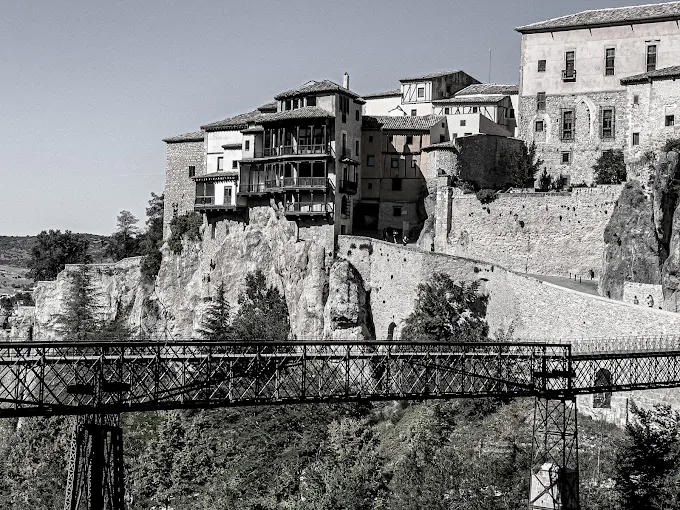
Cuenca Hanging Houses: Where Cliff Edge Meets Living Room
I stand on the stone bridge at ten in the morning. Sun strikes wood and plaster jutting straight out over empty space. Entry to the museum inside costs six euros. I lean slightly over the railing — the gorge drops sheer below, hundreds of feet to the river far down. Three storeys of balconies hang from the rock face, built right into the sandstone. Not everything feels perfect. The bridge fills fast. The narrowest sections bottleneck. Some viewpoints stay crowded. Yet these houses are one of Spain’s most improbable sights — dwellings where the floor ends and the air begins.
Why Cuenca Hanging Houses Matter
Cuenca rose as a fortified city on a steep ridge between two rivers in the 12th century. As space grew tight, residents built outward — cantilevering timber-framed rooms and balconies from the cliff face itself. By the 15th century these dwellings stood complete, occupied by merchants and craftspeople. Over time many were abandoned or collapsed. The remaining few were restored in the late 20th century, one now housing the Museum of Abstract Art. They became the city’s defining landmark — proof of how people adapt to impossible terrain. That fame brings pressure. Footfall strains the bridge. Queues form early. Balancing preservation with mass visitation grows harder. Still the balconies hang. The river flows far below. And people still live in parts of the cliff.
The Best Time to Experience Cuenca
April through June brings fresh green and soft light — 11°C to 21°C (52°F–70°F). The sandstone glows warmest in late afternoon. September offers golden leaves and thinner crowds — 13°C to 23°C (55°F–73°F). Summer from July to August stays warmest — 16°C to 29°C (61°F–84°F) — but the bridge fills by mid-morning. Winter from November to March stays cool and quiet — 5°C to 12°C (41°F–54°F). Low sun casts the houses in sharp relief. Weekdays beat weekends. Arrive before 09:30 to cross the bridge almost alone.
Approximate Budget for a 7-Day Trip
- Accommodation: Guesthouse in old town — 50–80 euros per night. Apartment overlooking gorge — 70–130 euros per night. Boutique hotel in cliff building — 100–200 euros per night. Campsite outside city — 15–22 euros per person.
- Food: Moorish stew lunch — 13–22 euros. Tapas dinner — 12–20 euros. Market meal — 8–14 euros. Pastry and coffee — 3–6 euros.
- Transport: High-speed train from Madrid — 35–60 euros one way. From Valencia — 30–50 euros. Local bus — 1.70 euros. Parking — 5–8 euros daily.
- Attractions: Hanging Houses museum — 6 euros. Cathedral — 4 euros. Castle viewpoint — free. Abstract art centre — 5 euros.
- Miscellaneous: Comfortable shoes, water — 8–15 euros daily.
Total estimated for one person, 7 days: 350–660 euros
Cafes right beside the bridge charge nearly double what you find five minutes uphill. Walk toward the main square. You will find family-run places serving better food at fairer prices.
Essential Hanging Houses Experiences
- Cross the bridge at sunrise. No crowds, no noise — just you and the houses hanging above the gorge. Light hits the balconies edge-on. It feels like stepping into a dream. Skip this if thick fog hangs low — the view vanishes completely.
- Step inside one of the houses. Wooden floors, plaster walls, windows looking straight out over empty space. You see how people lived — waking, eating, sleeping with a sheer drop beneath the floor. It humbles you.
- Walk the opposite gorge rim at golden hour. The houses stand lit up against shadowed rock. Every balcony, every beam clear. This is the classic view — and it belongs to anyone who walks ten minutes.
- Climb the castle ruins above. The whole city unfolds below — ridge, gorge, river loop, houses clinging to every slope. You see why Cuenca was built here — and how brave those first builders were.
- Explore the cathedral afterwards. Tall, light, quiet — built from the same golden stone. It feels solid and grounded, a perfect counterpoint to the houses hanging out over air.
- Eat local lamb in the old town. Slow-roasted, rich, tender — raised on the hills surrounding the city. Served with red wine from nearby slopes. It tastes of this high, rocky land.
Hidden Gems Most Travelers Miss
- The small path halfway down the opposite gorge wall. Most stay at the top viewpoint. Descend a little. You look level with the balconies — eye to eye with the hanging rooms. Almost no one stops here.
- The quiet lane behind the main houses. Runs parallel to the tourist route. Old doorways, shaded courtyards, locals going about their day. It feels like the real Cuenca.
- The so-called "perfect photo spot" right at the bridge end. It fills instantly. Walk fifty metres along the rim. The same houses appear framed by trees and rock — empty and just as magnificent.
Cultural & Practical Tips
- Do not lean on the bridge railings. They are old and the drop is sheer. Stand back, take your time, and keep children close.
- Arrive early or late. By 11:00 the bridge becomes a slow shuffle. The most beautiful moments come when you can stand and look without being hurried.
- Wear comfortable non-slip shoes. The old town climbs constantly. Cobblestones are worn smooth. Sturdy soles matter.
- Respect quiet in the residential sections. Some hanging houses are still lived in. Keep voices low and do not linger outside windows.
- Check sunset times. The light changes fast here. Be in position early — the best colour lasts barely ten minutes.
- Book accommodation months ahead in August. Prices rise fast. May or September offer better value and thinner crowds.
Essential Visitor Information
Location & Access: Cuenca, Castilla–La Mancha, Spain. 165 km east of Madrid — 1 hour by high-speed train. 190 km southwest of Valencia — 2 hours. The old city sits on a ridge between two deep river gorges.
Tickets & Booking: Bridge and exterior — free. Museum inside Hanging Houses — 6 euros. No reservation needed for individuals. Reserve accommodation June–September well ahead.
Operating Hours: Always accessible. Museum — generally 10:00–14:00 and 16:00–19:00. Closed Mondays.
Visit Duration: Minimum 1–2 days. 3 days lets you explore both gorges, old town, cathedral, and surrounding countryside without rushing.
Family Suitability: Good for older children. Bridge railings are high and secure. Narrow sections and sheer drops require supervision. Restrooms at both ends of the bridge.
Timing: Best season — April–June and September. Best time — before 09:30 or 1 hour before sunset.
Highlights: Sunrise bridge, inside the houses, opposite rim sunset, castle viewpoint, cathedral, old town meal.
Nearby & Day Trip: Ciudad Encantada — 30 mins. Alcalá del Júcar — 1 hour 30 mins. Teruel — 1 hour 45 mins. Madrid — 1 hour by train.
Conclusion: Travel with Boldness, Not Just Wonder
These houses were not built by magic. They were built by people who looked at impossible ground and said we will live here anyway. Before you leave, look at the farthest balcony. What will you build where others see only empty space?
Post a Comment