
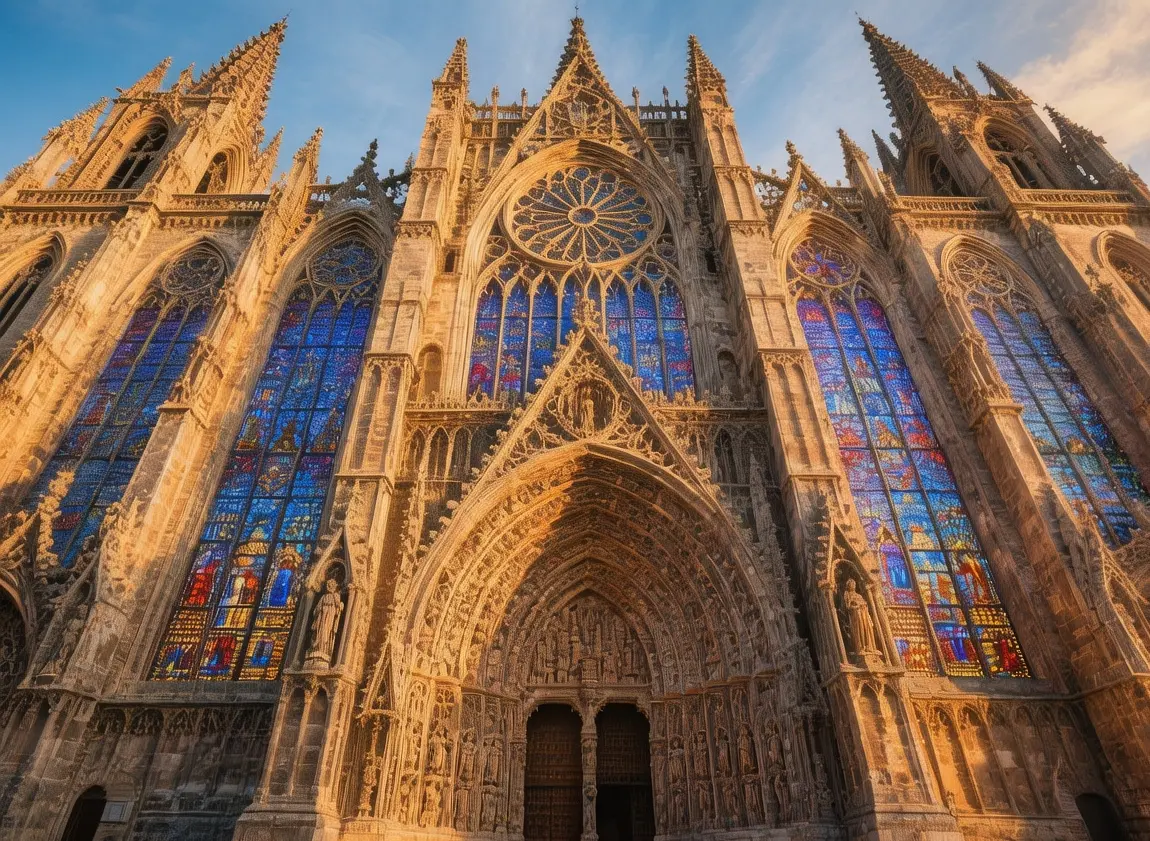
León Cathedral Gothic Light Meets Castilian Stone Heritage
The afternoon sun filters through 1,800 square meters of medieval stained glass as you step into the nave—your eyes adjust to the kaleidoscope of ruby, sapphire, and emerald light that has illuminated this sacred space for over seven centuries. Construction began in 1205 under Bishop Alfonso IX, making the León Cathedral one of Spain's most纯粹 Gothic monuments, a structure so devoted to light that its stone walls seem to dissolve into colored radiance. You stand beneath vaulted ceilings soaring 40 meters (131 feet) high, where the famous Pulchra Leonina—Beautiful Leonese—earned its name through architectural audacity that pushed medieval engineering to its limits. The air smells of ancient stone and beeswax candles; the silence is profound, broken only by the distant echo of footsteps on flagstones worn smooth by pilgrims walking the Camino de Santiago. In 2026, as historic cathedrals face mounting preservation challenges from climate change and overtourism, this place matters now more than ever: it represents a fragile balance between accessibility and conservation, demanding that you witness medieval artistry without compromising the very light that makes it transcendent.
Why León Cathedral Embodies Gothic Light Mastery
The León Cathedral represents far more than a religious monument—it stands as the supreme achievement of Spanish Gothic architecture and the most ambitious experiment in light manipulation ever attempted in medieval Europe. When Master Architect Enrique designed the cathedral in the early 13th century, he faced a critical structural problem: how to create walls of glass without compromising the building's stability against the harsh Castilian winters and seismic activity. The solution was revolutionary: reducing stone walls to slender columns and filling the remaining space with stained glass, creating a structure where 30% of the surface area consists of colored windows—a percentage unmatched by any other cathedral in Spain. This approach solved the immediate need for a grand episcopal seat while creating a theological statement about divine light penetrating the material world.
The engineering specifics reveal the audacity of the design: the cathedral measures 87 meters in length and 40 meters in height at the nave, supported by flying buttresses that transfer the roof's weight to external piers. The stained glass windows, created between 1250 and 1450 by French and Spanish masters, contain over 1,000 individual panels depicting biblical scenes, saints, and zodiac signs. Each panel utilizes pot metal glass—colored throughout its thickness rather than painted on surface—ensuring the vibrancy survives 700+ years of sunlight exposure. The famous Rose Window on the western facade measures 8 meters in diameter and contains 16 radial sections depicting the Last Judgment. After major restoration work completed in 2015 (costing €3.2 million), the windows were cleaned and stabilized using modern conservation techniques that preserve the original medieval glass. Today, the cathedral fulfills a dual need: functioning as an active diocesan seat while serving as a museum of medieval art. With 400,000 annual visitors, the León Cathedral remains structurally sound through continuous monitoring by the Cathedral Chapter and the Spanish Ministry of Culture, preserving a dialogue between faith and artistry that defines the Gothic imagination.
The Best Time to Experience León Cathedral
While the doors of the León Cathedral open daily at 9:30 AM, your experience depends heavily on the continental climate of Castilla y León and the angle of sunlight through the stained glass. For optimal visiting conditions, target May 15–June 20 or September 10–October 15, when daytime temperatures average 18–26°C (64–79°F) and rainfall is moderate. During these windows, you'll explore the cathedral and the old town comfortably without the biting winds of winter or the scorching heat of summer. The light during these months also enhances the stained glass colors, creating ideal photography conditions for the interior windows.
For the most atmospheric experience, arrive between 10:00–11:30 AM when the eastern windows catch the morning sun and the cathedral fills with colored light, or during late afternoon (4:00–6:00 PM) when the western Rose Window glows with golden hour illumination. Morning visits offer the clearest air for viewing the intricate glass details without crowd reflections. Winter months (December–February) bring colder temperatures of 4–12°C (39–54°F) and occasional snow, which dramatically reduces crowds but requires warm clothing for outdoor viewing. The cathedral looks dramatic under grey skies, though the stained glass appears less vibrant without direct sunlight.
Avoid July 20–August 25 and Spanish national holidays (Semana Santa/Easter Week, August 15 Assumption Day) when daily visitor numbers spike and temperatures soar to 30–36°C (86–97°F). Midday tours during peak season create bottlenecks near the main altar and the Museum entrance. For real-time opening hours and Mass schedules that may limit access, check the official website at www.catedraldeleon.org or call +34 987 875 670 before your visit.
Approximate Budget for a 7-Day Trip (2026)
León offers exceptional value compared to Madrid or Barcelona, though prices have risen 21% since 2020 due to tourism growth and inflation. This budget assumes moderate comfort—clean, well-located accommodation; authentic meals at traditional Castilian restaurants; and selective paid attractions. Prices reflect 2026 rates with approximately 4% annual inflation factored into estimates. This budget covers a relaxed 7-day stay based in León with day trips to nearby Astorga and the wine region.
Accommodation: €60–€120 per night for a double room in a historic hotel in the Old Town (Barrio Húmedo); budget hostels from €35/night
Food: €30–€50 per day
-
• Breakfast: €3–€6 (café con leche €2.20, tostada con jamón €3.50)
Transportation:
-
• AVE High-Speed Train from Madrid: €35–€55 one-way (Renfe, 2 hours 15 minutes)
Attractions:
-
• León Cathedral entrance: €7 adults, €4 students
Miscellaneous:
-
• Local wine bottle (Bierzo DO): €10–€18
Total for 7 days (per person, double occupancy): €750–€1,150
7 Essential León Cathedral Experiences
- View the Stained Glass at Morning Light: Enter the cathedral between 10:00–11:00 AM when the eastern windows catch direct sunlight. The nave transforms into a kaleidoscope of colored light on the stone floor. The sound of your footsteps echoes softly on the flagstones. This is the best time to photograph the windows without crowd reflections. The experience should not be rushed—sit in a pew and watch the light shift.
- Climb the Cathedral Rooftops: Ascend the 226 steps to the roof walkway between 9:30–10:30 AM to avoid crowds. The spiral staircase is narrow and steep, so wear sturdy shoes. From the top, you gain a panoramic view of the city and the flying buttresses. The wind is often strong here—secure loose items. Your guide will point out the original Gothic stonework visible from above.
- Explore the Cathedral Museum: Located in the cloister, this museum houses religious artifacts and medieval manuscripts. Access: Inside cathedral complex, open 10 AM–7 PM. Included in entry. Insider tip: Visit the chapter house to see the 13th-century frescoes. It provides context for the cathedral's artistic heritage. The illuminated manuscripts are exceptionally preserved.
- View the Main Altarpiece: This Renaissance masterpiece stands behind the main altar, carved from wood and gold leaf. Spend 15 minutes examining the intricate scenes depicting the life of Christ. The contrast between the Gothic architecture and Renaissance art creates a unique dialogue across centuries. Entry is included with cathedral ticket. The craftsmanship dates back to 1520.
- Dine in Barrio Húmedo: Reserve a table at a restaurant in the Old Town near the cathedral. Order the local specialty cecina de León (cured beef) while watching the light change on the stone facades. Evening dining (9:30 PM) allows you to see the cathedral illuminated against the night sky. The tapas culture is exceptional here, with free portions served with drinks.
- Visit Casa Botines: Located 500 meters from the cathedral, this building was designed by Antoni Gaudí in 1892. The 1-kilometer walk from the cathedral is flat and shaded, making it suitable for families. You will see Modernist architecture contrasting with Gothic. Allow 1 hour for the visit. Bring water as there are limited services along the trail. The connection between Gaudí and medieval inspiration is striking here.
- Attend the Easter Week Processions (If Visiting in Spring): If visiting during Semana Santa, witness the traditional processions winding through the old town. The cathedral fills with music, religious statues, and thousands of pilgrims. Book accommodation 6 months in advance as hotels fill completely. The torchlight processions are spectacular. This event showcases the community spirit that keeps the tradition alive.
3 Hidden Gems Most Travelers Miss
- Crypt of San Francisco: While most visitors focus on the main nave, this 14th-century crypt beneath the cathedral houses medieval tombs and frescoes. Access: Request access at the cathedral office, open 11 AM–1 PM by appointment, €3 entry. Insider tip: The Gothic frescoes date back to 1350 and are rarely photographed. Visit early morning to see the light filtering through the small windows without the midday rush. The preservation is remarkable for its age.
- Cloister Garden: Located adjacent to the cathedral, this peaceful garden features medieval architecture and medicinal plants. Access: Inside cathedral complex, open 10 AM–6 PM. Included in entry. Insider tip: The staff speaks excellent English and provides free maps highlighting less-visited capitals. Ask about the 13th-century carved stones. It provides context for the monastic life you're experiencing. It is often overlooked by those rushing to the stained glass.
- Puerta del Juicio Final (Last Judgment Door): A specific entrance located on the western facade, accessible during guided tours often overlooked by general visitors. This sculptural masterpiece features 13th-century stone carvings depicting the end of time. Access: Western facade, available during 11 AM and 3 PM guided tours. Insider tip: Bring binoculars to see the detailed carvings from ground level. Best visited late afternoon when the light hits the stone. The iconography is among the finest Gothic sculpture in Spain.
Cultural & Practical Tips
- Photography etiquette: Tripods require permission from cathedral security—fines up to €500 for violations. Street photography of locals requires verbal consent; a simple "¿Puedo?" (PWEH-doh) shows respect. Flash photography is prohibited inside the cathedral to protect the stained glass.
- Dress code for churches: Shoulders and knees must be covered to enter the León Cathedral. Carry a lightweight scarf even in summer. Remove hats when entering religious spaces.
- Respect Mass times: The cathedral remains an active church. Check the Mass schedule before visiting as access may be limited during services. Quiet hours are enforced during prayer times.
- Essential phrases: "Buenos días" (BWEH-nos DEE-as) before 2 PM; "¿Dónde está el baño?" (DON-deh es-TAH el BA-nyo) = "Where is the bathroom?"; "La cuenta, por favor" (la KWEEN-ta por fa-BOR) = "The bill, please."
- Weather preparedness: The region experiences extreme temperature shifts. Nights can be 15°C cooler than days. Bring layers and a windproof jacket. Winter visits require heavy coats and sturdy shoes for potentially icy paths on the rooftop climb.
- Tipping customs: Round up restaurant bills or leave 5–10% for exceptional service. Not tipping is acceptable but leaving small change shows appreciation. Taxi drivers appreciate small change rounded up to the nearest euro.
- Accessibility information: The main nave is wheelchair accessible with ramps. The rooftop and museum have limited accessibility. Contact the tourism office for adapted route maps along the ground floor.
Conclusion: Travel with Reverence, Not Just Checklist Tourism
The León Cathedral has witnessed over 800 years of human history—medieval masons carving stone, pilgrims walking the Camino, kings and queens praying beneath the vaults. When you walk these halls in 2026, you're not just capturing images for your gallery; you're stepping into a living narrative of faith and artistry that has endured through wars, earthquakes, and revolutions. The stained glass holding these colors never imagined they would illuminate tourists from every corner of the globe; the artisans who mixed the pigments never conceived their work would become a UNESCO-recognized treasure.
But here's what separates meaningful travel from tourism: this cathedral doesn't need your footprint—it needs your reverence, your willingness to understand the fragility of medieval glass, to recognize that each visitor adds carbon dioxide and heat that can damage pigments applied 700 years ago. In an age of overtourism, León offers a masterclass in preservation—showing us that some wonders demand we subordinate our desire for access to the greater need for protection. View the light, yes, but emerge with something deeper than souvenirs: carry forward a commitment to protect not just this cathedral, but all the fragile, irreplaceable treasures that connect us to our shared human history.