
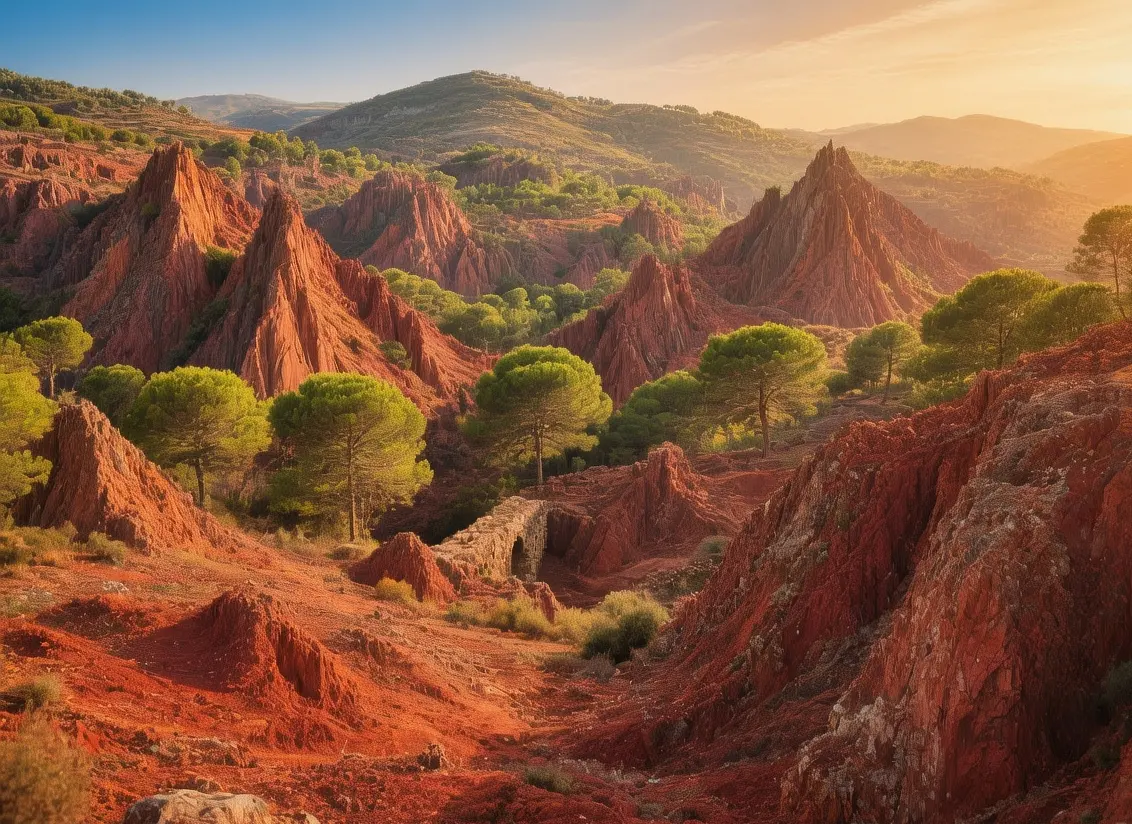
Las Médulas Roman Mines Ancient Engineering Meets Surreal Red Landscape
The wind whispers through the stone pines as dawn breaks over the El Bierzo region—your boots crunch on soil the color of dried blood, a vivid red earth that tells a story of imperial ambition and environmental transformation. Designated a UNESCO World Heritage Site in 1997, the Las Médulas Roman mines stand as the most extensive open-pit gold mine in the Roman Empire, a landscape sculpted by human hands nearly 2,000 years ago using hydraulic power on a colossal scale. You stand before the Orellán viewpoint, gazing across a surreal terrain of jagged red pinnacles and deep ravines where over 20,000 workers once toiled under the supervision of Emperor Augustus. The air smells of resin and dry thyme; the light is soft, casting long shadows that accentuate the erosion patterns carved by water channels built in the 1st century AD. In 2026, as industrial scars mar landscapes globally, this place matters now more than ever: it represents a unique dialogue between human destruction and natural reclamation, demanding that you witness how nature has healed a wound inflicted by the greatest empire history has ever known.
Why Las Médulas Roman Mines Embodies Engineering Audacity
The Las Médulas Roman mines represent far more than an archaeological site—they stand as a testament to Roman hydraulic engineering and the relentless pursuit of resources that fueled an empire. When Emperor Augustus ordered the exploitation of these gold deposits in the 1st century AD, engineers faced a critical geological problem: how to extract gold from alluvial deposits buried beneath hard conglomerate rock without modern explosives. The solution was the ruina montium (ruin of the mountains) technique, a method described by Pliny the Elder that involved channeling water from mountains up to 30 kilometers away into reservoirs perched above the mining site. This infrastructure solved the immediate need for gold to fund Roman legions while creating a landscape alteration so massive it remains visible from space today.
The engineering specifics reveal the scale of the operation: over 7 reservoirs and 100 kilometers of aqueducts were constructed to store and direct water with a pressure head of over 200 meters. When released, the water crashed into the mountainsides with enough force to collapse the rock, washing the debris into sluice boxes where gold was separated using mercury amalgamation. It is estimated that over 5,000 kilograms of gold were extracted over 250 years of operation, requiring the labor of 20,000 workers, many of whom were prisoners or local conscripts. The resulting landscape features red clay pinnacles rising up to 100 meters high, now covered in a forest of stone pines planted by monks in the 18th century to stabilize the soil. Today, the site fulfills a dual need: functioning as a protected cultural park managed by the Las Médulas Foundation while serving as a case study in post-industrial ecological recovery. With 300,000 annual visitors, the Las Médulas Roman mines remain preserved through strict conservation laws enforced by the Junta de Castilla y León, ensuring that the scars of empire become a sanctuary for biodiversity.
The Best Time to Experience Las Médulas Roman Mines
While the trails of the Las Médulas Roman mines remain accessible year-round, your experience depends heavily on the continental climate of the El Bierzo region and the visibility from the viewpoints. For optimal visiting conditions, target May 15–June 20 or September 10–October 15, when daytime temperatures average 18–26°C (64–79°F) and rainfall is moderate. During these windows, you'll hike the routes comfortably without the scorching heat of summer or the muddy paths of winter. The light during these months also enhances the red earth tones, creating ideal photography conditions for the contrast between soil and pine trees.
For the most atmospheric experience, arrive between 8:00–9:30 AM when the morning mist lifts off the ravines and the light is soft, or during golden hour (8:00–9:30 PM in summer, 6:30–8:00 PM in winter) when the sun sets behind the mountains. Early morning visits offer the clearest air for viewing the Orellán viewpoint without haze. Winter months (December–February) bring colder temperatures of 4–12°C (39–54°F) and occasional snow, which dramatically reduces crowds but requires warm clothing and sturdy boots for outdoor viewing. The landscape looks dramatic under grey skies, though some trails may close due to mud.
Avoid July 25–August 25 and Spanish national holidays (August 15 Assumption Day) when daily visitor numbers spike and temperatures soar to 32–38°C (90–100°F). Midday hikes during peak season create exposure risks on the unshaded viewpoints. For real-time weather and trail status, .
Approximate Budget for a 7-Day Trip (2026)
The El Bierzo region offers exceptional value compared to major Spanish cities, though prices have risen 22% since 2020 due to rural tourism growth and inflation. This budget assumes moderate comfort—clean, well-located accommodation; authentic meals at local restaurants; and selective paid attractions. Prices reflect 2026 rates with approximately 4% annual inflation factored into estimates. This budget covers a relaxed 7-day stay based in Ponferrada or Carucedo with day trips to the mines.
Accommodation: €65–€120 per night for a double room in a rural hotel in Carucedo or Ponferrada; budget hostels from €40/night
Food: €35–€60 per day
-
• Breakfast: €4–€7 (café con leche €2.50, toast with tomato €3.50)
• Lunch: €15–€25 (menú del día includes soup, main course like cocido maragato, dessert, wine/water)
• Dinner: €20–€35 (grilled pork €16, local trout €14, glass of Bierzo wine €4)
Transportation:
-
• Train from Madrid to Ponferrada: €40–€60 one-way (Renfe, 4 hours)
• Bus from Ponferrada to Las Médulas: €5 one-way (ALSA, 30 minutes)
• Taxi from station to accommodation: €10–€15
• Car rental for surrounding region: €45/day
Attractions:
-
• Las Médulas Visitor Center: Free
• Guided Mine Tour: €8
• Castle of Cornatel: €4
• Basilica of La Encina: Free
• Wine Tasting in Bierzo: €20
Miscellaneous:
-
• Local wine bottle (Bierzo DO): €10–€18
• Handcrafted slate items: €15–€40
• Travel insurance: €50 for week
• Souvenir honey: €8–€12
Total for 7 days (per person, double occupancy): €850–€1,300
7 Essential Las Médulas Roman Mines Experiences
- View from Orellán Viewpoint: Hike the 1.5-kilometer path to the main viewpoint between 8:00–9:00 AM to avoid crowds. The panoramic vista reveals the full scale of the red earth pinnacles. The wind is often strong here—secure loose items. This is the iconic image of the site and should not be rushed. Allow 30 minutes to absorb the landscape.
- Explore La Cuevona Cave: Enter this ancient mining tunnel carved directly into the rock. Access: Near Carucedo village, open 10 AM–6 PM, €5 entry. Insider tip: Bring a flashlight as lighting is dim. It provides context for the underground work you're experiencing. The acoustics inside the tunnel are remarkable. It is often cooler than the surface in summer.
- Visit the Visitor Center: Located in Carucedo, this museum explains the hydraulic engineering systems. Access: Carucedo town center, open 10 AM–7 PM. Free entry. Insider tip: Watch the documentary on the ruina montium technique. It provides context for the landscape you're viewing. The models of the aqueducts are detailed.
- Hike the Pereda Route: Walk this 3-kilometer circular trail through the pine forest. The path is flat and shaded, making it suitable for families. You will see erosion channels used by the Romans. Allow 90 minutes for the round trip. Bring water as there are no services along the trail. The connection between nature and history is striking here.
- Dine on Regional Specialties: Reserve a table at a restaurant in Carucedo near the visitor center. Order the local specialty botillo (pork stew) while watching the light change on the red earth facades. Evening dining (9:30 PM) allows you to see the landscape illuminated against the night sky. The wine pairings are also exceptional, using Mencía grapes.
- Visit the Castle of Cornatel: Located 10 kilometers away, this medieval fortress overlooks the mining region. The 2-kilometer walk from the parking area is steep, making it suitable for active visitors. You will see 14th-century stone walls. Allow 2 hours for the visit. Bring water as there are limited services along the trail. The views of the mines from the castle are unique.
- Attend the Magosto Festival (If Visiting in November): If visiting during the first week of November, witness the traditional chestnut roasting festival. The villages fill with music, food, and bonfires. Book accommodation 3 months in advance as hotels fill completely. The roasted chestnuts are spectacular. This event showcases the community spirit that keeps the tradition alive.
3 Hidden Gems Most Travelers Miss
- Chapel of San Juan de la Cueva: While most visitors focus on the viewpoints, this small hermitage is built into a rock face near the mines. Access: 2-kilometer hike from Carucedo, open daylight hours, free. Insider tip: Visit early morning when light hits the stone altar. The isolation is unmatched. It provides context for the spiritual life of the miners. It is often overlooked by those rushing to the Orellán viewpoint.
- Lake Carucedo: Located near the visitor center, this natural lake was formed by Roman mining debris blocking a valley. Access: Walking path from Carucedo, open 24 hours. Insider tip: The walking path around the lake is flat and takes 45 minutes. It provides the best opportunity for reflection without the crowds at the mines. The water is often calm here. It is often overlooked by those focused solely on the red earth.
- Village of Orellán: A specific viewpoint located in the village itself, accessible via a narrow path often overlooked by tour groups. This rocky outcrop offers a secluded spot for reflection away from tourist crowds. Access: Follow the signs from the main road, look for the marked trail. Insider tip: Bring binoculars. Golden eagles frequently soar on the thermal updrafts here. Best visited late afternoon when the heat subsides and the light hits the red stone.
Cultural & Practical Tips
- Photography etiquette: Drones require permission from the cultural park authority—fines up to €500 for violations. Street photography of locals requires verbal consent; a simple "¿Puedo?" (PWEH-doh) shows respect. Flash photography is prohibited inside the caves to protect the environment.
- Dress code for religious sites: Shoulders and knees must be covered to enter the Chapel of San Juan. Carry a lightweight scarf even in summer. Remove hats when entering religious spaces.
- Respect the environment: Do not leave trash on the trails. Carry out everything you bring in. Quiet hours are enforced in residential areas after 10 PM. Do not climb on the fragile red pinnacles.
- Essential phrases: "Buenos días" (BWEH-nos DEE-as) before 2 PM; "¿Dónde está el baño?" (DON-deh es-TAH el BA-nyo) = "Where is the bathroom?"; "La cuenta, por favor" (la KWEEN-ta por fa-BOR) = "The bill, please."
- Weather preparedness: The region experiences rapid weather changes. Nights can be 15°C cooler than days. Bring layers and a windproof jacket. Winter visits require sturdy boots for potentially muddy paths on the trails.
- Tipping customs: Round up restaurant bills or leave 5–10% for exceptional service. Not tipping is acceptable but leaving small change shows appreciation. Taxi drivers appreciate small change rounded up to the nearest euro.
- Accessibility information: The main viewpoints are accessible via paved paths. The caves and some trails are not wheelchair accessible. Contact the tourism office for adapted route maps along the visitor center area.
Conclusion: Travel with Reverence, Not Just Checklist Tourism
The Las Médulas Roman mines have witnessed nearly 2,000 years of human history—Roman engineers channeling water, monks planting pines, tourists marveling at the red earth. When you walk these trails in 2026, you're not just capturing images for your gallery; you're stepping into a living narrative of destruction and recovery. The clay pinnacles holding this landscape never imagined they would support tourists from every corner of the globe; the workers who carved these tunnels never conceived their toil would become a UNESCO treasure.
But here's what separates meaningful travel from tourism: this landscape doesn't need your footprint—it needs your reverence, your willingness to understand the fragility of post-industrial ecosystems, to recognize that each visitor adds wear to trails that cannot be easily repaired. In an age of overtourism, Las Médulas offers a masterclass in resilience—showing us that some wonders demand we subordinate our desire for access to the greater need for preservation. Hike the viewpoints, yes, but emerge with something deeper than souvenirs: carry forward a commitment to protect not just this site, but all the fragile, irreplaceable treasures that connect us to our shared human history.