
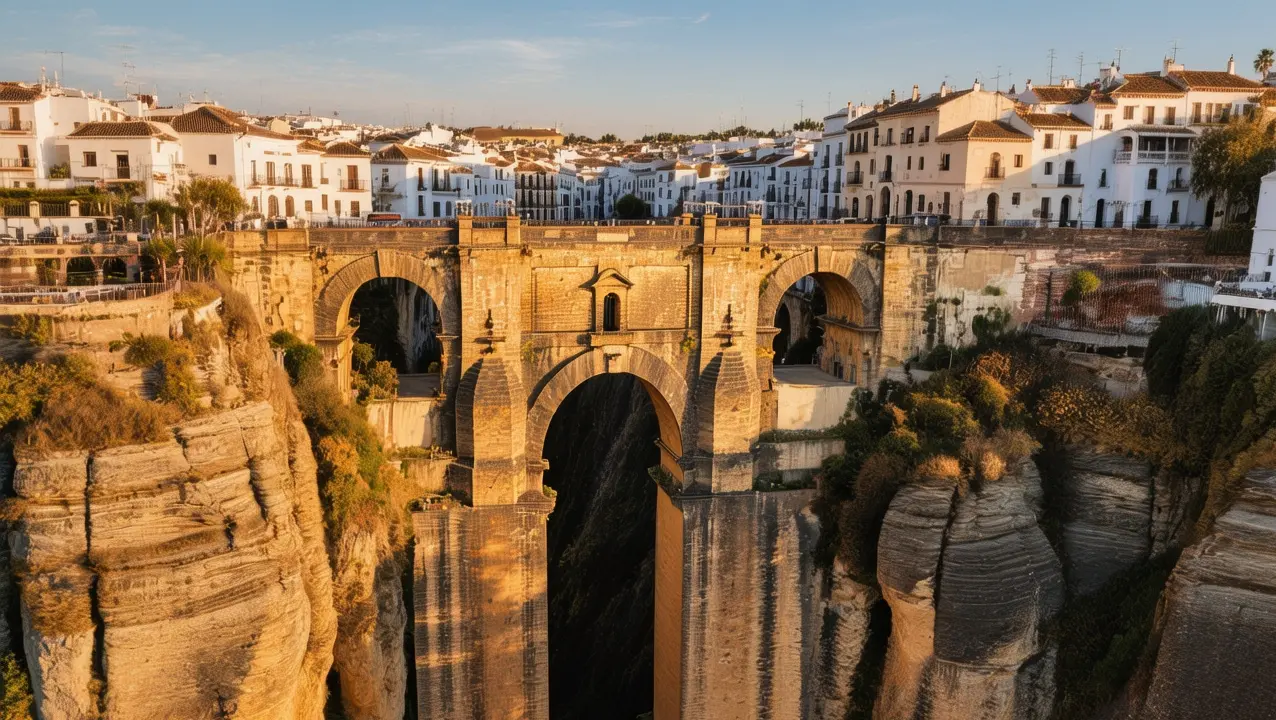
Ronda Bridge Dramatic Gorge Depths Meet Andalusian White-Washed Dreams
The first light of dawn breaks over the Serranía de Ronda mountains, casting long shadows across the 120-meter chasm of El Tajo gorge—your breath catches as you approach the Puente Nuevo, Spain's most audacious architectural feat. Stone masons' hammers echoed here for thirty-four relentless years (1759–1793), carving a passage across an abyss that once divided the city in two. Today, as you stand on the bridge's worn limestone surface, the Guadalevín River whispers 390 feet below while white-washed buildings cling precariously to cliff edges like barnacles on stone. This isn't merely a crossing—it's a testament to human determination against impossible geography, where engineer José Martín de Aldehuela's vision conquered nature's most formidable barrier. In 2026, as mass tourism threatens to overwhelm Andalusia's treasures, the Ronda Bridge stands as both a monument to the past and a urgent call to experience Spain's dramatic interior before it changes forever.
Why Ronda Bridge Embodies Andalusian Engineering Brilliance
The Puente Nuevo represents more than a convenient passage between Ronda's old Moorish quarter (La Ciudad) and its 15th-century expansion (El Mercadillo)—it embodies a civilization's refusal to be constrained by geography. When construction began in 1759, the gorge presented an existential problem: the Guadalevín River had carved a 120-meter (394-foot) vertical wound through the plateau, forcing residents to descend dangerous paths and cross via a much smaller 17th-century bridge that frequently flooded. The city needed a permanent solution, and architect José Martín de Aldehuela delivered one of the 18th century's most daring structural achievements.
The bridge's 98-meter (322-foot) span required innovations that pushed contemporary engineering to its limits. Aldehuela employed local limestone quarried from the gorge itself, creating a structure 7 meters (23 feet) wide with a central arch rising 35 meters above the river. Most remarkably, the bridge contains a hidden chamber—originally intended as a shrine but infamously used as a prison during the Spanish Civil War, where suspected Republicans met their end. The structure consumed 4,000 cubic meters of stone and took 34 years to complete, finally opening in 1793 at a cost that nearly bankrupted the municipality.
Beyond its technical specifications, the Ronda Bridge solved a fundamental human need: connection. Before its completion, the gorge isolated neighborhoods, separated families, and hampered commerce. Today, it serves 500,000+ annual visitors while remaining a functional thoroughfare for locals—a rare monument that balances tourism with daily life. The bridge's enduring presence reminds us that great infrastructure transcends its immediate purpose, becoming the soul of a place.
The Best Time to Experience Ronda Bridge
Timing your visit to the Ronda Bridge can mean the difference between a transcendent experience and a shoulder-to-shoulder shuffle through tour groups. For optimal conditions, target May 15–June 10 or September 18–October 15, when daytime temperatures hover between 18–24°C (64–75°F) and the summer crowds have either not yet arrived or have dispersed. During these windows, you'll experience the bridge in comfortable conditions with manageable visitor numbers.
For photographers and solitude-seekers, arrive between 7:00–8:30 AM when the morning light illuminates the eastern face of El Tajo gorge and tour buses haven't yet descended from the Costa del Sol. The golden hour before sunset (approximately 8:15–9:30 PM in summer, 6:00–7:15 PM in winter) offers equally magical conditions as the setting sun bathes the white buildings in amber tones. Winter months (December–February) bring cooler temperatures of 8–15°C (46–59°F) but dramatically fewer crowds—perfect if you don't mind wearing a jacket.
Avoid July 15–August 25 at all costs: temperatures soar to 35–40°C (95–104°F), the bridge becomes an oven with no shade, and visitor numbers peak at 3,000+ daily. Spanish holidays (Semana Santa/Easter Week, August 15 Assumption Day) also bring overwhelming domestic tourism. For current conditions and crowd forecasts, check the official Ronda tourism office at www.turismoderonda.es before your visit.
Approximate Budget for a 7-Day Trip (2026)
Ronda offers exceptional value compared to Spain's coastal resorts, though prices have risen 18% since 2020 due to increased tourism and inflation. The following budget assumes moderate comfort—clean, well-located accommodation; authentic meals at local restaurants; and selective paid attractions. Prices reflect 2026 rates with approximately 4% annual inflation factored in.
Accommodation: €65–€120 per night for a double room in a centrally-located parador or boutique hotel in El Mercadillo district; budget hostels start at €35/night
Food: €35–€55 per day
-
• Breakfast: €4–€8 (café con leche €2.50, tostada con tomate €3.50)
Transportation:
-
• Train from Málaga: €18.50 one-way (RENFE Media Distancia, 2 hours 15 minutes)
Attractions:
-
• Puente Nuevo viewpoint access: Free
Miscellaneous:
-
• Local wine bottle (Ronda DO): €8–€15
Total for 7 days (per person, double occupancy): €780–€1,150
7 Essential Ronda Bridge Experiences
- Walk the Bridge at Sunrise: Arrive by 7:30 AM to experience the Puente Nuevo when it belongs to locals walking their dogs and shopkeepers opening their doors. The morning light creates dramatic contrasts between the sun-warmed limestone and the cool shadows of El Tajo gorge. Stand at the central viewpoint and listen to the Guadalevín River's distant murmur while watching swallows nest in the cliff crevices.
- Descend to the Mirador de Aldehuela: Follow the winding path down 200+ stone steps to the base of the gorge for a perspective that reveals the bridge's true scale. This 25-minute descent rewards you with vertigo-inducing views looking straight up at the 98-meter span. Bring water and wear proper shoes—the return climb is strenuous but essential for understanding the engineering achievement.
- Explore the Bridge's Hidden Chamber: Book the €6 guided tour (available 10 AM–2 PM, advance reservation required at the tourist office) to access the central room that once served as a prison during the Civil War. The 4-meter-high chamber reveals original stonework and offers a sobering reminder of Spain's turbulent 20th-century history.
- Coffee at the Parador Terrace: The Parador de Ronda occupies the former town hall directly adjacent to the bridge. Order a cortado (€2.80) on their terrace and watch the light change across the gorge while enjoying arguably the best view in Andalusia without paying for it.
- Photograph from the Mirador de Cuesta de las Descalzas: This viewpoint on the new town side provides the iconic postcard angle of the bridge spanning the chasm with white buildings cascading down the cliffs. Visit during blue hour (20 minutes after sunset) when the buildings are illuminated and the sky turns indigo.
- Walk the Paseo de los Molinos: This 1.5-kilometer path follows the river below the bridge, passing restored 18th-century flour mills and natural swimming holes. In summer, the walk takes 45 minutes and offers cooling shade from plane trees—a perfect contrast to the exposed bridge above.
- Attend an Evening Flamenco Performance: At 9:00 PM, experience authentic flamenco at Peña Juan Breva (€18 entry including one drink), where local artists perform in an intimate setting just 200 meters from the bridge. The passionate cante jondo echoes through the historic streets, connecting you to Andalusia's Roma heritage.
3 Hidden Gems Most Travelers Miss
- La Casa del Rey Moro's Secret Water Mine: While most visitors photograph the bridge, few descend into this 14th-century Moorish structure's 200-step staircase leading to the Guadalevín River. Built during the Nasrid kingdom, the mine provided water during Christian sieges. Access: Calle Tenorio 15, open 10 AM–8 PM (summer), €6 entry. Insider tip: The garden designed by Jean-Claude Forestier offers peaceful respite and rarely sees crowds after 6 PM.
- Baños Árabes (Arab Baths): Spain's best-preserved Islamic baths lie 100 meters below the bridge in the old town, yet 70% of visitors never make the descent. These 13th-century horseshoe-arched chambers with star-shaped ceiling vents created atmospheric steam rooms for ritual purification. Access: Free entry, Molino de Alarcón street, open 10 AM–7 PM. Insider tip: Visit at opening time when light streams through the ceiling stars, creating ethereal patterns on the stone floors.
- Senda Litográfica Natural Trail: This 2-kilometer circular route follows an old lithographic quarry path with panoramic viewpoints of both the bridge and surrounding vineyards. Starting point: behind the bullring, marked trailhead. Insider tip: The trail is unmarked in sections—download the "Wikiloc Ronda" app for GPS tracking. Best hiked late afternoon when temperatures drop and the light turns the limestone golden.
Cultural & Practical Tips
- Respect siesta culture: Many shops close 2–5 PM. Plan bridge visits and outdoor activities for morning or evening; use midday for leisurely lunches or museum visits.
- Photography etiquette: Drone flights require special permission from the Junta de Andalucía—fines up to €600 for violations. Street photography of locals requires verbal consent; a simple "¿Puedo?" (PWEH-doh) shows respect.
- Dress code for churches: Shoulders and knees must be covered to enter Iglesia de Santa María la Mayor. Carry a lightweight scarf even in summer.
- Essential phrases: "Buenos días" (BWEH-nos DEE-as) before 2 PM, "Buenas tardes" (BWEH-nas TAR-des) after; "La cuenta, por favor" (la KWEEN-ta por fa-BOR) for the bill.
- Water safety: Ronda's tap water is potable but heavily mineralized—buy bottled water (€0.60/liter) if sensitive to taste. Always carry 1.5 liters when hiking.
- Weather preparedness: The gorge creates microclimates—temperatures at the bridge can be 5°C cooler than the town center. Bring layers even in summer; sudden winds (terral) can gust to 40 km/h.
- Tipping customs: Round up restaurant bills or leave 5–10% for exceptional service. Not tipping is acceptable but leaving small change shows appreciation.
Conclusion: Travel with Reverence, Not Just Checklist Tourism
The Ronda Bridge has witnessed 233 years of human drama—Napoleonic troops crossing in 1810, Republican militias retreating in 1936, honeymooners posing for photographs in the 1960s, and now you, standing where countless others have stood, gazing into the same vertiginous depths. But here's what separates meaningful travel from tourism: the bridge doesn't need your Instagram post; it needs your presence, your willingness to descend the steps, to speak with the shopkeepers who've watched the gorge for generations, to understand that this stone span represents not just engineering prowess but the human refusal to accept limitation.
In 2026, as overtourism threatens to transform Ronda into a theme park version of itself, your choices matter. Stay an extra night. Eat at the family-run taberna instead of the TripAdvisor top-ten. Learn why the bridge's chamber imprisoned your ideological ancestors. Leave only footprints on the limestone, only respect in your wake. The Puente Nuevo will stand for centuries more—whether it remains a living monument or becomes a museum piece depends on travelers like you choosing depth over breadth, connection over consumption. Cross the bridge, yes, but more importantly, let it cross into your understanding of what Andalusia truly means.