
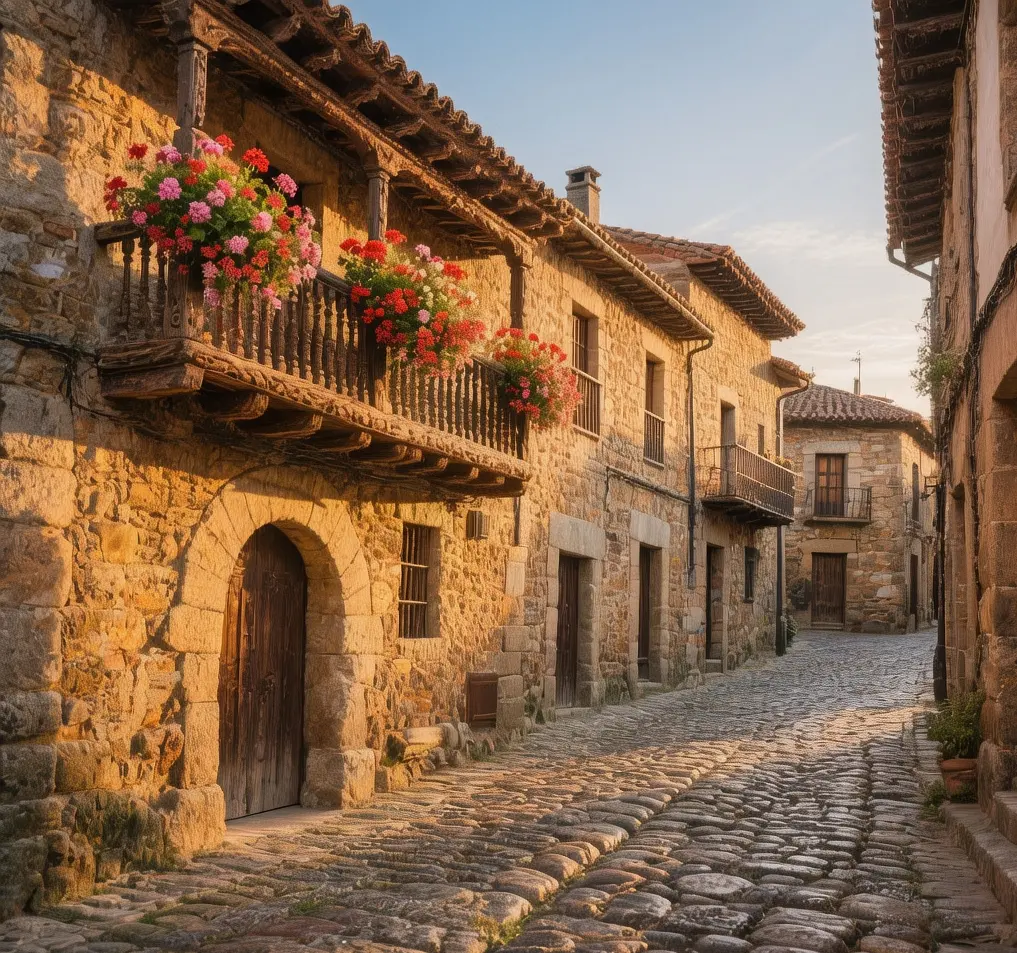
Santillana del Mar Medieval Stone Meets Cantabrian Coastal Heritage
The morning mist lifts slowly from the cobblestones as dawn breaks over the Cantabrian countryside—your footsteps echo on stones worn smooth by eight centuries of passage, from medieval pilgrims to modern travelers seeking authenticity. Declared a Historic-Artistic Site in 1943, Santillana del Mar stands as Spain's most perfectly preserved medieval village, a place where time seems to have stopped in the 15th century when the town flourished under the patronage of the powerful Velarde family. You walk beneath the shadow of the Torre de Merino, a 12-meter stone tower that has watched over the plaza since 1350, while the scent of fresh bread drifts from centuries-old bakeries and the distant lowing of cattle echoes from nearby pastures. The light is soft and golden, filtering through the characteristic northern humidity that keeps the hydrangeas blooming in every courtyard. In 2026, as historic towns face the pressure of commercialization, this place matters now more than ever: it remains a living museum where preservation is not a marketing strategy but a way of life, demanding that you slow down to understand the difference between a destination that sells history and one that lives it.
Why Santillana del Mar Embodies Medieval Preservation
Santillana del Mar represents far more than a picturesque village—it stands as a testament to successful heritage conservation and the delicate balance between tourism and authenticity. When the town faced potential demolition in the early 20th century due to urban modernization pressures, local intellectuals and the Spanish government intervened in 1943 to declare it a protected monument, solving a critical preservation problem: how to maintain medieval infrastructure while accommodating modern life. The solution was comprehensive: banning all motorized traffic from the historic center, requiring all new construction to follow traditional building codes, and limiting commercial signage to preserve the visual integrity of the stone façades. This approach created a 65-hectare protected zone where over 30 historic towers and manor houses remain intact, representing the largest concentration of medieval civil architecture in northern Spain.
The engineering specifics reveal the sophistication of medieval Cantabrian construction: the Collegiate Church of Santa Juliana, built between 1150 and 1250, features a Romanesque cloister with 24 double columns carved from local limestone, each capital depicting biblical scenes that have survived 800 years of weathering. The town's characteristic towers, constructed between the 14th and 16th centuries, utilize a defensive design with thick stone walls (1.5 meters average) and narrow windows that provided protection during the Wars of the Brotherhoods in 1475. The cobblestone streets follow a radial pattern from the central plaza, designed to channel rainwater away from buildings while creating natural gathering spaces. Today, the village fulfills a dual need: functioning as a working community with 4,000 residents while serving as a protected heritage site that receives 500,000 annual visitors. With strict conservation laws enforced by the Cantabrian Ministry of Culture, Santillana del Mar remains architecturally cohesive, preserving a dialogue between past and present that defines authentic heritage tourism in the 21st century.
The Best Time to Experience Santillana del Mar
While the cobblestone streets of Santillana del Mar remain accessible year-round, your experience depends heavily on the maritime climate of Cantabria and the tourism calendar. For optimal visiting conditions, target May 15–June 20 or September 10–October 15, when daytime temperatures average 17–24°C (63–75°F) and rainfall is moderate. During these windows, you'll explore the village comfortably without the heavy rains of winter or the overwhelming crowds of summer. The light during these months also enhances the honey-colored limestone, creating ideal photography conditions for the medieval architecture.
For the most atmospheric experience, arrive between 8:00–9:30 AM when day-trippers from Santander haven't yet arrived and the village belongs to locals, or during golden hour (8:30–10:00 PM in summer, 6:30–8:00 PM in winter) when the sun sets behind the Cantabrian mountains. Early morning visits offer the clearest air for viewing the Collegiate Church façade without crowds. Winter months (December–February) bring colder temperatures of 8–14°C (46–57°F) and frequent rain, which dramatically reduces crowds but requires warm clothing and umbrellas for outdoor viewing. The village looks magical under grey skies, though some outdoor cafés may close.
Avoid July 25–August 25 and Spanish national holidays (Semana Santa/Easter Week, August 15 Assumption Day) when daily visitor numbers exceed 5,000 and accommodation prices increase by 50-70%. Midday visits during peak season create bottlenecks on the narrow Calle de Juan Infante. For real-time weather and event schedules, check the official tourism office at www.santillanadelmarturismo.com or call +34 942 840 171 before your visit.
Approximate Budget for a 7-Day Trip (2026)
Santillana del Mar offers moderate value compared to other European heritage destinations, though prices have risen 24% since 2020 due to tourism growth and inflation. This budget assumes moderate comfort—clean, well-located accommodation; authentic meals at traditional Cantabrian restaurants; and selective paid attractions. Prices reflect 2026 rates with approximately 4% annual inflation factored into estimates. This budget covers a relaxed 7-day stay based in Santillana with day trips to nearby coastal towns and the Altamira caves.
Accommodation: €85–€160 per night for a double room in a parador or rural hotel in the historic center; budget hostels from €50/night
Food: €40–€70 per day
-
• Breakfast: €5–€9 (café con leche €3, pastry €3.50)
Transportation:
-
• Train from Madrid to Santander: €50–€75 one-way (Renfe, 5 hours)
Attractions:
-
• Collegiate Church of Santa Juliana: €5 adults, €3 students
Miscellaneous:
-
• Local cheese (Queso de Cantabria): €15–€25 per kg
Total for 7 days (per person, double occupancy): €1,050–€1,600
7 Essential Santillana del Mar Experiences
- Walk the Plaza Mayor at Dawn: Stroll through the central square between 8:00–9:00 AM to avoid crowds. The stone fountain glows in the morning light, and the cobblestones are dew-covered. The sound of church bells echoes through the empty streets. This is the best time to photograph the Collegiate Church without tourists in the frame.
- Visit the Collegiate Church of Santa Juliana: This 12th-century Romanesque masterpiece houses the relics of the martyred Saint Juliana. Access: Plaza Mayor, open 10 AM–2 PM and 4–7 PM, €5 entry. Insider tip: Visit early morning when light filters through the cloister arches. The 24 carved capitals depict biblical scenes from 1150. The acoustics during quiet moments are remarkable.
- Explore the Altamira Museum: Located 2 kilometers from town, this facility houses the famous Neocave replica of the prehistoric paintings. Access: Road to Santillana, open 9:30 AM–8 PM, €10 entry. Insider tip: Book tickets online 2 weeks in advance. It provides context for the Paleolithic art you're experiencing. The original cave is closed to protect the paintings.
- Climb the Torre de Merino: This 14th-century tower offers panoramic views of the village and surrounding countryside. Access: Calle de los Torreles, open 10 AM–6 PM, €3 entry. Insider tip: Visit at sunset when the stone glows orange. The 65 steps are steep but worth the climb. The views of the Cantabrian mountains are unmatched.
- Dine on Cantabrian Specialties: Reserve a table at a restaurant near the Plaza Mayor. Order the local specialty cocido lebaniego (chickpea stew) or rabas (fried squid) while watching the light change on the stone facades. Evening dining (9:30 PM) allows you to see the village illuminated against the night sky. The beef is exceptional, raised on the surrounding pastures.
- Walk the Calle de Juan Infante: This main street showcases the finest examples of medieval architecture. The 500-meter walk is flat and shaded, making it suitable for all visitors. You will see over 15 historic towers and manor houses. Allow 1 hour for the walk. Bring water as there are limited services along the trail. The connection between architecture and history is striking here.
- Attend the Medieval Market (If Visiting in August): If visiting during the second weekend of August, witness the traditional festivities with artisans, musicians, and period costumes. The village fills with performers, food stalls, and religious processions. Book accommodation 6 months in advance as hotels fill completely. The fireworks display over the church is spectacular. This event showcases the community spirit that keeps the tradition alive.
3 Hidden Gems Most Travelers Miss
- Capilla de los Velarde: While most visitors focus on the Collegiate Church, this 16th-century chapel houses extraordinary Renaissance altarpieces. Access: Calle de los Torreles, open 10 AM–2 PM, €3 entry. Insider tip: Visit early morning when the light illuminates the gold leaf. The Plateresque carvings date back to 1520. It provides context for the religious art you're experiencing beyond the main church. It is often overlooked by those rushing to the Collegiate Church.
- Jardín de la Quinta: Located near the edge of town, this botanical garden features native Cantabrian plants and historic greenhouses. Access: Road to Comillas, open 10 AM–7 PM, €5 entry. Insider tip: The staff speaks excellent English and provides free maps highlighting less-visited paths. Ask about the 19th-century glasshouse. It provides context for the agricultural culture you're experiencing. It is often overlooked by those focused on the medieval center.
- Mirador de Ubiarco: A specific viewpoint located 3 kilometers from town, accessible via a coastal path often overlooked by tour groups. This rocky outcrop offers a secluded spot for reflection away from tourist crowds. Access: Follow the signs from Santillana toward San Vicente de la Barquera, look for the marked trail. Insider tip: Bring binoculars. Cormorants frequently dive in the bay here. Best visited late afternoon when the light hits the water. The views of the Cantabrian coast are breathtaking.
Cultural & Practical Tips
- Photography etiquette: Drones require permission from the local council—fines up to €500 for violations. Street photography of locals requires verbal consent; a simple "¿Puedo?" (PWEH-doh) shows respect. Flash photography is prohibited inside the Collegiate Church to protect the artwork.
- Dress code for churches: Shoulders and knees must be covered to enter the Collegiate Church of Santa Juliana. Carry a lightweight scarf even in summer. Remove hats when entering religious spaces.
- Respect the historic center: No motorized vehicles are allowed in the old town. Park in designated areas outside the walls. Quiet hours are enforced in residential areas after 10 PM. Do not touch the historic stonework.
- Essential phrases: "Buenos días" (BWEH-nos DEE-as) before 2 PM; "¿Dónde está el baño?" (DON-deh es-TAH el BA-nyo) = "Where is the bathroom?"; "La cuenta, por favor" (la KWEEN-ta por fa-BOR) = "The bill, please."
- Weather preparedness: The region experiences frequent rain year-round. Nights can be 10°C cooler than days. Bring layers and a waterproof jacket. Winter visits require sturdy shoes for potentially slick cobblestones near the church.
- Tipping customs: Round up restaurant bills or leave 5–10% for exceptional service. Not tipping is acceptable but leaving small change shows appreciation. Taxi drivers appreciate small change rounded up to the nearest euro.
- Accessibility information: The cobblestone streets are uneven, making wheelchair access challenging. The visitor center has accessible facilities. Contact the tourism office for adapted route maps along the main plaza.
Conclusion: Travel with Reverence, Not Just Checklist Tourism
Santillana del Mar has witnessed nearly 1,000 years of human history—medieval pilgrims walking to Santiago, nobles building stone towers, farmers tending the same pastures for centuries. When you walk these cobblestones in 2026, you're not just capturing images for your gallery; you're stepping into a living narrative of preservation and continuity. The stone walls holding these buildings never imagined they would support tourists from every corner of the globe; the masons who carved these arches never conceived their work would become a UNESCO-recognized treasure.
But here's what separates meaningful travel from tourism: this village doesn't need your footprint—it needs your reverence, your willingness to understand the complexity of heritage preservation, to recognize that each visitor adds wear to structures that cannot be easily replaced. In an age of overtourism, Santillana del Mar offers a masterclass in balance—showing us that some wonders demand we subordinate our desire for access to the greater need for protection. Walk the plaza, yes, but emerge with something deeper than souvenirs: carry forward a commitment to protect not just this village, but all the fragile, irreplaceable treasures that connect us to our shared human history.