
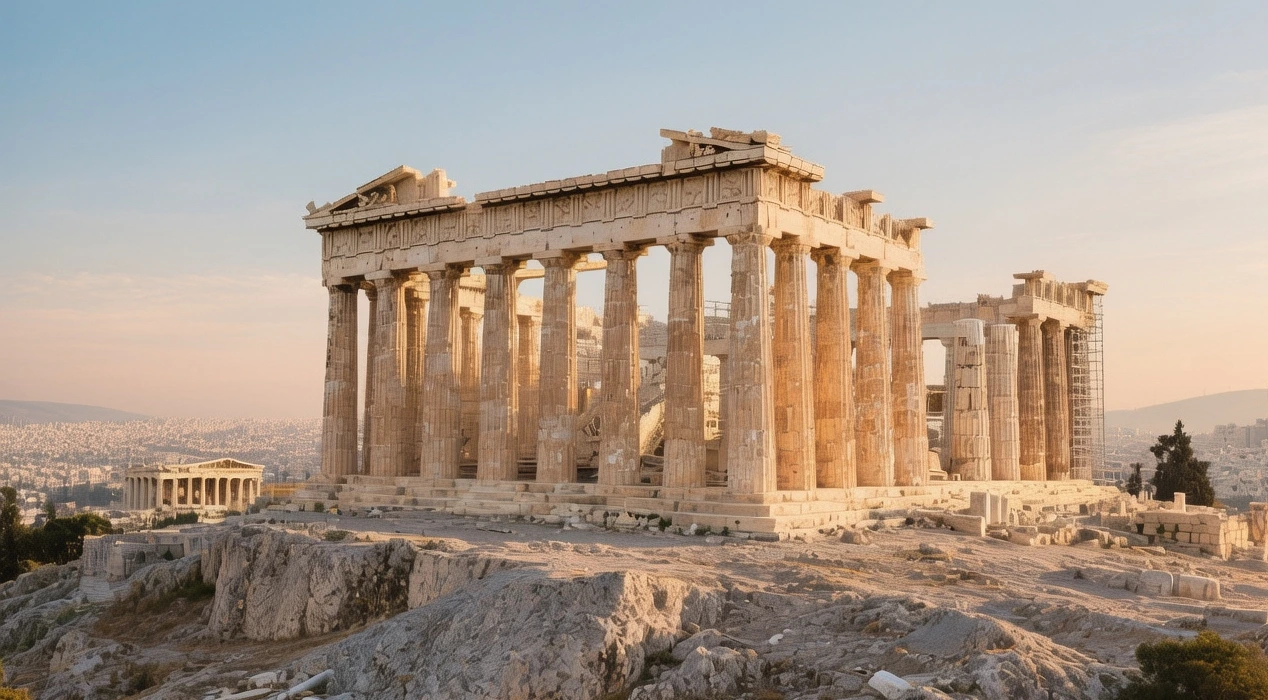
Acropolis: Where Ancient Marble Meets Eternal Athenian Sky
The first light of dawn breaks over Mount Lycabettus, casting long shadows across the limestone slopes as you approach the Propylaea—the monumental gateway that has welcomed visitors for twenty-five centuries. The air carries the scent of wild thyme and sun-warmed stone; cicadas begin their rhythmic chorus, a sound unchanged since Plato walked these same paths. Before you rises the Parthenon, its Doric columns reaching toward the heavens at precisely 10.4 meters high, each drum of Pentelic marble fitted without mortar so perfectly that a knife blade cannot slip between them. This rocky outcrop—156 meters above sea level, 170 by 350 meters across—has witnessed the birth of democracy, the flowering of classical philosophy, and the rise and fall of empires. Standing here, you understand: the Acropolis is not merely a monument to visit, but a living testament to human aspiration that continues to shape how we think about beauty, governance, and civilization itself.
Why the Acropolis Embodies Classical Perfection
The Acropolis represents humanity's most ambitious architectural statement—a sacred citadel that solved the fundamental need to create a permanent home for the divine while celebrating human achievement. Constructed primarily between 447 and 432 BCE under the visionary leadership of Pericles and the sculptural genius of Phidias, this complex addressed Athens' need to demonstrate its cultural supremacy following the Persian Wars. The Parthenon itself—measuring 69.5 meters long by 30.9 meters wide—employed revolutionary optical refinements: the columns lean inward 6 centimeters to counteract visual distortion, the stylobate curves upward 11 centimeters along the long sides, and each column swells with entasis at its midpoint to appear perfectly straight from ground level.
Built from 22,000 tons of Pentelic marble quarried 16 kilometers away and transported by ox-cart up the steep incline, the temple housed Phidias's chryselephantine statue of Athena Parthenos—12 meters tall, plated in ivory and gold weighing over 1,100 kilograms. The structure's 46 outer columns and 19 inner columns supported a roof of overlapping marble tiles, while the sculptural program included 92 metopes depicting mythological battles, a 160-meter continuous frieze showing the Panathenaic procession, and pediment sculptures featuring over 50 larger-than-life figures. This was not merely construction; it was an engineering marvel that solved structural challenges through mathematical precision—the golden ratio (1.618:1) governs the facade proportions, creating visual harmony that feels instinctively perfect to the human eye.
Beyond the Parthenon, the Acropolis encompasses the Erechtheion with its Caryatid porch, the Temple of Athena Nike perched on a bastion, and the Propylaea gateway—each structure serving specific religious and civic functions while contributing to an ensemble of unparalleled aesthetic unity. The site fulfilled Athens' need for a fortified sanctuary, a treasury, and a statement of imperial power, while establishing architectural principles that would influence building design for over two millennia. Today, ongoing restoration work using titanium reinforcements and newly quarried Pentelic marble ensures that this icon of classical antiquity continues to inspire visitors with the same power it held for ancient pilgrims.
The Best Time to Experience the Acropolis
Timing transforms a visit from pleasant to transcendent. The optimal window stretches from May 18–June 12 and September 15–October 20, when temperatures hover between 18–25°C (64–77°F), crowds remain manageable, and the Mediterranean light achieves that honeyed quality photographers chase. During these shoulder seasons, you'll experience comfortable conditions for climbing the 100+ steps to the summit while avoiding the oppressive heat that peaks at 35°C (95°F) in July and August.
Arrive precisely at 8:00–9:30 AM when the gates open—this golden hour delivers cooler temperatures, softer light for photography, and crucially, freedom from the tour bus armies that descend by 10:30 AM. The site operates daily from 8:00 AM year-round, closing at 8:00 PM during summer (April–October) and 5:00 PM in winter (November–March), with last entry 30 minutes before closing [[38]][[39]]. Winter months (November–February) offer minimal crowds and dramatic storm-washed skies, though temperatures drop to 10–13°C (50–55°F) with increased rainfall.
Avoid July 15–August 31 unless absolutely necessary: temperatures regularly exceed 32°C (90°F), cruise ship schedules create crushing midday crowds, and the marble radiates heat that makes extended exploration uncomfortable. Also skip Greek Orthodox Easter week and major public holidays when domestic tourism swells visitor numbers. For the most current information on hours, ticket availability, and special closures, always check the official Athens tourism portal at www.thisisathens.org before your visit [[14]].
Approximate Budget for a 7-Day Trip
Athens remains one of Europe's most affordable capitals, offering exceptional value without sacrificing cultural richness or comfort. The following breakdown reflects mid-range travel—comfortable three-star accommodations, authentic taverna dining mixed with occasional upscale meals, and comprehensive site visits—based on current pricing for a single traveler.
- Accommodation: €80–€150 per night in Plaka, Monastiraki, or Koukaki neighborhoods (€560–€1,050 total). Budget hostels start at €25; luxury boutique hotels run €200+ [[69]][[70]].
- Food: €45–€65 per day total. Breakfast: €5–€8 (Greek coffee €3, tyropita pastry €2.50, fresh orange juice €3). Lunch: €12–€18 (gyros pita €3.50–€4.50, Greek salad €8–€10, moussaka €12). Dinner: €20–€35 (grilled octopus €16, lamb chops €18, house wine €5/glass, dessert €6) [[78]][[79]].
- Transportation: €35 total. Metro from airport: €9 one-way (€18 round-trip). 5-day unlimited transit pass: €8.20. Occasional taxi rides: €10–€15 each [[89]][[93]].
- Attractions: €85 total. Acropolis single ticket: €30 (or €36 combo ticket including Ancient Agora, Temple of Olympian Zeus, Roman Agora, Hadrian's Library, Kerameikos, and Lyceum). Acropolis Museum: €15. National Archaeological Museum: €12. Day trip to Cape Sounion (Temple of Poseidon): €20 including transport [[29]][[30]].
- Miscellaneous: €100 total. Water/snacks €5/day, olive oil soap €8, handmade sandals €40–€80, museum guidebooks €15, tips €20.
Total: €1,300–€1,600 for 7 days (excluding international airfare)
7 Essential Acropolis Experiences
- Witness sunrise from the Areopagus: Arrive at 6:30 AM at the Mars Hill rock formation southwest of the Acropolis. This 115-meter elevation offers unobstructed eastern views as dawn breaks over the Parthenon. Bring a light jacket—morning temperatures run 5°C cooler than the valley floor. The 30-minute climb involves scrambling on worn marble steps; wear sturdy shoes.
- Walk the Panathenaic Way: Enter through the Propylaea and trace the exact path ancient Athenians took during the Great Panathenaea festival. Notice the wheel ruts worn 2 meters deep into the limestone by ceremonial chariots. Pause at the bronze statue of Athena Promachos site—once a 9-meter-tall landmark visible from ships approaching Piraeus harbor.
- Study the Parthenon's optical illusions: Stand at the southeast corner and observe how the columns appear perfectly vertical despite leaning inward. Count the 8 columns on the facade and 17 on the flanks—a 2:1 ratio plus one. Touch the marble (gently!) to feel the subtle entasis swelling that prevents the columns from appearing pinched at mid-height.
- Contemplate the Caryatids at the Erechtheion: Six draped female figures support the south porch roof, each bearing 2.5 tons of weight on her head. The originals reside in the Acropolis Museum; these are precise marble replicas. Notice how each statue's weight-bearing leg creates a subtle contrapposto stance, distributing load through classical engineering.
- Descend to the Theater of Dionysus: Exit the Acropolis south side to reach the world's first theater, carved into the hillside in the 6th century BCE. The 17,000-seat venue hosted premieres of Sophocles' Oedipus Rex and Euripides' Medea. Sit in the front-row prohedria seats reserved for priests, still inscribed with names after 2,400 years.
- Explore the Odeon of Herodes Atticus: This 5,000-seat Roman theater, built in 161 CE, still hosts summer performances. Stand on the stage and clap once—the acoustics carry sound to the highest seats without amplification. Visit during evening performances if your schedule allows; the experience of watching Greek tragedy under stars with the illuminated Acropolis as backdrop is transformative.
- Photograph the Parthenon through the Propylaea columns: Position yourself at the gateway's central passage just before sunset. Frame the Parthenon between the Doric columns, capturing the interplay of light and shadow as the sun drops toward the Saronic Gulf. This composition, beloved by 19th-century photographers, reveals the architectural dialogue between the two structures.
3 Hidden Gems Most Travelers Miss
- The Sanctuary of Artemis Brauronia: Tucked behind the Propylaea on the southwest side, this small shrine dedicated to the goddess of childbirth receives perhaps 5% of Acropolis visitors. Look for the foundation stones outlining the stoa where women dedicated offerings before and after childbirth. The site offers intimate views of the Temple of Athena Nike without crowds. Access: Free with Acropolis ticket; best visited 4:00–5:00 PM when tour groups have departed.
- The Beulé Gate: Discovered in 1852 by French archaeologist Charles Ernest Beulé, this fortified entrance predates the Propylaea and reveals the Acropolis's evolution from Bronze Age fortress to classical sanctuary. The gate's limestone blocks, some spolia from earlier monuments, tell the story of Late Roman fortification. Access: Visible from the main path between the ticket booth and Propylaea; most visitors rush past without noticing the interpretive plaque.
- The Klepsydra Spring: On the northwest slope, this natural spring has provided water for 5,000 years, sustaining Bronze Age settlements and classical sieges. The Byzantine chapel of Agios Apostoloi sits beside the springhouse. During summer droughts, you can still hear water trickling beneath the stone. Access: Follow the path descending from the Propylaea's north side; allow 15 minutes extra. The spring runs year-round; bring an empty bottle to fill with the coolest, freshest water in Athens.
Cultural & Practical Tips
- Dress code: While not as strict as monasteries, shoulders and knees should be covered out of respect for the sacred site. The marble becomes extremely slippery when wet—avoid visiting during rain.
- Photography: Personal photography is permitted, but tripods and professional equipment require special permits. Drones are strictly prohibited. The best light occurs during the first and last hours of daylight.
- Hydration: Carry at least 1.5 liters of water per person; there are no vendors on the hill itself. The nearest cafes are in Plaka at the base. Fill bottles at the Klepsydra Spring if needed.
- Local phrases: Kalimera (kah-lee-MEH-rah) = Good morning; Efharisto (ef-hah-REE-stoh) = Thank you; Parakalo (pah-rah-kah-LOH) = Please/You're welcome. Using these greetings earns warm smiles from Athenians.
- Accessibility: An elevator serves visitors with mobility issues, but advance reservation is required (+30 210 321 4172). The path remains uneven even with assistance; a companion is recommended.
- Security: Pickpockets operate in crowded areas, particularly near the ticket booth and Propylaea. Use cross-body bags and keep valuables in front pockets. The site has metal detectors and bag checks.
- Seasonal considerations: Summer temperatures on the exposed marble can feel 5–7°C hotter than city center readings. Winter brings strong meltemi winds that make the summit feel bitterly cold despite mild valley temperatures.
Conclusion: Travel with Reverence, Not Just Checklists
The Acropolis demands more than a photograph and a hashtag—it asks for your presence, your contemplation, your willingness to stand where Pericles once stood and imagine a world where beauty and reason could reshape stone into philosophy. When you run your hand along the weathered marble of a Doric column, you touch the same surface that felt the chisel of ancient craftsmen who believed they were building for eternity. They were right.
Responsible travel here means understanding that every footprint contributes to erosion, every flash photograph accelerates pigment fading in remaining polychrome traces, every careless touch wears away another molecule of history. Walk lightly. Speak softly. Take only images; leave only gratitude. Support the ongoing restoration efforts by purchasing official tickets and visiting the Acropolis Museum, where your entrance fees directly fund conservation work.
This is not a theme park attraction but a sacred space where Western civilization's foundational ideals took physical form. Slow down. Sit on the warm stone. Watch the light change across the pediment sculptures. Let the weight of twenty-five centuries settle around you. The Acropolis has survived war, earthquake, explosion, and pillage—it will endure long after our visit. But whether it continues to inspire depends on travelers like you choosing reverence over rushing, understanding over indifference, preservation over convenience.