
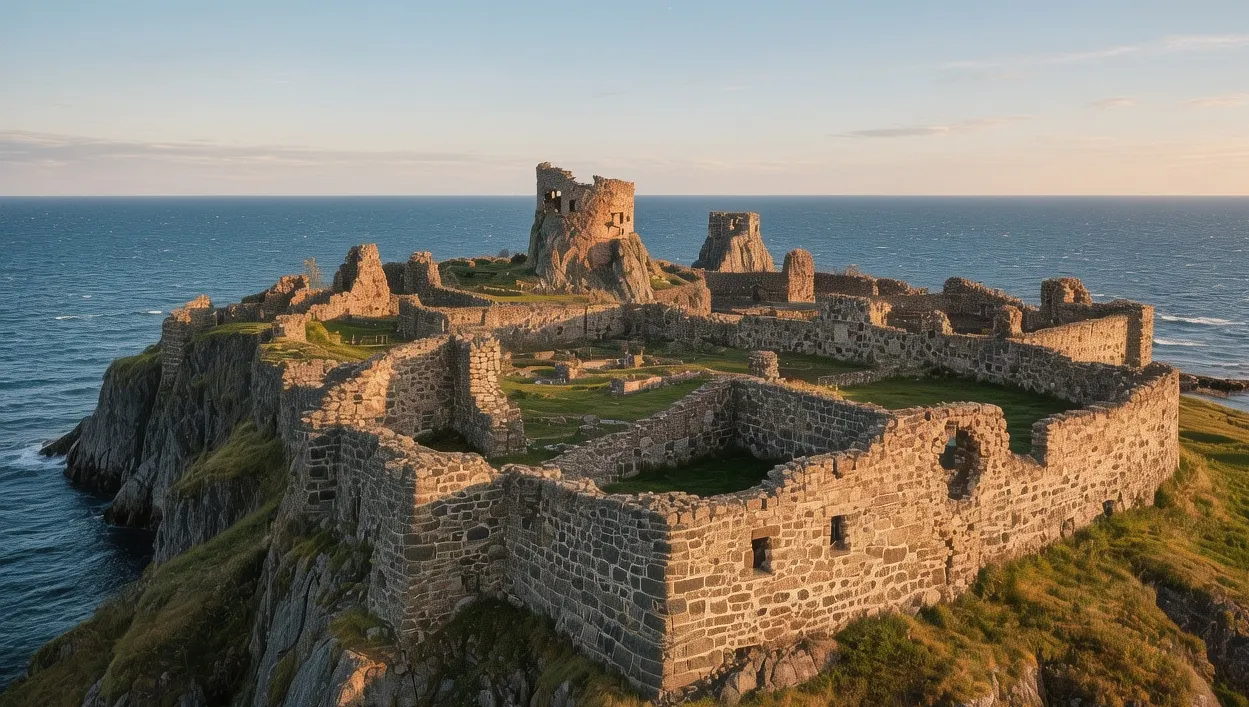
Hammershus Castle Ruins: Where Medieval Fortress Meets Baltic Coastal Majesty
Golden afternoon light spills across the weathered granite walls of Europe's largest medieval fortress ruin as you stand atop Bornholm's dramatic northwest coast—Hammershus awakens with the thunderous crash of Baltic waves against forty-meter cliffs, the distant cry of seagulls wheeling above ancient stone battlements, and the soft murmur of visitors exploring a landscape where thirteen centuries of history breathe through every weathered block. You feel the cool granite beneath your palm, hear the wind whispering through arrow slits that once defended Baltic trade routes, and watch sunlight illuminate the sprawling 35,000-square-meter complex where thick walls, defensive towers, and hidden chambers tell stories of archbishops, sieges, and maritime power. This extraordinary archaeological treasure, constructed around 1250 by the Archbishop of Lund to control strategic shipping lanes, rises from Bornholm's granite foundation like a sentinel guarding the gateway between Scandinavia and continental Europe [[15]][[22]]. The ruins' distinctive red-brick and grey-granite construction, weathered by centuries of Baltic storms, creates a stark silhouette against the deep blue sea and lush coastal heathland. But Hammershus matters because it preserves not just a fortress, but an entire chapter of Northern European history—a testament to how medieval engineering, political ambition, and coastal geography converged to create one of the Baltic's most formidable strongholds, reminding us of the enduring power of stone, strategy, and the sea.
Why Hammershus Castle Ruins Embody Medieval Maritime Power
Hammershus represents the pinnacle of medieval fortress engineering, solving a fundamental need to control Baltic trade routes while creating an enduring symbol of ecclesiastical and political authority that shaped Northern European history for centuries. When Archbishop Jacob Erlandsen commissioned the fortress around 1250, he faced a profound challenge: how to project power across the volatile Baltic Sea while defending Bornholm's strategic position between Denmark, Sweden, and the Hanseatic League [[15]][[20]]. His visionary solution—constructing a 35,000-square-meter complex on granite cliffs forty meters above the sea—established an engineering legacy that has allowed Hammershus to dominate Bornholm's skyline for nearly eight centuries.
The fortress's design showcases medieval military architecture at its finest: concentric defensive walls up to three meters thick, a central keep (Manteltårnet) rising twenty-five meters above the courtyard, and a sophisticated water cistern system carved directly into granite bedrock to sustain garrisons during prolonged sieges [[18]][[24]]. The construction employed local Bornholm granite for foundations and Danish red brick for upper structures, creating a distinctive aesthetic that has become iconic of Baltic medieval architecture. Hammershus fulfilled a dual purpose: militarily, it served as a strategic stronghold controlling shipping lanes between the North Sea and Baltic; politically, it became a symbol of the Archbishop of Lund's authority in regional conflicts. Technical preservation efforts include sustainable erosion control using native coastal vegetation, climate-controlled exhibition spaces at the visitor center maintaining 19°C (66°F) and 45% humidity to preserve archaeological artifacts, and structural monitoring systems that track wall stability while ensuring visitor safety [[22]]. Today, managed by the Danish Nature Agency alongside Bornholm Regional Municipality, Hammershus stands as a testament to how medieval ambition can inspire modern wonder, how ruins can educate without reconstruction, and how a single fortress can anchor regional identity through centuries of change.
The Best Time to Experience Hammershus Castle Ruins
Timing your visit to Hammershus profoundly influences both atmospheric immersion and practical accessibility. The optimal window falls between May 28 and June 25, when Bornholm enjoys extended daylight—sunset occurs around 9:50 PM—and temperatures range from 14°C to 21°C (57°F to 70°F), creating ideal conditions for exploring cliff-top ruins, coastal paths, and the visitor center [[68]][[72]]. During this period, the coastal heathland blooms with wildflowers including sea thrift and sea kale, outdoor interpretive panels remain fully accessible, and summer crowds remain manageable before peak season. For photographers, visit between 5:30–7:30 AM when soft morning light illuminates the granite walls with minimal crowds, or 8:00–10:00 PM for dramatic golden-hour shots where red brick glows against twilight skies.
Hammershus operates year-round as an open-air archaeological site, but key facilities follow seasonal hours: summer season (June–August) extends visitor center hours to 10:00 AM–6:00 PM daily; winter hours (November–February) reduce to 10:00 AM–3:00 PM, and some cliff-top paths may be limited due to weather conditions. For current conditions, event schedules, and visitor information, visit the official Bornholm tourism website at www.bornholm.info or the national tourism portal at www.visitdenmark.com [[52]][[85]]. Avoid visiting during late November through early February, when temperatures drop to -2°C to 5°C (28°F to 41°F), daylight shrinks to seven hours, and Baltic storms can make cliff-top exploration dangerous with slippery paths and falling debris. Also steer clear of Danish school holidays (week 7 in February, week 42 in October) when family crowds increase. Standard admission to the Hammershus visitor experience costs DKK 75 for adults (€10), DKK 40 for children ages 6–17 (€5), with children under 6 admitted free; access to the ruins themselves remains free year-round [[24]]. The visitor center café is particularly rewarding between 2:00–4:00 PM when afternoon light enhances the panoramic Baltic views from the cliff-top terrace.
Approximate Budget for a 7-Day Trip
Exploring Hammershus and Bornholm island requires moderate budgeting, as Denmark maintains higher price points than many European destinations. However, strategic planning—including staying in Rønne or Allinge and utilizing the island's excellent cycling infrastructure—can optimize your experience. The following breakdown reflects mid-range preferences with cultural and nature immersion priorities.
- Accommodation: €62–€112 per night for a double room in Rønne or Allinge (10-minute drive to Hammershus); budget guesthouses €32–€52 per night; coastal heritage hotels €122+ per night
- Food: €37–€65 per day total
- Breakfast: €6–€10 (Danish pastry and coffee from local bakery)
- Lunch: €11–€18 (smørrebrød or smoked fish platter at harbor café)
- Dinner: €17–€31 (mid-range restaurant featuring Bornholm specialties like sol over Gudhjem or local lamb)
- Visitor center café option: €7–€11 for soup, sandwich, and coffee
- Transportation:
- Ferry from Ystad, Sweden to Rønne: €28 per vehicle round-trip (80 minutes)
- Local bus to Hammershus: €3 per ride (Line 8); bicycle rental €9 per day (ideal for island exploration)
- Car rental for Bornholm exploration: €44 per day including fuel
- Fast ferry from Copenhagen: €45 one-way (5.5 hours)
- Attractions:
- Hammershus visitor experience: €10 (DKK 75) adults; €5 children [[24]]
- Guided fortress tour: €8 additional
- Bornholm Art Museum: €12 adults; €6 children
- Round church entry (Østerlars): €6
- Dueodde Beach access: Free
- Miscellaneous:
- Local craft souvenirs and glass art: €10–€48
- Audio guide rental: €4
- Photography permit for professional use: €24
Total estimated budget for 7 days: €850–€1,280 per person (excluding international flights)
7 Essential Hammershus Castle Ruins Experiences
- Walk the Main Gate at Sunrise: Arrive between 6:00–8:00 AM when the fortress is quiet and mist softens the granite walls. Enter through the reconstructed main gate, observing the thick defensive walls and arrow slits that once protected the garrison. Allow 30 minutes for this contemplative approach; the morning light enhances photographic opportunities and the atmosphere feels particularly magical before crowds gather. Listen for the wind moving through ancient stonework and imagine the footsteps of medieval soldiers who once guarded these battlements.
- Climb Manteltårnet for Panoramic Views: Ascend the central keep (Manteltårnet), rising twenty-five meters above the courtyard, for 360-degree views across Hammershus, the Baltic Sea, and Bornholm's northwest coast. Visit between 10:00 AM–12:00 PM when morning light provides optimal visibility across the coastline. The tower offers unparalleled perspectives of the fortress's strategic positioning and the dramatic granite cliffs plunging into turquoise waters. Allow 20 minutes; the climb is moderate but rewards with understanding of medieval defensive architecture [[22]].
- Explore the Visitor Center Exhibits: Step into the modern exhibition space where interactive displays explain Hammershus's construction, political significance, and archaeological discoveries. Visit between 1:00–3:00 PM when natural light illuminates artifacts including medieval weapons, pottery, and architectural fragments recovered from excavations. Allow 45 minutes for full appreciation; hands-on displays let you examine replica tools, experience simulated siege scenarios, and understand how granite and brick were shaped into Europe's largest medieval fortress.
- Walk the Coastal Path to Slotshaven: Follow the marked trail along the cliff edge to Slotshaven, a secluded cove beneath the fortress where medieval ships once landed supplies. Visit between 2:00–4:00 PM when afternoon light enhances the contrast between grey granite and blue sea. Allow 30 minutes for the circuit; the path reveals how the fortress's designers integrated natural defenses—steep cliffs, hidden coves, and granite outcrops—into their strategic planning.
- Photograph the Granite-Baltic Contrast: Position yourself at designated viewpoints between 7:00–9:00 AM when soft light highlights the texture of weathered granite and red brick against the deep blue Baltic. Use a polarizing filter to manage reflections; a wide-angle lens captures the scale of the sprawling ruins. The iconic view—red brick, grey granite, blue water, green heathland—defines Hammershus's raw, elemental beauty.
- Attend a Guided Historical Tour: Join expert-led walks that explain fortress construction, medieval warfare, and Bornholm's role in Baltic politics. Tours typically occur at 11:00 AM and 3:00 PM daily in summer; book in advance. The experience provides deeper context for what you're witnessing, revealing how a single fortress could influence trade, warfare, and diplomacy across Northern Europe.
- Explore the Water Cistern System: Descend into the fortress's remarkable underground cisterns, carved directly into granite bedrock to store fresh water during sieges. Visit between 12:00–2:00 PM when lighting is optimal for appreciating the engineering precision. Allow 20 minutes; the cool, echoing chambers reveal how medieval engineers solved the critical challenge of sustaining garrisons on a cliff-top fortress with no natural water source.
3 Hidden Gems Most Travelers Miss
- The Eastern Bastion Viewpoint: Tucked away on the fortress's eastern edge, a lesser-known bastion offers equally dramatic perspectives of the Baltic coastline without the crowds. Most visitors focus solely on the main courtyard without exploring alternative vantage points. Access: From the main gate, follow the eastern wall path; accessible during regular hours; included with admission. Best visited between 11:00 AM–1:00 PM when the space is least crowded. The viewpoint's interpretive panels explain the fortress's defensive layout visible from this angle, creating educational value alongside scenic beauty.
- The Medieval Quarry Site: Beyond the main fortress area, a small abandoned quarry reveals where granite blocks were extracted for Hammershus's construction—a tangible connection to the labor and engineering that built this monumental fortress. Most tourists focus on the ruins without exploring this industrial heritage. Access: Follow signs from the visitor center toward "Stenbrud"; accessible via 10-minute forest walk; open daily daylight hours; free. Best visited between 10:00 AM–12:00 PM when quarry keepers provide informal explanations. The site's interpretive panels explain medieval stone-cutting techniques, creating a tangible connection to the craftsmanship that shaped Bornholm's most iconic landmark.
- The Coastal Wildflower Meadows: Beyond the main paths, species-rich coastal grasslands support rare wildflowers including sea thrift, sea campion, and early purple orchid. Most visitors focus on the fortress without exploring these botanical treasures. Access: Follow the yellow-marked meadow trail from the visitor center; best flowering period June–July; accessible 10:00 AM–4:00 PM; free with park entry. Best visited between 11:00 AM–1:00 PM when flowers are most vibrant. The grasslands' fragile ecosystem requires staying on marked paths, but rewards patient observers with Bornholm's richest coastal wildflower diversity.
Cultural & Practical Tips
- Photography Guidelines: Photography for personal use is permitted throughout Hammershus, but drones require special permission from the Danish Nature Agency—contact +45 56 92 00 00 in advance. The granite walls and Baltic views are ideal for photography; visit during golden hour for optimal light. Respect nesting birds on cliff faces—maintain safe distances from marked areas.
- Language: While signage and staff are English-friendly, learning Danish phrases enhances your experience: tak (tahk = thank you), undskyld (oon-skool = excuse me), hej (hi = hello/goodbye). The local Bornholm dialect features distinctive vowel sounds; locals appreciate visitors' efforts to engage.
- Safety at the Ruins: Hammershus's cliff-top location requires caution: stay on marked paths, never climb on unstable walls, and supervise children closely near cliff edges. Check conditions at the visitor center before exploring; coastal winds can be strong, and some paths may be slippery after rain.
- Footwear: Sturdy walking shoes with good grip are essential—exploring granite paths and uneven ruins involves varied surfaces including loose gravel, grass, and weathered stone. The main circuit involves moderate walking; allow 60–90 minutes for full exploration.
- Weather Considerations: Bornholm's exposed coastal location means rapid weather shifts. Check the forecast before visiting; fog can obscure Baltic views, while strong winds make cliff-top walks challenging. Summer (June–August) offers the most reliable conditions; spring and fall provide dramatic skies but pack layers for variable temperatures.
- Combining with Copenhagen: Hammershus is a 5.5-hour journey from Copenhagen via ferry to Bornholm. Purchase a Bornholm transport pass for flexible travel. Consider spending 2–3 nights on Bornholm to fully explore Hammershus alongside the island's round churches, artisan workshops, and coastal cycling routes.
- Respectful Engagement: Hammershus is a protected archaeological monument and active heritage site. Stay on marked paths, never remove stones or artifacts, and support preservation by using designated facilities. The fortress's fragility requires visitor cooperation to ensure future generations can experience this wonder.
Conclusion: Travel with Reverence, Not Just Observation
Hammershus invites more than passive sightseeing—it demands engagement with the layered narratives embedded in granite, brick, and sea: the ambition of medieval archbishops who built a fortress to control Baltic trade, the resilience of stonemasons who shaped local rock into defensive masterpieces, and the ongoing stewardship that keeps heritage alive for future generations. When you stand on that cliff-top watching weathered walls meet turquoise waters, you're not merely viewing a ruin; you're connecting with a model for sustainable preservation, a testament to how medieval engineering can inspire modern wonder, and a reminder that the most meaningful places honor both past and future. This isn't a place to rush through, checklist in hand, snapping photos before racing to the next attraction. Slow down. Feel the cool granite beneath your palm; listen to the wind whispering through arrow slits; contemplate how a single fortress could shape the destiny of Northern Europe. Travel here with curiosity about how places shape identity and how identity gives meaning to places. Support preservation by respecting the site, choosing experiences that employ local guides, and sharing not just images but understanding. The most transformative journeys leave you not just with memories of what you saw, but with deeper appreciation for continuity—and Hammershus, with its seamless fusion of medieval power and coastal majesty, offers precisely that invitation to those willing to wander, to wonder, and to simply connect across time.