
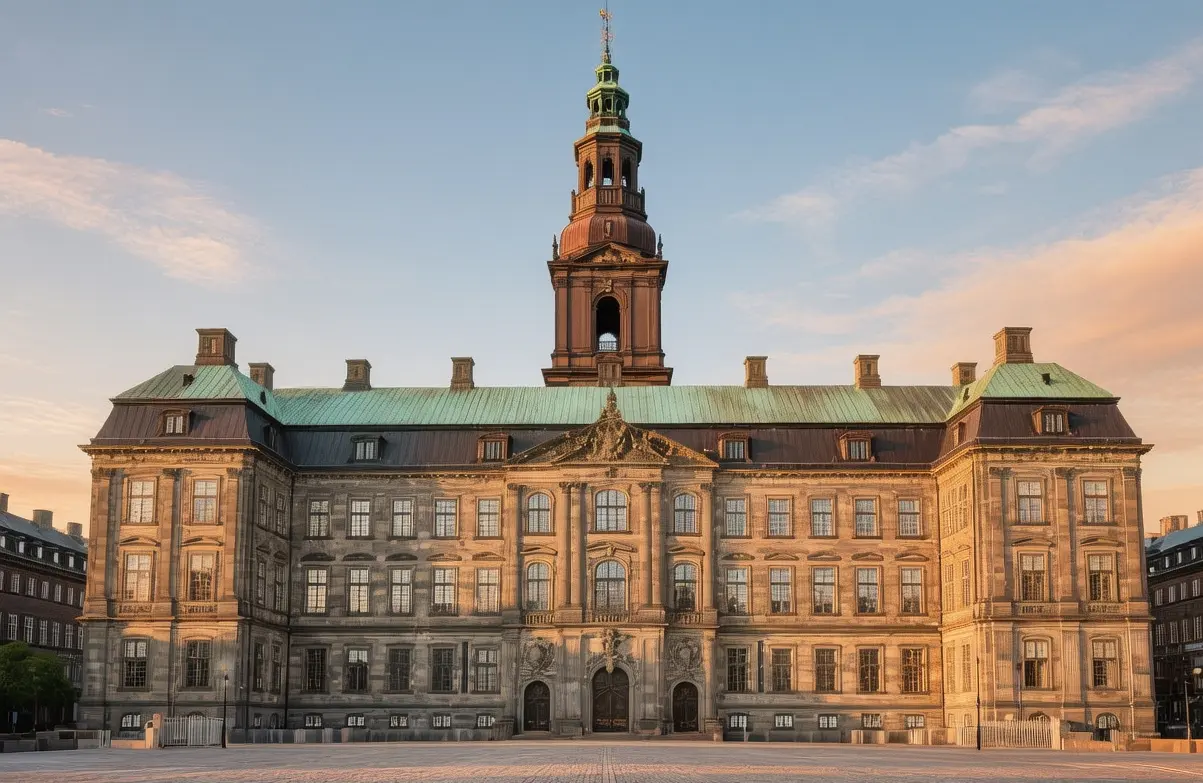
Christiansborg Palace: Where Democratic Power Meets Royal Tradition
Golden hour bathes the granite façade of Christiansborg Palace in warm amber light, while the 106-meter tower pierces the Copenhagen sky like a sentinel overlooking the harbor. You approach across the cobblestone courtyard as the late afternoon sun casts long shadows from the equestrian statue of King Christian V, the air carrying the faint scent of harbor salt mixed with freshly cut grass from the palace gardens. Inside, the Great Hall's vaulted ceiling soars 18 meters overhead, adorned with tapestries depicting a millennium of Danish history, while the Royal Reception Rooms shimmer with gilded moldings and crystal chandeliers that have witnessed coronations, state banquets, and historic treaties. This is Christiansborg Palace—a unique complex housing all three branches of Danish government: the Parliament, the Supreme Court, and the Prime Minister's Office, alongside royal reception rooms used by the monarchy for official ceremonies. In an age where political institutions often feel distant or opaque, Christiansborg matters because it invites you to walk the same halls where democracy unfolds, to touch the same stone where centuries of Danish history have been made, and to understand that governance, at its best, belongs to the people it serves.
Why Christiansborg Palace Embodies Danish Democracy
Christiansborg Palace represents far more than a government building—it is a living testament to Denmark's constitutional evolution, where monarchy, democracy, and justice converge beneath one remarkable roof. The current palace, completed in 1928 after the devastating fire of 1884 destroyed its predecessor, stands on the same site as three previous royal castles dating to 1167, when Bishop Absalon first fortified Copenhagen. The complex spans approximately 12,000 square meters, with its distinctive tower rising precisely 106 meters (348 feet) above sea level, constructed primarily of gray granite from Bornholm Island and limestone from Faxe—a material choice that conveys both permanence and transparency.
The palace solves a profound civic need: it provides a unified seat of government that embodies Denmark's constitutional balance between royal tradition and democratic governance. The Folketing (Parliament) chamber, with its circular design and 179 seats, facilitates open debate visible to the public through glass-walled galleries; the Supreme Court's solemn chambers uphold judicial independence; and the Royal Reception Rooms—used by the monarch for state occasions—maintain ceremonial continuity. Technically, the building showcases remarkable engineering: the tower's spiral staircase comprises exactly 320 steps, engineered with a gradual incline to accommodate ceremonial processions; the Great Hall's tapestries, woven by Bjørn Nørgaard between 1990 and 1999, measure 2.5 meters in height and collectively span over 40 meters, depicting Danish history from the Viking Age to the present using traditional weaving techniques combined with contemporary artistic vision.
Since opening sections to the public in the early 20th century, Christiansborg has welcomed millions of visitors, making it not merely a political symbol but an educational institution where citizens engage with their heritage. The palace's design intentionally merges functionality with grandeur: climate-controlled display cases maintain 45–55% relative humidity to protect historic textiles, while LED lighting with less than 50 lux illumination preserves delicate pigments. This commitment to accessibility—paired with the building's role as a working seat of government—makes Christiansborg a bridge between Denmark's past and present, where the machinery of democracy operates in full view, inviting understanding rather than mystique.
The Best Time to Experience Christiansborg Palace
Timing transforms a visit to Christiansborg from informative to inspiring. The optimal window arrives May 18 through June 10, when daylight extends until 10:00 PM, temperatures range between 14–20°C (57–68°F), and the tower's outdoor balcony remains accessible without peak-season crowds. During this period, ascending the 320 steps at sunset rewards you with panoramic views of Copenhagen's red-tiled rooftops, the Øresund Strait, and the distant Swedish coastline, all bathed in golden light that enhances the city's architectural harmony.
For atmospheric photography, September 15 through October 8 offers crisp autumn light that bathes the granite façade in warm tones from 3:30–5:00 PM, while temperatures of 9–15°C (48–59°F) keep both interior exploration and tower climbing comfortable. Arrive at 10:00 AM sharp when the palace opens to experience the Great Hall and Royal Reception Rooms with minimal crowds, allowing quiet contemplation of the intricate tapestries and gilded details.
Avoid July 12–August 18 when cruise ship season brings peak tourist volumes, creating queue times of 30–45 minutes for tower access and limiting photography opportunities in crowded chambers. Similarly, December 20 through January 5 sees reduced daylight (sunset around 3:30 PM) and occasional closures for parliamentary sessions or royal events, though the palace's Christmas decorations provide charming atmosphere for exterior photography.
For current opening hours, guided tour schedules, and parliamentary session information, consult the authoritative source: www.ft.dk/en. The official website of the Danish Parliament provides real-time updates on public access, special exhibitions, and security procedures. Copenhagen's maritime climate means weather can shift rapidly—always check the forecast before visiting, and remember that the palace's interior maintains comfortable temperatures year-round, making it an ideal refuge during unpredictable Scandinavian weather.
Approximate Budget for a 7-Day Trip
Copenhagen ranks among Europe's more expensive capitals, but strategic planning enables comfortable exploration. This breakdown reflects mid-range travel with quality accommodations, authentic dining, and comprehensive sightseeing, based on current pricing in Danish Kroner (DKK) with Euro conversions (1 EUR ≈ 7.45 DKK).
Accommodation:
• Budget hostel (shared room, Vesterbro/Indre By): 300–450 DKK (€40–60) per night
• Mid-range hotel (3-star, city center near Christiansborg): 1,000–1,500 DKK (€134–201) per night
• Boutique hotel (4-star, Slotsholmen vicinity): 1,700–2,400 DKK (€228–322) per night
Food:
• Breakfast: 80–120 DKK (€11–16) — Danish pastry and coffee at local bakery
• Lunch: 140–200 DKK (€19–27) — smørrebrød or hot dog from street vendor
• Dinner: 250–350 DKK (€34–47) — traditional Danish meal at mid-range restaurant
• Daily food total: 470–670 DKK (€63–90)
Transportation:
• Copenhagen Card (72-hour unlimited transport + attractions): 1,099 DKK (€148)
• Single metro/bus ticket: 24 DKK (€3.20)
• Airport to city center (metro line M2): 36 DKK (€4.80)
• Bicycle rental (daily): 100–150 DKK (€13–20)
• Walking to Christiansborg from city center: Free (600 meters from Central Station)
Attractions:
• Christiansborg Palace entrance: 120 DKK (€16) adult; free under 18
• Christiansborg included in Copenhagen Card: Free with card purchase
• Tower access: Included in palace admission
• Royal Stables and Carriages: Included in palace admission
• National Museum of Denmark: Free
• Nyhavn canal tour: 129 DKK (€17)
Miscellaneous:
• Souvenir postcards: 15–25 DKK (€2–3) each
• Danish design items: 300–800 DKK (€40–107)
• Coffee to go: 35–45 DKK (€5–6)
• Political history guidebook: 150 DKK (€20)
Total 7-Day Budget (Mid-Range): 8,000–10,700 DKK (€1,074–1,436)
7 Essential Christiansborg Palace Experiences
- Tower Ascent for Panoramic Views: Begin your visit by climbing the tower's spiral staircase of exactly 320 steps to reach the observation deck at 80 meters (262 feet). The gradual incline—engineered for ceremonial processions—makes the climb manageable for most visitors; allow 15–20 minutes for ascent with rest stops. At the top, 360-degree views reveal Copenhagen's red-tiled rooftops, the Øresund Strait, and on clear days, the Swedish coastline 20 kilometers away. Visit during late afternoon (4:00–5:30 PM) when angled sunlight creates dramatic shadows across the cityscape. Bring a light jacket; winds at this elevation can feel 5°C cooler than ground level.
- Royal Reception Rooms Exploration: Enter the palace's opulent state rooms to witness Danish royal ceremonial life. Begin in the Throne Room, where two silver thrones sit beneath an embroidered canopy, then proceed to the Banqueting Hall—40 meters long with space for 400 guests—and the Audience Chamber with its gilded ceiling medallions. Allow 45–60 minutes to appreciate the intricate details: silk wall coverings woven in Lyon, porcelain from Royal Copenhagen, and portraits by court painters. Audio guides (available in eight languages for 40 DKK) provide rich historical context. Photography is permitted without flash; use natural light from tall windows to capture the rooms' elegance.
- Great Hall Tapestry Study: Dedicate focused time to Bjørn Nørgaard's monumental tapestries in the Great Hall, which depict 1,000 years of Danish history through vibrant, contemporary imagery. Each of the 11 tapestries measures 2.5 meters in height and collectively spans over 40 meters, featuring more than 1,000 hand-woven figures. Stand at the hall's center and observe how natural light from the tall windows illuminates the intricate details: Viking ships, medieval kings, modern social reforms. Allow 20–25 minutes to absorb the narrative progression; the tapestries reward close observation with hidden symbols and witty commentary on Danish identity.
- Royal Stables and Carriage Tour: Descend to the palace's lower level to explore the Royal Stables, home to the ceremonial carriage collection and approximately 20 horses used for state occasions. View the Golden Coach—crafted in 1745 with gilded wood and velvet upholstery—and the State Coach used for royal weddings. If visiting between 9:00–11:00 AM on weekdays, you may observe grooms caring for the horses; staff often share insights about equine training for ceremonial duties. Allow 30 minutes for this unique glimpse into living royal tradition; the stable's brick-vaulted architecture, dating to the 18th century, adds atmospheric context.
- Parliament Gallery Observation: When the Folketing (Parliament) is in session, visit the public gallery to observe Danish democracy in action. Enter via the separate parliamentary entrance on Prins Jørgens Gård; security screening takes 5–10 minutes. The circular chamber's design facilitates open debate, with glass-walled galleries allowing unobstructed views of proceedings. Check the parliamentary schedule online before visiting; sessions typically run Tuesday–Thursday, 10:00 AM–4:00 PM. Remain silent during debates, and respect photography restrictions inside the chamber. This experience transforms abstract concepts of governance into tangible reality.
- Medieval Ruins Exploration: Beneath the palace courtyard lies the Christiansborg Ruins, preserving foundations from Bishop Absalon's 12th-century fortress and subsequent castles. Access via the courtyard entrance (included in palace admission) to walk among original stone walls, archways, and defensive structures dating to 1167. Informative displays explain archaeological discoveries and the site's evolution across eight centuries. Allow 25–30 minutes for exploration; the cool, atmospheric space provides a powerful counterpoint to the palace's grandeur above. Visit during weekday mornings when natural light filters through courtyard openings, illuminating the ancient stonework.
- Harbor View Photography at Golden Hour: Return to Christiansborg's exterior during the "golden hour"—the hour before sunset when light turns warm and directional. Position yourself on the Slotsholmen Canal bridge to frame the palace tower with the harbor in the foreground, using the setting sun to illuminate the granite façade and waving parliamentary flags. Use a tripod for low-light shots of architectural details, and experiment with long exposures to capture the motion of clouds against the tower's static grandeur. The palace's symmetrical design creates unique compositional opportunities; walk the perimeter to discover varied perspectives. Respect other visitors by keeping your shoot brief in popular photo locations.
3 Hidden Gems Most Travelers Miss
- The Tower's Hidden Balcony: While most visitors photograph from the main observation deck, a small, lesser-known balcony accessible via a side door on the tower's northern side offers intimate views of the palace courtyard and parliamentary gardens. Request access from tower staff when purchasing your ticket (available for photography enthusiasts, subject to availability). This vantage point remains overlooked because signage is minimal and access requires staff approval, yet it provides the perfect angle for capturing the tower's copper spire against the sky without crowds. Visit during weekday afternoons (2:00–4:00 PM) when natural light filters through the copper roof, creating warm reflections on the granite walls. Allow 10–15 minutes to appreciate this exclusive perspective.
- The Palace Chapel's Royal Gallery: Located on the palace's upper level, the Christiansborg Palace Chapel features a secluded royal gallery where the monarch and family observe services. Access via the chapel's side entrance near the Royal Reception Rooms (open during palace hours, included in admission). The gallery's intimate scale—seating approximately 12 people—offers a quiet moment of reflection amid the palace's grandeur. The chapel's baroque interior, with its ornate altar and 1792 organ, remains overlooked because many visitors focus on the Great Hall and tower. Visit during weekday mornings (10:00–11:30 AM) when natural light illuminates the gilded details through stained-glass windows. Allow 15–20 minutes to absorb the chapel's spiritual atmosphere.
- Slotsholmen Canal's Architectural Walk: Walk the perimeter of Slotsholmen Island—the small landmass housing Christiansborg—to discover a concentrated collection of Danish governmental architecture. Begin at the palace's eastern side and follow the canal path clockwise, passing the Royal Library's Black Diamond, the Supreme Court building, and the Ministry of Justice. This 800-meter route reveals how Christiansborg integrates with Copenhagen's administrative heart. Visit between 9:00–11:00 AM when morning light illuminates the granite and limestone façades and the canal remains nearly empty except for local commuters. The walk remains overlooked because it lacks major signage, yet it offers authentic context for understanding Denmark's governmental landscape. Pause at the canal bridge for panoramic views of the palace reflected in still water.
Cultural & Practical Tips
- Parliamentary Etiquette: Christiansborg is a working government building. Speak softly in parliamentary areas, keep mobile phones on silent, and follow staff guidance regarding restricted zones. When observing parliamentary sessions, remain seated and silent; applause or commentary is inappropriate. A simple "Undskyld" (OON-skyld, "Excuse me") suffices when navigating crowded spaces.
- Photography Guidelines: Photography is permitted throughout public palace areas for personal use, but flash and tripods require staff approval. The parliamentary chamber prohibits photography during sessions. For exterior shots, the best lighting occurs during golden hour (7:30–8:30 PM summer; 3:30–4:30 PM winter). Respect security personnel by avoiding photographs of restricted entrances or surveillance equipment.
- Weather Preparedness: Copenhagen's maritime climate means conditions change rapidly. Even in summer, temperatures can drop 5°C (9°F) after sunset. Always carry a windproof layer. The palace's interior maintains comfortable temperatures year-round, but the tower's outdoor balcony can feel chilly—dress in layers for ascent.
- Transportation Access: Christiansborg Palace sits at Prins Jørgens Gård 1, accessible by metro to Gammel Strand Station (2-minute walk) or buses 1A, 2A, and 9A. From Copenhagen Airport, take the metro to Gammel Strand (18 minutes, 36 DKK). If cycling, use the dedicated bike lanes on H.C. Andersens Boulevard; bike parking is available near the palace entrance (free with helmet lock).
- Ticket Strategy: Purchase tickets online via the official website to avoid entrance queues. The Copenhagen Card includes free Christiansborg entry plus unlimited public transport—calculate if your itinerary justifies the 1,099 DKK cost. Children under 18 enter free; students and seniors receive discounted admission with valid ID. Audio guides enhance understanding of the palace's political and royal history.
- Accessibility Information: The palace's main exhibition areas and Royal Reception Rooms are wheelchair-accessible via elevators; request assistance at the main ticket desk. The tower's spiral staircase is not accessible to mobility devices, but a virtual reality experience on the ground floor provides the panoramic view. Accessible restrooms are available near the entrance. The courtyard features level cobblestones suitable for wheelchairs and strollers.
- Seasonal Considerations: Christiansborg transforms subtly across seasons: spring brings blooming tulips in palace gardens; summer offers extended tower hours and outdoor events; autumn features golden foliage framing the granite façade; winter provides atmospheric photography opportunities with occasional frost. Check the official website for special exhibitions and temporary closures, as programming shifts based on parliamentary sessions and royal events.
Conclusion: Travel with Understanding, Not Just Sightseeing
Christiansborg Palace endures not because it houses impressive architecture—though it does—but because it invites us to witness democracy in action, to understand that governance is not a distant abstraction but a daily practice shaped by citizens, representatives, and history. In an age of political polarization and digital distraction, this granite sentinel asks us to pause: to observe parliamentary debate not as spectacle but as civic engagement, to trace the tapestries' narratives not as decoration but as collective memory, to feel the weight of responsibility that comes with self-rule.
Responsible travel here means more than purchasing a ticket—it means engaging with Christiansborg as a living institution worthy of respect. Support democratic transparency by following parliamentary etiquette and respecting security protocols. Choose to learn: read the informative placards, join a guided tour, or simply sit quietly in the courtyard and observe how power and accessibility intersect. When you ascend the tower, remember the view represents not just a cityscape but a community you're temporarily part of.
Most importantly, allow yourself to feel curiosity without rushing to the next attraction. Let the palace's atmosphere settle over you. Notice how afternoon light transforms the granite façade. Watch how locals move through the courtyard with quiet familiarity. Christiansborg was created to embody accountability—and accountability requires time, attention, and openness. As you exit through the palace gates, carry forward not just photographs but the quiet certainty that understanding how societies govern themselves remains one of travel's most profound gifts. Return to the world a little more informed, a little more engaged, a little more willing to participate in the democracy you've witnessed.