
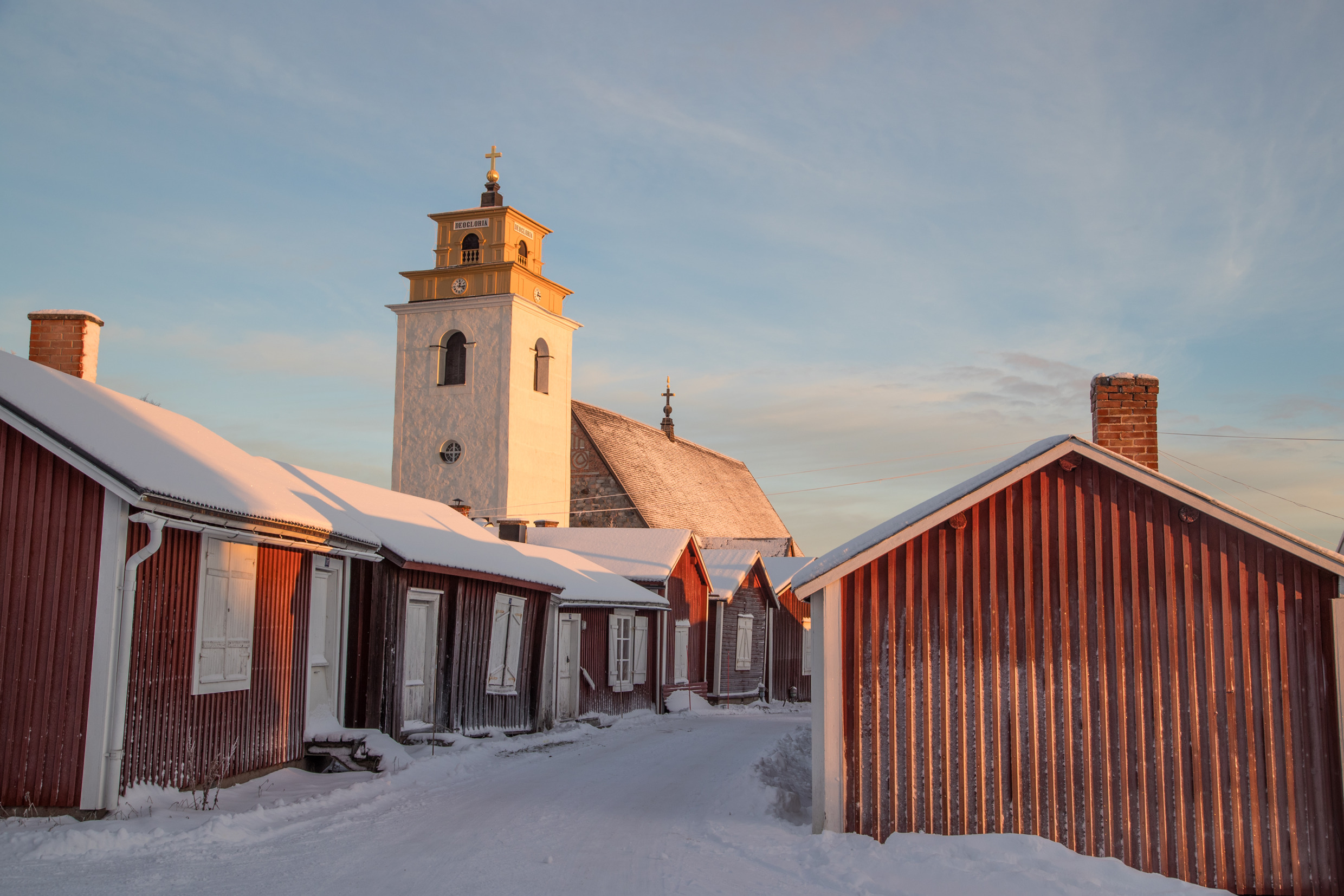
Gammelstad Church Town: Where Medieval Stone Meets Nordic Devotion
The morning light arrives late this far north—creeping over the Gulf of Bothnia at 9:47 AM in mid-January, casting long shadows across 404 identical red cottages that huddle together like congregants seeking warmth. You stand at the foot of Nederluleå Church, its 15th-century stone walls rising 35 meters (115 feet) above the settlement, and listen: the silence is profound, broken only by the crunch of snow beneath your boots and the distant toll of a bell that has marked time since 1492. This is Gammelstad Church Town, the largest and best-preserved church village in the world—a place where post-glacial land uplift forced a harbor to retreat, where farmers once walked 20 kilometers through subarctic darkness to fulfill their Sunday obligation, and where 520 protected buildings still whisper stories of faith, community, and survival in one of Europe's most unforgiving climates. Here, architecture serves belief; the cottages exist not for commerce or comfort, but for devotion.
Why Gammelstad Church Town Embodies Sacred Community
Gammelstad represents something nearly extinct: the church town tradition of northern Scandinavia. When the Swedish crown mandated church attendance in the 16th century, farmers living more than 10 kilometers from their parish church faced an impossible choice—travel through harsh terrain in a single day, or build overnight accommodations. The solution transformed the landscape. Between 1492 and the mid-17th century, 404 wooden cottages emerged around Nederluleå Church, creating 552 separate chambers where worshippers could shelter during weekends of prayer and parish meetings.
The settlement's survival owes everything to geological catastrophe. Post-glacial land uplift—caused by the retreat of ice sheets that had compressed the Earth's crust—raised the coastline by 10 meters, rendering Gammelstad's harbor unusable by 1649. The commercial center relocated 10 kilometers downstream to present-day Luleå, leaving Gammelstad (literally "Old Town") frozen in time, untouched by industrialization. On December 7, 1996, UNESCO recognized this preservation, inscribing Gammelstad as a World Heritage Site for illustrating "the adaptation of conventional urban design to the special geographical and climatic conditions of a hostile natural environment." The site remains unique: of 71 original Swedish church towns, only 16 survive, and none match Gammelstad's scale or integrity.
The Best Time to Experience Gammelstad Church Town
For optimal exploration, plan your visit between June 20 and August 15, when temperatures range from 15°C to 25°C (59°F–77°F) and daylight extends nearly 22 hours. During this window, the Visitor Centre operates extended hours (12:00–16:00 Monday–Thursday, 12:00–15:00 Saturday–Sunday, closed Fridays), and guided tours run regularly. The Midsummer celebration on June 24 transforms the town with traditional dancing around the maypole, craft workshops, and haystack jumping.
Winter visitors (December 1–March 15) encounter temperatures between -15°C and -30°C (5°F to -22°F), with only 3–4 hours of daylight around the winter solstice. However, this season offers the ethereal beauty of snow-laden rooftops and, from September to March, opportunities to witness the aurora borealis dancing above the church tower. Avoid late March through early May, when melting snow creates muddy conditions and many facilities remain closed between winter and summer seasons.
For official visitor information, current event schedules, and booking guided tours, consult the official tourism website: https://www.visitgammelstad.se/
Approximate Budget for a 7-Day Trip
Costs in Swedish Lapland reflect the region's remoteness, though Gammelstad itself offers free wandering. Budget travelers can manage comfortably with strategic planning.
- Accommodation: €75–€120 per night in Luleå city center hotels (Clarion Hotel Sense, Elite Hotel Luleå); €45–€80 for guesthouses and B&Bs in Gammelstad area; Airbnb rentals within the church town itself range €60–€90 nightly.
- Food: €55 per day—breakfast €12 (hotel buffet or café pastry with coffee), lunch €18 (traditional Swedish smörgåsbord or moose meatballs with lingonberry at Kaptensgården), dinner €25 (locally caught whitefish or Kalix löjrom—vendace roe known as "Swedish caviar").
- Transportation: Bus #9 from Luleå city center to Gammelstad costs approximately €3.50 one-way (35 SEK), with departures every 20 minutes. Taxi from Luleå Airport (7 km) to Gammelstad: €25–€30. Car rental: €45–€65 daily.
- Attractions: Guided tour of Gammelstad: €8–€10 (80–100 SEK); Visitor Centre exhibition: free; Midsummer celebration entrance: €3 (30 SEK); traditional cooking class at Kaptensgården: €45–€60.
- Miscellaneous: Hand-carved wooden utensils at Hägnan Open-Air Museum shop: €15–€35; locally woven textiles: €40–€80; woolen mittens: €25.
Total for 7 days: €850–€1,400 per person (budget to mid-range), excluding international flights.
6 Essential Gammelstad Church Town Experiences
- Climb the Bell Tower: Ascend the church's tower—technically constructed without building permits in the 18th century—for panoramic views across the 404 red cottages and the frozen Bothnian Bay. The climb reveals the settlement's radial street pattern, designed organically over centuries with roads circling the hilltop church.
- Step Inside a Show Cottage: Visit the furnished cottage at 253–254 Framlänningsvägen, where traditional Scandinavian "cupboard beds" (skåpssängar), cast-iron coffee pots, and hand-sewn clothing recreate 18th-century parish life. Note the social architecture: cottages were designed for conversation, not privacy.
- Attend a Traditional Fika: Join the guided tour's coffee break inside a historic cottage, where guides explain how the church town tradition fostered courtship and community. The coffee ritual—kaffe served with cardamom buns—was exempt from Sunday cooking prohibitions and became the week's social centerpiece.
- Explore Hägnan Open-Air Museum: Located adjacent to the church town, this museum preserves 18th–20th century buildings from across Swedish Lapland. Watch blacksmithing demonstrations, try butter churning, or visit the heritage farm animals. The Kafé Fägnan serves authentic fika in period surroundings.
- Walk the Ancient Road Network: Trace the medieval paths that radiate from the church like spokes on a wheel, then explore the 17th-century gridiron pattern added when Gammelstad briefly served as a commercial harbor. The contrast reveals how land uplift forced urban adaptation.
- Experience a Church Holiday: Time your visit for the second Sunday of Advent (early December) when the Christmas Market fills Hägnan with handicrafts, or Midsummer Eve (June 24) when locals raise the maypole and perform traditional ring dances. These events activate the cottages' original purpose—community gathering around faith.
3 Hidden Gems Most Travelers Miss
- The Cottage of the Separatists (Separatisternas stuga): Tucked away on the settlement's eastern edge, this modest cottage served 19th-century religious dissenters who broke from the state church. Unlike the uniform red cottages, it bears subtle architectural differences reflecting nonconformist identity. Access requires asking at the Visitor Centre for the unlocked entrance during summer months (June–August).
- The Old Harbor Site: Now a parking lot for Hägnan Museum, this unmarked location 200 meters northeast of the church marks where boats once docked when sea levels were 10 meters higher. Stand here and imagine the maritime settlement that existed before post-glacial uplift transformed the landscape—it's a powerful lesson in geological time.
- Bethel Chapel (Bethelskapellet): This 19th-century prayer house, located near the main church, served the town's growing population when Nederluleå Church couldn't accommodate all worshippers. Most visitors focus on the medieval stone church and miss this wooden gem. The chapel opens only for special services; contact the Visitor Centre at +46 920 24 59 00 to inquire about access.
Cultural & Practical Tips
- Respect the living community: Gammelstad remains inhabited by approximately 798 residents. The 404 cottages are privately owned—never enter without permission or a guide. Shuttered windows indicate unoccupied spaces; open shutters signal welcome.
- Learn basic Swedish courtesies: Hej (hey) for hello, Tack (tahk) for thank you, Ursäkta (oor-sehk-tah) for excuse me. English is widely spoken, but attempting Swedish earns warm smiles.
- Dress for the subarctic: Even summer evenings can drop to 10°C (50°F). Winter requires thermal base layers, insulated boots rated to -30°C, and windproof outer shells. The Visitor Centre provides snowshoes for winter walking tours.
- Photography guidelines: The red cottages against snow create iconic images, but avoid photographing private residences with identifying details. The church interior permits non-flash photography; the ornate Antwerp altarpiece (c. 1520) rewards patient shooting.
- Embrace the silence: Gammelstad's power lies in contemplation. Avoid loud conversations in the narrow lanes; this was, and remains, a place of spiritual retreat.
- Plan for limited services: The church town has no hotels, restaurants, or ATMs. Bring water and snacks, and complete transactions in Luleå before arriving.
Conclusion: Travel with Reverence, Not Just Curiosity
Gammelstad Church Town endures because it was forgotten—abandoned by commerce, preserved by accident, and protected by UNESCO recognition. When you walk these lanes, you tread paths shaped not by market forces but by spiritual necessity, not by architectural fashion but by climatic survival. The 404 red cottages represent something increasingly rare in contemporary travel: a place that exists for reasons entirely separate from tourism.
Approach Gammelstad slowly. Sit on a wooden bench and watch the light shift across the church tower. Consider the farmers who walked 20 kilometers through darkness to sleep in unheated chambers, all for the privilege of communal worship. This is not a museum piece to be consumed and photographed; it is a continuing tradition of faith, community, and adaptation to a demanding landscape. Travel here not to collect experiences, but to understand how place and belief can intertwine across 500 years—and how, sometimes, the most profound destinations are those that were never meant to be destinations at all.