
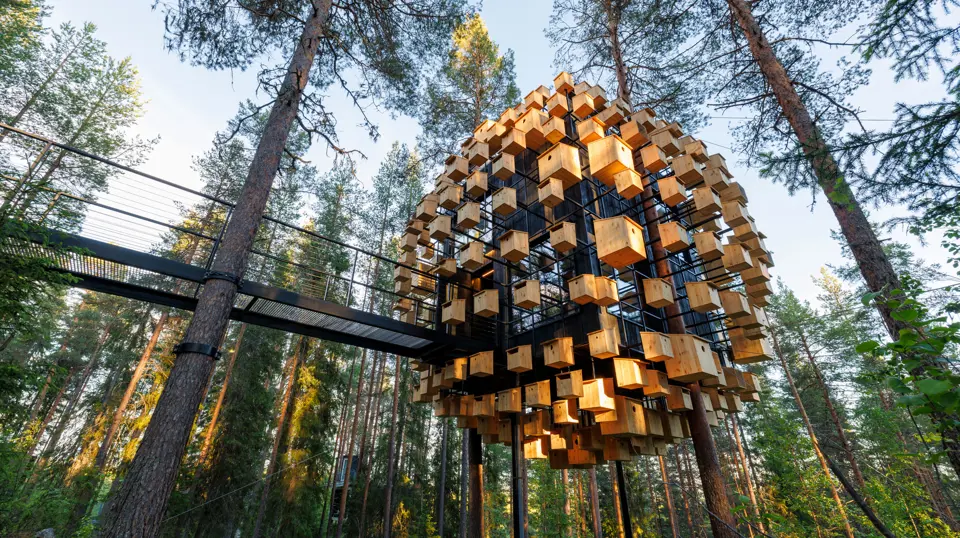
Treehotel Harads: Where Architectural Fantasy Meets Nordic Wilderness
The afternoon light filters through the pine canopy at 3:47 PM in late February, casting long shadows across the snow-covered forest floor. You stand at the base of a retractable ladder, looking up at a structure that seems to defy gravity—a 4-meter by 4-meter cube clad entirely in mirrors, hovering 6 meters above the ground among the treetops. The Mirrorcube reflects the surrounding Scandinavian woodland so perfectly that it nearly disappears, a ghost of architecture suspended in mid-air. This is Treehotel, located in the village of Harads—population 600—where the Lule River winds through Swedish Lapland and the Arctic Circle lies just 80 kilometers north. Founded in 2010 by Kent and Britta Lindvall, this collection of eight extraordinary tree rooms represents the culmination of a childhood fantasy: to sleep among the trees without sacrificing comfort, to inhabit the forest rather than merely observe it. Here, design serves nature; each room—created by Scandinavia's most celebrated architects—exists not to dominate the landscape but to dissolve into it.
Why Treehotel Harads Embodies Sustainable Innovation
Treehotel solves a fundamental tension in luxury travel: how to offer extraordinary accommodation without destroying the very environment that makes the destination worth visiting. The concept emerged from a collaboration between the Lindvalls and a film crew documenting treehouse architecture. When the project needed a location, the Lindvalls offered their 1930s guesthouse in Harads—and the Treehotel was born .
Each tree room demonstrates technical ingenuity married to ecological sensitivity. The Mirrorcube—designed by Tham & Videgård—measures 4x4x4 meters and features exterior walls of laminated reflective glass printed with a transparent ultraviolet color that prevents bird collisions . The 7th Room, designed by Snøhetta, elevates guests 10 meters above ground on twelve slender pillars, its charred timber exterior blending into the pine forest while a netted terrace allows sleeping under open skies—mosquito-free, since insects rarely fly above 10 meters . The UFO, created by Bertil Harström, accommodates families with its 5-meter diameter disc shape and retractable ladder that emits theatrical smoke upon arrival. Construction employed sustainable methods: no trees were felled to build the rooms; instead, each structure attaches to living pines using adjustable steel collars that allow for tree growth and movement . The hotel operates on hydroelectric power and maintains a strict no-chemical policy throughout the property.
The Best Time to Experience Treehotel Harads
For optimal aurora viewing and winter activities, visit between November 15 and February 28, when temperatures range from -10°C to -30°C (14°F to -22°F) and the Northern Lights dance across 20+ hours of darkness. During this window, the hotel offers snowshoeing, husky sledding, and ice fishing on the frozen Lule River. The dry Arctic air makes subzero temperatures feel more bearable than the thermometer suggests .
Summer visitors (June 20–August 15) enjoy temperatures of 15°C to 25°C (59°F–77°F) with nearly 22 hours of daylight during the midnight sun period. This season brings hiking, horseback riding, and canoeing opportunities, though mosquitoes peak from late June through July—pack repellent or book the 7th Room, where altitude provides natural protection .
Avoid March 15–May 15, when melting snow creates muddy conditions and many winter activities cease while summer operations have not yet begun. September offers excellent value with autumn colors and possible early aurora sightings, though weather becomes unpredictable .
For availability, seasonal packages, and activity bookings, visit the official website: treehotel.se
Approximate Budget for a 7-Day Trip
Treehotel represents luxury accommodation in a remote Arctic setting; prices reflect both the uniqueness of the experience and the logistical challenges of operating in Swedish Lapland. Budget accordingly.
- Accommodation: €620–€950 per night for tree rooms (Mirrorcube, UFO, 7th Room, Bird's Nest, Cabin, Blue Cone, Dragonfly, or Biosphere). Rates vary by season—October offers lowest prices (approximately 10% reduction), while January commands premium rates (16% higher) . Minimum two-night stay recommended. Britta's Guesthouse rooms (ground level) available for €180–€250 nightly.
- Food: €85 per day—breakfast €0 (included in tree room rates), lunch €25 (wood-fired pizza making experience at the hotel), dinner €45–€60 (four-course seasonal tasting menu at Treehotel Restaurang featuring locally sourced moose, Arctic char, or cloudberries). The guesthouse restaurant serves traditional Swedish cuisine in 1930s-era surroundings.
- Transportation: Flight to Luleå Kallax Airport (LLA), then 100-kilometer transfer to Harads. Rental car: €55–€75 daily. Airport shuttle arranged through hotel: €120–€150 each way. Train to Boden plus taxi: €45 total.
- Attractions: Guided hotel tour: €220 base rate for up to 10 people, plus €22 per additional person . Northern Lights photography workshop: €85–€120. Moose safari: €95. Sami cultural experience: €75. Spa access (sauna, hot tub): included for guests.
- Miscellaneous: Reindeer leather slippers at hotel shop: €45. Local cloudberry jam: €12. Hand-carved wooden utensils: €25–€40.
Total for 7 days: €5,800–€8,500 per couple (luxury experience), excluding international flights.
6 Essential Treehotel Harads Experiences
- Spend a Night in the Mirrorcube: Climb the 12-meter rope bridge and enter the 4x4-meter mirrored cube that reflects the forest on all sides. Inside, the plywood interior contrasts with the exterior illusion; the room accommodates two guests with a double bed, compost toilet, and rooftop terrace. Wake at 2:00 AM to watch the Northern Lights reflected infinitely in the mirrored walls—a surreal experience available only to occupants.
- Retract the UFO Ladder: Book the UFO room—5 meters in diameter, suspended among pines—and activate the hydraulic ladder system that descends with theatrical smoke effects. The interior features space-age decor, accommodates two adults and two children, and includes a small seating area. Children universally declare this the ultimate accommodation; the experience of "boarding" a spacecraft in the Swedish forest creates indelible memories.
- Sleep on the 7th Room's Net Terrace: At 10 meters above ground—the highest of all tree rooms—Snøhetta's creation features a netted outdoor platform where guests can sleep under stars and aurora, protected from mosquitoes by altitude. The room's charred timber exterior and panoramic windows frame the Lule River valley. Access via external staircase; the terrace net supports full adult weight with theatrical suspension.
- Make Pizza in the Wood-Fired Oven: Join the hotel's pizza-making experience at the outdoor stone oven, located near the guesthouse. Staff provide dough and local toppings—reindeer meat, chanterelle mushrooms, Västerbotten cheese—while you learn to manage the 400°C oven. The activity runs year-round; winter sessions include torches and blankets.
- Relax in the Forest Spa: Access the hotel's sauna and outdoor hot tub, located in a separate building near the guesthouse. The facility overlooks the Lule River and operates on renewable energy. Winter visits allow hot tub soaking while snow falls; summer sessions extend past 10:00 PM in the endless daylight. Bathrobes and slippers provided; the experience is included for all tree room guests.
- Walk the Suspension Bridge to Bird's Nest: Access the Bird's Nest room—designed to resemble a giant avian habitat woven from branches—via a retractable staircase. The exterior appears chaotic and organic, but the interior reveals a surprisingly spacious 17-square-meter suite with separate bedroom and living areas. The contrast between wild exterior and refined interior encapsulates the Treehotel philosophy.
3 Hidden Gems Most Travelers Miss
- The Alpaca Farm in Harads Village: Located just 1.5 kilometers from Treehotel, this small working farm houses alpacas that visitors can feed and photograph. Most guests focus on the tree rooms and miss this opportunity for close wildlife interaction. The farm opens daily 10:00–16:00; no appointment needed, though calling ahead at +46 928-XXX XX ensures the owner is present. Winter visits offer snow-dusted animals against white landscapes.
- The Original Harbor Site on the Lule River: Before the tree rooms existed, the Lindvalls operated a simple guesthouse. Walk 200 meters north from the main property to find the original wooden dock where Kent Lindvall first conceived the Treehotel concept. The site offers the best unobstructed river views and serves as a quiet meditation spot. Most guests never venture beyond the tree room paths; this location provides solitude and historical context.
- Britta's Secret Recipe Archive: In the guesthouse restaurant, ask to see the handwritten recipe book that Britta Lindvall compiled over decades—containing traditional Norrland dishes including kalops (meat stew), palt (potato dumplings), and cloudberry desserts. The staff will share stories about the hotel's founding while showing photographs from the 2010 construction period. This cultural dimension—accessible only by asking—reveals the human story behind the architectural spectacle.
Cultural & Practical Tips
- Respect the silence: Treehotel emphasizes shinrin-yoku (forest bathing)—the Japanese philosophy that forests calm the racing mind. Keep voices low on the forest paths; this is a place of contemplation, not social media performance (though photography is encouraged).
- Learn essential Swedish: Hej (hey) for hello, Tack (tahk) for thank you, God morgon (good mor-yon) for good morning. Staff speak excellent English, but attempting Swedish earns warm appreciation.
- Dress for Arctic conditions: Even summer evenings drop to 10°C (50°F). Winter requires thermal base layers, insulated boots rated to -30°C, and windproof outer shells. The hotel provides snowshoes and walking poles.
- Photography guidelines: The Mirrorcube's reflective surfaces create challenging lighting conditions—shoot during golden hour (10:00–11:00 AM or 2:00–3:00 PM in winter) for optimal results. Drones are prohibited to preserve guest privacy and wildlife tranquility.
- Understand the bathroom situation: Only the Dragonfly and 7th Room include in-room showers; other tree rooms use shared facilities in an adjacent building with shampoo, soap, towels, and bathrobes provided . The compost toilets in-tree are eco-friendly but require brief outdoor exposure.
- Book activities in advance: The hotel's guided tours, moose safaris, and Northern Lights excursions fill quickly, especially during peak aurora season (December–February). Reserve at least two weeks before arrival via +46 928-103 00.
Conclusion: Travel with Wonder, Not Just Wanderlust
Treehotel Harads succeeds because it refuses to choose between comfort and conscience, between architectural ambition and environmental humility. When you climb that ladder—whether to the UFO's metallic disc or the Mirrorcube's reflective prism—you enter a space that challenges assumptions about where humans belong in nature. The rooms do not sit upon the forest; they float within it, suspended by cables and imagination, visible yet invisible, present yet ephemeral.
Approach this place with the openness of a child and the respect of a steward. The architects—Snøhetta, Tham & Videgård, Rintala Eggertsson—have created more than accommodations; they have built arguments for how humans might inhabit wild spaces without destroying them. As you lie on the 7th Room's net terrace, watching aurora borealis ripple across the Arctic sky, consider that this experience exists because a family in a remote Swedish village dared to dream differently. Travel here not to escape the world, but to reimagine your place within it—to remember that the best architecture, like the best travel, leaves no trace except transformation.