
Plaka: Where Ancient Cobblestones Meet Neoclassical Charm
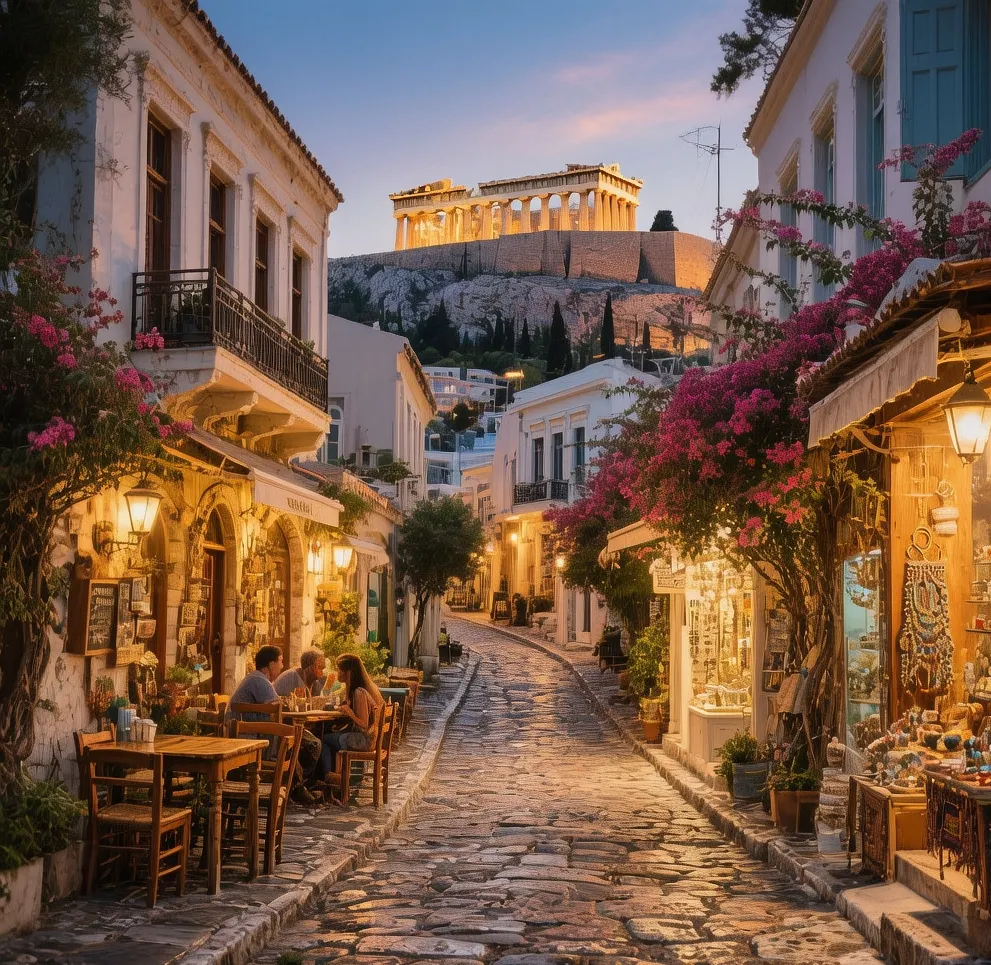
The late afternoon sun casts long shadows across Plaka's labyrinthine streets as you wander beneath cascading bougainvillea and jasmine vines that drape over terracotta rooftops. The air carries the intoxicating blend of freshly brewed Greek coffee, sizzling souvlaki, and the faint mineral scent of Pentelic marble from the Acropolis looming 300 meters above. Street musicians strum bouzoukis in hidden courtyards while cats—Plaka's unofficial guardians—sun themselves on weathered stone steps worn smooth by countless footsteps over three millennia. This neighborhood, sprawling across 47 hectares at the foot of the Acropolis, represents Athens' oldest continuously inhabited district, where Ottoman-era houses stand beside neoclassical mansions and Byzantine churches share corners with ancient ruins. The narrow alleys—some barely 2 meters wide—twist and turn in deliberate patterns designed to confuse invaders, creating an intimate urban fabric where every corner reveals a new discovery: a 17th-century mosque converted to a church, a family-run taverna serving recipes unchanged for generations, or a small workshop where artisans still craft sandals using techniques passed down since antiquity. Plaka matters because it embodies Athens' layered soul—a living palimpsest where every civilization that touched this city left its mark, creating a neighborhood that refuses to be merely a museum but insists on remaining vibrantly, authentically alive.
Why Plaka Embodies Timeless Athenian Character
The Plaka neighborhood represents Athens' most successful urban preservation effort—a living solution to the fundamental challenge of maintaining historical continuity while accommodating modern life. Inhabited continuously since the Bronze Age, Plaka was systematically developed in its current form during the Ottoman period (15th–19th centuries) and underwent significant neoclassical transformation after Greek independence in 1830, when architects like Stamatios Kleanthes and Eduard Schaubert designed the area's distinctive grid pattern with wide boulevards intersecting narrow pedestrian lanes. The neighborhood solved Athens' need for a residential quarter that respected archaeological constraints while providing functional urban space: buildings were restricted to two or three stories, constructed primarily from local limestone and marble, with traditional features like wooden balconies (sachnisi), tile roofs, and interior courtyards that provided natural cooling during Athens' intense summers.
Plaka's architectural significance lies in its preservation of over 300 neoclassical buildings, 12 Byzantine and post-Byzantine churches, and numerous Ottoman structures—including the Fethiye Mosque (built 1458) and the Hamam (Turkish bath) on Kydathinaion Street. The area's urban planning follows a unique hybrid model: the northern section features the grand neoclassical boulevards of Adrianou and Lysikratous Streets (12–15 meters wide), while the southern warren maintains medieval alleyways averaging just 3 meters in width, creating distinct microclimates and social spaces. This duality addresses both ceremonial procession routes and intimate residential needs, allowing the neighborhood to function simultaneously as tourist destination and living community.
The district's cultural importance extends beyond architecture: Plaka houses the Museum of Greek Folk Art (est. 1918), the Jewish Museum of Greece, and sits adjacent to the Roman Agora and Tower of the Winds—an octagonal marble clocktower built by Andronicus of Cyrrhus around 50 BCE that stands 12 meters tall and functioned as both timepiece and weather vane. The neighborhood's 47-hectare expanse contains archaeological sites from seven distinct civilizations, yet maintains 850 permanent residents who preserve traditional crafts, family tavernas, and the daily rhythms that prevent Plaka from becoming a sterile theme park. This balance between preservation and habitation makes Plaka not just a place to visit, but a model for how historic urban cores can remain vibrant, functional communities in the 21st century.
The Best Time to Experience Plaka
Timing transforms Plaka from crowded tourist corridor to enchanting Athenian village. The optimal windows stretch from May 18–June 12 and September 15–October 20, when temperatures hover between 18–25°C (64–77°F), bougainvillea reaches peak bloom, and the neighborhood maintains its authentic character before cruise ship crowds arrive or after they've departed. During these shoulder seasons, you'll experience comfortable conditions for walking the hilly terrain while enjoying outdoor café culture without oppressive heat.
Arrive precisely at 8:00–10:00 AM when shopkeepers unlock wooden shutters and taverna owners sweep cobblestone streets—this golden hour reveals Plaka before the midday rush, offering pristine photography conditions and genuine interactions with locals beginning their day. The neighborhood operates as a 24-hour residential quarter, but shops and restaurants typically open at 9:00 AM, closing for siesta 3:00–6:00 PM (though tourist-oriented establishments now often remain open), then reopening until 11:00 PM or later. Evening strolls between 7:00–9:00 PM provide magical ambiance as string lights illuminate narrow alleys and the Acropolis glows golden against twilight skies.
Avoid July 15–August 31 unless absolutely necessary: temperatures regularly exceed 32°C (90°F), humidity climbs above 60%, and narrow streets become uncomfortably crowded with tour groups, making leisurely exploration nearly impossible. Also skip Greek Orthodox Easter week, August 15 (Dormition of the Virgin), and major public holidays when domestic tourism swells visitor numbers and many family-run establishments close for celebration. For the most current information on events, guided walks, and seasonal activities, always check the official Athens tourism portal at www.thisisathens.org before your visit.
Approximate Budget for a 7-Day Trip
Athens remains one of Europe's most accessible capitals, and staying in Plaka offers exceptional value with its central location eliminating extensive transportation costs. The following breakdown reflects mid-range travel—comfortable boutique hotel or apartment accommodation, authentic taverna dining mixed with occasional upscale meals, and comprehensive cultural experiences—based on current pricing for a single traveler exploring Plaka and greater Athens.
- Accommodation: €90–€180 per night in Plaka or adjacent Koukaki (€630–€1,260 total). Budget studios start at €50; luxury boutique hotels with Acropolis views run €250+.
- Food: €40–€60 per day total. Breakfast: €5–€8 (Greek coffee €3, bougatsa pastry €2.50, fresh orange juice €3). Lunch: €10–€15 (gyros pita €3.50, Greek salad €8, spanakopita €6). Dinner: €20–€30 (grilled fish €18, moussaka €12, house wine €5/glass, dessert €6).
- Transportation: €25 total. Metro from airport: €9 one-way (€18 round-trip on Line 3). Walking within Plaka: free. Occasional taxi rides: €8–€12 each. 5-day transit pass (if needed): €8.20.
- Attractions: €75 total. Acropolis combo ticket: €36 (includes Ancient Agora, Temple of Olympian Zeus, Roman Agora, Hadrian's Library, Kerameikos). Acropolis Museum: €15. Jewish Museum: €6. Walking food tour: €65 (optional).
- Miscellaneous: €100 total. Water/snacks €4/day, handmade leather sandals €50–€100, olive oil soap €8, local honey €12, tips €20.
Total: €1,250–€1,600 for 7 days (excluding international airfare)
7 Essential Plaka Experiences
- Wander Adrianou Street at golden hour: Athens' oldest commercial street stretches 800 meters from Thiseio to Syntagma, lined with neoclassical buildings housing jewelry shops, antique stores, and traditional kafeneia. Visit between 6:00–8:00 PM when the Acropolis illuminates and shop windows glow warmly. Stop at a third-floor rooftop café for Greek coffee (€3) and watch sunset paint the Parthenon in amber light.
- Dine at a family taverna on Mnisikleous Street: This pedestrian lane, just 150 meters long, concentrates some of Plaka's most authentic restaurants. Choose establishments with outdoor seating beneath grapevines. Order meze: dolmades (stuffed grape leaves, €8), saganaki (flaming cheese, €9), and grilled octopus (€16). Request a table after 8:30 PM when locals dine and the atmosphere becomes genuinely Athenian rather than performative.
- Explore the Anafiotika island enclave: Climb the northeastern slope of the Acropolis to discover this Cycladic-style village built in the 1840s by workers from Anafi island. White-washed cubic houses with blue doors cluster around tiny courtyards, creating a miniature Santorini in Athens' center. The area measures just 200 by 150 meters but contains 45 houses and the Church of Agios Georgios. Visit at 10:00 AM when cats lounge on sun-warmed stone and jasmine scent fills the air.
- Visit the Church of Agios Nikolaos Rangavas: This 11th-century Byzantine church, built into the Acropolis rock itself, features original frescoes and a bell tower constructed from ancient marble spolia. The church sits at the intersection of three historical periods—Byzantine, Ottoman, and modern Greek. Enter between 7:00–8:00 AM for morning prayer when candlelight illuminates the iconostasis and you can experience Plaka's spiritual dimension before tourists arrive.
- Shop for handmade sandals on Adrianou: Visit Melissinos Art (operating since 1890) or other family workshops where artisans craft custom leather sandals using 2,000-year-old techniques. The process takes 20 minutes: select leather color (€45–€80), trace your foot, choose strap design, and watch as the sandal is cut, stitched, and fitted. These workshops preserve a craft mentioned in ancient Greek texts and provide functional souvenirs that improve with age.
- Climb to the Acropolis viewpoint at Lysikratous Monument: The Choragic Monument of Lysikratous, built in 334 BCE, stands 10 meters tall and marks the spot where you can photograph the Acropolis framed by ancient columns. This circular structure, the only surviving choragic monument in Athens, supported bronze tripods awarded to musical competition winners. Visit at 9:00 AM when morning light creates dramatic shadows and the square remains peaceful.
- Experience Plaka's café culture at Brettos: Established in 1909, this colorful distillery and café on Kydathinaion Street displays hundreds of bottles creating rainbow walls of ouzo, tsipouro, and liqueurs. Order a traditional Greek coffee (€3) or sample house-made mastiha liqueur (€5). The space measures just 40 square meters but contains over 5,000 bottles—a living museum of Greek spirits. Best visited between 5:00–7:00 PM when the owner often shares stories about the neighborhood's evolution.
3 Hidden Gems Most Travelers Miss
- The Museum of Greek Folk Art's textile collection: Tucked away at 17 Kydathinaion Street, this museum houses an extraordinary collection of 18th and 19th-century embroideries, costumes, and household items that reveal daily life in Ottoman and early modern Greece. The textile gallery features wedding dresses with gold-thread embroidery taking 2–3 years to complete. Access: Open Tuesday–Sunday 8:00 AM–3:00 PM; admission €6. Most visitors walk past the unassuming neoclassical building. Allow 45 minutes; the English-language audio guide provides essential context for understanding the symbolic patterns in traditional crafts.
- The Roman Agora's Tower of the Winds interior: While tourists photograph the octagonal marble tower externally, few pay the €4 to enter the Roman Agora and see the interior frieze depicting the eight wind gods, or explore the extensive archaeological site featuring Hadrian's Library foundations and Ottoman-era structures. Access: Enter from Aeolou Street; open 8:00 AM–8:00 PM (summer). Visit at 1:00 PM when crowds thin for lunch. The site covers 12,000 square meters and reveals Athens' commercial center from 1st century BCE through Byzantine times—a crucial piece of Plaka's historical puzzle.
- The Jewish Museum of Greece rooftop: Located at 39 Nikis Street (Plaka's edge), this museum's fifth-floor terrace offers one of Athens' best Acropolis views without entrance fees or crowds. The museum itself documents 2,500 years of Jewish presence in Greece, but the rooftop café serves excellent coffee (€3.50) with panoramic vistas. Access: Museum open Sunday–Friday 9:00 AM–2:30 PM, Thursday until 5:30 PM; admission €6. Even if you skip the museum, ask politely to use the terrace—staff often allow café purchases without full admission. Best visited 4:00–6:00 PM for sunset photography.
Cultural & Practical Tips
- Respectful photography: While Plaka's streets are public spaces, always ask permission before photographing residents, especially in Anafiotika where people actually live. Avoid photographing inside churches during services. The best light for street photography occurs 7:00–9:00 AM and 7:00–9:00 PM when shadows create dramatic contrast on white walls.
- Navigational strategy: Plaka's streets form an intentional labyrinth—embrace getting lost rather than fighting the layout. Download offline Google Maps before visiting, as narrow streets can confuse GPS. Key orientation points: the Acropolis (always uphill to the south), Syntagma Square (north), and Monastiraki (west). Wear comfortable walking shoes with good grip; cobblestones become slippery when wet.
- Dining etiquette: Greeks dine late—lunch 2:00–4:00 PM, dinner 9:00–11:00 PM. Many tavernas close between 4:00–7:00 PM. Request "neró tapá" (tap water) for free instead of buying bottled water. Tipping: round up or leave 5–10% for good service. Never rush a meal; lingering over coffee is expected and appreciated.
- Local phrases: Kalimera (kah-lee-MEH-rah) = Good morning; Kalispera (kah-lee-SPER-ah) = Good evening; Efharisto (ef-hah-REE-stoh) = Thank you; Parakalo (pah-rah-kah-LOH) = Please/You're welcome; Yassou (YAH-soo) = Hello. Using these greetings transforms transactions into genuine interactions.
- Shopping wisely: Plaka's tourist shops sell mass-produced "Greek" items made elsewhere. Seek authentic crafts: leather sandals (€45+), handmade worry beads (kompoloi, €20+), local olive oil soap (€8), and thyme honey from Attica (€12). Avoid "ancient replica" statues—these violate cultural heritage laws. Support family businesses that have operated for generations.
- Safety considerations: Plaka is extremely safe for walking at all hours, but pickpockets operate in crowded areas near Monastiraki. Use cross-body bags and keep valuables secure. The neighborhood is well-lit at night with regular police presence. Emergency number: 100 (police), 166 (medical).
- Seasonal adjustments: Summer (June–August) requires early morning or evening exploration; midday heat in narrow streets can be oppressive. Winter (December–February) brings occasional rain—cobblestones become very slippery, so wear appropriate footwear. Spring (March–May) offers wildflowers in Anafiotika and perfect temperatures for rooftop dining.
Conclusion: Travel with Presence, Not Just Checklists
The Plaka neighborhood demands more than a hurried walkthrough en route to the Acropolis—it asks for your patience, your curiosity, your willingness to sit in a tiny café for an hour watching the world drift by, to accept that sometimes the greatest discovery is not a monument but a moment. When you allow yourself to wander without destination, to follow a cat down an alley or pause when bouzouki music spills from an open window, you participate in the neighborhood's timeless rhythm. This is not passive tourism; it is active engagement with a living community that has survived empires, economic crises, and mass tourism while maintaining its essential character.
Responsible travel here means understanding that Plaka is not a museum exhibit but home to 850 residents who deserve respect and space. Speak softly in residential areas after 10:00 PM. Support family businesses rather than international chains. Purchase authentic crafts at fair prices. Leave no trace beyond footprints on ancient stones. Your presence should contribute to the neighborhood's vitality, not diminish its authenticity.
This is not a theme park but a palimpsest—layer upon layer of human experience written in stone, marble, and memory. Slow down. Sit on a sun-warmed step. Watch light change on neoclassical facades. Let Plaka reveal itself gradually, as it has for three millennia. The neighborhood will still be here tomorrow, but your opportunity to experience it with wonder and respect exists only in this moment. Choose presence over haste, connection over completion, and carry not just photographs but understanding.