
Skuleskogen National Park: Where Ancient Granite Meets Living History
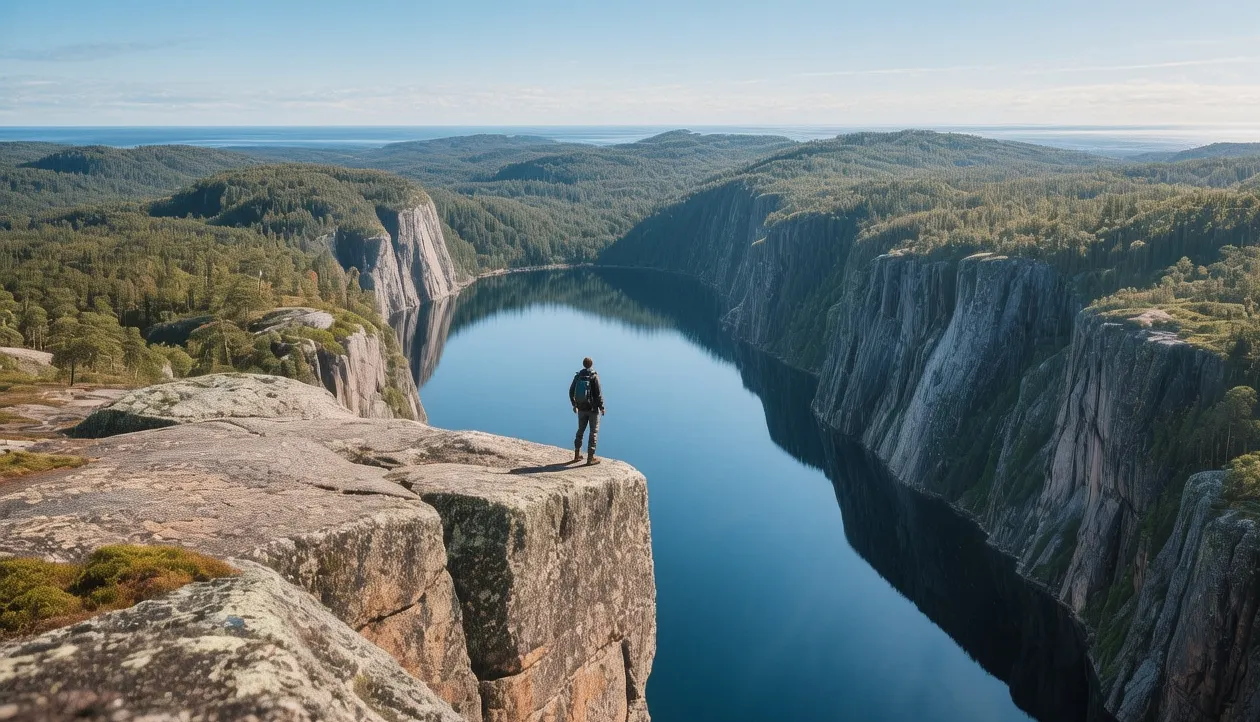
The morning mist clings to the pine needles at 7:30 AM in late May, filtering the early light into shafts of pale gold that illuminate the forest floor. You stand at the South Entrance—Entré Syd—and listen: the silence is profound, broken only by the distant call of a Siberian jay and the soft crunch of your boots on the wooden boardwalk. Before you lies 30 square kilometers of protected wilderness, a landscape shaped by forces almost beyond comprehension. The granite beneath your feet formed 1,200 million years ago when molten magma cooled deep within the Earth's crust; the ravines and cliffs around you were sculpted by ice sheets two kilometers thick that retreated just 10,000 years ago; and the land continues rising—8 millimeters annually—as the Earth's crust rebounds from that immense weight . This is Skuleskogen National Park, the heart of the High Coast UNESCO World Heritage Site, where post-glacial land uplift occurs faster than anywhere else on Earth. Here, nature serves as both museum and laboratory—a place where geological time becomes visible, tangible, and immediate.
Why Skuleskogen National Park Embodies Geological Wonder
Skuleskogen solves a fundamental question of landscape formation: what happens when land rises faster than the sea can reclaim it? The answer unfolds across the park's dramatic terrain—steep cliffs, deep ravines, and extensive stone fields that document the world's highest recorded post-glacial land uplift . When the last ice age ended, this region lay submerged beneath the Baltic Sea; today, the shoreline sits 286 meters higher than it did then, creating a unique chronology of ecological succession visible in the vegetation zones that climb from the water's edge to the barren mountaintops.
The park's most celebrated feature—Slåttdalsskrevan—embodies this geological narrative. This 200-meter-long crevice, 30–40 meters deep, splits Slåttdalsberget mountain in two . Formed when softer diabase rock eroded away between harder granite walls, the canyon was subsequently scoured by ice, waves, and weathering. The result is a natural cathedral: vertical walls of Nordingrå Granite that amplify every sound, a floor littered with boulders that have tumbled from above, and an atmosphere of profound antiquity. Since summer 2023, the canyon itself has been closed to hikers due to safety concerns from falling rock, but a new trail circles the crevice offering equally dramatic viewpoints . The park also preserves human history: Näskebodarna, a summer grazing farm used since the mid-1800s as an outpost for spring herring fishermen, stands as testament to the coastal communities that once depended on these forests .
The Best Time to Experience Skuleskogen National Park
For optimal hiking conditions and fewer crowds, visit between May 18–June 30 or September 1–September 30, when temperatures range from 10°C to 20°C (50°F–68°F) and daylight extends 16–18 hours . During these windows, the forest floor blooms with twinflower, starflower, and rare orchids, while the autumn colors—birch gold against pine green—create spectacular vistas from Slåttdalsberget's summit .
Summer visitors (July 1–August 10) enjoy the warmest weather—15°C to 25°C (59°F–77°F)—but face the park's peak season. The South Entrance parking lot fills by 11:00 AM, and the park management occasionally closes access due to overcrowding . If visiting during this period, arrive before 9:00 AM or use the national park bus from Naturum Visitor Centre to avoid parking congestion.
Winter offers a different solitude: February and March provide excellent conditions for snowshoeing and cross-country skiing, with temperatures between -10°C and -15°C (14°F to 5°F) . The roads to Entré Väst and Entré Syd remain plowed all winter. Avoid November–January, when daylight shrinks to 6 hours, weather becomes unpredictable, and trails may be icy without snow cover .
For trail conditions, weather updates, and guided activity schedules, visit the official tourism website: sverigesnationalparker.se
Approximate Budget for a 7-Day Trip
Skuleskogen offers excellent value for nature-focused travelers, with free park entry and affordable accommodation options in nearby villages. Budget travelers can experience world-class hiking without premium prices.
- Accommodation: €55–€95 per night for mid-range hotels in Örnsköldsvik or Bjästa (Hotell Höga Kusten, Best Western Hotel); €35–€55 for hostels and guesthouses; €15–€25 for camping at designated tent areas within the park (Kälsviken, Tärnättholmarna) or nearby campgrounds .
- Food: €45 per day—breakfast €10 (hotel buffet or self-catered oatmeal with cloudberries), lunch €15 (packed sandwich with locally baked bread and Västerbotten cheese), dinner €20 (moose stew or fresh whitefish at Friluftsbyn restaurant or self-cooked over camp stove).
- Transportation: Train from Stockholm to Örnsköldsvik: €50–€70 (SJ or Norrtåg). Rental car: €45–€65 daily. Bus #100 from Örnsköldsvik to Docksta: €12 one-way. The national park bus (July only) from Naturum to park entrances: €5 round-trip.
- Attractions: Park entrance: free; Naturum Visitor Centre exhibition: free; guided hiking tours: €25–€40; Via Ferrata climbing at nearby Skuleberget: €45; kayak rental at Docksta Havet: €35–€50 daily.
- Miscellaneous: Local cloudberry jam at Docksta market: €8; handcrafted wooden hiking poles: €25; woolen socks from local artisans: €18.
Total for 7 days: €650–€1,100 per person (mid-range with some camping), excluding international flights.
6 Essential Skuleskogen National Park Experiences
- Hike to Slåttdalsskrevan Canyon: From Entré Syd, follow the High Coast Trail 3.5 kilometers through dense spruce forest—crossing wooden boardwalks over marshy terrain—until the ground drops away and the 200-meter-long crevice appears. Though the canyon floor is closed for safety, the new perimeter trail offers vertiginous views into the 30-meter-deep chasm. Listen for the amplified echoes of your footsteps against granite walls that have stood for 1,200 million years. Allow 3 hours round-trip .
- Summit Slåttdalsberget: Continue past the canyon to climb the barren granite peak of Slåttdalsberget. The trail becomes steep and rocky—hands needed for balance—but the 360-degree panorama rewards the effort: the High Coast archipelago spreads below, islands dotting the Baltic Sea, while the forest canopy stretches inland like a green ocean. The mountain's bald crown resulted from post-glacial wave action that washed away soil before the land rose above sea level .
- Swim at Tärnättvattnen: After the canyon hike, descend to these pristine lakes where the water runs clear and cold. The red cabin at the shore offers shelter, while smooth granite slabs provide perfect sunbathing platforms. The lakes sit in a depression between rocky ridges—evidence of the geological forces that shaped this terrain. Bring a picnic; this is the park's most idyllic lunch spot .
- Explore Tärnättholmarna: Walk 3.5 kilometers from Entré Nord to reach these small peninsulas connected to the mainland by narrow sand bridges—living proof of ongoing land uplift. Not long ago, these were islands; now, you can walk between them at low tide. The outer rocks offer the park's best coastal views and swimming holes. Overnight cabins stand available for hikers on multi-day treks .
- Visit Näskebodarna Heritage Farm: Hike 3.8 kilometers from Entré Syd to reach this summer grazing farm established in the mid-1800s. The preserved cabins and meadow document the region's herring fishing history, when coastal families maintained forest outposts for spring fishing seasons. A communal cabin offers overnight shelter; the nearby beach provides excellent tenting on soft grass .
- Walk the Långtjärnhällorna Loop: From Entré Väst, follow the 1.2-kilometer circuit around these smooth rock formations. The trail—marked by blue paint on stone—crosses boardwalks and bare granite, offering panoramic views over the national park and distant Ulvöarna islands. The terrain showcases the "till-capped" mountains—peaks that remained above sea level after the ice age and retained their soil, while lower slopes were washed bare by waves .
3 Hidden Gems Most Travelers Miss
- The Till-Capped Summit of Nylandsruten: Located 800 meters from Entré Väst, this forested peak with barren sides represents a geological rarity—the mountain top never submerged after the ice age, preserving ancient soil and vegetation. Most hikers rush toward Slåttdalsskrevan and miss this viewpoint, which offers panoramic vistas of Skags lighthouse, Trysunda nature reserve, and the dark waters of Lake Svarttjärn below. Access requires no technical climbing; follow the blue-marked trail west from the entrance .
- The Kälsviken Ant Colony: One kilometer from Entré Syd lies Kälsviken, a sandy beach popular for swimming. However, few visitors notice the massive red ant colony that occupies the dune system behind the beach. The ants—Formica rufa—construct dome-shaped nests from pine needles and create visible trails across the sand. Observe from a distance; the colony represents a keystone species in the park's ecosystem. Visit in July when the ants are most active .
- The Abandoned Quarry at Västra Skravelberget: Outside the park boundary but accessible via the High Coast Trail, this 19th-century granite quarry features hand-hewn cuts in the rock face and rusted winch equipment. Most hikers turn back at Slåttdalsskrevan and never reach this site, which offers insight into the region's stone-cutting industry that supplied building materials for Stockholm and beyond. The quarry sits 5 kilometers north of Entré Väst; allow a full day for the round-trip hike.
Cultural & Practical Tips
- Respect the right of public access: Swedish allemansrätten permits hiking and camping on uncultivated land, but maintain 70 meters from private residences at Näskebodarna and never pitch tents on the heritage farm's meadow. Use designated tent areas at Kälsviken and Tärnättholmarna .
- Learn essential Swedish: Hej (hey) for hello, Tack (tahk) for thank you, Ursäkta (oor-sehk-tah) for excuse me. English is widely spoken, but attempting Swedish earns appreciation from local staff at Naturum.
- Prepare for rapid weather changes: The High Coast's maritime climate brings sudden shifts. Even summer mornings can drop to 8°C (46°F). Pack windproof layers, waterproof footwear, and a warm mid-layer—cotton is dangerous when wet .
- Photography guidelines: The best light occurs 30 minutes after sunrise and 45 minutes before sunset, when the low Arctic sun illuminates the granite cliffs. Drones are prohibited within the national park. The canyon's north-facing walls create dramatic shadows at midday.
- Bring a head torch: Even in summer, dense forest canopy creates twilight conditions on the trails. For autumn and winter visits, a head torch is essential—daylight disappears faster than expected, and trails are unlit .
- Carry a thermos: Hot beverages transform cold-weather hiking. The dry air at elevation chills quickly; a warm drink at Tärnättvattnen or Näskebodarna provides necessary calories and morale. Avoid alcohol—it accelerates heat loss .
Conclusion: Travel with Patience, Not Just Purpose
Skuleskogen National Park demands a different rhythm of travel—one measured not in kilometers covered or summits conquered, but in moments of stillness and observation. When you stand at the edge of Slåttdalsskrevan, watching mist drift through the granite walls that have stood since before multicellular life colonized land, you confront a humbling truth: human timescales are insignificant against geological ones.
Approach this landscape not as a challenge to be overcome but as a text to be read slowly. Notice how the vegetation changes as you climb—spruce giving way to pine, then to bare rock and lichen. Observe the stone fields that mark ancient shorelines, now stranded high above the sea. Listen for the Siberian jay's call, the same sound that greeted herring fishermen 150 years ago. Travel here to remember that wilderness is not empty space awaiting human meaning, but a living archive of deep time—where every boulder, every crevice, every strand of hanging lichen tells a story millions of years in the making.