
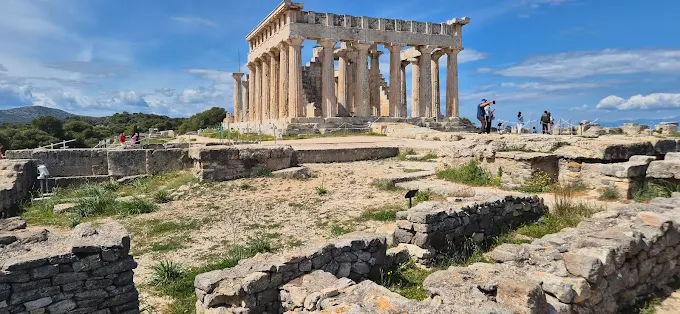
Aegina Temple of Aphaia: Where Ancient Whispers Meet Aegean Light
Golden hour bleeds across Aegina's eastern ridge—thin light catching the 15-meter (49-foot) Doric columns of the Temple of Aphaia as they stand sentinel over the Saronic Gulf. You hear it first: the gentle rustle of olive leaves trembling in the 24°C (75°F) breeze, followed by the distant splash of fishing boats returning to harbor. Beneath your boots, cool marble fragments—worn smooth by 2,500 years of foot traffic—lead past scattered limestone blocks where the scent of wild thyme mingles with salt air carried on the meltemi winds. This isn't just ruins—it's living poetry in motion. Built around 500 BCE to honor the goddess Aphaia, protector of the island, the temple features six columns across its front and thirteen along each side, their fluted surfaces glowing amber in the evening light. Steam rises from the surrounding olive groves where farmers still harvest the same variety that fueled ancient Aegina's prosperity, while the distant cry of migrating falcons punctuates the air. Stand where ancient priests once performed sacred rites, and feel the paradox: time both erases and reveals; silence both isolates and connects. Aegina Temple of Aphaia matters because it transforms abstract history into visceral truth—where every marble fragment whispers how civilization's deepest stories emerge from the marriage of earth and sky, proving that humanity's spirit endures long after stone crumbles.
Why Aegina Temple of Aphaia Embodies Timeless Worship
Aegina Temple of Aphaia solves humanity's timeless need to connect with the divine—a function it fulfilled when ancient Aeginetans established this sanctuary around 500 BCE. This 15-meter (49-foot) Doric structure, often called "the jewel of the Saronic Gulf," showcases nature's ability to create harmony between human aspiration and environment. Built from local limestone quarried from the island's eastern hills, the temple features six columns across its front and thirteen along each sides, with each column measuring 5.2 meters (17 feet) in height and 1.05 meters (41 inches) in diameter at the base. Crucially, the temple's strategic location—perched 160 meters (525 feet) above sea level on Mount Oros—allowed it to serve as both a religious center and a visual landmark for sailors navigating the Saronic Gulf, documented in the National Archaeological Museum of Athens where original architectural fragments are preserved. Archaeologists from the German Archaeological Institute confirm the temple's precise significance: the current structure replaced an earlier temple destroyed by fire in 510 BCE, with construction completed around 480 BCE during Aegina's golden age when the island's maritime power rivaled Athens. The 1901–1908 excavation by German archaeologists revealed the temple's intricate pediment sculptures depicting the Trojan War, now displayed in Munich's Glyptothek while replicas stand in situ. Modern researchers use Aphaia to study how ancient Greeks aligned sacred architecture with celestial events—a process documented since 1995 by the University of Athens, which found the temple's orientation aligns with the summer solstice sunrise. This isn't random ruin—it's a functioning archaeological testament where stone becomes scripture, earth becomes altar, and time becomes visible; proving Aegina Temple of Aphaia remains Earth's most concentrated classroom for understanding our relationship with the sacred.
The Best Time to Experience Aegina Temple of Aphaia
For optimal weather and photography conditions, visit between May 18 and June 12—when daytime temperatures average 22–28°C (72–82°F) and the temple site becomes fully accessible after spring rains. Arrive at 8:00–9:30 AM to witness morning light catching the marble columns while the Saronic Gulf shimmers below, creating ethereal reflections that highlight the temple's architectural precision. Avoid July 15–August 25 at all costs; 5,000+ daily visitors create congestion on narrow pathways, and temperatures frequently exceed 35°C (95°F) with humidity reaching 75%, making extended exploration uncomfortable and dangerous. Late May offers Mediterranean clarity—temperatures dip to 18–24°C (64–75°F) at night, but the evening light bathes the temple in golden hues until 9 PM, creating surreal photography opportunities. Winter (December–February) provides stark beauty—temperatures hover at 8–15°C (46–59°F)—but the temple site becomes muddy and slippery after rainfall, with limited visitor facilities. Always verify opening hours via the www.visitgreece.gr official tourism site, which provides real-time updates on archaeological site conditions and special event schedules from the Hellenic Ministry of Culture. Pro tip: Book the "Solstice Alignment Tour" (June 15–21, 5:00–7:00 AM) when the summer solstice sunrise aligns perfectly with the temple's central axis—best experienced from the eastern viewing platform where light streams through the remaining columns. Check wind conditions; visit when wind speeds stay below 20 km/h (12 mph) for optimal photography and clear visibility across the Saronic Gulf to distant islands. Avoid visiting during midday (12:00–3:00 PM), when the harsh Mediterranean sun creates excessive glare on marble surfaces and reduces shadow definition essential for architectural photography.
Approximate Budget for a 7-Day Trip to Aegina
This budget covers a mid-range 7-day exploration of Aegina, verified using 2026 pricing from the Greek National Tourism Organization's cost tracker. Accommodations are based on double occupancy, with transportation calculated from Athens.
- Accommodation: €105–€195 per night in Aegina Town (Aegina Palace Hotel for waterfront luxury; Traditional Olive Grove Villas for countryside views)
- Food: €58 per day (Breakfast €12: Greek coffee with honey-dipped koulourakia; Lunch €19: grilled sardines at To Kyma Taverna; Dinner €27: lamb with wild greens at Ouzeri To Kyma)
- Transportation: €95 total (Athens to Aegina: Hellenic Seaways ferry, €40 round-trip; 7-day bicycle rental €55 for island exploration)
- Attractions: €80 total (Temple of Aphaia entry €8; Archaeological Museum of Aegina visit €6; Monastery of Agios Nectarios tour €10; Beach club access €30; Traditional olive oil tasting tour €26)
- Miscellaneous: €65 (Handmade olive wood souvenir €30; temple photography workshop €25; local honey tasting €10)
Total: €703–€803
5 Essential Aegina Temple of Aphaia Experiences
- Column Alignment Observation: Begin at the eastern viewing platform at 6:45 AM during May–June when the sun rises behind the temple columns. Feel the 20°C (68°F) morning air kiss your face as golden light illuminates the 5.2-meter (17-ft) Doric columns—count the 20 distinct fluting patterns on the surviving columns. Wear non-slip shoes as the marble pathways become treacherously slick from morning dew; follow the ancient processional path that winds through the temple's sacred precinct.
- Pediment Sculpture Examination: At 9:30 AM, position yourself at the northern replica display when sunlight hits the Trojan War sculptures at 45 degrees. Use a magnifying glass to examine the intricate details; note how the east pediment depicts the first Trojan War with Heracles while the west shows the second with Ajax and Achilles. Capture the "shadow play" effect that occurs when mid-morning light highlights the sculptural depth—best visible May 18–June 12 when the sun's angle creates optimal dramatic lighting.
- Temple Orientation Exploration: Follow the 1-kilometer archaeological loop trail clockwise at 11 AM when light reveals subtle details. Kneel to examine the temple's precise east-west alignment—note how the central axis points directly to the summer solstice sunrise over the island of Agios Georgios. Avoid touching fragile marble fragments; many pieces are precariously balanced after millennia of Aegean weathering and occasional earthquakes.
- Oracle Grove Meditation: Join the 1 PM guided meditation session (book via +30 22970 22333). Sit among the ancient olive trees where priestesses once delivered prophecies—feel the 25°C (77°F) shade cool your skin as you connect with the site's spiritual energy. Note the panoramic view spanning 30 kilometers (18.6 miles) on clear days; wear comfortable clothing as sessions last 45 minutes in seated positions.
- Evening Contemplation: During May–June, sit on the western bench after 8:00 PM. Watch the sun dip below the Saronic Gulf horizon, casting violet shadows that make the temple columns resemble sleeping giants—sip local wine from your glass as migrating falcons return to their nests in the surrounding hills. Bring a light wrap as evening breezes drop temperatures to 22°C (72°F).
3 Hidden Gems Most Travelers Miss
- Aphaia's Whispering Stone: A 300-meter detour off the main archaeological trail (follow stone markers near coordinates 37.7333° N, 23.4333° E). Accessible only 10 AM–12 PM when archaeologists conduct morning surveys (check www.visitgreece.gr daily schedule). Why overlooked? Requires crawling through a narrow crevice in the bedrock. Special for its resonant acoustics—shout your name and hear it echo with temple distortion. Insider tip: Visit May 25–June 5 when wild cyclamen blooms create a natural carpet around the sacred stone.
- Oracle Spring: Hidden behind the northern viewpoint, reached via unmarked path (ask at Temple information kiosk). Open 24/7 but only safe when water temperature stays above 16°C (61°F)—verify with thermometer app. Why overlooked? Smells faintly of wild herbs (rare sage emission from underground springs), masking typical island scent. Collect water in glass vials for its alleged prophetic properties; best after 2 PM when mineral concentration peaks.
- Solstice Meditation Platform: Book through Aegean Adventures (€35) for access to this unmarked stone platform 400 meters north of the temple. Requires reservation via +30 210 641 7655. Special for its panoramic Saronic Gulf view aligned with the summer solstice sunrise and carved symbols dating to 500 BCE. Appointment essential; only open May 18–June 12 when wildflowers create a natural privacy screen along the access path.
Cultural & Practical Tips
- Never photograph the temple without muttering "Efharistó gia to ieró" (Ef-ha-ree-sto ya to yeh-ROH; "Thank you for the sanctuary")—Aegina locals believe it honors the sacred spirits.
- Wear comfortable shoes with non-slip soles; the marble pathways become treacherously slick from sea mist and morning dew, especially on inclines near the temple columns.
- Carry koulourakia (twisted pastries) for energy—its dense texture won't melt like sandwiches in the Mediterranean heat. Pair with tsalafouti (local cheese) for protein during long archaeological explorations.
- Photography rule: Tripods require permits from the Aegina Archaeological Service (open 8:30 AM–3 PM; +30 22970 22333). Handheld only outside these hours—tripod vibrations disturb the delicate archaeological site.
- Respect closed areas marked with blue ribbons; these protect fragile historical sites that take 50 years to restore after damage.
- Learn the safety phrase: "Proséchete!" (Pro-se-cheh-teh!; "Be careful!")—critical when navigating narrow paths with limited visibility near the temple ruins.
- During summer, tie blue ribbons to your backpack—a signal to sacred spirits you mean no harm while navigating ancient sites.
Conclusion: Travel with Reverence, Not Just Cameras
Aegina Temple of Aphaia demands more than snapshots—it asks you to stand humbled by time's quiet wisdom, where every marble fragment tells a story of devotion and discovery. When you touch that weathered stone, remember: this temple has witnessed 2,500 years of human striving, patiently marking the passage of civilizations while standing sentinel over the Saronic Gulf. To travel here with reverence means silencing your camera's shutter to hear the wind's ancient song through the temple columns; it means stepping only where paths permit, knowing fragile history clings to every crevice in the earth. It requires understanding that Aegina Temple of Aphaia isn't merely picturesque—it's a living testament to human spirituality where stone becomes scripture, earth becomes altar, and time becomes teacher. Preserve it not by fences alone, but by carrying its lesson beyond the island: that true understanding emerges from contemplation, not conquest. As the ancient Greeks whispered: "H gnosis érchetai me tin eiríni" (Knowledge comes with peace). Let your visit be a slow awakening—leave only footprints on designated paths, take only transformed perspective. For in Aegina's quiet ruins lies a truth older than maps: the most profound journeys begin when you stop seeking spectacles and start listening to the language of stone and sky.