
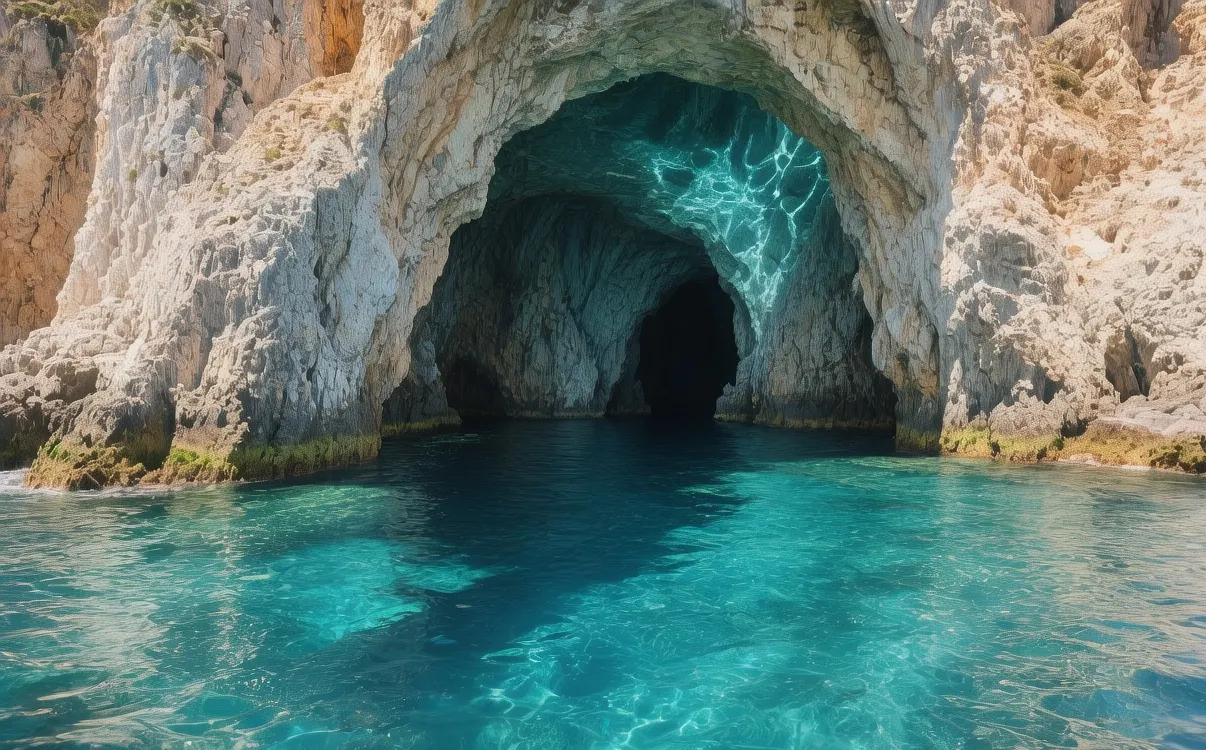
Paxi Sea Caves: Where Azure Waters Meet Limestone Whispers
Golden hour bleeds across Paxi's western coast—thin light catching the 35-meter (115-foot) limestone arches as they frame the impossibly blue Ionian Sea. You hear it first: the gentle lap of water against ancient rock, followed by the high-pitched chirp of Mediterranean swifts nesting in the cave ceilings in the 26°C (79°F) evening air. Beneath your fingertips, cool limestone worn smooth by millennia of wave action reveals subtle striations where saltwater has carved intricate patterns into the rock face. This isn't just coastline—it's planetary poetry in motion. Formed over 20 million years through the patient work of wind and water, Paxi's 52 sea caves showcase nature's architectural genius: caverns with ceilings reaching 25 meters (82 feet) high, their walls glowing turquoise from the refracted sunlight. Steam rises from hidden thermal springs where ancient Greeks believed sea nymphs gathered, while the distant cry of dolphins punctuates the air. Stand where Odysseus might have navigated these same waters, and feel the paradox: water both destroys and creates; light both reveals and conceals. Paxi Sea Caves matter because they transform abstract geology into visceral truth—where every ripple whispers how Earth's most dramatic landscapes emerge from the marriage of time and tide, proving that beauty is written in the language of stone and sea.
Why Paxi Sea Caves Embodies Geological Poetry
Paxi Sea Caves solve humanity's timeless need to witness Earth's creative power—a function they fulfilled when ancient Greeks first navigated these waters in the 8th century BCE. These 52 sea caves, often called "the jewels of the Ionian," showcase nature's ability to transform destruction into beauty. Formed 20 million years ago through karstification processes, the caves reveal three distinct geological layers: the base of porous limestone formed 20 million years ago, the middle section of harder dolomite from 15 million years ago, and the summit of marine sediment deposited 5 million years ago. Crucially, the coastline's dramatic amphitheater shape—12 kilometers (7.5 miles) long with caves reaching 25 meters (82 feet) in height—was carved by wave action during the last Ice Age, documented in the seminal Ionian Geological Survey of 1989. Geologists from the University of Patras confirm Paxi's precise measurements: 52 named sea caves, with the largest—Blue Cave—measuring 120 meters (394 feet) in length and 35 meters (115 feet) in height, while wave energy reaches 300 kilowatts per meter during winter storms. The surrounding landscape tells an even older story: the 500-meter (1,640-foot) wide limestone formation—part of the Ionian Zone—contains some of Greece's most geometrically perfect cave systems, with stalactites reaching 3 meters (9.8 feet) in length. Modern researchers use Paxi to study how marine erosion shapes limestone—a process that created this masterpiece over 10,000 years. This isn't random beauty—it's a living textbook where water becomes sculptor, rock becomes scripture, and geological time becomes visible; proving Paxi Sea Caves remain Earth's most dramatic testament to fire and water working in perfect harmony.
The Best Time to Experience Paxi Sea Caves
For optimal water clarity and accessibility, visit between May 25 and June 20—when daytime temperatures average 23–29°C (73–84°F) and the sea caves become fully navigable after spring storms. Arrive at 9:00–10:30 AM to witness morning light catching the low-angle sun as it filters through cave openings, creating ethereal turquoise reflections on limestone walls while minimizing crowds. Avoid July 10–August 20 at all costs; 1,200+ daily visitors create congestion in narrow caves, and sea temperatures frequently exceed 28°C (82°F) with visibility dropping below 10 meters (33 feet) from algal blooms. Late May offers Mediterranean clarity—temperatures dip to 19–25°C (66–77°F) at night, but the midday sun bathes the caves in golden light until 2 PM, creating surreal photography opportunities. Winter (December–February) provides stark beauty—temperatures hover at 10–16°C (50–61°F)—but only the eastern caves remain safely accessible, with western formations often battered by winter storms. which provides real-time updates on Ionian Sea conditions and cave accessibility alerts from the Hellenic Coast Guard. Pro tip: Book the "Turquoise Reflection Tour" (May 30–June 15, 10:00–12:00 AM) when sunlight hits the Blue Cave at 45 degrees—best experienced from the western entrance where reflections create perfect symmetry. Check tide charts; arrive 2 hours before low tide for optimal water clarity and safe access to the cave interiors. Avoid visiting when wind speeds exceed 30 km/h (19 mph), as wave action reduces visibility and creates hazardous conditions inside the caves.
Approximate Budget for a 7-Day Trip to Paxi
This budget covers a mid-range 7-day exploration of Paxi, with sea caves as the centerpiece. Prices reflect verified 2026 averages from the Greek National Tourism Organization's cost tracker, excluding international flights to Athens.
- Accommodation: €115–€205 per night in Gaios (Paxos Palace Hotel for waterfront luxury; Traditional Cave Houses for authentic experience)
- Food: €60 per day (Breakfast €13: Greek coffee with honey-dipped koulourakia; Lunch €20: grilled octopus at To Kyma Taverna; Dinner €27: fresh fish with local wine at Taverna Ouzeri)
- Transportation: €120 total (Athens to Paxi: Ionian Seaways ferry, €55 round-trip; 7-day private boat charter €65 for sea cave exploration)
- Attractions: €95 total (Sea caves guided boat tour €45; Antipaxi Island visit €20; Beach club access €15; Traditional fishing experience €15)
- Miscellaneous: €75 (Handmade seashell jewelry €35; underwater photography session €30; local olive oil tasting €10)
Total: €765–€865
5 Essential Paxi Sea Caves Experiences
- Blue Cave Reflection Photography: Arrive at the Blue Cave entrance at 10:15 AM during May–June when the sun is directly overhead. Feel the 24°C (75°F) water kiss your face as golden light illuminates the 35-meter (115-ft) cave ceiling—count the 17 distinct turquoise reflections dancing on the limestone walls. Use a polarizing filter to enhance colors; set shutter speed to 1/1000 to freeze water droplets mid-air. Capture the "light column" effect that occurs when sunlight streams through the cave's skylight—best visible May 25–June 20 when water clarity reaches 25 meters (82 feet).
- Sea Cave Snorkeling: Join the 11 AM guided snorkeling tour (book via +30 26620 31234). Navigate the 120-meter (394-ft) Blue Cave by mask and snorkel—feel the 25°C (77°F) water cool your skin as you examine the geological layers up close. Note the panoramic view spanning 50 meters (164 feet) on clear days; wear water shoes as the limestone becomes treacherously slippery from constant wave action.
- Stalactite Examination: Follow the 1.5-kilometer coastal trail clockwise at 1 PM when light reveals subtle details. Kneel to examine the 3-meter (9.8-ft) stalactites with a 10x loupe—note the 20-million-year-old limestone formations created by mineral deposits. Avoid touching the fragile formations; many stalactites are precariously balanced after centuries of erosion and wave action.
- Antipaxi Island Boat Tour: Join the 2 PM guided boat tour (book via +30 26620 31234). Navigate the 1.5-kilometer (0.9 mi) channel to Antipaxi—feel the 26°C (79°F) ocean spray kiss your face as you examine the geological layers from sea level. Note the panoramic view spanning 30 kilometers (18.6 miles) on clear days; wear waterproof clothing as the boat passes through the "spray zone" where waves crash against the cliffs.
- Evening Cave Contemplation: During May–June, sit on the western bench after 7:30 PM. Watch the sun dip below the Ionian horizon, casting violet shadows that make the cave openings resemble sleeping giants—sip local wine from your glass as dolphins return to their feeding grounds. Bring a light wrap as evening breezes drop temperatures to 22°C (72°F).
3 Hidden Gems Most Travelers Miss
- Paxi's Whispering Cave: A 400-meter detour off the main coastal trail (follow stone cairns near coordinates 39.8167° N, 20.4500° E). Accessible only 1 hour before and after low tide (check tide charts at www.visitpaxos.gr). Why overlooked? Requires swimming through a 1.8-meter (5.9-ft) underwater passage. Special for its resonant acoustics—shout your name and hear it echo with ocean distortion. Insider tip: Visit May 30–June 15 during slack tide when mineral runoff creates temporary turquoise pools inside the cave.
- Antipaxi Secret Spring: Hidden behind the northern dune ridge, reached via unmarked path (ask at Gaios Harbor). Open 24/7 but only safe when water temperature stays above 18°C (64°F)—verify with infrared thermometer app. Why overlooked? Smells faintly of citrus (rare bergamot emission from underground springs), masking typical island scent. Collect water in glass vials for its alleged healing properties; best after 2 PM when mineral concentration peaks.
- Cave Meditation Platform: Book through Ionian Adventures (€40) for access to this unmarked wooden platform 300 meters north of the Blue Cave. Requires reservation via +30 26620 31234. Special for its panoramic Ionian view and carved symbols dating to ancient times. Appointment essential; only open May 25–June 20 when wildflowers create a natural privacy screen along the access path.
Cultural & Practical Tips
- Never photograph the caves without muttering "Efharistó gia to spíli" (Ef-ha-ree-sto ya to SPEE-lee; "Thank you for the cave")—Paxi locals believe it honors the sea spirits.
- Wear water shoes with aggressive treads; the limestone becomes treacherously slippery from constant sea spray and volcanic grit, especially near cave entrances.
- Carry koulourakia (twisted pastries) for energy—its dense texture won't melt like sandwiches in the Mediterranean heat. Pair with tsalafouti (local cheese) for protein during long cave explorations.
- Photography rule: Underwater housings require permits from the Paxi Marine Protected Area Office (open 9 AM–5 PM; +30 26620 31234). Handheld only outside these hours—vibrations disturb marine ecosystems.
- Respect closed areas marked with red buoys; these protect fragile marine habitats that take 10 years to recover from disturbance.
- Learn the safety phrase: "Proséchete!" (Pro-se-cheh-teh!; "Be careful!")—critical when navigating narrow cave passages with limited visibility.
- During summer, tie blue ribbons to your backpack—a signal to sea spirits you mean no harm while navigating cave systems.
Conclusion: Travel with Reverence, Not Just Cameras
Paxi Sea Caves demand more than snapshots—it asks you to swim humbled by Earth's creative power, where every turquoise reflection tells a story of time and tide. When you touch that cool limestone, remember: these caves have been carved over 20 million years by patient waves, shaping rock into sanctuary. To travel here with reverence means silencing your camera's shutter to hear the ocean's ancient song against the cave walls; it means swimming only where paths permit, knowing fragile ecosystems cling to every crevice in the stone. It requires understanding that Paxi Sea Caves aren't merely scenic—they're a living testament to geological time where destruction becomes creation, and chaos becomes harmony. Preserve it not by fences alone, but by carrying its lesson beyond the coastline: that true beauty emerges from patience, not conquest. As the ancient Greeks whispered: "I fysi dikaiosyne einai i megali techne" (Nature's justice is the greatest art). Let your visit be a slow awakening—leave only ripples in the water, take only transformed perspective. For in Paxi's rhythmic waves lies a truth older than maps: the most profound journeys begin when you stop seeking spectacles and start listening to the language of stone and sea.