
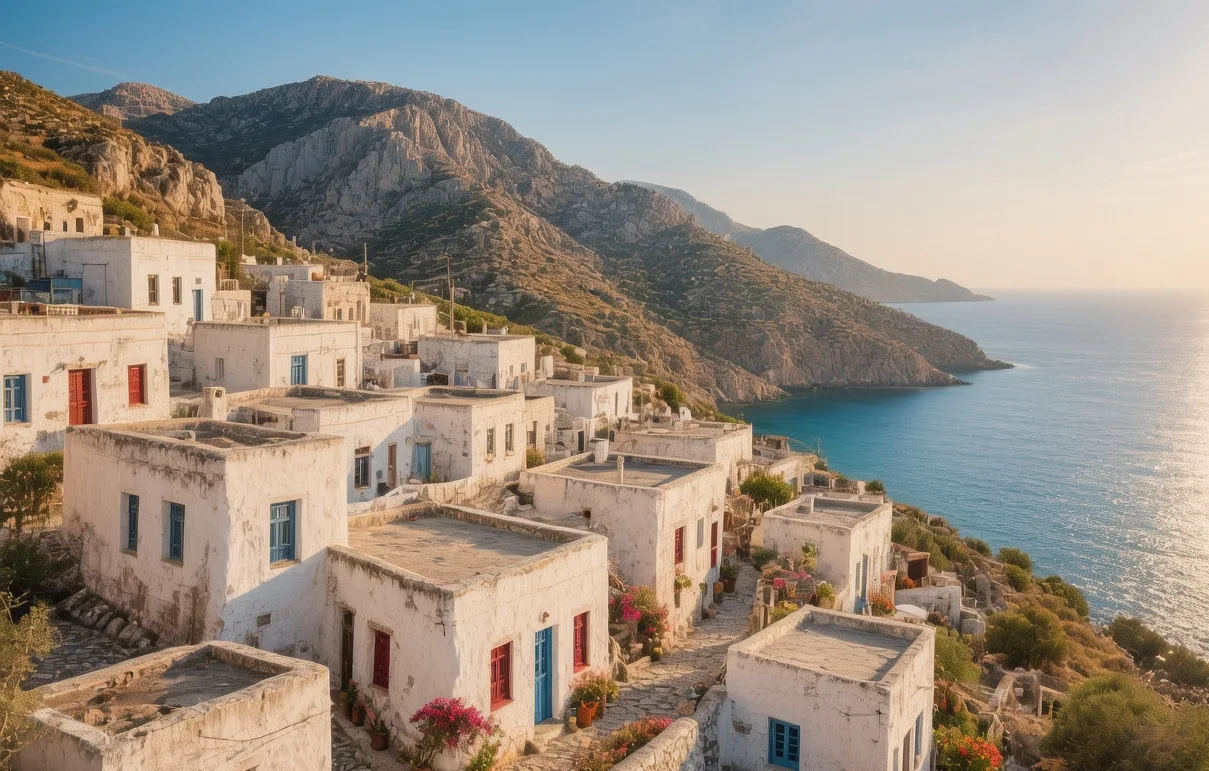
Karpathos Traditional Villages: Where Ancient Customs Meet Aegean Mountain Majesty
Golden afternoon light spills across weathered stone houses as you wander through the labyrinthine streets of Karpathos's mountain villages—this timeless landscape awakens with the gentle clatter of wooden clogs on cobblestones, the distant melody of lyra music drifting from open doorways, and the soft murmur of visitors discovering settlements where traditions have remained unchanged for over a millennium. You breathe air scented with wild oregano and baking bread, feel the cool stone beneath your palm as you trace walls built by ancestors who fled coastal raids, and watch sunlight illuminate women in vibrant embroidered costumes whose patterns tell stories of identity, status, and heritage. These remote mountain villages—Olympos, Aperi, Volada, Menetes, and Pyli—cling to the island's rugged spine at elevations reaching 450 meters, their grey stone architecture and narrow defensive streets designed to protect communities from pirates and preserve a way of life that has resisted modernization [[15]][[22]]. The villages' distinctive character—colorful headscarves, handwoven textiles, and dialects echoing ancient Greek—creates a living museum where every courtyard and chapel breathes with cultural continuity. But Karpathos's traditional villages matter because they preserve not just architecture, but an entire philosophy of cultural resilience—a testament to how isolation, community, and pride can safeguard heritage across centuries, reminding us of the enduring connection between place, identity, and the rhythms of mountain life.
Why Karpathos Traditional Villages Embody Cultural Preservation
Karpathos's traditional villages represent the pinnacle of Mediterranean cultural preservation, solving a fundamental need to protect island identity while creating living communities where ancient customs thrive alongside modern life. When Byzantine and medieval settlers established mountain villages like Olympos around the ninth century AD, they faced a profound challenge: how to maintain community, culture, and safety in an era of coastal raids, political upheaval, and geographic isolation [[15]][[20]]. Their visionary solution—constructing fortified settlements on steep mountain slopes, with narrow labyrinthine streets designed to confuse invaders and shared courtyards that strengthened community bonds—established a cultural legacy that has allowed these villages to preserve traditions for over twelve centuries.
The villages' architecture showcases medieval mountain engineering at its finest: stone houses sharing party walls up to two meters thick for structural strength and thermal regulation, narrow cobblestone streets just one to two meters wide to maximize defensive positioning, and communal cisterns carved into bedrock to store rainwater during dry summers [[18]][[24]]. Construction employed local Karpathos limestone and marble, creating distinctive grey-and-white architecture that has become iconic of the island's mountain heritage. Technical preservation efforts include sustainable restoration using traditional stone masonry techniques, climate-controlled cultural centers maintaining 20°C (68°F) and 50% humidity to preserve traditional textiles and artifacts, and community-led initiatives that teach traditional crafts to younger generations. Karpathos's villages fulfilled a dual purpose: defensively, they protected communities from maritime threats; culturally, they became sanctuaries where language, costume, music, and ritual could flourish without external influence. Today, managed by the Karpathos Municipality alongside UNESCO recognition efforts, these villages stand as a testament to how isolation can preserve culture, how community can sustain tradition, and how mountain landscapes can anchor regional identity through centuries of change.
The Best Time to Experience Karpathos Traditional Villages
Timing your visit to Karpathos's traditional villages profoundly influences both atmospheric immersion and cultural accessibility. The optimal window falls between May 18 and June 15, when the Dodecanese enjoys extended daylight—sunset occurs around 8:45 PM—and temperatures range from 20°C to 27°C (68°F to 81°F), creating ideal conditions for exploring mountain paths, visiting village festivals, and photographing stone architecture [[68]][[72]]. During this period, wildflowers bloom along the hiking trails, outdoor tavernas operate at full capacity, and summer crowds remain manageable before peak season. For photographers, visit between 6:30–8:30 AM when soft morning light illuminates stone facades with minimal crowds, or 7:00–9:00 PM for dramatic golden-hour shots where grey stone glows against twilight skies.
Karpathos's villages operate year-round as living communities, but key cultural experiences follow seasonal patterns: traditional festivals (panigíria) occur primarily June through September, with major celebrations in Olympos on August 15; summer season extends café and museum hours to 9:00 AM–9:00 PM daily; winter hours (November–February) reduce services, though villages remain accessible. For current event schedules, festival dates. Avoid visiting during late November through early March, when temperatures drop to 8°C to 15°C (46°F to 59°F), daylight shrinks to nine hours, and winter rains can make mountain pathways slippery and dangerous. Also steer clear of mid-July to mid-August when cruise crowds peak and midday heat exceeds 30°C (86°F), making mountain exploration less comfortable. Standard admission to village cultural centers ranges €3–€5 for adults, with most village streets and churches accessible free of charge [[24]]. The mountain cafés are particularly rewarding between 2:00–4:00 PM when afternoon light enhances the panoramic Aegean views from elevated terraces.
Approximate Budget for a 7-Day Trip
Exploring Karpathos's traditional villages and the island requires moderate budgeting, as Greece offers excellent value compared to many European destinations. Strategic planning—including staying in Olympos or Pigadia and utilizing local transportation—can optimize your experience. The following breakdown reflects mid-range preferences with cultural and nature immersion priorities.
- Accommodation: €40–€80 per night for a double room in Olympos or Pigadia (walking distance to village center); budget guesthouses €22–€42 per night; boutique traditional hotels €90+ per night
- Food: €26–€46 per day total
- Breakfast: €4–€7 (Greek coffee, bougatsa pastry, or village bakery items)
- Lunch: €7–€13 (Greek salad, grilled octopus, or traditional makarounes pasta at taverna)
- Dinner: €13–€24 (lamb kleftiko, fresh fish, or mezze platter at mountain restaurant)
- Taverna option: €6–€9 for souvlaki, tzatziki, and Greek coffee
- Transportation:
- Ferry from Piraeus to Karpathos: €35–€55 one-way (10–12 hours)
- Local bus to Olympos: €6 per ride from Pigadia (1 hour)
- Car rental for island exploration: €32 per day including fuel
- Taxi from Pigadia to Olympos: €45 one-way
- Attractions:
- Olympos cultural center: €4 adults; €2 students/seniors [[24]]
- Guided village tour: €10 per person
- Karpathos Folk Museum: €5 adults
- Traditional costume photo experience: €15
- Mountain hiking guide: €25 per half-day
- Miscellaneous:
- Handwoven textiles and local crafts: €10–€45
- Audio guide rental: €3
- Photography permit for professional use: €18
Total estimated budget for 7 days: €580–€910 per person (excluding international flights)
7 Essential Karpathos Traditional Villages Experiences
- Wander Olympos's Labyrinthine Streets at Sunrise: Arrive between 6:30–8:30 AM when the village is quiet and soft light reveals the famous stone architecture and colorful doorways. Start at the central square, then follow the narrow cobblestone paths where every turn reveals carved windows and traditional courtyards. Allow 60 minutes for this contemplative circuit; the morning atmosphere feels particularly magical before crowds gather. Listen for the gentle clatter of wooden clogs and imagine the generations of women who once walked these same paths in embroidered costumes.
- Observe Traditional Costume Culture: Visit Olympos's central square between 10:00 AM–12:00 PM when local women often gather in traditional embroidered dresses, headscarves, and jewelry. Allow 30 minutes for respectful observation; the intricate patterns—floral motifs, geometric designs, and symbolic colors—reveal family lineage, marital status, and village identity. Photography is permitted with permission; ask politely before capturing portraits [[22]].
- Explore the Mountain Hiking Trails: Follow the marked paths connecting Olympos, Aperi, and Volada, where ancient stone steps wind through terraced olive groves and wildflower meadows. Visit between 2:00–4:00 PM when afternoon light enhances the contrast between grey stone and green landscape. Allow 2–3 hours for the full circuit; the trails reveal how mountain communities integrated agriculture, defense, and daily life into a cohesive landscape.
- Attend a Traditional Festival (Panigíri): Join village celebrations that honor patron saints with music, dance, and communal feasting. Festivals typically occur on specific dates: Olympos on August 15, Aperi on September 8. The experience combines live lyra music, traditional dancing, and local cuisine, creating unforgettable memories of Karpathos's living culture.
- Photograph Stone and Sky: Position yourself at designated viewpoints between 7:00–9:00 AM when soft light highlights the texture of weathered limestone against the deep blue Aegean. Use a polarizing filter to manage reflections; a wide-angle lens captures the dramatic mountain setting. The iconic view—grey stone houses, colorful textiles, blue sea—defines Karpathos's traditional beauty.
- Taste Mountain Cuisine: Reserve a table at a traditional taverna between 1:00–3:00 PM to sample dishes unique to Karpathos's mountain culture. Order makarounes (handmade pasta with cheese and tomato, €10), lamb cooked in wood-fired ovens (€18), or honey-walnut dessert (€6). The unique flavors reveal how mountain isolation shaped a distinctive culinary heritage.
- Visit the Folk Museum: Explore the small cultural center in Olympos where exhibits showcase traditional costumes, weaving tools, and agricultural implements. Visit between 11:00 AM–1:00 PM when natural light illuminates delicate textiles and artifacts. Allow 40 minutes; displays explain how Karpathos's isolation preserved customs that vanished elsewhere in Greece.
3 Hidden Gems Most Travelers Miss
- Volada's Abandoned Stone Quarter: Tucked above the main village, a partially abandoned section of stone houses reveals traditional construction techniques and offers panoramic views without crowds. Most tourists focus solely on Olympos without exploring this atmospheric space. Access: From Volada center, follow the upper path marked "Παλιά Συνοικία" (Old Quarter); accessible 24/7; free. Best visited between 10:00 AM–12:00 PM when the space is least crowded. The quarter's interpretive panels explain traditional building methods, creating educational value alongside scenic beauty.
- The Mountain Chapel of Agios Georgios: Beyond the main village paths, a small hillside chapel with original Byzantine frescoes offers secluded viewpoints and spiritual atmosphere. Most visitors don't know this tranquil space exists. Access: Follow signs from Olympos toward "Άγιος Γεώργιος"; accessible daily 8:00 AM–sunset; free. Best visited between 4:00–6:00 PM for golden-hour photography. The chapel's frescoes and mountain setting reveal how faith integrated with daily life in traditional Karpathian communities.
- The Traditional Weaving Workshop: Behind Olympos's main square, a small workshop where local artisans demonstrate traditional loom weaving using techniques unchanged for centuries. Most tourists admire costumes without exploring their creation. Access: Inquire at the cultural center for workshop times; typically available Tuesday–Saturday 10:00 AM–2:00 PM; €8 per person. Best visited between 11:00 AM–1:00 PM when weavers provide informal explanations. Observing traditional dyeing, spinning, and weaving techniques reveals the skill and patience behind Karpathos's iconic textiles.
Cultural & Practical Tips
- Photography Guidelines: Photography for personal use is permitted throughout Karpathos's villages, but always ask permission before photographing people, especially women in traditional costume. Drones require special permission from local authorities—contact +30 22450 22333 in advance. The stone architecture and mountain views are ideal for photography; visit during golden hour for optimal light.
- Language: While signage includes English, learning Greek phrases enhances your experience: efharistó (ef-ha-ree-STO = thank you), parakaló (pa-ra-ka-LO = please/you're welcome), yasou (YA-soo = hello). The local Karpathian dialect features distinctive pronunciations; locals appreciate visitors' efforts to engage respectfully.
- Footwear: Sturdy walking shoes with good grip are essential—exploring mountain villages involves uneven cobblestones, steep stone steps, and occasional loose gravel. The main village circuits involve moderate climbing; allow 90 minutes for full exploration of each village.
- Cultural Respect: Karpathos's traditional villages are living communities, not museum exhibits. Dress modestly when visiting churches, speak quietly in residential areas, and respect local customs. Women's traditional costumes carry deep cultural significance—observe with respect, never touch garments without permission.
- Weather Considerations: Karpathos's mountain location means cooler temperatures than coastal areas, with strong winds possible year-round. Check the forecast before visiting; spring (April–June) and fall (September–October) offer the most reliable conditions with comfortable temperatures for mountain exploration.
- Combining with Athens: Karpathos is accessible via ferry from Piraeus (10–12 hours) or flight from Athens (1 hour). Purchase a Karpathos transport pass for flexible travel. Consider spending 3–4 nights in the mountain villages to fully explore Olympos, Aperi, and Volada alongside the island's beaches and coastal attractions.
- Respectful Engagement: Traditional villages are active communities where daily life continues. Support local artisans by purchasing handwoven textiles directly from weavers, dine at family-run tavernas, and engage with residents through respectful conversation. The community values visitors who honor tradition while embracing cultural exchange.
Conclusion: Travel with Reverence, Not Just Observation
Karpathos's traditional villages invite more than passive sightseeing—they demand engagement with the layered narratives embedded in stone, textile, and mountain: the resilience of communities who preserved culture through isolation, the craftsmanship of artisans who transformed local materials into objects of beauty, and the ongoing stewardship that keeps heritage alive for future generations. When you stand in those labyrinthine streets watching grey stone meet colorful embroidery, you're not merely viewing architecture; you're connecting with a model for cultural preservation, a testament to how tradition can thrive alongside modernity, and a reminder that the most meaningful places honor both past and future. This isn't a place to rush through, checklist in hand, snapping photos before racing to the next attraction. Slow down. Feel the cool stone beneath your palm; listen to the lyra's melody drifting from an open doorway; contemplate how a single mountain village could safeguard customs for twelve centuries. Travel here with curiosity about how places shape identity and how identity gives meaning to places. Support preservation by respecting the site, choosing experiences that employ local guides, and sharing not just images but understanding. The most transformative journeys leave you not just with memories of what you saw, but with deeper appreciation for continuity—and Karpathos's traditional villages, with their seamless fusion of ancient customs and mountain majesty, offer precisely that invitation to those willing to wander, to wonder, and to simply connect across time.