
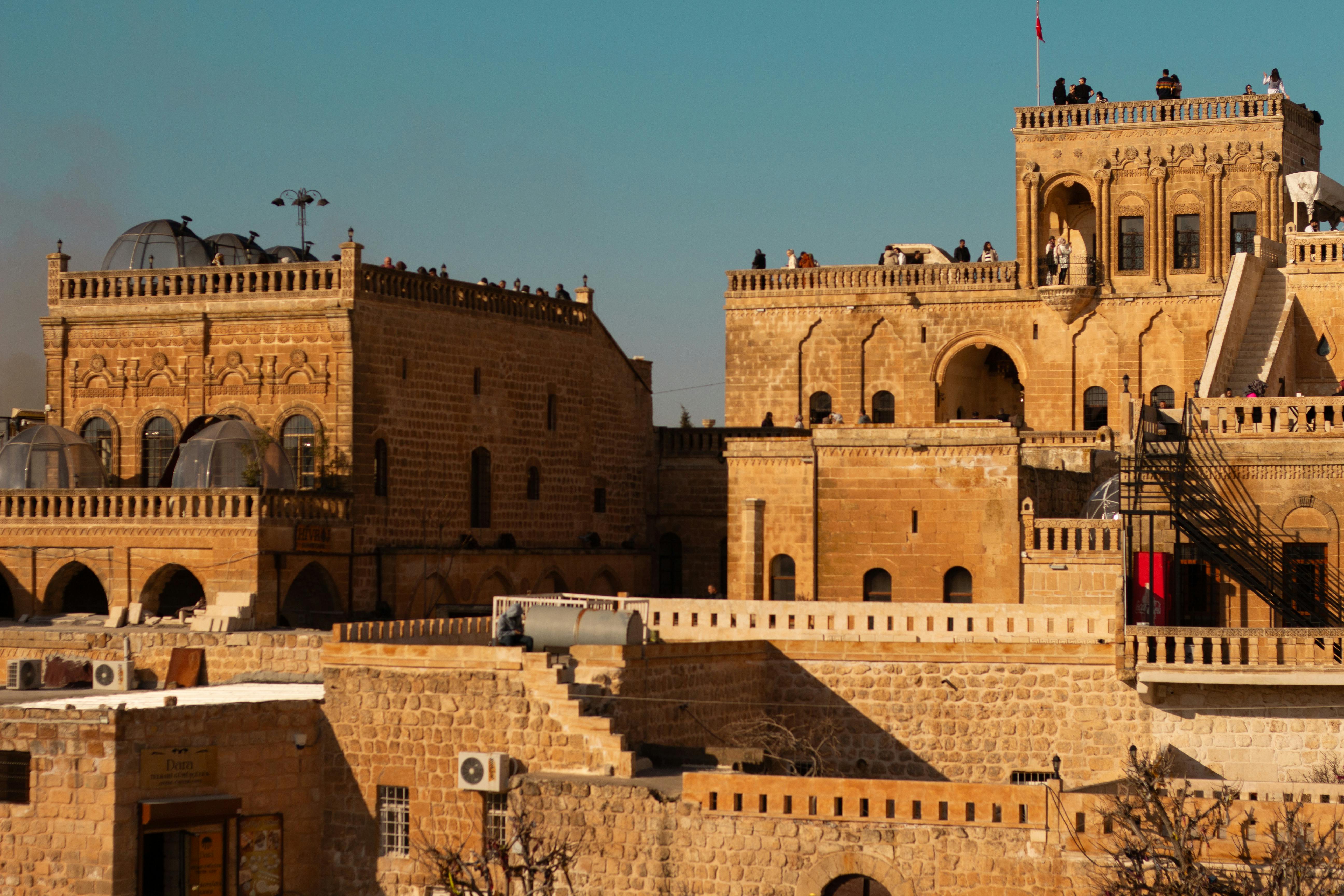
Mardin Stone Houses: Where Ancient Limestone Meets Mesopotamian Sky
The late afternoon sun bathes the old city in liquid gold as you wander narrow stone alleyways that have wound through this hilltop citadel for over two millennia. The air carries the scent of roasting coffee, freshly baked pide bread, and the faint perfume of jasmine climbing the ancient walls. Before you, Mardin's stone houses cascade down the mountainside like a frozen waterfall of honey-colored limestone—each building carved from the very bedrock beneath, their walls glowing amber in the dying light. The architecture tells stories in stone: Artuqid arches from the 12th century, Syriac Christian doorways older than Islam, Ottoman windows with intricate latticework framing views across the Mesopotamian plain stretching 80 kilometers to the Syrian border. You hear the call to prayer echoing from minarets, the hammer of coppersmiths in the bazaar, and the murmur of Kurdish, Turkish, Arabic, and Syriac—the four languages that still live in these streets. The limestone itself seems to breathe, absorbing heat by day and releasing it by night, a natural climate control system perfected over centuries. This isn't merely a city to visit—it's a living museum where past and present merge in golden stone, where every doorway opens onto a story, and where the architecture itself becomes a testament to human resilience, cultural fusion, and the timeless beauty of building with the earth beneath your feet.
Why Mardin Stone Houses Embody Architectural Harmony
Mardin's distinctive stone houses represent far more than aesthetic beauty—they embody a sophisticated response to the harsh realities of southeastern Anatolia's climate and the region's complex cultural tapestry. Built primarily from local limestone quarried from the very mountainside the city clings to, these structures solve fundamental problems: extreme summer heat reaching 45°C (113°F), winter temperatures dropping to -5°C (23°F), and the need for defensive fortification in a border region that has witnessed empires rise and fall.
The construction technique, refined over centuries, uses a specific type of sedimentary limestone known as "Mardin taşı" (Mardin stone)—a creamy yellow calcareous rock extracted from deposits 15-20 meters below the city. This material possesses remarkable thermal mass properties: walls typically measure 60-80 centimeters thick, absorbing heat during the day and slowly releasing it at night, maintaining interior temperatures 10-15 degrees cooler than outside in summer. The stone is soft enough to carve when first quarried but hardens upon exposure to air, creating structures that have survived for 800+ years with minimal degradation.
The architectural style reflects Mardin's unique position at the crossroads of civilizations. Artuqid builders in the 12th-13th centuries established the characteristic aesthetic: pointed arches, ribbed vaulting, and decorative stone carving featuring geometric patterns and muqarnas (stalactite vaulting). Syriac Christian masons contributed techniques for creating elaborate window tracery and cross motifs; Ottoman architects added the distinctive "cumba" (projecting bay windows) and elaborate stone doorframes with Arabic inscriptions. Each house features a central "hayat" (courtyard)—typically 4x6 meters—providing ventilation, natural light, and a private outdoor space shielded from the street. The houses cluster so tightly that rooftops form a secondary street network, with stone staircases connecting levels and creating the terraced effect that makes Mardin appear as a single organic structure rather than individual buildings. This architectural harmony solves the human need for shelter, community, and beauty while adapting perfectly to both climate and cultural complexity.
The Best Time to Experience Mardin Stone Houses
To experience Mardin's stone architecture at its most enchanting, plan your visit between April 15–June 5 or September 20–October 25, when daytime temperatures range from 18-28°C (64-82°F) and the limestone glows with perfect golden-hour radiance. During these windows, you'll enjoy comfortable conditions for walking the steep, cobbled streets and exploring the stone houses without the oppressive heat that characterizes southeastern Anatolia's summers or the chill of winter nights.
For optimal photography of the honey-colored stone facades, arrive at key viewpoints at 6:30–8:00 AM when the morning light strikes the eastern-facing buildings, or 5:30–7:00 PM during golden hour when the entire old city transforms into liquid amber. The stone's color shifts dramatically throughout the day—from pale cream at dawn to deep gold at sunset—making timing crucial for capturing its full beauty.
Avoid the peak summer period of June 20–September 10 when temperatures regularly exceed 40°C (104°F), making exploration of unshaded streets uncomfortable and potentially dangerous. While the stone houses stay cool inside, moving between sites becomes arduous. Winter months (December–February) bring temperatures of 2-10°C (36-50°F) during the day but can drop to -8°C (18°F) at night; rain makes the steep limestone streets slippery, and some boutique hotels close for renovation.
Approximate Budget for a 7-Day Trip
Mardin offers exceptional value, with costs lower than Turkey's western cities. The following budget assumes moderate travel style—staying in restored stone houses, dining at local restaurants, and using a mix of walking and local transport. Prices are listed in euros for international travelers, though Turkey uses the Turkish Lira (₺).
- Accommodation: €35–€65 per night in the old city (Eski Mardin). Budget pensions in restored stone houses start at €25; luxury boutique hotels in historic mansions run €70-120. Staying in the old city puts you within walking distance of major stone house architecture.
- Food: €16-24 per day total. Breakfast: €4-6 for traditional Turkish breakfast with menemen, cheese, olives, and çay at stone-house hotels. Lunch: €5-8 for Mardin kebab, içli köfte, or sembusek at local esnaf lokantası. Dinner: €8-12 for sit-down meals featuring kaburga dolması (stuffed lamb ribs), süryani şarabı (Syriac wine), and baklava.
- Transportation: Round-trip flight to Mardin Airport from Istanbul: €65-140. Airport shuttle to old city: €4. Local dolmuş within city: €0.60 per ride. Taxi to Midyat (day trip): €35 each way. Car rental: €35/day.
- Attractions: Mardin Museum (in historic Syriac Catholic Patriarchate): €5. Kasımiye Medrese: €4. Deyrulzafaran Monastery: €6. Guided stone house architecture tour: €30. Traditional stone house hammam experience: €20.
- Miscellaneous: Hand-carved Mardin stone soap: €8-15. Traditional silver jewelry (Mardin işi): €25-80. Copper coffee pot: €20-50. Handwoven kilim: €40-150.
Total 7-Day Budget: €450–€680 per person (excluding international flights to Turkey)
7 Essential Mardin Stone House Experiences
- Stay in a Restored Stone Mansion: Book accommodation in a converted 19th-century stone house in the old city's Şahmeran or Abbariye neighborhoods. These properties feature original limestone walls 70cm thick, vaulted ceilings with traditional "kundekari" woodwork, and courtyards with flowing fountains. Wake to the call to prayer echoing off stone walls, breakfast on a terrace overlooking the Mesopotamian plain, and experience how the thermal mass keeps interiors cool even in summer. Recommended: Look for houses with "cumba" bay windows for the best views.
- Walk the Rooftop Labyrinth: Climb the stone staircases that connect the terraced rooftops of the old city, creating a secondary street network 15-20 meters above the ground-level alleys. Start at Ulu Camii (Grand Mosque) at 8:00 AM and follow the rooftops westward toward the citadel. The limestone terraces offer ever-changing perspectives of the stone houses, the plain below, and glimpses into private courtyards through open archways. Wear sturdy shoes—the stone can be slippery.
- Explore the Kasımiye Medrese: Visit this 15th-century theological school, a masterpiece of stone architecture featuring a two-story courtyard with a central pool that fills with rainwater. The building demonstrates perfect proportions: the main iwan (vaulted hall) measures 12 meters high, with muqarnas decoration so intricate it appears to be lace carved from stone. Arrive at 9:00 AM when opening to avoid tour groups. Entry: €4. The medrese shows how Mardin's builders used local limestone to create structures that are both functional and transcendent.
- Photograph the Stone House Facades: Position yourself on the main street (Cumhuriyet Caddesi) at 6:00 PM during golden hour to capture the honey-colored limestone facades in their most dramatic light. Focus on the ornate doorframes—many feature Arabic inscriptions, geometric patterns, and dates from the 18th-19th centuries. The best examples cluster between the Grand Mosque and the old Syriac quarter. Use a polarizing filter to enhance the stone's warm tones against the blue sky.
- Visit a Working Stone Mason's Workshop: Seek out the traditional stone carving workshops in the bazaar area near Çarşı Kapısı (Market Gate), where master craftsmen still extract, cut, and carve Mardin stone using techniques unchanged for centuries. Watch as they shape the soft limestone into decorative elements, soap dishes, and architectural fragments. Many workshops offer 30-minute demonstrations (€10) where you can try carving under supervision. Contact: Mardin Esnaf ve Sanatkarlar Odası +90 482 212 3456.
- Experience a Stone House Hammam: Book a traditional bath experience in a historic hammam built entirely of limestone, where the heated stone floors and walls create an intensely warming environment. The 16th-century Cercis Murat Konağı offers authentic hammam experiences (€20, 90 minutes) including traditional kese (exfoliation) and foam massage. The stone architecture creates perfect acoustics and the thermal properties maintain consistent temperature. Book 24 hours ahead; open 9:00 AM–8:00 PM.
- Climb to the Citadel for Panoramic Views: Ascend to Mardin Kalesi (Citadel), perched at the highest point of the old city at 1,083 meters elevation. The climb involves navigating steep stone staircases and narrow alleys for 20 minutes from the city center. From the citadel walls, you'll see the entire stone city spread below, the white dome of Deyrulzafaran Monastery on the northern ridge, and the Mesopotamian plain stretching 80 kilometers to Syria. Visit at sunset (7:00–8:00 PM in summer) when the limestone glows amber. Entry: €6.
3 Hidden Gems Most Travelers Miss
- Sakıp Sabancı Mardin City Museum: Housed in a restored 1890s Syriac Catholic patriarchate, this museum occupies one of the finest stone houses in the old city but draws far fewer visitors than it deserves. The building itself is the star: three stories of vaulted limestone rooms, original 19th-century frescoes depicting biblical scenes, and a rooftop terrace with 360-degree views. The museum displays archaeological finds, but the architecture—the intricate stone carving, the perfect proportions of the courtyard, the way light filters through arched windows—is the real treasure. Entry: €5. Open 8:30 AM–5:30 PM (closed Mondays). Located in the Syriac quarter, 300 meters east of Ulu Camii.
- Attar Ibrahim Bey Mansion (Attar Ibrahim Bey Konağı): This 19th-century merchant's house, now a boutique hotel, features some of the finest "kundekari" woodwork and stone carving in Mardin, yet most tourists never enter unless they're guests. The mansion's central courtyard has a marble fountain surrounded by four iwans with muqarnas vaulting so delicate it appears weightless. Non-guests can visit the café in the ground-floor iwan (open 10:00 AM–6:00 PM) for Turkish coffee (€3) and admire the architecture. Located on 1. Cadde, 200 meters south of the Grand Mosque. Ask for permission to photograph the interior—the owners are usually happy to show visitors the restoration details.
- Zinciriye Medrese Stone Carving Workshop: This 14th-century theological school now houses a working conservation laboratory where stone masons restore damaged architectural elements from Mardin's historic buildings. Unlike tourist-oriented workshops, this is where actual preservation work happens. Visit Tuesday–Thursday, 9:00 AM–3:00 PM to watch master craftsmen carve replacement pieces for damaged muqarnas, repair weathered doorframes, and document original techniques. The medrese itself features exquisite stone carving, including a portal with interlaced geometric patterns that took three years to complete. Entry is free but requires permission from the site supervisor. Contact: Mardin Vakıflar Bölge Müdürlüğü +90 482 212 4567. Located 400 meters northwest of the citadel.
Cultural & Practical Tips
- Dress Modestly: Mardin is conservative, especially in the old city and religious sites. Women should cover shoulders and knees; carry a scarf for entering mosques and monasteries. Men should avoid sleeveless shirts in religious areas. The stone house hotels provide slippers for indoor wear—use them to protect both the historic floors and your feet from hot stone in summer.
- Photography Etiquette: Always ask permission before photographing people, especially women in traditional dress and elderly residents in the old city. Photography inside mosques is permitted but avoid prayer times. The stone house interiors are often privately owned—ask before entering courtyards or photographing through doorways. Drone photography requires permits from the provincial governor's office (apply 2 weeks ahead via mardin.valiligi@icisleri.gov.tr).
- Essential Phrases: "Teşekkür ederim" (teh-shek-kür eh-deh-rim) = Thank you; "Mardin evleri nerede?" (mar-din ev-ler-ee neh-reh-deh) = Where are the Mardin stone houses?; "Ne kadar?" (neh kah-dar) = How much?; "Hoş geldiniz" (hosh gel-din-iz) = Welcome (you'll hear this often).
- Navigate the Steep Streets: Mardin's old city is built on a 45-degree slope, and the limestone streets become extremely slippery when wet. Wear shoes with good grip—avoid smooth soles. The main streets are paved with stone; side alleys may have loose gravel. In summer, the stone absorbs heat and can reach 50°C (122°F) at midday—test with your hand before sitting on stone walls or steps.
- Respect the Architecture: The stone houses are living structures, not museum pieces. Many are still inhabited by families who have lived there for generations. Don't touch carved doorframes or decorative elements—the oils from your hands accelerate erosion of the soft limestone. Stay on marked paths in historic buildings. If you visit a functioning hammam or medrese, follow posted guidelines and respect prayer times.
- Weather Considerations: The limestone architecture creates microclimates: shaded alleys can be 8-10°C cooler than sun-exposed streets. In summer, plan outdoor exploration for early morning (7:00–10:00 AM) and late afternoon (5:00–8:00 PM); use midday for indoor sites like museums and hammams. In winter, the stone retains cold—bring layers even if daytime temperatures seem mild. Rain is rare but makes the steep streets treacherous.
- Understand the Cultural Context: Mardin's stone houses embody centuries of coexistence between Muslims, Christians, and Jews. Many buildings changed hands multiple times as demographics shifted. When visiting Syriac Christian stone houses or Muslim mansions, recognize that the architecture reflects shared building traditions adapted to different religious needs. This context enriches your appreciation beyond aesthetic beauty.
Conclusion: Travel with Reverence, Not Just Checklists
Mardin's stone houses ask something deeper of you than a photograph and a passport stamp. These golden limestone structures are not relics frozen in time but living spaces where families still gather in courtyards, where artisans still carve stone with chisels passed down through generations, where the call to prayer still echoes off walls that have heard it for eight centuries. To walk these streets is to enter a conversation between past and present, between earth and sky, between the harsh realities of a borderland and the human determination to create beauty from stone.
Travel to Mardin with reverence for the craftsmanship that shaped these houses, for the cultures that merged in their arches and doorways, for the resilience that keeps this city alive on its mountainside perch. Respect the fragility of the limestone—soft enough to carve, hard enough to endure, but vulnerable to careless hands. Understand that the quiet streets you wander are someone's home, that the views you admire are someone's daily reality. Let the golden light on stone slow your pace, let the weight of history humble your expectations, and let the harmony of architecture and landscape remind you that the most beautiful buildings are those that grow from the earth beneath them, telling stories in stone that outlast us all.