
Mount Nemrut: Where Ancient Stone Gods Meet the Edge of the Sky
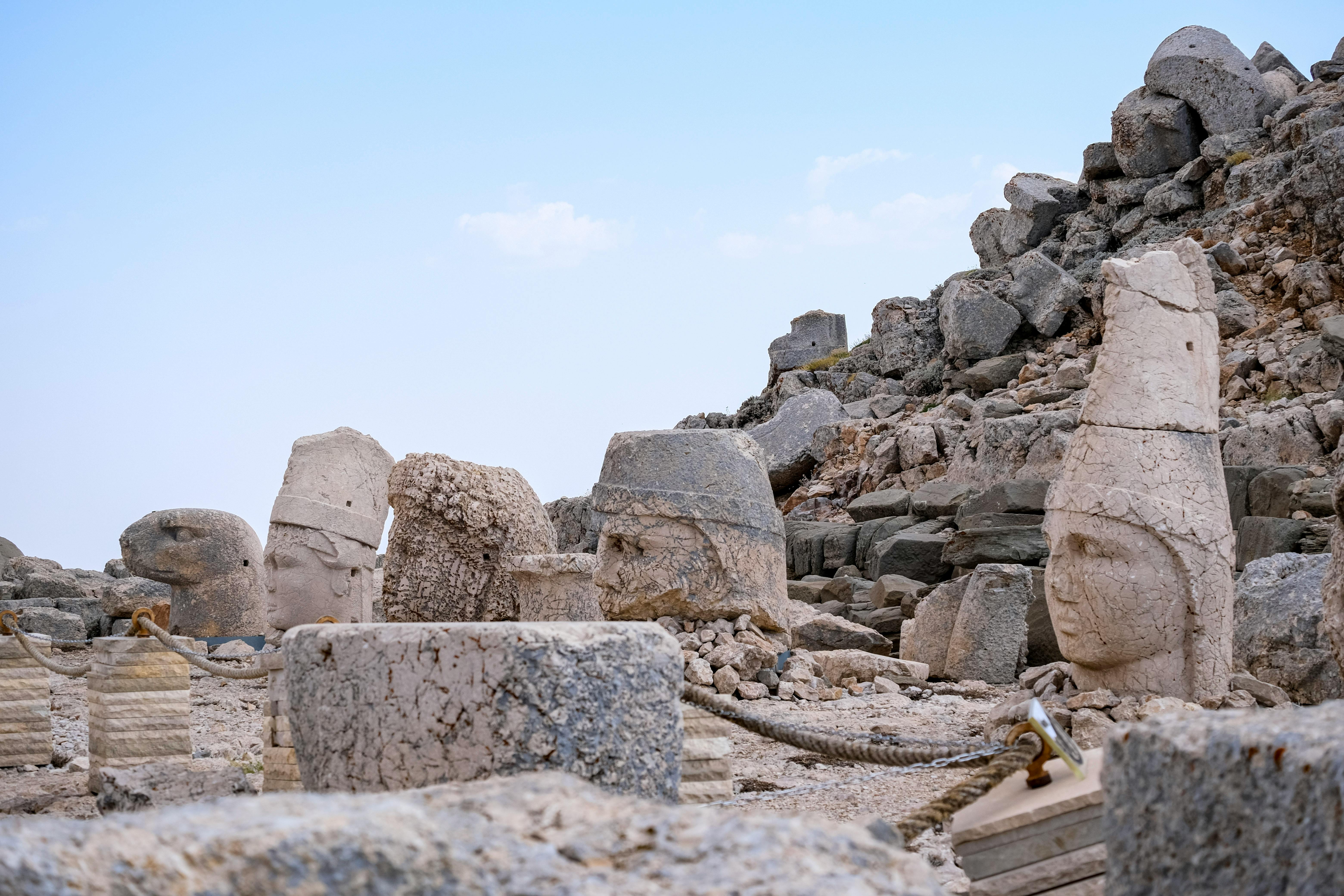
The first rays of dawn break over the Anti-Taurus Mountains, painting the sky in streaks of rose and amber as you stand at 2,134 meters (7,001 feet) above sea level on the summit of Mount Nemrut. The air is crisp—often near freezing even in summer—and carries the scent of wild thyme and volcanic stone. Before you, the colossal heads of gods and kings lie scattered across the mountaintop: Zeus-Ahura Mazda, Apollo-Mithras, Heracles-Artagnes, and the deified King Antiochus I himself, each carved from limestone blocks weighing up to six tons, their serene faces turned eternally eastward to greet the rising sun. The statues, originally ten meters tall, now rest with their bodies fallen, their heads detached by centuries of earthquakes and erosion, yet their presence remains overwhelming. You hear only the whisper of wind through the scree, the distant call of a golden eagle, and your own breath fogging in the morning chill. This is no ordinary archaeological site—it is a sanctuary built on the roof of the world, where a Hellenistic king sought to join the pantheon of gods, and where you now stand at the intersection of human ambition, divine aspiration, and the raw power of nature.
Why Mount Nemrut Embodies the Ambition of a Forgotten Kingdom
Mount Nemrut represents the extraordinary vision of Antiochus I Theos, ruler of the small but strategically vital Kingdom of Commagene, who reigned from 70-38 BCE. Facing the geopolitical pressures of Rome to the west and Parthia to the east, Antiochus crafted a unique religious syncretism—blending Greek, Persian, and Armenian deities—to unify his diverse subjects and legitimize his divine right to rule. The hierotheseion (temple-tomb) he commissioned atop this remote peak was designed to immortalize him among the gods, solving the profound human need for legacy in an era of imperial uncertainty.
The engineering achievement is staggering. The summit features two terraces—east and west—flanking a central tumulus of crushed limestone 49 meters high and 152 meters in diameter, containing Antiochus's presumed tomb, though it has never been excavated. The colossal statues were carved from local limestone and assembled using iron clamps and lead dowels, techniques borrowed from both Greek and Persian traditions. Each seated figure originally stood ten meters tall on a stepped platform; the heads alone measure two to three meters in height and weigh approximately six tons. The east terrace features a 2.4-meter-high limestone stele depicting Antiochus shaking hands with each deity—a visual treaty of divine alliance—while relief slabs along the processional way show his Persian and Greek ancestors, reinforcing his dual heritage.
The iconography reveals meticulous theological planning: Zeus-Ahura Mazda combines the Greek king of gods with the Zoroastrian supreme deity; Apollo-Mithras merges the Greek sun god with the Persian covenant deity; Heracles-Artagnes blends the Greek hero with the Armenian war god. Antiochus placed himself among them, not as a worshipper but as an equal. The site was deliberately oriented so that on Antiochus's birthday and coronation day, the rising sun would illuminate his face first—a celestial endorsement of his divine status. Though Commagene was annexed by Rome in 72 CE and the site abandoned, Mount Nemrut endures as a testament to one ruler's audacious attempt to transcend mortality through stone, sky, and sacred geometry.
The Best Time to Experience Mount Nemrut
To witness Mount Nemrut at its most transcendent, plan your visit between May 20–June 15 or September 10–October 10, when daytime summit temperatures range from 12-22°C (54-72°F) and the skies are typically clear for sunrise viewing. During these windows, you'll experience comfortable conditions for the steep ascent and extended time at the summit without the extreme cold of winter or the intense summer crowds.
For the iconic sunrise experience—the primary reason most travelers climb Nemrut—arrive at the summit by 4:30–5:15 AM depending on the season. The sun rises between 5:45 AM (June) and 7:15 AM (October), and the pre-dawn light creates dramatic shadows across the stone faces. For sunset visits, plan to reach the summit by 6:00–7:00 PM; the west-facing statues glow amber in the dying light, offering a more intimate, less crowded alternative to sunrise.
Avoid the peak summer period of June 20–August 25 if possible: while daytime temperatures at the base may reach 38°C (100°F), the summit remains windy and can drop to 8°C (46°F) at dawn, creating challenging conditions. More critically, this period draws massive tour groups, diminishing the spiritual solitude of the site. Winter months (November–March) bring snow, ice, and frequent road closures; the access road from Kahta is often impassable, and summit temperatures can plummet to -15°C (5°F).
Approximate Budget for a 7-Day Trip
Visiting Mount Nemrut requires basing yourself in Adıyaman or Kahta, with day trips to the summit. The following budget assumes moderate travel style—comfortable local hotels, authentic regional dining, and a mix of shared tours and private transport. Prices are listed in euros for international travelers, though Turkey uses the Turkish Lira (₺).
- Accommodation: €25–€50 per night in Adıyaman city center or Kahta. Budget pensions start at €18; boutique hotels with Nemrut views run €55-80. Staying in Kahta reduces sunrise transfer time by 45 minutes.
- Food: €14-20 per day total. Breakfast: €3-4 for traditional Turkish kahvaltı with menemen, cheese, and çay. Lunch: €4-6 for Adıyaman kebab, çiğ köfte, or şıllık dessert at local esnaf lokantası. Dinner: €7-10 for sit-down meals featuring lahmacun, baklava, and ayran.
- Transportation: Round-trip flight to Adıyaman Airport from Istanbul: €60-130. Shared minibus from Adıyaman to Kahta: €3. Guided sunrise tour to Nemrut (minibus + guide): €25 per person. Private taxi round-trip: €80. Car rental: €32/day (4WD recommended).
- Attractions: Mount Nemrut entrance: €6. Karakuş Royal Tomb: €3. Arsameia ancient city: €4. Cendere Bridge (Roman): Free. Guided archaeological tour of Commagene sites: €35.
- Miscellaneous: Handwoven Commagene-style wool rug: €45-120. Local Adıyaman pistachios: €9/kg. Replica statue head souvenir: €15-40. Traditional copper coffee set: €25-60.
Total 7-Day Budget: €420–€610 per person (excluding international flights to Turkey)
7 Essential Mount Nemrut Experiences
- Witness Sunrise Among the Gods: Depart your hotel in Kahta by 3:30 AM for the 45-minute ascent. Arrive at the summit parking area and hike the final 15 minutes on foot to the east terrace. Position yourself southeast of the Zeus-Ahura Mazda statue as the sky lightens. When the sun crests the horizon, watch as golden light first strikes Antiochus's face, then cascades across the divine assembly. Bring a warm jacket—summit temperatures at dawn often hover near 5°C (41°F) even in summer—and a headlamp for the pre-dawn walk.
- Decipher the Handshake Reliefs: On the east terrace, examine the 2.4-meter limestone stele showing Antiochus shaking hands (dexiosis) with each deity. This gesture symbolizes divine covenant and political legitimacy. Use a magnifying glass or your phone's zoom to see the intricate details: the folds of Antiochus's Persian-style robe, the radiate crown of Apollo-Mithras, the thunderbolt of Zeus. The reliefs face east to catch the morning sun—visit between 6:00–8:00 AM for optimal viewing.
- Walk the Processional Way: Follow the ancient pathway connecting the east and west terraces, lined with relief slabs depicting Antiochus's ancestors. The Persian side shows figures in trousers and pointed caps; the Greek side displays togas and laurel wreaths. This visual genealogy reinforced Antiochus's dual heritage. The path is uneven—wear sturdy shoes—and offers panoramic views of the Euphrates Valley 1,000 meters below.
- Explore the West Terrace at Sunset: While most crowds gather east for sunrise, the west terrace offers a more contemplative experience at dusk. The statues here face west, catching the final rays of daylight. The Heracles-Artagnes figure, with its distinctive club and lion skin, is best preserved. Arrive by 6:30 PM in summer to watch the light shift from gold to amber to violet across the stone faces.
- Visit the Tumulus Base: Circle the central mound of crushed limestone that likely contains Antiochus's tomb. Though unexcavated to preserve its integrity, the tumulus rises 49 meters high with a base diameter of 152 meters—visible from 30 kilometers away in antiquity. Walk clockwise around its perimeter, noting the retaining walls and drainage channels that have preserved the structure for two millennia.
- Photograph the Eagle and Lion: At the north end of the east terrace, find the relief of an eagle and lion flanking a star—symbols of royal power and celestial favor. This iconic image appears on Turkish tourism materials. Position yourself with the statues in the foreground and the vast Anatolian plateau stretching behind. Best light: 7:00–8:30 AM for sunrise visits; avoid midday when harsh overhead light flattens the carvings.
- Attend the Night Sky Program: From May through September, the site offers occasional astronomy nights (check with visitor center: +90 416 725 2030). With minimal light pollution at 2,134 meters elevation, the Milky Way arcs brilliantly overhead—the same sky Antiochus gazed upon when aligning his sanctuary with celestial events. Bring a red-light headlamp to preserve night vision and a star chart app to identify constellations referenced in Commagene iconography.
3 Hidden Gems Most Travelers Miss
- Arsameia on the Nymphaios: Located 12 kilometers southwest of the Nemrut summit, this ancient Commagene city features a 158-step tunnel carved into the mountain leading to a relief of Antiochus shaking hands with Heracles. The tunnel maintains a constant 14°C (57°F) and emerges at a ceremonial platform with panoramic views. Entry: €4. Open 8:00 AM–6:00 PM. Most tour groups skip it due to the extra drive, but it offers crucial context for understanding Nemrut's religious program. Contact for guided access: +90 416 725 2115.
- Karakuş Royal Tomb: This lesser-known hierotheseion, 25 kilometers from Kahta, features three 10-meter columns topped with reliefs of an eagle, lion, and bull—symbols of Commagene royalty. Built for Antiochus's mother, Queen Isias, and female relatives, it offers a more intimate glimpse into Commagene funerary art without the crowds. Entry: €3. Open daily 8:00 AM–7:00 PM. Visit mid-morning when side-lighting accentuates the carvings. The site is unguarded; bring water and wear sun protection.
- Cendere Bridge Roman Engineering: This remarkably preserved 2nd-century CE Roman bridge, 18 kilometers north of Kahta, spans the Cendere River with a single 34-meter arch built without mortar. Commissioned by Emperor Septimius Severus, it features inscriptions in Latin and Greek. Unlike Nemrut, it's free to visit and rarely crowded. Access: Park at the small lot off D850 highway; walk 200 meters downhill. Best photographed in late afternoon when low light highlights the stone voussoirs. Combine with a picnic using supplies from Kahta market.
Cultural & Practical Tips
- Altitude & Weather Preparedness: The summit sits at 2,134 meters (7,001 feet). Even in summer, dawn temperatures average 5-10°C (41-50°F) with wind chill making it feel colder. Dress in layers: moisture-wicking base, fleece mid-layer, windproof outer shell. Bring gloves and a warm hat—many visitors underestimate the cold while waiting for sunrise.
- Photography Guidelines: Tripods are permitted but must not obstruct pathways or other visitors. Drone photography requires advance permission from the Adıyaman Provincial Culture Directorate (apply 10 days ahead via email: adiyaman.kultur@ktb.gov.tr). The best light for statue photography is the "golden hour" immediately after sunrise or before sunset; avoid midday when harsh light creates deep shadows in facial features.
- Essential Turkish Phrases: "Teşekkür ederim" (teh-shek-kür eh-deh-rim) = Thank you; "Nemrut Dağı nerede?" (nem-rut dah-uh neh-reh-deh) = Where is Mount Nemrut?; "Güneş doğuşu saat kaçta?" (gü-nehsh do-oo-shu sah-at kach-tah) = What time is sunrise?; "Ne kadar?" (neh kah-dar) = How much?
- Respect the Sacred Space: Mount Nemrut is an active archaeological site and holds cultural significance for many Turks. Do not climb on the statues or remove any stones—even small fragments. Stay on marked paths to protect unexcavated areas. Speak quietly, especially during sunrise, to preserve the contemplative atmosphere for all visitors.
- Transportation Logistics: The final 8 kilometers to the summit is a steep, unpaved road. Standard rental cars can manage in dry conditions, but 4WD is recommended, especially after rain. Shared tour minibuses depart Kahta at 3:00 AM for sunrise; book one day ahead at your hotel. If driving yourself, allow 75 minutes from Kahta to account for slow mountain driving.
- Health Considerations: The combination of altitude, pre-dawn cold, and 30-45 minutes of walking on uneven terrain can challenge those with respiratory or mobility issues. The site is not wheelchair-accessible beyond the parking area. Carry water, snacks, and any necessary medications. If you feel dizzy or short of breath, descend immediately—altitude sickness is possible even at 2,100 meters.
- Cultural Context: Antiochus's syncretic religion blended Greek, Persian, and Armenian traditions—a reminder that cultural fusion is not a modern phenomenon. When viewing the statues, consider how Antiochus used art and architecture to navigate complex political realities. This perspective enriches the experience beyond mere spectacle.
Conclusion: Travel with Wonder, Not Just Checklists
Mount Nemrut invites you to do more than photograph colossal heads against a dramatic sky. This is a place to stand where a king once stood, gazing at the same horizon, asking the same eternal questions: What endures? What is our place among the stars? When you feel the chill of dawn on your face and watch light awaken the stone gods, you participate in a ritual of awe that has drawn humans to this summit for over two millennia. The scattered heads are not ruins to be consumed but witnesses to be honored—reminders of human ambition, artistic mastery, and the humbling power of time.
Travel to Mount Nemrut with wonder, not just a checklist. Respect the fragility of this UNESCO World Heritage site by staying on paths, speaking softly, and leaving no trace. Understand that the solitude you cherish depends on the restraint of every visitor who comes after you. Let the vastness of the sky and the silence of the stones slow your pace, quiet your mind, and deepen your connection to a story far older and grander than any single life. The gods may have fallen, but the mountain remains—and so does the invitation to look up, to wonder, and to remember that we, too, are part of something enduring.