
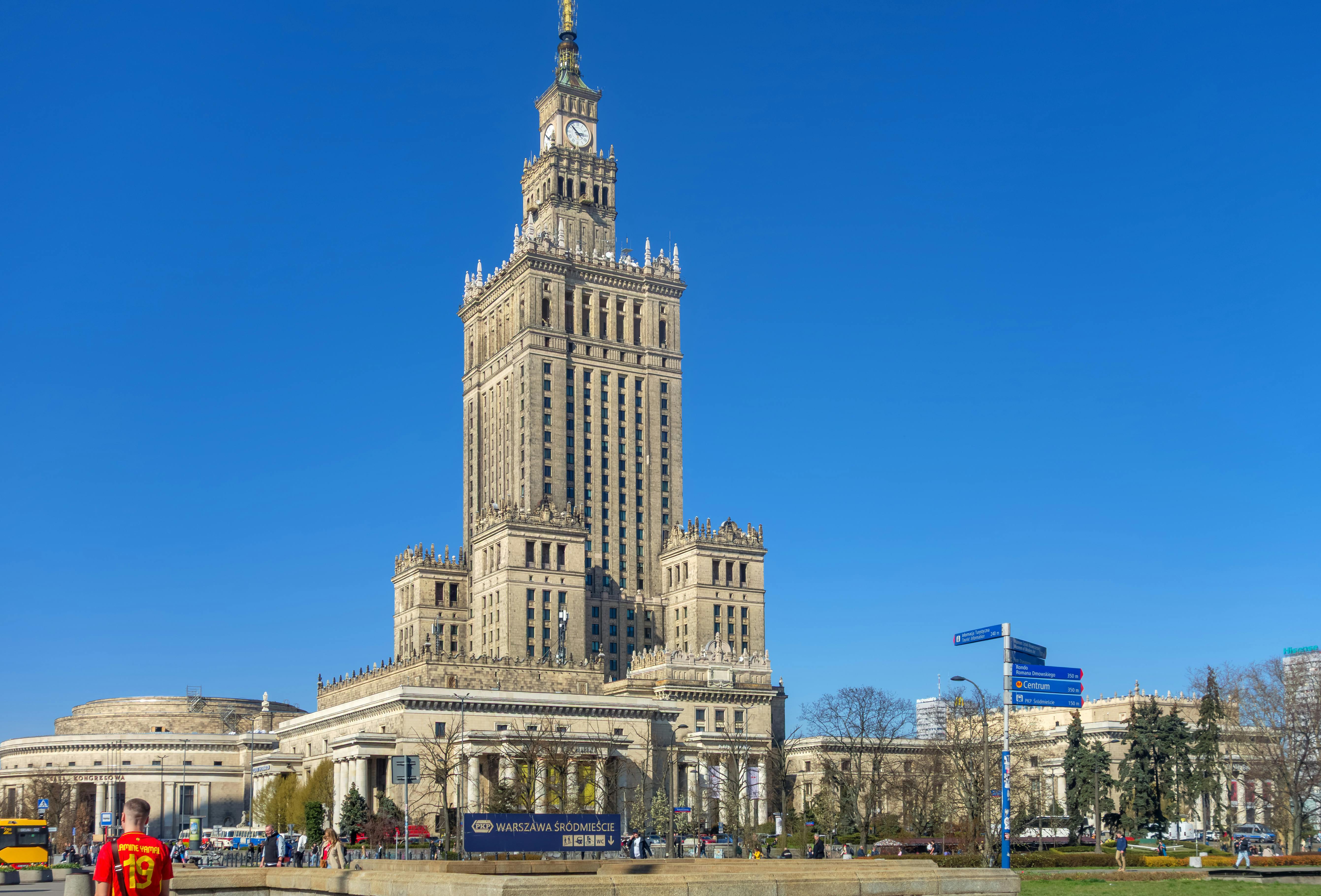
Palace of Culture: Where Soviet Legacy Meets Modern Warsaw
Golden hour light spills across Warsaw's skyline as you approach the towering silhouette of the Palace of Culture—a 237-meter Stalinist skyscraper that has dominated the city's horizon since 1955. The air carries the scent of freshly baked pierogi from street vendors, the faint aroma of blooming linden trees in nearby parks, and the distant hum of trams navigating the bustling streets below. You hear the soft chime of the observation deck elevator, the multilingual murmur of visitors from around the world, and the persistent pulse of a city that has transformed this once-controversial symbol into a beloved landmark. This isn't merely a building—it's a living chronicle of Poland's complex history, where Soviet-era architecture now houses contemporary art galleries, theaters, and cultural institutions, and where every floor tells a story of political transformation and national identity. Standing beneath its illuminated spire, you connect with the same urban fabric that has witnessed communist rule, Solidarity movement, and Poland's vibrant reemergence as a European cultural capital. This place matters because it represents Warsaw's remarkable ability to reclaim and redefine spaces of political imposition, transforming a symbol of foreign domination into a multifunctional heart of Polish creativity and community.
Why Palace of Culture Embodies Political Transformation
The Palace of Culture represents far more than architectural grandeur—it embodies one of history's most complex transformations of political symbolism into cultural utility. Constructed between 1952–1955 as a "gift" from the Soviet Union to the Polish people, this 237-meter skyscraper (including its spire) was the tallest building in Europe upon completion and remains Warsaw's tallest structure today. The palace solved a fundamental political challenge of its era: how to impose ideological dominance through architecture while providing tangible infrastructure. Built with 250,000 tons of Soviet steel and 14,000 cubic meters of Polish limestone, the 42-story structure features Stalinist architecture with distinctive Polish decorative elements—a calculated blend of Soviet power and national identity. The building's footprint measures 95 meters by 60 meters, containing approximately 430,000 square meters of interior space housing theaters, museums, cinemas, offices, and educational institutions. What makes the Palace of Culture unique is its evolving symbolism: once viewed as an unwelcome symbol of Soviet occupation, it has gradually transformed into a functional cultural hub embraced by Warsaw residents. Unlike many communist-era monuments removed after 1989, Warsaw chose to repurpose rather than demolish this structure—a testament to pragmatic cultural adaptation that acknowledges history while moving forward. The building's observation deck on the 30th floor, offering panoramic views of the reconstructed Old Town and modern skyline, has become one of Warsaw's most popular attractions, symbolizing the city's ability to rise above its complex past.
The Best Time to Experience Palace of Culture
To experience Palace of Culture at its most atmospheric, plan your visit between May 15–June 10 or September 15–October 10, when daytime temperatures range from 15–24°C (59–75°F) and the surrounding city parks bloom with spring blossoms or glow with autumn colors. During these windows, you'll enjoy comfortable conditions for exploring the building's interior, photography from the observation deck, and walking the surrounding streets without summer's crowds or winter's chill. For optimal photography of the illuminated spire and city skyline, arrive at 7:30–9:00 PM when the building's lighting system creates dramatic contrasts against the twilight sky. Alternatively, visit at 5:00–6:30 PM during golden hour for panoramic views that capture both natural light and emerging city lights. You should firmly avoid July 20–August 25 when temperatures can exceed 32°C (90°F), the observation deck becomes congested with tour groups, and haze diminishes visibility for photography. For event schedules, opening hours, and special exhibitions, visit pkin.pl.
Approximate Budget for Visiting Palace of Culture
Visiting Palace of Culture requires basing yourself in Warsaw's city center with easy access to public transportation. The following budget assumes moderate travel style—comfortable city accommodations, authentic Polish cuisine, and a mix of public transportation and occasional taxi rides. Prices are listed in Polish Złoty (PLN) with euro equivalents for international travelers (1 EUR ≈ 4.3 PLN in 2026).
- Accommodation: 120–280 PLN (28–65€) per night in Śródmieście (city center). Budget hotels start at 60 PLN; mid-range options run 280–550 PLN (65–128€).
- Food: 55–85 PLN (13–20€) per day total. Breakfast: 18–28 PLN for traditional śniadanie with jajecznica, local cheese, and fresh bread. Lunch: 25–40 PLN for pierogi or bigos at a milk bar like Pod Orłem. Dinner: 45–75 PLN for sit-down meals featuring duck with apples, oscypek cheese, and craft beer.
- Transportation: Local tram/bus: 3.40 PLN (0.80€) for 20 minutes; one-day pass: 16 PLN (3.70€); Uber/Bolt: ~15 PLN (3.50€) for short trips within city center.
- Attractions: Observation deck: 30 PLN (7€); Museum of Evolution: 25 PLN (5.80€); Palace cinema ticket: 35 PLN (8.10€); Guided tour: 50 PLN (11.60€).
- Miscellaneous: Souvenir postcards: 5–10 PLN (1.20–2.30€); traditional Polish pottery: 40–90 PLN (9–21€); concert ticket: 50–120 PLN (12–28€).
Total 3-Day Visit Budget: 1,100–1,900 PLN (255–445€) per person (excluding international flights and main accommodation)
5 Essential Palace of Culture Experiences
- Visit the Observation Deck at Sunset: Take the high-speed elevator to the 30th-floor observation deck as the sun begins to set over Warsaw. The 230-meter vantage point offers panoramic views spanning from the reconstructed Old Town to the modern financial district. Visit during golden hour (5:00–7:00 PM) for optimal lighting; entry 30 PLN; allow 45 minutes for the full experience.
- Explore the Museum of Evolution: Discover one of Poland's most impressive natural history collections housed within the palace. The museum features dinosaur skeletons, taxidermied animals, and interactive exhibits spanning evolutionary history. Visit mid-week (Tuesday–Thursday) when crowds are lighter; entry 25 PLN; allow 90 minutes.
- Attend a Performance at Congress Hall: Experience one of Europe's largest concert halls, seating 3,000 guests beneath its distinctive chandelier. The venue hosts classical concerts, film festivals, and cultural events throughout the year. Performance times vary; tickets 50–150 PLN; book online in advance.
- Walk the Palace Grounds at Dawn: Arrive early morning to experience the palace and surrounding parks with minimal crowds. The quiet atmosphere allows for reflection on the building's complex history while capturing architectural details in soft morning light. Free; allow 45 minutes; wear comfortable shoes.
- Join a Historical Guided Tour: Take a specialized tour focusing on the palace's construction, political significance, and architectural details. Knowledgeable guides reveal stories often overlooked by casual visitors. Tours typically begin at 10:00 AM and 2:00 PM; tickets 50 PLN; allow 90 minutes; book online to secure spots.
3 Hidden Gems Most Travelers Miss
- The Clock Tower Mechanics: Tucked away on the upper floors, the intricate clock mechanism that powers the palace's distinctive clock faces remains operational since installation. Most visitors miss it because access is limited to special heritage days. Access: Check pkin.pl for "Open Monument Days" (typically September); no advance booking required. Best visited midday; free; allow 20 minutes.
- The Secret Conference Rooms: Hidden on the 35th floor, these rooms were once used for high-level political meetings during the communist era. Often overlooked because they're not part of standard tours. Access: Included with premium historical tour; visit mid-morning (10:00 AM–12:00 PM) when lighting enhances appreciation of preserved interiors. Premium tour: 80 PLN; allow 60 minutes.
- The Rooftop Garden: Located on the upper levels of the palace, this serene garden offers unique perspectives of Warsaw with fewer crowds than the main observation deck. Most tourists turn back at the observation deck, missing this peaceful spot. Access: Ask staff about seasonal availability; best visited mid-week for solitude. No additional fee; allow 30 minutes; bring water.
Cultural & Practical Tips
- Respect Historical Complexity: The Palace represents a complicated chapter in Polish history—speak thoughtfully about its Soviet origins while acknowledging its current role as a cultural hub. Avoid simplistic judgments about its significance.
- Essential Polish Phrases: "Dzień dobry" (jen doh-brih) = Good day; "Dziękuję" (jen-koo-yeh) = Thank you; "Proszę" (proh-sheh) = Please/You're welcome; "Przepraszam" (psheh-prah-sham) = Excuse me. Locals appreciate the effort, even if pronunciation isn't perfect.
- Booking Strategy: Purchase observation deck tickets online to skip queues, especially during peak season. Evening slots (5:00–7:00 PM) offer the best lighting conditions for photography.
- Photography Guidelines: Photography is permitted throughout the building except in certain museum exhibits. Tripods require advance permission for use in public areas; prohibited in elevators and narrow corridors.
- Weather Preparedness: Warsaw experiences continental climate: summer highs reach 25–32°C (77–90°F); winter lows drop to -5°C (23°F). The observation deck can be windy year-round; carry a light layer even in summer.
- Accessibility Notes: The Palace has excellent accessibility features including elevators to all public areas. The observation deck and most museums are fully accessible; contact staff for specific accessibility information.
- Combine with Nearby Sites: Enhance your Palace visit with walking-distance attractions: Warsaw Uprising Monument (5 minutes), Theater Square (adjacent), and the Vistula River boulevards (10 minutes). A regional perspective enriches understanding of Warsaw's historical layers.
Conclusion: Travel with Understanding, Not Just Observation
The Palace of Culture invites you to do more than photograph a towering landmark against the city skyline. This is a place to stand where political narratives have shifted dramatically, where a symbol of foreign domination has transformed into a multifunctional heart of Polish creativity, where the quiet persistence of cultural adaptation triumphs over historical division. When you ascend the same elevators once used by communist officials, when you gaze upon the same skyline witnessed by generations of Poles through political transformation, when you experience cultural events in spaces once dedicated to ideology, you participate in a legacy that transcends tourism. Travel to Palace of Culture with reverence for the complex history it embodies, for the pragmatic wisdom that repurposed rather than destroyed, for the community that has claimed this space as their own. Respect the fragility of historical interpretation—every perspective on this building reveals different truths about power, identity, and resilience. Understand that the vibrant atmosphere you cherish depends on the mindfulness of every visitor who comes after you. Let the palace's commanding presence humble your understanding, let its layered history deepen your compassion, and let the convergence of past and present remind you that the most profound journeys are those that transform observation into nuanced understanding of how societies navigate their complex histories.