
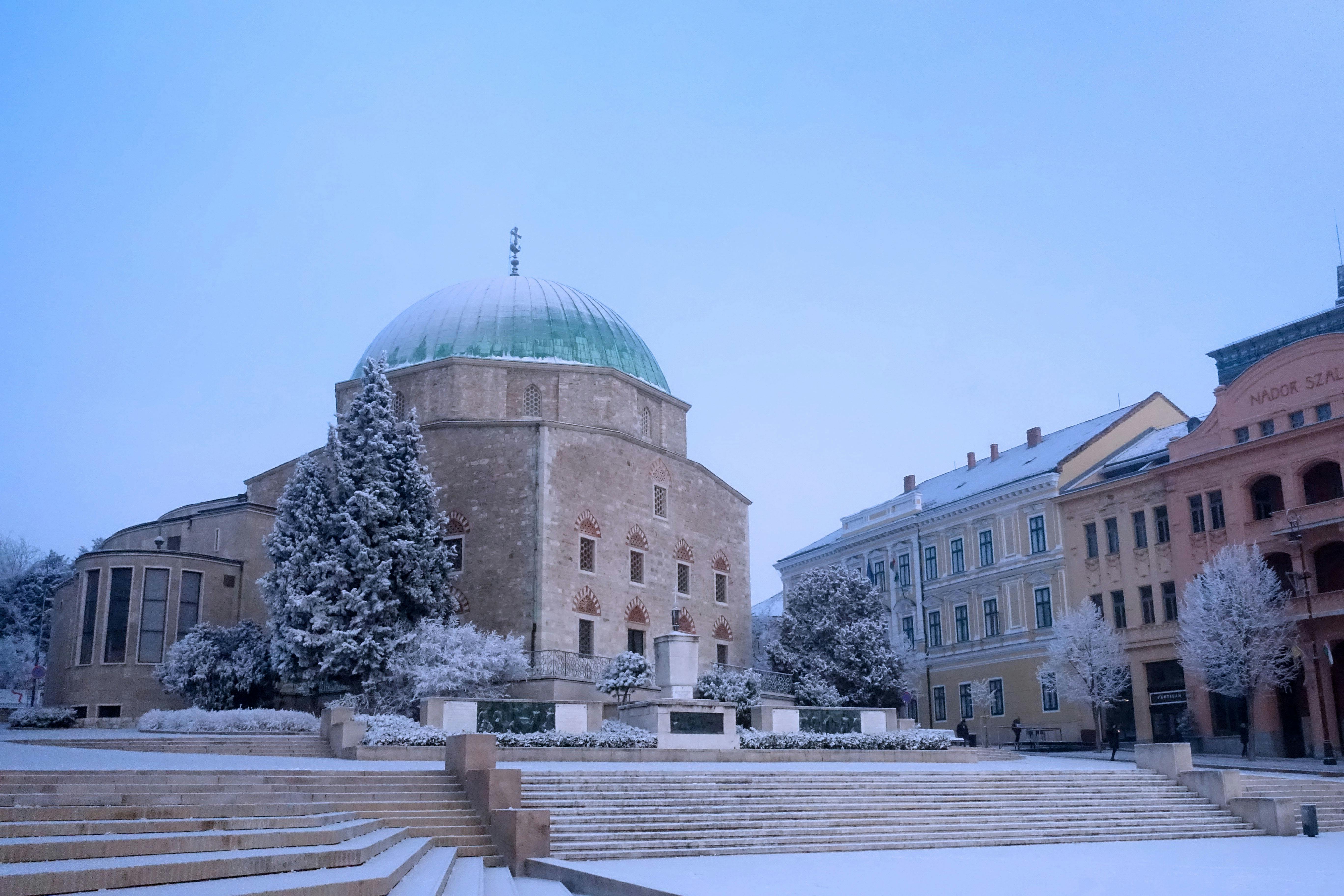
Pécs Mosque Church: Where Crescent and Cross Meet Under One Stone Roof
The call to prayer has long fallen silent here—but walk through the courtyard gates at noon, and you’ll still feel the echo. The sun strikes a 35-meter-tall minaret—slender, elegant, unmistakably Ottoman—and yet the bells of the city’s cathedral ring from just across the square. This is the Mosque Church of Pécs: a 16th-century Islamic place of worship transformed into a 21st-century Catholic sanctuary. Built between 1543 and 1546 under Pasha Qasim the Victorious, its limestone walls have witnessed the Sultan’s conquest and the Hapsburg’s reconquest . Step inside, and you enter a space of impossible harmony—Arabic calligraphy curls beneath Baroque altarpieces; the mihrab (prayer niche) points toward Mecca, yet a Madonna and Child gaze down from where the minbar once stood. For nearly 500 years, this building has solved an impossible riddle: how to honor two faiths within the same four walls without erasing either . The answer stands before you—not a compromise, but a quiet miracle of coexistence.
Why the Mosque Church Embodies Pécs’ Layered Identity
The building solved a problem that has haunted conquerors for millennia: how to assert dominance without erasing the past. When Sultan Suleiman the Magnificent’s forces captured Pécs in 1526, they could have demolished the existing Gothic church on this site. Instead, they adapted it—widening the nave, adding a minaret, plastering over Christian frescoes, and installing a mihrab . The result was the Pasa Qasim Camii, named for the Ottoman governor who funded its completion in 1546. For 144 years, the faithful answered the muezzin’s call from the minaret’s balcony, 80 steps up . Then came 1686: the Hapsburg army, led by Prince Louis of Baden, recaptured Pécs. Most Ottoman mosques in Hungary were demolished or converted into barns. But this one? The Franciscans simply removed the mihrab, added a high altar, and re-consecrated it as the Church of St. Bertalan . The minaret stayed. The Islamic foundation remained. Today, the University of Pécs’ Department of Art History has identified at least seven distinct construction phases, from 13th-century Romanesque foundations to 18th-century Baroque vaulting . This isn’t architectural schizophrenia—it’s the physical manifestation of a city that has never erased its past but has instead built upon it, layer by patient layer.
The Best Time to Experience the Mosque Church
The Mosque Church operates as an active Catholic parish (Church of the Blessed Virgin Mary), meaning visit times must work around masses. For the most serene exploration, arrive on Tuesday through Friday between 10:00 AM and 11:30 AM or 2:30 PM and 4:00 PM . Pécs enjoys mild weather from May 1 through June 30 (18–25°C / 64–77°F) and again from September 1 through October 15 (16–22°C / 61–72°F), making it comfortable to also climb the minaret . Sunday mornings (9:00 AM–12:00 PM) have multiple masses and are not ideal for non-worshippers. Avoid midday in July and August if you dislike crowds; the interior stays cool, but the square outside fills with tourists. For the most dramatic light, visit when the afternoon sun ( 3:00–4:30 PM ) streams through the south-facing windows, illuminating the contrast between the Baroque pulpit and the plastered-over Islamic inscriptions
Approximate Budget for a 7-Day Trip
Pécs remains one of Hungary’s most affordable historic cities. The following mid-range budget includes Mosque Church entry, minaret climb, and access to the attached museum. Prices in Hungarian Forint (HUF); 1 EUR ≈ 385 HUF as of 2026.
- Accommodation: 10,000–28,000 HUF (€26–73) per night. Budget guesthouses within the historic core start at 9,000 HUF; mid-range hotels like Hotel Palatinus (200 meters from the Mosque Church) run 25,000–35,000 HUF including breakfast.
- Food: 6,000–11,000 HUF (€16–29) per day. Breakfast at a local bakery: 1,200 HUF for a pogácsa (savory scone) and coffee. Lunch: 2,000–3,000 HUF for halászlé (fisherman’s soup) or töltött káposzta (stuffed cabbage). Dinner: 3,000–5,000 HUF; a glass of Villány red wine adds 800–1,200 HUF.
- Transportation: 2,500–6,500 HUF (€6.50–17) for the week. Train from Budapest’s Keleti station to Pécs: 4,200 HUF one-way (2.5 hours) . Local buses: 350 HUF per ride. The Mosque Church is in the pedestrianized city center; you won’t need transit within Pécs.
- Attractions: Mosque Church entry: free. Minaret climb (80 steps): 400 HUF (€1). Museum in former sacristy (Ottoman artifacts, vestments): 800 HUF. Combined ticket with Early Christian Necropolis (Cella Septichora): 3,500 HUF. Pécs Cathedral: free for main hall, 1,500 HUF for tower.
- Miscellaneous: 7,000–12,000 HUF (€18–31). Zsolnay porcelain miniature (eosin glaze): 4,000–8,000 HUF. Villány wine bottle: 2,500–5,000 HUF. Pécs Card (72-hour museum pass, optional): 4,500 HUF .
Total for 7 days (mid-range, solo traveler): 106,000–221,000 HUF (€275–575). Couples sharing accommodations spend roughly €450–900 combined.
7 Essential Mosque Church Experiences
- Climb the Original Ottoman Minaret: The 35-meter (115-foot) minaret remains unchanged since 1546—80 narrow, winding stone steps, worn smooth by four centuries of feet . The stairs are dark and steep; take them slowly. At the top, the balcony offers panoramic views of Pécs’ red-tiled roofs, the cathedral’s spires, and, on clear days, the Mecsek Hills. Climb before 10:30 AM to avoid queuing.
- Find the Hidden Arabic Calligraphy: Look above the main entrance, beneath layers of whitewash. Between 2014 and 2016, restorers revealed fragments of an Islamic inscription—likely a verse from the Quran or the name of Pasha Qasim . It’s subtle, easy to miss. Stand near the organ and face the entrance; the script appears along the upper edge of the door arch, painted in faded red.
- Step Inside at Organ Rehearsal: The church houses a late-Baroque organ built in 1765 by master organ builder Franz Xaver Christoph . On Tuesday and Thursday mornings (10:30–11:30 AM), the cathedral organist practices. The sound inside the former mosque is extraordinary—the minaret acts as a resonance chamber, and the acoustics shift as the organist moves through the scales. Sit in the back pew; the sound seems to come from everywhere at once.
- Stand on the Mihrab’s Location: The mihrab—the niche indicating the direction of Mecca—was bricked over in 1702 during the Franciscan conversion . But its exact location survived in Ottoman tax records. Stand in the central aisle, approximately 8 meters from the main altar, and look down at the slightly lighter-colored stone beneath your feet. That’s where pilgrims once prostrated themselves toward Mecca.
- Visit During the Ramadan Memorial Concert (July): Every July since 2015, the Pécs Summer Festival organizes an evening concert called “Ramadan in Pécs”—a program of Ottoman classical music and Sufi poetry readings inside the Mosque Church . In 2026, the concert falls on July 17 at 7:00 PM. Tickets (3,000 HUF) sell out within days; buy them at the Pécs Tourist Office starting June 1.
- Explore the Ottoman Stone Carvings in the Sacristy: The small attached museum (entered through the church’s north door) houses stone fragments salvaged during 20th-century restorations . Look for the carved stone rosette from the original minbar (the pulpit where the imam preached) and a marble fragment of an Islamic geometric star pattern. The museum is small—15 minutes, maximum—but essential for understanding what the church once was.
- Attend Saturday Evening Mass for the Frescoes: Saturday evening mass at 6:00 PM happens in near-darkness except for spotlights illuminating the main altar. In that dim light, the 18th-century frescoes by Austrian painter Johann Pock on the vaulted ceiling glow as if newly painted . Even non-Catholics are welcome to sit quietly—and to witness how two faiths share light.
3 Hidden Gems Most Travelers Miss
- The Unmarked Dervish Lodge Cellar: Under the church’s southern courtyard, a locked stone cellar contains the foundations of a 16th-century dervish lodge (zaviye)—a gathering place for Sufi mystics . The cellar is not open to the public, but the parish secretary (ask at the church office, open Tuesday 2:00–4:00 PM) will unlock it for serious researchers or curious travelers who make a small donation (500 HUF recommended). Inside, you’ll see a single arched room with fragments of original tile flooring and a shallow niche for meditation.
- The Stone of the Seven Sleepers (Courtyard Wall): In the courtyard, embedded in the north wall about 1.5 meters above ground, is a small carved stone depicting seven figures sleeping under a cliff—the legend of the Seven Sleepers of Ephesus, a story sacred to both Muslims and Christians . The Ottomans carved this stone as a symbol of shared faith; most tour guides walk past it without pausing. It’s easiest to find at noon, when the sun illuminates the carving directly.
- The Gül Baba Tomb Connection (Budapest Detour): This hidden gem requires a half-day trip to Budapest, but it’s worth it. Gül Baba (“Father of Roses”) was an Ottoman Bektashi dervish who died in Buda in 1541. His octagonal tomb—the northernmost Islamic pilgrimage site in the world—was built in 1548, the same decade as the Pécs mosque . Inside, the tomb’s interior layout mirrors the Pécs Mosque Church’s original mihrab placement. Visit both, and you’ll understand how Ottoman architects standardized sacred space across occupied Hungary. The tomb is free to enter, open Tuesday–Sunday 10:00 AM–4:00 PM .
Cultural & Practical Tips
- Dress code for active worship space: Though the church is a tourist attraction, it remains a Catholic parish. Cover shoulders and knees inside. Women are not required to cover their heads, but removing hats is customary. During mass (Sunday 9:00 AM, 11:00 AM, 6:00 PM), non-worshippers should sit in the last three pews only.
- Photography guidelines: No flash photography inside—the light damages centuries-old plaster and pigments. Tripods require a 2,000 HUF permit, available from the parish office. The minaret’s staircase is too narrow for tripods in any case.
- Learn key Hungarian and Turkish phrases: Köszönöm (KUH-suh-nuhm) means “thank you.” Szép templom (SAPE TEM-plohm) means “beautiful church.” If you want to surprise the caretaker, say Eski cami çok güzel (old mosque is very beautiful)—Turkish is still remembered here. Béke veled (BAY-keh VEH-led) means “peace be with you,” appropriate for leaving a sacred space.
- Respect the minaret’s limits: Only three people may ascend the minaret at once, for safety. Maximum stay at the top: 5 minutes. Children under six, people with heart conditions, and those with mobility impairments should not attempt the climb (the stairs are uneven and unlit).
- Combination ticket savings: The “Pécs Heritage Pass” (5,500 HUF, sold at the Mosque Church ticket desk) covers entry to the Mosque Church museum, the minaret climb, the Early Christian Necropolis, and the Cathedral Treasury . If you plan to visit all four, the pass saves 2,000 HUF versus individual tickets.
- Beware of the midday sun: From May through August, the interior of the church becomes noticeably warm between 12:30–2:30 PM (25–28°C / 77–82°F inside). There is no air conditioning. Visit in the morning or late afternoon for comfort.
- Accessibility note: The main church interior is wheelchair accessible via a portable ramp at the main entrance. The minaret is not accessible. The museum in the sacristy has a single step at its entrance; staff can provide a portable ramp on request (call +36 30 701 3771 in advance).
Conclusion: Travel with Reverence, Not Just Wonder
The Mosque Church will not shout its mysteries at you. It whispers them: a fragment of Arabic script here, a Baroque cherub there, a stone step worn smooth by Muslims and Christians alike. This building has watched empires rise and fall, has heard the call to prayer and the ringing of bells, has sheltered conquerors and the conquered within the same cool stone walls. When you leave, carrying nothing but the image of a minaret rising behind a crucifix, remember that coexistence is not a destination—it is a practice. The Mosque Church has practiced it for 500 years. You can practice it for an afternoon: slow down, look closely, and let this quiet miracle teach you that holiness wears many faces, and all of them belong here.