
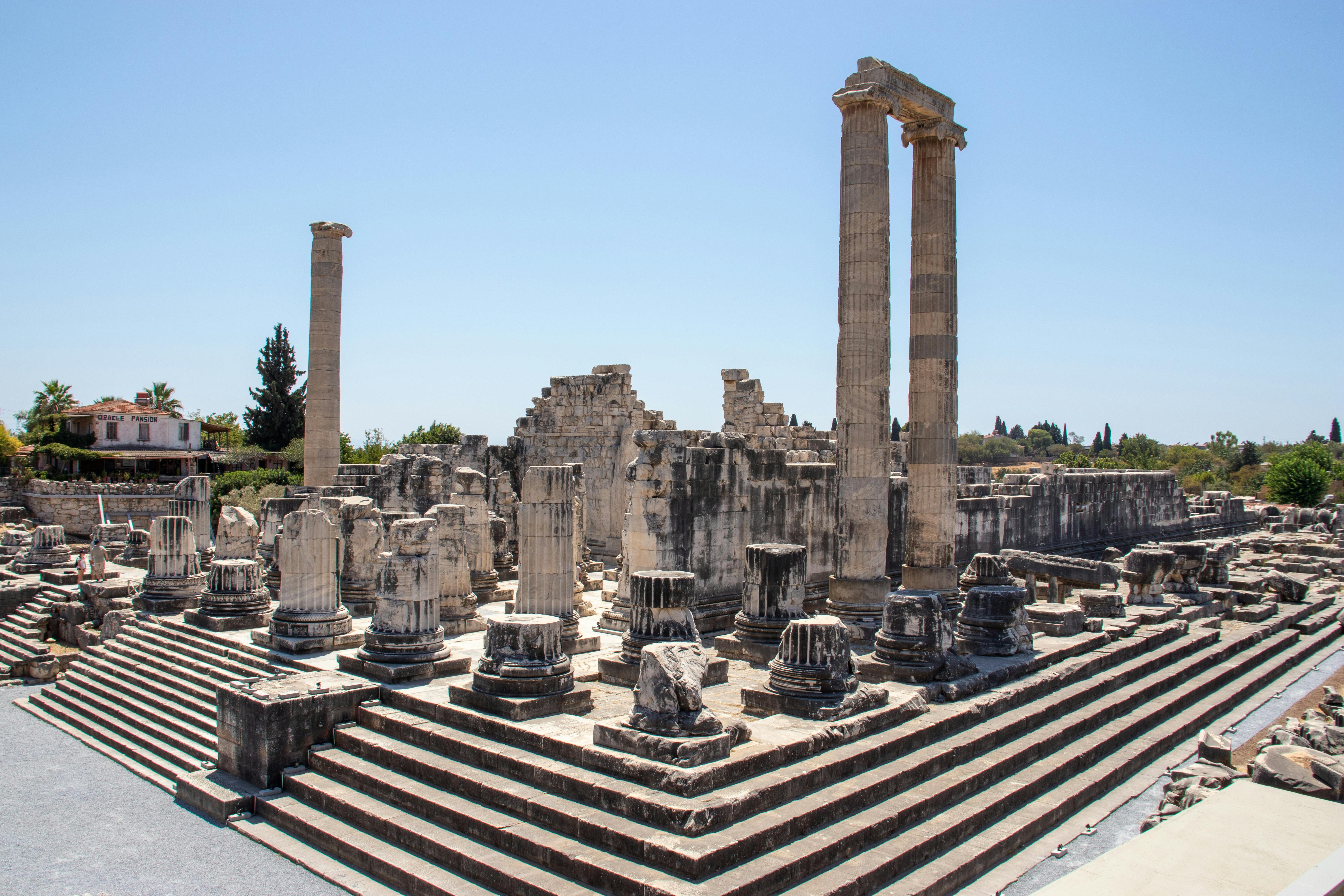
Temple of Apollo: Where Ancient Oracles Meet the Aegean Light
The late afternoon sun bathes weathered marble in liquid gold as you stand within the sacred enclosure of the Temple of Apollo at Didyma, where colossal Ionic columns rise 19.5 meters toward the sky, framing vistas of the Mediterranean horizon just 15 kilometers away. The air carries the scent of wild thyme, sun-baked limestone, and the faint aroma of olive groves that have flourished in this sacred valley for millennia. You hear the whisper of wind through fallen capitals, the distant call of shepherds guiding flocks through the hills, and your own footsteps echoing on stone pathways worn smooth by centuries of pilgrims, priests, and travelers seeking divine guidance. Before you stretches an archaeological masterpiece: the third-largest temple of the ancient world, with a sacred spring emerging from the adyton (inner sanctuary) where oracles once delivered prophecies that shaped empires, and a processional way lined with monumental statues that once connected this sanctuary to the harbor of Miletus. This isn't merely an archaeological site—it's a sanctuary where human aspiration met divine mystery, where architecture embodied spiritual longing, and where travelers can contemplate how ancient civilizations sought meaning through the convergence of stone, water, and sky.
Why the Temple of Apollo Embodies Sacred Architecture
The Temple of Apollo at Didyma represents far more than ancient ruins—it embodies the extraordinary synthesis of religious devotion, architectural innovation, and political ambition that defined Hellenistic sanctuary design at its zenith. Construction began around 300 BCE under the patronage of the Seleucid dynasty and continued for over 600 years without ever reaching completion, making it one of antiquity's most ambitious architectural projects. This sanctuary solved fundamental challenges of sacred space: creating an atmosphere of divine transcendence through monumental scale, engineering a functional oracle system within a massive temple complex, and establishing a pilgrimage destination that could rival Delphi in influence while serving the maritime trade routes of the Aegean.
The technical achievements are staggering. The temple's colossal dimensions—51 by 109 meters at the base, with 120 Ionic columns originally rising 19.5 meters—required sophisticated engineering to stabilize foundations on the sloping terrain. The sacred spring emerging in the adyton was channeled through stone conduits to a ritual pool where priestesses delivered prophecies, demonstrating advanced understanding of hydrology and acoustics. The processional way, extending 1.5 kilometers from the harbor of Miletus, was lined with over 100 monumental statues of priests, dignitaries, and mythological figures, creating a theatrical approach that prepared pilgrims for the divine encounter. The temple's unfinished state—many columns lack fluting, capitals remain rough-hewn—reveals ancient construction techniques and the economic challenges of monumental projects.
What makes Didyma unique is its layered narrative: the sanctuary served successive civilizations—Greek, Roman, Byzantine, and Ottoman—each leaving architectural and cultural traces visible in the stonework. The oracle's influence extended across the Mediterranean, with emperors, generals, and merchants seeking guidance before major decisions. This convergence of spiritual aspiration, architectural ambition, and political significance—where stone reaches toward the divine, where water carries prophetic voice, where pilgrimage paths connect harbor to sanctuary—creates a destination that invites travelers to contemplate how ancient civilizations expressed their deepest questions through the language of architecture.
The Best Time to Experience the Temple of Apollo
To experience the Temple of Apollo at its most atmospheric, plan your visit between April 15–June 10 or September 20–October 25, when daytime temperatures range from 19-27°C (66-81°F) and the sacred valley blooms with wildflowers or glows with autumn gold. During these windows, you'll enjoy comfortable conditions for exploring the expansive sanctuary, photography, and walking the processional way without summer's intense heat or winter's chill.
For optimal photography of the colossal columns and sacred landscape, arrive at 7:30–9:00 AM when morning light strikes the eastern colonnade, illuminating marble fluting with soft, directional illumination. Alternatively, visit at 5:00–6:30 PM during golden hour when warm light transforms limestone into amber tones and long shadows emphasize the temple's monumental scale. The stone's appearance shifts dramatically throughout the day—from pale gray at dawn to warm copper at sunset—making timing crucial for capturing its full sculptural beauty.
Avoid the peak summer period of June 25–August 20 when temperatures can exceed 38°C (100°F) on the exposed sanctuary, making exploration uncomfortable and causing harsh overhead light that flattens architectural details. While summer offers reliable weather, intense sun diminishes the visual drama of the columns and the climb becomes physically demanding. Winter months (November–March) bring temperatures of 6-14°C (43-57°F) during the day but can drop to 1°C (34°F) at night; rain makes ancient stone pathways extremely slippery, and occasional fog reduces visibility across the valley.
For current information on visiting hours, site access, and regional tourism services, visit the official Turkish Ministry of Culture and Tourism website: www.ktb.gov.tr
Approximate Budget for a 7-Day Trip
Visiting the Temple of Apollo at Didyma requires basing yourself in Didim town or nearby Söke, with day trips to explore the sanctuary and surrounding ancient cities of Miletus and Priene. The following budget assumes moderate travel style—comfortable local hotels, authentic Aegean cuisine, and a mix of public transportation and occasional private transfers. Prices are listed in euros for international travelers, though Turkey uses the Turkish Lira (₺).
- Accommodation: €26–€48 per night in Didim town center. Budget pensions start at €21; boutique hotels with sea views run €50-75. Staying in Didim provides immediate sanctuary access while Söke offers more amenities and lower prices.
- Food: €12-19 per day total. Breakfast: €3-5 for traditional Turkish breakfast with menemen, local cheese, olives, and çay. Lunch: €4-6 for regional specialties like Didim köfte, fresh Aegean fish, and Turkish pide at local esnaf lokantası. Dinner: €6-10 for sit-down meals featuring olive oil dishes, baklava, and ayran.
- Transportation: Round-trip flight to İzmir Adnan Menderes Airport from Istanbul: €58-125. Airport shuttle to Didim: €12. Local dolmuş within region: €0.50 per ride. Taxi to archaeological sites: €10 round-trip. Car rental: €32/day.
- Attractions: Temple of Apollo entrance: €8. Miletus ruins: €8. Priene archaeological site: €10. Three Cities combined ticket: €20. Guided archaeological tour: €35.
- Miscellaneous: Handwoven Aegean textiles: €30-85. Local olive oil: €8/bottle. Replica ancient artifacts: €13-40. Regional guidebook: €11.
Total 7-Day Budget: €395–€575 per person (excluding international flights to Turkey)
7 Essential Temple of Apollo Experiences
- Enter Through the Sacred Gateway: Approach the temple through the monumental propylon (gateway) at 7:30 AM when morning light illuminates the colossal Ionic columns. Walk the 15-meter-wide entrance passage flanked by columns rising 19.5 meters to experience the theatrical approach designed to inspire awe. The gateway's precise proportions and decorative details reveal Hellenistic architectural sophistication. Allow 30 minutes to fully appreciate the transition from mundane world to sacred space.
- Explore the Adyton and Sacred Spring: Descend into the temple's inner sanctuary (adyon) where the sacred spring emerges from bedrock. This was the oracle's chamber where priestesses delivered prophecies while seated above the flowing water. Examine the stone conduits, ritual pool, and acoustical design that amplified the oracle's voice. Visit between 9:00–11:00 AM when natural light penetrates the sanctuary. The combination of water, stone, and shadow creates a powerful atmosphere of ancient spiritual practice.
- Walk Among the Colossal Columns: Wander through the forest of surviving columns—120 originally stood in double rows around the temple's perimeter. Touch the marble fluting (some finished, some rough-hewn) to understand ancient construction techniques. The columns' massive scale (19.5 meters tall, 1.9 meters diameter) becomes apparent only when standing beside them. Visit mid-morning (10:00 AM–12:00 PM) when directional light emphasizes the fluting's texture. Allow 45 minutes to circumnavigate the temple and appreciate its monumental dimensions.
- Walk the Processional Way: Follow the ancient sacred road that connected the harbor of Miletus to the Temple of Apollo, lined with bases for over 100 monumental statues. Though most statues are now in museums, the 1.5-kilometer pathway reveals the theatrical approach designed for pilgrims. Visit late afternoon (4:00–5:30 PM) when golden light illuminates the stone path and creates long shadows. The walk provides perspective on how sanctuary and city were integrated in ancient religious practice.
- Photograph the Temple at Golden Hour: Position yourself at the temple's western end at 5:00–6:30 PM when warm light transforms the limestone into amber tones and long shadows emphasize the columns' monumental scale. Use a wide-angle lens to capture the temple's relationship to the surrounding landscape. The setting sun creates dramatic backlighting through the colonnade. Best captured in spring or autumn when atmospheric clarity is optimal and wildflowers frame the foreground.
- Visit the Temple Museum: Explore the small on-site museum displaying artifacts excavated from the sanctuary: statue fragments, inscriptions, ritual objects, and architectural elements. Exhibits explain the oracle's function, construction techniques, and the sanctuary's historical significance. Entry included with site ticket. Allow 30-45 minutes to contextualize your experience of the ruins. The museum's shaded interior provides welcome relief during hot days.
- Climb to the Viewing Platform: Ascend to the elevated platform at the temple's eastern end for panoramic views across the sanctuary toward the Mediterranean Sea. This vantage point reveals the temple's strategic location between mountain and sea, and its relationship to the ancient harbor of Miletus. Visit at sunset (6:00–7:30 PM) when the setting sun bathes the landscape in golden light. Bring water and wear sturdy shoes—the path is uneven but rewards with exceptional photography perspectives.
3 Hidden Gems Most Travelers Miss
- The Ancient Quarry Workshop: Approximately 600 meters northeast of the main temple, a partially excavated stone workshop displays tools, unfinished column drums, and worker graffiti that reveal ancient construction techniques. Most visitors overlook this feature because it's not prominently signposted. Access: From the temple's eastern side, follow the unmarked path northeastward for 10 minutes. Best examined midday when overhead light reveals tool marks. No entrance fee; allow 20 minutes to appreciate the tangible connection to the labor that built this monumental sanctuary.
- The Roman Bath Complex: On the sanctuary's southern edge, the partially preserved Roman baths feature hypocaust heating systems, marble basins, and mosaic fragments that reveal how pilgrims purified themselves before approaching the oracle. Most tourists focus on the temple, missing this complementary structure. Access: From the main pathway, follow the southern trail for 200 meters. Best visited late afternoon (4:00–5:30 PM) when side-lighting emphasizes architectural details. This feature reveals the practical infrastructure that supported ancient religious practice.
- The Hidden Oracle Inscription: On a fallen column drum near the adyton, a partially preserved Greek inscription records an oracle's response to a historical question—a rare survival of the sanctuary's prophetic function. Most visitors miss it because it's at ground level and not highlighted. Access: From the sacred spring, examine column fragments on the northern side of the adyton. Best viewed mid-morning (10:00 AM–12:00 PM) when light illuminates carved text. Bring a magnifying glass to read the weathered letters. This inscription offers direct connection to the oracle's voice across two millennia.
Cultural & Practical Tips
- Respect Sacred Space: The Temple of Apollo remains a site of cultural and spiritual significance. Speak quietly within the sanctuary, especially in the adyton. Dress modestly when exploring religious structures. Do not climb on fragile columns or remove stones—every fragment contributes to ongoing preservation efforts.
- Physical Preparedness: Exploring Didyma involves walking on uneven stone pathways, gentle slopes, and exposed terrain. The sanctuary covers approximately 6 hectares. Wear sturdy, closed-toe shoes with good grip. Carry at least 1.5 liters of water per person—there are limited facilities on-site. The site is partially accessible but not fully wheelchair-friendly due to ancient stone steps and uneven surfaces.
- Essential Phrases: "Teşekkür ederim" (teh-shek-kür eh-deh-rim) = Thank you; "Apollo Tapınağı nerede?" (ah-pol-lo tah-puh-nah-uh neh-reh-deh) = Where is the Temple of Apollo?; "Ne kadar?" (neh kah-dar) = How much?; "Hoş geldiniz" (hosh gel-din-iz) = Welcome.
- Photography Guidelines: Photography is permitted throughout the site, but tripods require care not to obstruct pathways or damage fragile surfaces. Drone photography requires advance permission from provincial authorities (contact: aydin.kultur@ktb.gov.tr). The best light for architectural photography is early morning (7:30–9:30 AM) and late afternoon (5:00–7:00 PM).
- Weather Considerations: The Didim region experiences Mediterranean climate: summer temperatures can exceed 38°C (100°F) with intense sun; winter brings temperatures near freezing and occasional rain. The sanctuary offers minimal shade—bring sun protection, water, and layers regardless of season. Afternoon winds are common; secure loose items.
- Understand the Context: Didyma represents complex intersections of Greek, Roman, and Turkish heritage. Approach the site with curiosity about ongoing archaeological research and respect for multiple cultural perspectives. Consider hiring a licensed guide who can explain the oracle's function and contextualize Didyma's role in ancient Mediterranean religion.
- Combine with Regional Sites: Enhance your Didyma visit with nearby attractions: the ancient city of Miletus with its grand theater and harbor ruins (12 kilometers), the perfectly planned city of Priene (20 kilometers), and the Maeander Delta's natural beauty. A regional perspective enriches understanding of Didyma's strategic and cultural significance in ancient Ionia.
Conclusion: Travel with Reverence, Not Just Checklists
The Temple of Apollo invites you to do more than photograph colossal columns against an azure sky. This is a place to stand where ancient pilgrims sought divine guidance, where architects pushed the boundaries of stone and ambition, where oracles spoke words that shaped empires. When you walk among columns that reach toward the heavens, when you descend into the adyton where water carried prophetic voice, when you gaze across the valley that witnessed millennia of human questioning, you participate in a meditation on meaning and mystery that transcends any single lifetime.
Travel to Didyma with reverence for the craftsmanship that shaped these stones, for the civilizations that sought meaning in this sacred space, for the resilience that preserved this heritage through centuries of change. Respect the fragility of exposed archaeology—two millennia of weathering have softened edges, and every touch accelerates erosion. Understand that the contemplative silence you cherish depends on the restraint of every visitor who comes after you. Let the temple's grandeur humble your expectations, let its history slow your pace, and let the convergence of architecture, spirituality, and natural beauty remind you that the most profound journeys are those that deepen our understanding of how human aspiration and divine mystery can converge across the ages.