
Priene: Where Hellenistic Stone Meets the Shadows of Mount Mycale
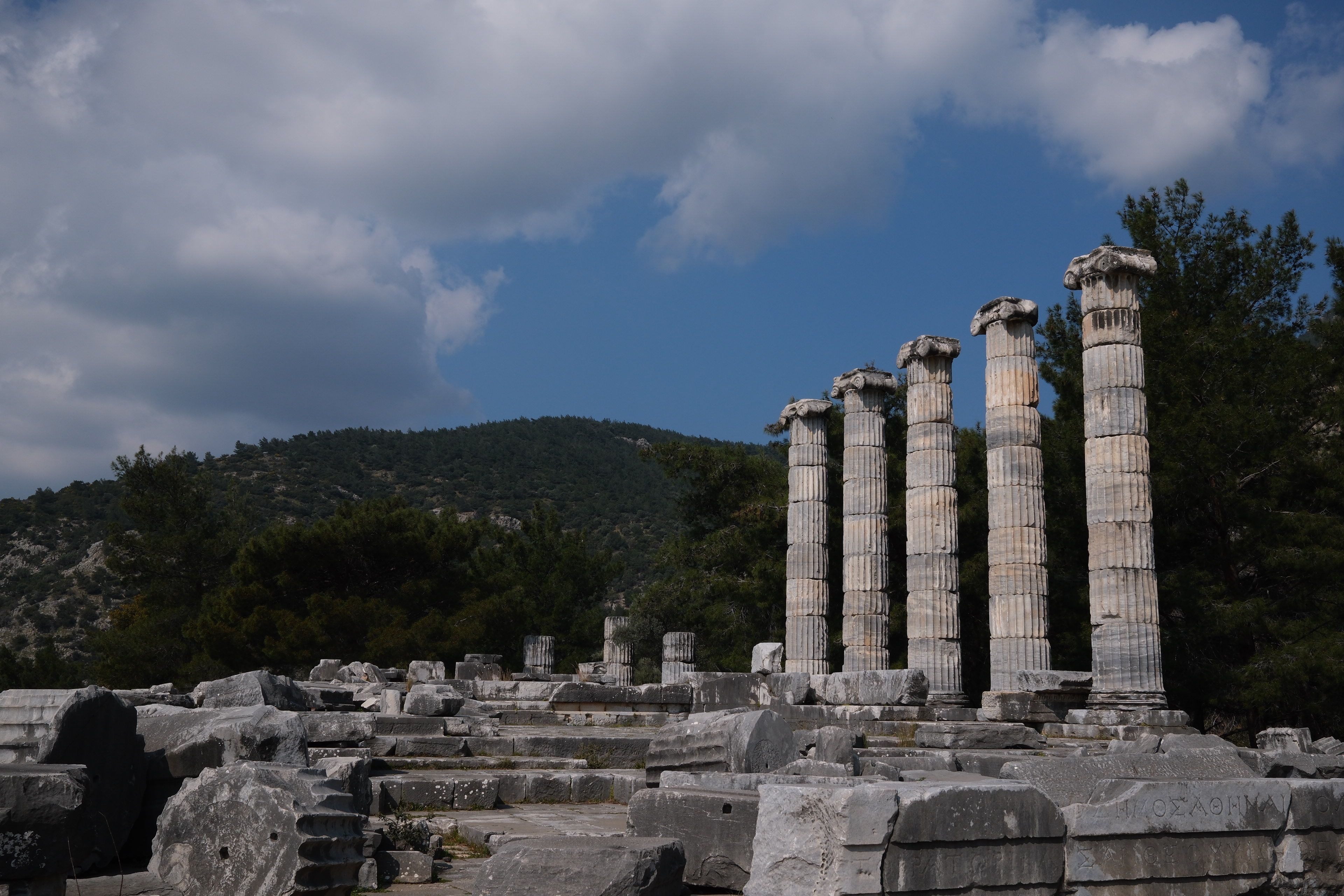
The late afternoon sun bathes weathered marble in liquid gold as you ascend the ancient pathways of Priene, where the ruins of one of antiquity's most perfectly planned cities cling to the southern slopes of Mount Mycale at 380 meters elevation. The air carries the scent of wild thyme, sun-baked limestone, and the faint aroma of olive groves that have flourished in the Maeander Valley for millennia. You hear the whisper of wind through fallen columns, the distant call of shepherds guiding flocks through the valley below, and your own footsteps on stone pathways worn smooth by centuries of citizens, scholars, and travelers. Before you stretches an archaeological masterpiece: the Temple of Athena Polias designed by Pytheos—the same architect who created the Mausoleum at Halicarnassus—featuring six surviving Ionic columns that once supported a roof adorned with intricate coffered ceilings, the remarkably preserved theater carved into the mountainside with seating for 5,000 spectators, and the grid-patterned streets that exemplify Hippodamian urban planning at its zenith. This isn't merely an archaeological site—it's a testament to ancient Greek ideals of order, beauty, and civic life, where geometry met geography, where philosophy shaped architecture, and where travelers can walk the very ground that influenced urban design from Alexandria to Rome.
Why Priene Embodies Hellenistic Urban Perfection
Priene represents far more than ancient ruins—it embodies the extraordinary achievement of Hellenistic urban planning where mathematical precision, aesthetic harmony, and practical functionality converged to create a model city that influenced urban design across the ancient world. Founded as a coastal settlement around 1000 BCE and relocated to its current hillside location around 350 BCE under the patronage of Mausolus of Caria, Priene solved fundamental challenges of ancient city-building: creating defensible fortifications on steep terrain, establishing efficient drainage and water systems in a Mediterranean climate, and designing a civic layout that balanced public spaces with private residences while maximizing views and ventilation.
The engineering achievements are remarkable. The city follows a strict Hippodamian grid plan with streets oriented east-west and north-south, creating 80 rectangular blocks (insulae) measuring approximately 47 by 35 meters each. The main thoroughfare, measuring 7 meters wide, slopes gently to facilitate natural drainage during winter rains. The Temple of Athena Polias, constructed from local marble and limestone, features a colonnade of 6 by 11 Ionic columns rising 8.5 meters, with an innovative coffered ceiling that reduced weight while maintaining structural integrity. The theater, carved directly into the mountainside with a gradient of 30 degrees, seats 5,000 spectators with acoustics so precise that whispers from the orchestra carry to the highest rows. Sophisticated water management systems included terracotta pipes channeling spring water to public fountains, private cisterns, and the gymnasium's bathing facilities.
What makes Priene unique is its preservation of urban planning principles: unlike many ancient cities that grew organically, Priene was designed as a complete system where residential quarters, public buildings, religious sanctuaries, and defensive walls were integrated from the outset. The bouleuterion (council chamber) seated 640 citizens in a semi-circular arrangement that facilitated democratic debate; the gymnasium combined athletic training with philosophical education; and the residential blocks featured standardized house plans with central courtyards that provided light, ventilation, and privacy. This convergence of mathematical order, aesthetic refinement, and civic functionality—where geometry serves democracy, where architecture embodies philosophy, where planning anticipates human needs—creates a destination that invites travelers to contemplate how ancient civilizations achieved urban excellence through the integration of diverse human endeavors.
The Best Time to Experience Priene
To experience Priene at its most atmospheric, plan your visit between April 15–June 10 or September 20–October 25, when daytime temperatures range from 19-27°C (66-81°F) and the Maeander Valley blooms with wildflowers or glows with autumn gold. During these windows, you'll enjoy comfortable conditions for climbing the steep archaeological pathways, exploring exposed ruins, and photography without summer's intense heat or winter's chill.
For optimal photography of the Temple of Athena and theater ruins, arrive at 7:30–9:00 AM when morning light strikes the eastern facades, illuminating marble columns with soft, directional illumination. Alternatively, visit at 5:00–6:30 PM during golden hour when warm light transforms limestone into amber tones and long shadows emphasize the theater's dramatic gradient. The stone's appearance shifts dramatically throughout the day—from pale gray at dawn to warm copper at sunset—making timing crucial for capturing its full sculptural beauty.
Avoid the peak summer period of June 25–August 20 when temperatures can exceed 38°C (100°F) on the exposed hillside, making the steep climb uncomfortable and causing harsh overhead light that flattens architectural details. While summer offers reliable weather, intense sun diminishes the visual drama of the ruins and the climb becomes physically demanding. Winter months (November–March) bring temperatures of 6-14°C (43-57°F) during the day but can drop to 1°C (34°F) at night; rain makes ancient stone pathways extremely slippery, and occasional fog reduces visibility across the valley.
For current information on visiting hours, site access, and regional tourism services, visit the official Turkish Ministry of Culture and Tourism website: www.ktb.gov.tr
Approximate Budget for a 7-Day Trip
Visiting Priene requires basing yourself in Söke town or nearby Kuşadası, with day trips to explore the archaeological site and surrounding ancient cities of Miletus and Didyma. The following budget assumes moderate travel style—comfortable local hotels, authentic Aegean cuisine, and a mix of public transportation and occasional private transfers. Prices are listed in euros for international travelers, though Turkey uses the Turkish Lira (₺).
- Accommodation: €28–€50 per night in Söke town center. Budget pensions start at €22; boutique hotels with valley views run €52-78. Staying in Söke provides immediate access to Priene (15 kilometers) while Kuşadası (45 kilometers away) offers coastal amenities and flight connections.
- Food: €13-20 per day total. Breakfast: €4-6 for traditional Turkish breakfast with menemen, local cheese, olives, and çay. Lunch: €4-7 for regional specialties like Söke köfte, fresh Aegean fish, and Turkish pide at local esnaf lokantası. Dinner: €6-10 for sit-down meals featuring olive oil dishes, baklava, and ayran.
- Transportation: Round-trip flight to İzmir Adnan Menderes Airport from Istanbul: €60-128. Airport shuttle to Söke: €10. Local dolmuş Söke to Priene: €3 each way. Taxi to archaeological sites: €12 round-trip. Car rental: €33/day.
- Attractions: Priene archaeological site entrance: €10. Miletus ruins: €8. Didyma Temple of Apollo: €6. Three Cities combined ticket: €18. Guided archaeological tour: €35.
- Miscellaneous: Handwoven Aegean textiles: €32-88. Local olive oil: €8/bottle. Replica ancient artifacts: €14-42. Regional guidebook: €11.
Total 7-Day Budget: €410–€595 per person (excluding international flights to Turkey)
7 Essential Priene Experiences
- Explore the Temple of Athena at Dawn: Arrive at the sanctuary at 7:30 AM when morning light illuminates the six surviving Ionic columns of the Temple of Athena Polias. Examine the innovative coffered ceiling fragments and the precise proportions that influenced later Greek architecture. The temple's eastern orientation means morning light penetrates the cella, revealing details of the cult statue base. Allow 45 minutes to fully appreciate Pytheos's architectural mastery and photograph the columns against the Mount Mycale backdrop. Bring water and wear sturdy shoes—the path to the temple is steep and stone steps can be uneven.
- Walk the Hippodamian Grid: Follow the main east-west street (plateia) that exemplifies Hippodamian urban planning at its finest. The 7-meter-wide thoroughfare slopes gently for drainage and is flanked by standardized residential blocks measuring 47 by 35 meters. Visit between 9:00–11:00 AM when directional light emphasizes the grid's geometric precision. Note how the street network integrates public buildings, private residences, and defensive walls into a cohesive urban system. Allow 60 minutes to walk the full length and appreciate the planning sophistication.
- Experience the Theater's Acoustics: Ascend to the remarkably preserved theater carved into the mountainside with seating for 5,000 spectators. Test the acoustics by speaking softly from the orchestra—your voice will carry clearly to the highest rows due to the 30-degree gradient and precise stone cutting. Visit late afternoon (4:00–5:30 PM) when golden light illuminates the seating tiers and creates dramatic shadows. The theater's orientation toward the Maeander Valley provides spectacular views that contextualize Priene's strategic location.
- Explore the Bouleuterion: Visit the council chamber where 640 citizens once gathered for democratic debate. The semi-circular seating arrangement with tiered stone benches demonstrates how architecture facilitated civic participation. Examine the speaker's platform and the acoustic design that allowed all participants to hear debates clearly. Entry included in site ticket. Allow 30 minutes to contemplate how ancient democratic institutions were physically embodied in architectural form.
- Walk the Residential Quarter: Explore the standardized house blocks that reveal daily life in Hellenistic Priene. Each insula featured central courtyards for light and ventilation, standardized room layouts, and shared party walls that maximized space efficiency. Visit mid-morning (10:00 AM–12:00 PM) when light penetrates courtyard spaces. Look for surviving door frames, drainage channels, and wall foundations that reveal domestic architecture. This area provides intimate insight into how ordinary citizens lived within the city's grand design.
- Climb to the Acropolis Summit: Ascend to Priene's highest point for panoramic views across the Maeander Valley toward the Aegean Sea and the ancient harbor that once connected the city to maritime trade routes. The 20-minute climb rewards with perspective on how Priene's planners integrated defensive strategy with urban aesthetics. Visit at sunset (6:00–7:30 PM) when the setting sun bathes the valley in golden light. Bring water and wear sturdy shoes—the path is steep and exposed.
- Study the Water Management System: Examine the sophisticated hydraulic engineering that sustained Priene: terracotta pipes channeling spring water to public fountains, cisterns carved into bedrock, and drainage channels protecting foundations from winter rains. Look for these features along the main street and residential quarters. Visit midday (12:00–2:00 PM) when overhead light reveals the stonework. This infrastructure reveals how ancient engineers solved practical challenges while maintaining aesthetic harmony.
3 Hidden Gems Most Travelers Miss
- The Ancient Quarry Site: Approximately 800 meters northeast of the main archaeological area, the limestone quarry that provided building materials for Priene's monuments still displays tool marks, partially extracted blocks, and ancient worker graffiti. This industrial archaeology offers tangible connection to the labor that built the city. Access: From the acropolis path, follow the unmarked trail northeastward for 15 minutes. Best photographed midday when overhead light reveals tool marks. No entrance fee; bring water and sun protection for the exposed site.
- The Sanctuary of Demeter and Kore: On the city's western slope, the partially excavated sanctuary dedicated to Demeter and her daughter Kore features stone foundations, altar remains, and votive offerings that reveal religious practices beyond the main Athena sanctuary. Most tourists focus on the temple and theater, missing this quieter sacred space. Access: From the main pathway, follow the western trail for 300 meters. Best visited late afternoon (4:00–5:30 PM) when side-lighting emphasizes stonework. No additional entrance fee; allow 20 minutes for quiet contemplation of this lesser-known sanctuary.
- The Hidden Cistern Chamber: Beneath the residential quarter, a rock-cut cistern with vaulted ceiling and plastered walls once stored water for the neighborhood during dry seasons. This engineering feature is rarely signposted but offers insight into ancient urban infrastructure. Access: From the residential area, look for a stone archway partially hidden by vegetation; entry may require permission from site staff. Best examined mid-morning when guides are available. This feature reveals the practical systems that sustained daily life in a hillside city.
Cultural & Practical Tips
- Respect Archaeological Integrity: Priene is an active research site as well as a tourist destination. Stay on marked pathways to protect unexcavated areas. Do not touch or remove stones, pottery fragments, or other artifacts—every piece contributes to ongoing scholarship. Speak quietly to maintain the contemplative atmosphere that honors the site's significance.
- Physical Preparedness: Exploring Priene involves climbing steep stone pathways with gradients up to 30 degrees, navigating uneven surfaces, and ascending over 200 meters elevation. The site is not wheelchair-accessible. Wear sturdy, closed-toe shoes with excellent grip. Carry at least 2 liters of water per person—there are limited facilities on the steep slopes.
- Essential Phrases: "Teşekkür ederim" (teh-shek-kür eh-deh-rim) = Thank you; "Priene nerede?" (pree-eh-neh neh-reh-deh) = Where is Priene?; "Ne kadar?" (neh kah-dar) = How much?; "Hoş geldiniz" (hosh gel-din-iz) = Welcome.
- Photography Guidelines: Photography is permitted throughout the site, but tripods require care not to obstruct pathways or damage fragile surfaces. Drone photography requires advance permission from provincial authorities (contact: aydin.kultur@ktb.gov.tr). The best light for architectural photography is early morning (7:30–9:30 AM) and late afternoon (5:00–7:00 PM).
- Weather Considerations: The Maeander Valley experiences Mediterranean climate: summer temperatures can exceed 38°C (100°F) with intense sun; winter brings temperatures near freezing and occasional rain. The hillside site offers minimal shade—bring sun protection, water, and layers regardless of season. Afternoon winds are common; secure loose items.
- Understand the Context: Priene represents complex intersections of Greek, Roman, and Turkish heritage. Approach the site with curiosity about ongoing archaeological research and respect for multiple cultural perspectives. Consider hiring a licensed guide who can explain Hippodamian planning principles and contextualize Priene's role in Hellenistic urbanism.
- Combine with Regional Sites: Enhance your Priene visit with nearby attractions: the ancient city of Miletus with its grand theater and harbor ruins (20 kilometers), the Temple of Apollo at Didyma with its colossal columns (25 kilometers), and the Maeander Delta's natural beauty. A regional perspective enriches understanding of Priene's strategic and cultural significance in ancient Ionia.
Conclusion: Travel with Reverence, Not Just Checklists
Priene invites you to do more than photograph ancient columns against a dramatic valley. This is a place to stand where Greek architects defied gravity to create beauty, where democratic ideals shaped civic architecture, where mathematical precision served human needs. When you walk the Hippodamian grid, when you test the theater's acoustics that carried democratic debate, when you gaze across the Maeander Valley that witnessed empires rise and fall, you participate in a meditation on human achievement that transcends any single lifetime.
Travel to Priene with reverence for the craftsmanship that shaped these stones, for the civilizations that rose and fell on this hill, for the scholars who continue to unlock its secrets. Respect the fragility of exposed archaeology—two millennia of weathering have softened edges, and every touch accelerates erosion. Understand that the contemplative silence you cherish depends on the restraint of every visitor who comes after you. Let the acropolis's grandeur humble your expectations, let its history slow your pace, and let the convergence of geometry, democracy, and aesthetic refinement remind you that the most profound journeys are those that deepen our understanding of how human ambition and intellectual curiosity can create order and beauty that endure across millennia.