
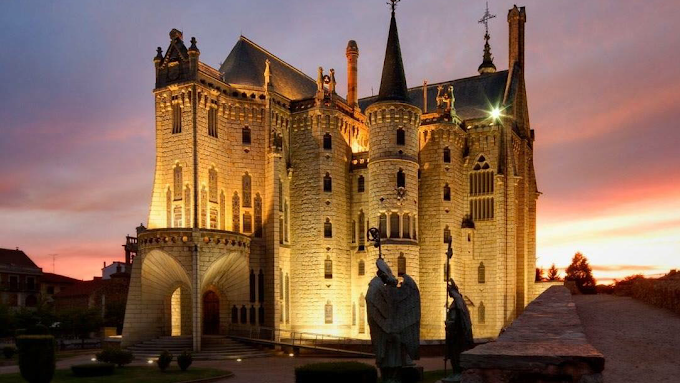
Astorga Gaudí Palace Modernist Whimsy Meets Medieval Stone
The evening sun casts long shadows across the granite plaza as you stand before the turrets—your breath catches when the golden light strikes the polychrome stone, revealing a fairy-tale castle that seems to have grown organically from the medieval streets of Astorga. Commissioned in 1887 by Bishop Juan Bautista Grau and designed by the visionary Antoni Gaudí, the Astorga Gaudí Palace stands as one of only three buildings the Catalan architect created outside his native Catalonia, a Neo-Gothic masterpiece completed in 1913 after Gaudí's departure. You walk across the drawbridge over the dry moat, the air crisp with the scent of dry stone and wild thyme from the nearby mountains, while the silence of the plaza is broken only by the distant tolling of the cathedral bell. The structure rises 17 meters to its highest turret, a geometric paradox of straight lines and organic curves that defies the rigid military architecture surrounding it. In 2026, as historic sites face the dual threats of commercialization and climate degradation, this place matters now more than ever: it preserves a rare moment where ecclesiastical power met artistic revolution, demanding that you witness a building that is not merely a monument but a stone poem written by a genius.
Why Astorga Gaudí Palace Embodies Architectural Revolution
The Astorga Gaudí Palace represents far more than a bishop's residence—it stands as a critical pivot point in the career of Antoni Gaudí, marking his transition from historicist imitation to the organic Modernism that would define his legacy. When Bishop Grau requested a new episcopal palace in 1887 following a fire that destroyed the previous structure, the city faced a critical identity problem: how to house the diocese in a manner befitting its Roman heritage without resorting to sterile neoclassicism. Gaudí's solution was audacious: he designed a building that looked like a medieval castle but functioned with modern structural logic, utilizing a granite base quarried from the nearby Sierra de los Ancares to anchor the structure against the harsh Castilian winters. This approach solved the immediate need for a durable administrative center while creating an architectural landmark that would draw visitors from around the globe over a century later.
The engineering specifics reveal the complexity of Gaudí's vision: the palace is built on a rectangular plan measuring 50 meters by 30 meters, surrounded by a defensive moat 5 meters wide that references the city's Roman military past. The facade features four cylindrical turrets topped with conical roofs covered in slate, rising to a height of 17 meters, while the interior utilizes a central courtyard with a glass skylight to illuminate the four floors naturally. Gaudí designed every detail, from the door handles to the stained glass, ensuring a total work of art (Gesamtkunstwerk), though he resigned in 1893 due to conflicts with the cathedral chapter, leaving the interior completion to architect Ricardo García Guereta. Today, the building fulfills a dual need: functioning as the Episcopal Museum of Sacred Art while serving as a protected cultural asset managed by the Diocese of Astorga. With 150,000 annual visitors, the Astorga Gaudí Palace remains structurally sound through continuous conservation efforts funded by the Spanish Ministry of Culture, preserving a dialogue between faith and art that defines the Modernist movement in Spain.
The Best Time to Experience Astorga Gaudí Palace
While the doors of the Astorga Gaudí Palace open daily at 10:00 AM, your experience depends heavily on the continental climate of Castilla y León and the tourism flow along the Camino de Santiago. For optimal visiting conditions, target May 15–June 20 or September 10–October 15, when daytime temperatures average 18–26°C (64–79°F) and rainfall is moderate. During these windows, you'll explore the palace and the old town comfortably without the biting winds of winter or the scorching heat of summer. The light during these months also enhances the grey granite, creating ideal photography conditions for the facade textures.
For the most atmospheric experience, arrive between 10:00–11:30 AM when the morning light illuminates the eastern facade and tour groups from León haven't yet arrived, or during late afternoon (5:00–7:00 PM) when the sun sets behind the cathedral. Early morning visits offer the clearest air for viewing the turret details without crowd reflections. Winter months (December–February) bring colder temperatures of 4–12°C (39–54°F) and occasional snow, which dramatically reduces crowds but requires warm clothing for outdoor viewing. The palace looks dramatic under grey skies, though the moat may be icy.
Avoid July 25–August 25 and Spanish national holidays (Semana Santa/Easter Week, August 15 Assumption Day) when daily visitor numbers spike and temperatures soar to 30–36°C (86–97°F). Midday tours during peak season create bottlenecks in the central courtyard. For real-time opening hours and Mass schedules that may limit access, check the official website at https://www.palaciodegaudi.es/ or call +34 987 616 882 before your visit.
Approximate Budget for a 7-Day Trip (2026)
Astorga offers exceptional value compared to major Spanish cities, though prices have risen 21% since 2020 due to tourism growth and inflation. This budget assumes moderate comfort—clean, well-located accommodation; authentic meals at traditional Maragato restaurants; and selective paid attractions. Prices reflect 2026 rates with approximately 4% annual inflation factored into estimates. This budget covers a relaxed 7-day stay based in Astorga with day trips to León and Las Médulas.
Accommodation: €60–€110 per night for a double room in a historic hotel in the Old Town; budget hostels from €35/night
Food: €30–€50 per day
-
• Breakfast: €3–€6 (café con leche €2.20, tostada con jamón €3.50)
Transportation:
-
• AVE High-Speed Train from Madrid to León: €35–€55 one-way (Renfe, 2 hours 15 minutes)
Attractions:
-
• Astorga Gaudí Palace entrance: €6 adults, €4 students
Miscellaneous:
-
• Local wine bottle (Bierzo DO): €10–€18
Total for 7 days (per person, double occupancy): €750–€1,150
7 Essential Astorga Gaudí Palace Experiences
- Walk Across the Drawbridge: Enter the palace grounds between 10:00–11:00 AM to avoid crowds. The iron bridge creaks slightly underfoot, echoing the medieval design. The view of the facade from the moat is the definitive photograph. The light is often best in the morning. This is the core experience and sets the tone for the visit.
- Explore the Central Courtyard: Located in the heart of the building, this space features a glass skylight and granite arches. Spend 15 minutes examining the geometric patterns on the floor. The contrast between the open sky and the enclosed stone creates a unique dialogue across spaces. Entry is included with palace ticket. The acoustics during quiet moments are remarkable.
- Visit the Episcopal Museum: Housed on the upper floors, this collection displays religious art from the diocese. Access: Inside palace, open 10 AM–7 PM. Included in entry. Insider tip: Look for the 16th-century goldsmith work. It provides context for the religious function of the building. The stained glass windows are original Gaudí designs.
- View the Turrets from the Plaza: Step back into the Plaza de la Catedral for panoramic vistas of the palace silhouette. Although urban, the viewpoint offers the best panoramic vista of the turrets glowing red in the evening light. Visit at sunset when the stone glows orange. It is a popular spot for photographers, so arrive 20 minutes early to secure a position.
- Dine on Cocido Maragato: Reserve a table at a restaurant near the palace. Order the local specialty cocido maragato (meat and chickpea stew) while watching the light change on the stone facades. Evening dining (9:30 PM) allows you to see the palace illuminated against the night sky. The meal is served in reverse order, a tradition since the 16th century.
- Walk the Roman Walls: Located 200 meters from the palace, these fortifications date back to the 3rd century. The 1-kilometer walk is flat and shaded, making it suitable for families. You will see original Roman masonry. Allow 1 hour for the walk. Bring water as there are limited services along the trail. The connection between Roman and Modernist history is striking here.
- Attend the Holy Week Processions (If Visiting in Spring): If visiting during Semana Santa, witness the traditional processions winding through the old town. The plaza fills with music, religious statues, and thousands of pilgrims. Book accommodation 6 months in advance as hotels fill completely. The torchlight processions are spectacular. This event showcases the community spirit that keeps the tradition alive.
3 Hidden Gems Most Travelers Miss
- Convento de Santo Domingo: While most visitors focus on the palace, this 17th-century convent houses a museum of religious art often overlooked. Access: Calle del Convento, open 10 AM–2 PM and 4–7 PM, €3 entry. Insider tip: The cloister features Baroque arches that rival the palace. Visit early morning to see the light filtering through the courtyard without the midday rush. The preservation is remarkable for its age.
- Castrillo de los Polvazares: Located 5 kilometers from Astorga, this village preserves traditional Maragato architecture. Access: Bus line from Astorga, open 24 hours. Insider tip: The cobblestone streets are original. It provides context for the rural culture you're experiencing. The smokehouses are still active. It is often overlooked by those focused solely on Gaudí.
- Roman Museum (Museo Romano): A specific site located near the walls, accessible via a narrow path often overlooked by tour groups. This underground chamber displays mosaics and artifacts found during excavations. Access: Near Plaza de San Andrés, open 10 AM–6 PM, €4 entry. Insider tip: Bring a flashlight to see the mosaic details. Best visited late afternoon when the light hits the entrance. The history dates back to the 1st century AD.
Cultural & Practical Tips
- Photography etiquette: Tripods require permission from museum security—fines up to €500 for violations. Street photography of locals requires verbal consent; a simple "¿Puedo?" (PWEH-doh) shows respect. Flash photography is prohibited inside the museum to protect the artwork.
- Dress code for churches: Shoulders and knees must be covered to enter the Astorga Cathedral. Carry a lightweight scarf even in summer. Remove hats when entering religious spaces.
- Respect siesta culture: Many shops close 2–5 PM. Plan palace visits and outdoor activities for morning or evening; use midday for leisurely lunches. Quiet hours are enforced in residential areas.
- Essential phrases: "Buenos días" (BWEH-nos DEE-as) before 2 PM; "¿Dónde está el baño?" (DON-deh es-TAH el BA-nyo) = "Where is the bathroom?"; "La cuenta, por favor" (la KWEEN-ta por fa-BOR) = "The bill, please."
- Weather preparedness: The region experiences extreme temperature shifts. Nights can be 15°C cooler than days. Bring layers and a windproof jacket. Winter visits require heavy coats and sturdy shoes for potentially icy paths on the plaza.
- Tipping customs: Round up restaurant bills or leave 5–10% for exceptional service. Not tipping is acceptable but leaving small change shows appreciation. Taxi drivers appreciate small change rounded up to the nearest euro.
- Accessibility information: The palace has an elevator for wheelchair access. The Old Town is cobblestoned and uneven, making wheelchair access challenging. Contact the tourism office for adapted route maps along the main plaza.
Conclusion: Travel with Reverence, Not Just Checklist Tourism
The Astorga Gaudí Palace has witnessed nearly 140 years of human history—bishops walking the halls, architects arguing over plans, tourists marveling at the turrets. When you walk these rooms in 2026, you're not just capturing images for your gallery; you're stepping into a living narrative of artistic struggle and triumph. The granite walls holding this structure never imagined they would support visitors from every corner of the globe; the masons who cut the stone never conceived their work would become a UNESCO-recognized treasure.
But here's what separates meaningful travel from tourism: this palace doesn't need your footprint—it needs your reverence, your willingness to understand the complexity of architectural preservation, to recognize that each visitor adds wear to structures that cannot be easily replaced. In an age of overtourism, Astorga offers a masterclass in balance—showing us that some wonders demand we subordinate our desire for access to the greater need for protection. Walk the halls, yes, but emerge with something deeper than souvenirs: carry forward a commitment to protect not just this palace, but all the fragile, irreplaceable treasures that connect us to our shared human history.