
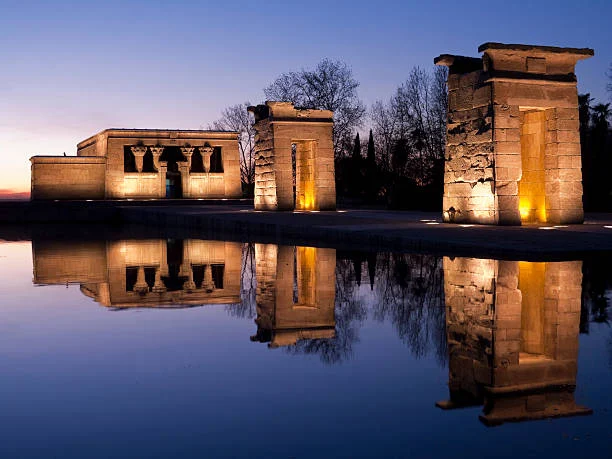
Temple of Debod, Madrid Ancient Sandstone Meets Castilian Sky
The sun dips below the western horizon, casting long shadows across the sandstone blocks that have weathered over two millennia. You stand before the Temple of Debod, Madrid, an ancient Egyptian sanctuary transported 4,000 kilometers from its original home on the Nile. The air carries the scent of pine from the surrounding Parque del Oeste mixed with the mineral tang of heated stone. This is no replica—the temple was built around 200 BC during the reign of Ptolemy IV, dedicated to the goddess Isis and the god Amun. You walk across the reflecting pool, watching the temple's silhouette double in the still water as the sky transitions from azure to violet. In 2026, as cultural heritage faces threats from climate change and conflict, the Temple of Debod, Madrid stands as a testament to international cooperation—a place where ancient devotion meets modern preservation, reminding us that some treasures transcend borders.
Why Temple of Debod Embodies Cultural Diplomacy
The Temple of Debod, Madrid represents one of the most remarkable examples of cultural rescue and international diplomacy in the 20th century. When Egypt announced plans to build the Aswan High Dam in 1960, the rising waters of Lake Nasser threatened to submerge numerous ancient temples, including Abu Simbel and Philae. In gratitude for Spain's assistance in the UNESCO-led rescue campaign, Egypt gifted the Temple of Debod to Spain in 1968—a rare honor, as Egypt typically does not part with its ancient monuments.
The engineering challenge was immense: the temple had to be dismantled stone by stone, transported across the Mediterranean, and reconstructed in Madrid. Between 1970 and 1972, over 600 sandstone blocks were carefully catalogued, shipped, and reassembled on a hill in Parque del Oeste. The temple measures 12 meters in height and 15 meters in width, constructed from Nubian sandstone that gives it a distinctive golden hue. The hypostyle hall features columns with lotus and papyrus capitals, while the sanctuary contains reliefs depicting Ptolemy IV making offerings to the gods.
What makes the Temple of Debod, Madrid unique is its status as one of only a handful of ancient Egyptian temples located outside Egypt—the others being in Turin, Paris, New York, and Leiden. The reconstruction preserved the original east-west orientation, allowing the sun to illuminate the sanctuary on the winter solstice, just as it did 2,200 years ago. This architectural precision demonstrates the sophisticated astronomical knowledge of ancient Egyptian builders. The temple serves not merely as a monument but as a bridge between civilizations, connecting the Iberian Peninsula to the Nile Valley across millennia.
The Best Time to Experience Temple of Debod
For the optimal Temple of Debod, Madrid visit, target March 15–May 20 or September 10–October 25, when temperatures range between 16–26°C (61–79°F) and the light is ideal for photography. The temple grounds open at 10:00 AM daily; arrive at 9:45 AM to enter with the first group before crowds gather. The interior closes at 7:00 PM in winter and 8:00 PM in summer, but the exterior grounds remain accessible for sunset viewing. The golden hour—specifically 7:30–9:00 PM in summer—offers the most dramatic lighting as the sandstone glows amber against the darkening sky.
Avoid July 15–August 25 unless you tolerate extreme heat; temperatures regularly exceed 35°C (95°F), making the stone surfaces radiate intense thermal energy. The lack of shade on the hill exacerbates the heat. Winter months (December–February) bring cold weather (5–12°C / 41–54°F) but fewer crowds and clear skies perfect for photography. The temple closes on Mondays and public holidays; verify current hours at www.madrid.es or contact the information desk at templodebod@madrid.es (+34 913 660 100). Tuesday and Wednesday mornings typically see the lowest visitor density, allowing for contemplative exploration without obstruction from tour groups.
Approximate Budget for a 7-Day Trip (2026)
Madrid offers excellent value for cultural travelers, though costs fluctuate during major events. The following budget assumes mid-range comfort with a focus on local experiences, based on 2026 pricing with approximately 3.5% inflation from 2025 figures. Estimates include stays near the historic center for easy access to the Temple of Debod, Madrid.
- Accommodation: €80–€150 per night for a double room in a boutique hotel or renovated apartment in Centro, Moncloa, or Argüelles neighborhoods; luxury options with park views command €200–€400 per night
- Food: €45–€65 per day—breakfast €5–€9 (café con leche and churros con chocolate), lunch €15–€25 (menú del día including cocido madrileño, salad, and wine), dinner €25–€35 (tapas selection including calamari and jamón ibérico)
- Transportation: Train from Barcelona Sants to Madrid Atocha: €50–€80 high-speed AVE (2.5 hours); Metro single ticket: €1.50 or €18.50 10-trip pass; taxi from airport: €35 fixed rate; bike rental: €15 per day
- Attractions: Temple of Debod, Madrid entry: free; Royal Palace: €13; Prado Museum: €16; Reina Sofía: €10; Retiro Park boat rental: €6
- Miscellaneous: Egyptian-themed souvenirs from €10; local wine €8–€20 per bottle; horchata drink €3; artisan leather goods €30–€70; guided temple tour €15
Total estimated cost for 7 days: €1,050–€1,450 per person (based on double occupancy; solo travelers should add 35–45% for single supplements)
7 Essential Temple of Debod Experiences
- Watch the Sunset from the Reflecting Pool: Position yourself at the rectangular pool in front of the temple 30 minutes before sunset. The sandstone facade reflects perfectly in the still water, creating a symmetrical composition. Visit at 8:00 PM in summer when the sky transitions through shades of orange and purple. The temple is illuminated from below, casting dramatic shadows on the columns. This is the most photographed angle of the Temple of Debod, Madrid; arrive early to secure a spot without people in your frame.
- Explore the Hypostyle Hall: Enter the columned hall featuring lotus and papyrus capitals carved into the sandstone. Visit at 11:00 AM when natural light streams through the entrance, illuminating the hieroglyphic inscriptions. The columns stand 6 meters high and support the roof beams. Notice the astronomical ceiling depicting stars and constellations. Audio guides available in six languages for €3. Allow 20 minutes to examine the reliefs showing Ptolemy IV making offerings to Isis and Amun.
- Examine the Sanctuary Reliefs: Locate the innermost chamber where the cult statue once stood. The walls feature well-preserved carvings depicting the king before various deities. Visit between 2:00–4:00 PM when lighting accentuates the depth of the carvings. The reliefs show the pharaoh offering wine, incense, and cloth to the gods. This is the spiritual heart of the temple. The colors, though faded, still show traces of the original paint. This reveals the religious function of the structure.
- Walk the Surrounding Gardens: Stroll through the Parque del Oeste grounds that frame the temple. The pine trees and rose gardens provide a Mediterranean contrast to the Egyptian architecture. Visit in late afternoon when the scent of roses is strongest. The park covers 98 hectares with walking paths and viewpoints. Entry is free; open 6:00 AM–10:00 PM. This provides context for the temple's placement within Madrid's urban landscape. The elevation offers views over the Manzanares River valley.
- Photograph the Winter Solstice Alignment: If visiting around December 21, witness the sun illuminating the sanctuary at dawn. The temple was oriented so that sunlight penetrates the inner chamber on the solstice, just as it did in ancient Egypt. Arrive by 7:30 AM to capture the phenomenon. This demonstrates the astronomical precision of ancient builders. The event draws photographers and astronomy enthusiasts. It connects Madrid to the celestial cycles observed millennia ago.
- Visit the Interpretation Center: Explore the small museum adjacent to the temple featuring models and explanations of the reconstruction process. Visit at 12:00 PM when the guide explains the dismantling and transport. The exhibits show photographs from the 1968 rescue operation. Entry is included with temple access. It provides crucial context for understanding the engineering feat. Look for the original stones marked with numbers from the reconstruction.
- Attend Evening Cultural Events: During summer months, special concerts and performances occur on the temple grounds. The acoustics against the stone walls are exceptional. Events typically start at 9:00 PM. Tickets range €10–€25 depending on the performance. The atmosphere is magical with the illuminated temple as backdrop. Follow @templodebod on social media for schedule updates. These events reveal the temple's function as a living cultural space.
3 Hidden Gems Most Travelers Miss
- Rosaleda Rose Garden: Located 800 meters northeast in Parque del Oeste, this formal garden features over 20,000 rose bushes. Entry is free; open 10:00 AM–sunset. It is often overlooked as visitors focus on the temple. The garden won international awards for its design. Contact: +34 915 881 636. Visit early morning for photography without crowds. The scent is intense in May and June. It provides a peaceful retreat from the tourist center.
- Cable Car (Teleférico): A 5-minute walk from the temple, this aerial tramway offers panoramic views over the park and Manzanares River. Entry: €6 one-way, €10 round-trip; open 12:00 PM–8:00 PM. It is often overlooked by tourists rushing to Retiro Park. The 2.5-kilometer route takes 15 minutes. Contact: +34 915 410 100. Visit at sunset when the city lights turn on. The perspective allows you to see the temple from above. It provides a unique aerial view of Madrid's western districts.
- Ermita de San Antonio de la Florida: Located 1 kilometer north at Glorieta de San Antonio, this 18th-century chapel features frescoes by Goya. Entry: €3; open Tuesday–Saturday 9:30 AM–8:00 PM. It is often overlooked by tourists rushing to the Prado. The dome paintings are masterpieces of neoclassical art. Contact: +34 915 420 059. Visit mid-morning when light illuminates the frescoes. Goya is buried here. It provides artistic context often missing from the temple visit.
Cultural & Practical Tips
- Respect the monument: The Temple of Debod, Madrid is a protected archaeological site. Do not climb on the sandstone blocks or touch the reliefs. Oils from skin damage the ancient carvings. Fines for vandalism can reach €300. Security monitors the grounds. Keep the site clean; use provided bins.
- Master these phrases: "Buenos días" (BWEH-nos DEE-as) for good morning; "Por favor" (por fah-BOR) for please; "¿Cuánto cuesta?" (KWAN-toh KWES-tah) to ask price; "La cuenta, por favor" (lah KWEN-tah) to request the bill.
- Photography guidelines: Tripods are allowed on the grounds but not inside the temple without permission. Drone usage is strictly prohibited. Flash photography is discouraged inside to protect the reliefs. Respect other visitors when composing shots. Early morning and sunset offer the best light without crowds.
- Hydration strategy: Madrid's inland location means dry heat; carry a refillable bottle. Public fountains (fuentes) are available in Parque del Oeste. The water is potable. Avoid alcohol during midday heat. You'll save €2–€3 daily and reduce plastic waste. Purchase water from kiosks if fountains are unavailable.
- Footwear selection: The ground consists of gravel paths and stone steps. Wear sturdy walking shoes with good grip. The hill can be slippery when wet. Avoid high heels. Comfortable walking shoes essential for exploring the grounds. The gravel can be uneven.
- Weather considerations: The temple provides little shade; wear a hat and sunscreen during summer months. Winter evenings can be chilly; bring a light jacket even if the day is warm. Rain is rare but possible in November; the stone surfaces become slick when wet.
- Security awareness: While the area is safe, pickpockets operate near crowded viewpoints. Keep bags zipped and valuables secure. Do not leave phones on benches. Allow an extra 15 minutes for security processing during peak festival seasons. Report suspicious activity to park police.
Conclusion: Travel with Reverence, Not Just Reverie
The Temple of Debod, Madrid demands more than casual observation—it asks for contemplation of the layers of history embedded in every sandstone block, every hieroglyph, every column carved by hands long turned to dust. When you walk these grounds in 2026, you're not merely touring a monument; you're walking through a fragile ecosystem of memory where ancient devotion, international cooperation, and modern preservation intersect in delicate balance.
Choose to engage deeply: hire a local guide from the Moncloa neighborhood rather than a large tour company; respect the silence of the sanctuary; understand that this temple represents a gift from one civilization to another. The Temple of Debod, Madrid survives not as a museum exhibit but as a living bridge between cultures—and its preservation depends on visitors who recognize the difference between appreciation and consumption.
Slow down. Sit on the steps after the tour buses depart. Listen to the wind moving through the pine trees. Watch the sunset paint the sandstone in shades of gold and amber. The temple rewards those who approach it not as a checklist item but as a conversation across time—a dialogue between ancient Egypt and modern Spain that continues, like the solstice sun, in perpetual motion.