
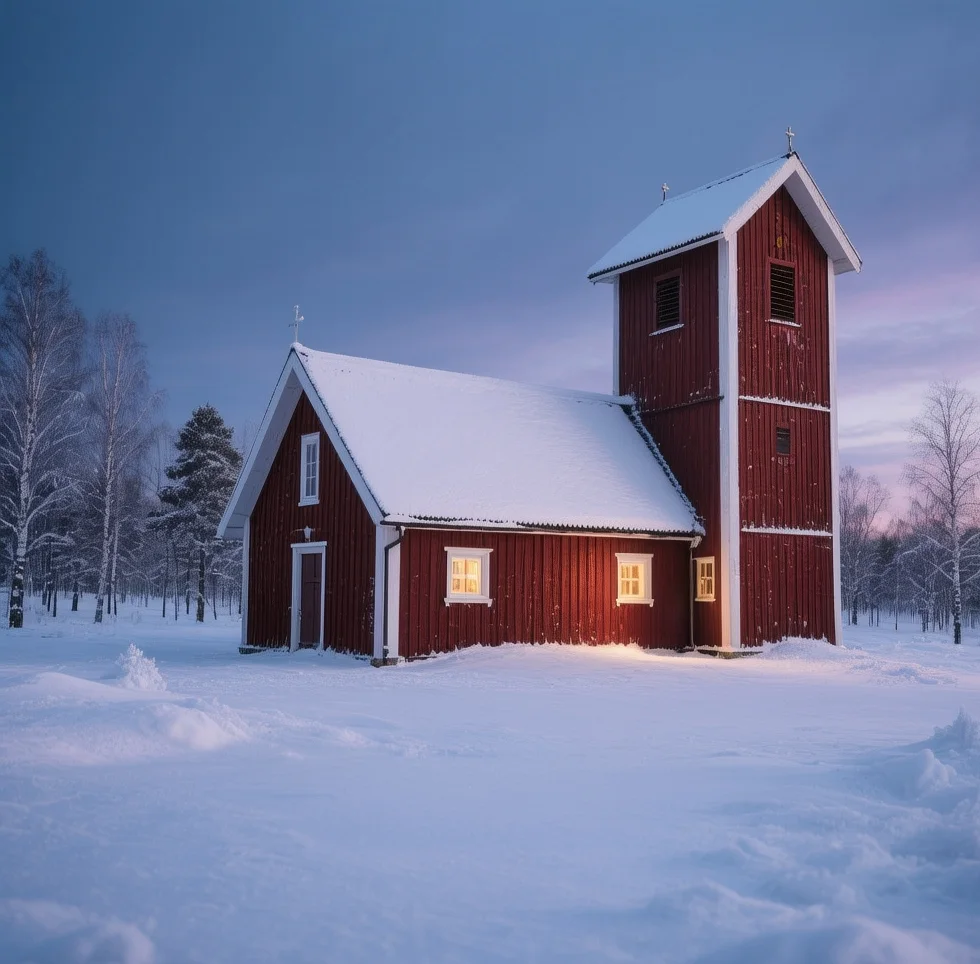
Jukkasjärvi Church: Where Ancient Faith Meets Sami Spiritual Heritage
The crisp Arctic air carries the scent of pine resin and aged timber as you approach the weathered red facade—its wooden planks darkened by centuries of snow, wind, and sun. This is Jukkasjärvi Church, Sweden's oldest protected wooden church in Lapland, standing sentinel since the early 1600s beside the frozen Torne River. The bell tower rises 12 meters (39 feet) above the modest sanctuary, its silhouette etched against a sky that shifts from pale blue to aurora-lit green depending on the hour. Inside, the air hangs still and reverent, carrying the faint aroma of beeswax candles and old wood. Sunlight filters through small, diamond-paned windows, illuminating the remarkable altarpiece carved by Bror Hjorth in 1958—a triptych depicting the Laestadian revival movement that transformed Sami spiritual life. You run your gloved hand along the hand-hewn beams, feeling the craftsmanship of ancestors who built this sacred space without nails, using only traditional joinery techniques passed down through generations. This place matters because it preserves not just architecture, but a living dialogue between Lutheran Christianity and indigenous Sami culture—a testament to faith's ability to adapt, endure, and unite across centuries of Arctic winters.
Why Jukkasjärvi Church Embodies Arctic Cultural Synthesis
Jukkasjärvi Church represents one of Scandinavia's most remarkable examples of cultural fusion, where European ecclesiastical architecture meets indigenous Sami spiritual expression. Constructed between 1607 and 1608, the church solved a fundamental need for early settlers and Sami communities: a permanent gathering place for worship, community decisions, and cultural exchange in a landscape where distances were vast and winters isolating. The building's unique timber construction—using interlocking logs without metal fasteners—was engineered to withstand extreme temperature fluctuations from -40°C to +25°C (-40°F to 77°F) while allowing the wood to expand and contract naturally.
The church measures 18 meters (59 feet) in length and 9 meters (30 feet) in width, with walls 40 centimeters (16 inches) thick providing natural insulation. Its distinctive red color comes from traditional Falu red pigment mixed with linseed oil, a treatment that protects the wood while creating the iconic Scandinavian aesthetic. The interior features hand-carved pews, a pulpit dating to the 1700s, and the celebrated altarpiece by sculptor Bror Hjorth, which depicts Pastor Lars Levi Læstadius preaching to Sami congregants—a visual narrative of the religious revival that swept Lapland in the 19th century.
Beyond its architectural significance, Jukkasjärvi Church fulfills an ongoing cultural role as an active parish church and heritage site. It hosts regular Lutheran services while welcoming visitors of all backgrounds to learn about Sami history, Laestadianism, and Arctic spirituality. The adjacent cemetery contains graves spanning four centuries, including markers for Sami elders, Finnish settlers, and Swedish clergy—a physical archive of the region's diverse population. This living heritage makes the church more than a museum; it is a bridge between past and present, inviting reflection on how faith, culture, and community intertwine in one of Earth's most challenging environments.
The Best Time to Experience Jukkasjärvi Church
For optimal visiting conditions, plan your trip between June 15–September 10, when temperatures average 12–20°C (54–68°F) during the day and the midnight sun provides extended daylight for exploration. The church opens daily from 9:00 AM–6:00 PM during this period, with the softest interior light for photography occurring between 10:00 AM–2:00 PM. For winter atmosphere, visit December 15–March 15, when temperatures range from -15°C to -25°C (5°F to -13°F) and the church's red facade contrasts dramatically against snow-covered landscapes. The interior remains heated to approximately 18°C (64°F) year-round.
For Northern Lights photography combined with a church visit, target January 15–March 1, when darkness prevails after 3:00 PM and aurora activity peaks. Avoid visiting during late October–November and late April–May, known as "kaosvinter" (chaos winter), when freeze-thaw cycles create muddy conditions and limited daylight reduces visibility. Also skip major religious holidays like Christmas Eve and Easter Sunday, when the church closes for services. For current opening hours and service schedules, verify at www.kirunalapland.se before your visit.
Approximate Budget for a 7-Day Trip
Traveling to Jukkasjärvi involves premium Arctic pricing, reflecting remote location logistics and specialized services. This budget assumes traveling during peak winter season and balances authentic experiences with mid-range comfort. Prices reflect current rates and assume solo travel (costs decrease 25–35% per person for couples sharing accommodation).
- Accommodation: €100–€220 per night. Budget: Hostel or shared cabin in Jukkasjärvi village (€100/night). Mid-range: Hotel room near Ice Hotel (€160/night). Higher-end: Luxury Arctic suite with aurora view (€220/night). Book 4–6 months ahead for December–January.
- Food: €45–€75 per day. Breakfast: €10–15 (hotel included or café with coffee, smörgås open sandwich). Lunch: €16–20 (dagens lunch—daily special including soup, main, salad, bread). Dinner: €25–35 (traditional Swedish at restaurants like Restaurant Ovttas). Self-catering reduces costs by 35%.
- Transportation: Stockholm to Kiruna: €90–130 one-way via SJ Night Train (12 hours). Kiruna to Jukkasjärvi: €5 by bus 501 (20 minutes, 18 km/11 miles). Car rental (4WD recommended): €80/day plus fuel (€2.10/liter).
- Attractions: Jukkasjärvi Church entry: Free. Ice Hotel tour: €20. Sami Siida cultural experience: €35. Northern Lights tour: €95. Dog sledding (half-day): €180. Snowmobile safari: €150. Guided church history tour: €15.
- Miscellaneous: Sami craft souvenir: €30–70. Local reindeer meat products: €25–45. Travel insurance (Arctic coverage): €60 for week. SIM card/ €20.
Total 7-day budget: €1,050–€1,650 (excluding international flights)
7 Essential Jukkasjärvi Church Experiences
- Study the Bror Hjorth Altarpiece: Arrive at 11:00 AM when natural light best illuminates the church's centerpiece. The wooden triptych, carved in 1958, depicts the Laestadian revival: the left panel shows Pastor Læstadius preaching as followers repent; the right portrays a Sami woman experiencing liikutuksia (religious ecstasy); the central panel transforms Christ's blood into red flowers. Spend 20 minutes observing the intricate details—the expressions, the flowing robes, the symbolic flora. This artwork bridges Lutheran theology and Sami spirituality, making it essential for understanding Arctic religious history.
- Explore the Timber Construction: Walk slowly around the church exterior at 2:00 PM, examining the hand-hewn logs joined without nails. Notice how the corners interlock using traditional Scandinavian knuttimmer technique, allowing the structure to flex with temperature changes. The walls measure 40 centimeters (16 inches) thick, providing natural insulation against -30°C (-22°F) winters. Touch the weathered wood to feel centuries of history; the texture tells stories of axe marks, seasonal expansion, and careful maintenance by generations of caretakers.
- Visit the Historic Cemetery: Step outside to the churchyard at 3:00 PM, where gravestones span four centuries. Look for markers in Swedish, Sami, and Finnish—evidence of the diverse communities that worshipped here. The oldest graves date to the 1600s; newer sections include modern memorials. Walk quietly; this is an active burial ground. The cemetery offers peaceful views of the Torne River and surrounding forest, providing context for the church's role as a community anchor through centuries of change.
- Attend a Sunday Service: If your visit coincides with Sunday, join the 11:00 AM Lutheran service (conducted in Swedish with some Sami elements). The experience offers authentic insight into contemporary Arctic worship. Visitors are welcome; dress modestly and follow the congregation's lead for standing, sitting, and singing. The hymns, often accompanied by organ or a cappella voices, resonate beautifully in the wooden sanctuary. This is living heritage, not performance—participate with respect and openness.
- Photograph the Bell Tower: Position yourself 30 meters (98 feet) from the church at 4:00 PM when the low Arctic sun creates long shadows. The freestanding bell tower rises 12 meters (39 feet), housing bells cast in the 1700s. Use a wide-angle lens to capture both tower and church facade; the red wood against blue sky or snowy landscape creates striking compositions. In winter, include falling snow for atmosphere; in summer, frame with wildflowers. Avoid flash inside; natural light preserves the sacred ambiance.
- Learn About Laestadianism: Request the church's informational pamphlet (available in English near the entrance) to understand the religious movement depicted in Hjorth's altarpiece. Pastor Lars Levi Læstadius (1800–1861) led a revival emphasizing personal repentance, temperance, and Sami cultural respect. His teachings reduced alcohol abuse and strengthened community bonds across ethnic lines. Reading this context enriches your appreciation of the artwork and the church's historical significance. Allow 15 minutes to absorb the material before continuing your exploration.
- Walk to the Torne River: After visiting the church, follow the path 200 meters (656 feet) east to the riverbank at 5:00 PM. The Torne River, which forms the border between Sweden and Finland, flows year-round despite Arctic temperatures. In winter, watch for ice formations; in summer, spot fishing boats and migratory birds. This short walk connects the sacred space to the natural landscape that shaped the communities who built and maintained the church. The river's presence reminds you that faith here has always been intertwined with survival, subsistence, and respect for nature.
3 Hidden Gems Most Travelers Miss
- The 1736 Timber Cottage: Located 300 meters north of the church in Jukkasjärvi's oldest settlement area, this preserved farmhouse is one of Lapland's earliest surviving civilian buildings. Open by appointment only; contact kiruna.museum@kiruna.se or call +46 980-727 00 to arrange a visit. The cottage features original hand-hewn beams, a turf roof, and period furnishings demonstrating 18th-century Arctic life. Why overlooked: It lacks signage and isn't on standard tourist maps. Insider tip: Visit in late afternoon when golden light illuminates the timber; bring a small gift (coffee or pastries) for the caretaker as a gesture of appreciation.
- Puimenen Hill Viewpoint: A 15-minute hike from the church leads to this modest elevation offering panoramic views of Jukkasjärvi village, the Torne River, and surrounding forests. Access via the path behind the football field; follow the snowmobile trail in winter or the footpath in summer. The summit provides the best photographic perspective of the church's red facade against the Arctic landscape. Why overlooked: Most visitors focus on the Ice Hotel nearby. Insider tip: Visit at sunrise in winter for aurora photography potential, or at midnight in summer for midnight sun shots. Bring a tripod and dress warmly—wind chill is significant at the exposed summit.
- The Sami Prayer Stones: Near the church's eastern cemetery wall, a small cluster of unmarked stones marks a traditional Sami sieidi (sacred site) incorporated into the Christian landscape. No signage identifies this spot; look for the arrangement of smooth river stones near a birch tree. Why overlooked: It's subtle and requires cultural awareness to recognize. Insider tip: Approach with reverence; this is a living spiritual site for some Sami visitors. Do not move stones or leave offerings unless you understand the tradition. Silent reflection is the appropriate gesture. This hidden element embodies the church's role as a bridge between faith traditions.
Cultural & Practical Tips
- Respect active worship: Jukkasjärvi Church is a functioning parish church. During services (typically Sundays at 11:00 AM), enter quietly, sit in the back, and follow the congregation's lead. Photography is permitted but avoid flash and movement during prayers. Children should be supervised to maintain the reverent atmosphere.
- Learn essential Swedish phrases: "Tack" (tahk = Thank you), "Hej" (hay = Hello), "Kyrka" (cheer-kah = Church). Pronunciation matters less than effort—local staff appreciate attempts at their language.
- Photography guidelines: Interior photography is permitted without flash. Tripods require prior permission from church staff. Respect privacy when photographing other visitors; ask before close-ups. Exterior shots are unrestricted. The best light occurs 10:00 AM–2:00 PM when windows illuminate the altarpiece without glare.
- Weather preparation: Arctic conditions change rapidly. Even in summer, bring a windproof layer; temperatures can drop 10°C (18°F) near the river. In winter, dress in thermal layers, insulated boots, and face protection. The church interior is heated, but the walk from parking may be exposed. Check forecasts at smhi.se before departure.
- Accessibility considerations: The church entrance has a single step; a portable ramp is available upon request. Interior aisles are narrow but navigable for wheelchairs with assistance. Contact svkp1323@svenskakyrkan.se or call +46 980-678 12 two days ahead to arrange accessibility support. The cemetery paths are gravel and may be challenging in winter.
- Cultural sensitivity: Sami culture is integral to the church's history. Avoid referring to Sami traditions as "folklore" or "primitive"; these are living spiritual practices. If you encounter Sami visitors conducting private prayers at the sieidi stones, maintain respectful distance. Ask before photographing individuals in traditional gákti (Sami clothing).
- Payment and connectivity: Sweden is nearly cashless; cards accepted everywhere. However, bring 200–500 SEK (€20–€50) cash for small donations or rural vendors. Mobile coverage is reliable in Jukkasjärvi village but spotty on hiking trails. Download offline maps before exploring beyond the church area.
Conclusion: Travel with Reverence, Not Just Curiosity
Jukkasjärvi Church invites you to slow down—to measure your visit not by photographs captured, but by moments of connection with a place where faith, culture, and landscape have intertwined for over four centuries. This is not a destination to rush through; it is a sanctuary that asks you to feel the weight of history in hand-hewn timber, to understand the dialogue between Lutheran and Sami spirituality, to recognize that sacred spaces endure because communities choose to preserve them. When you travel here with reverence, you honor the ancestors who built this church without nails, the Sami elders who adapted their traditions within its walls, and the caretakers who maintain its legacy today. As you leave Jukkasjärvi Church, carry forward the understanding that true cultural travel lies not in collecting sights, but in allowing a place to deepen your appreciation for human resilience, spiritual diversity, and the quiet beauty of Arctic faith. The church will stand long after you depart, its red facade glowing against snow or summer green, waiting for the next visitor willing to pause, listen, and truly see.