
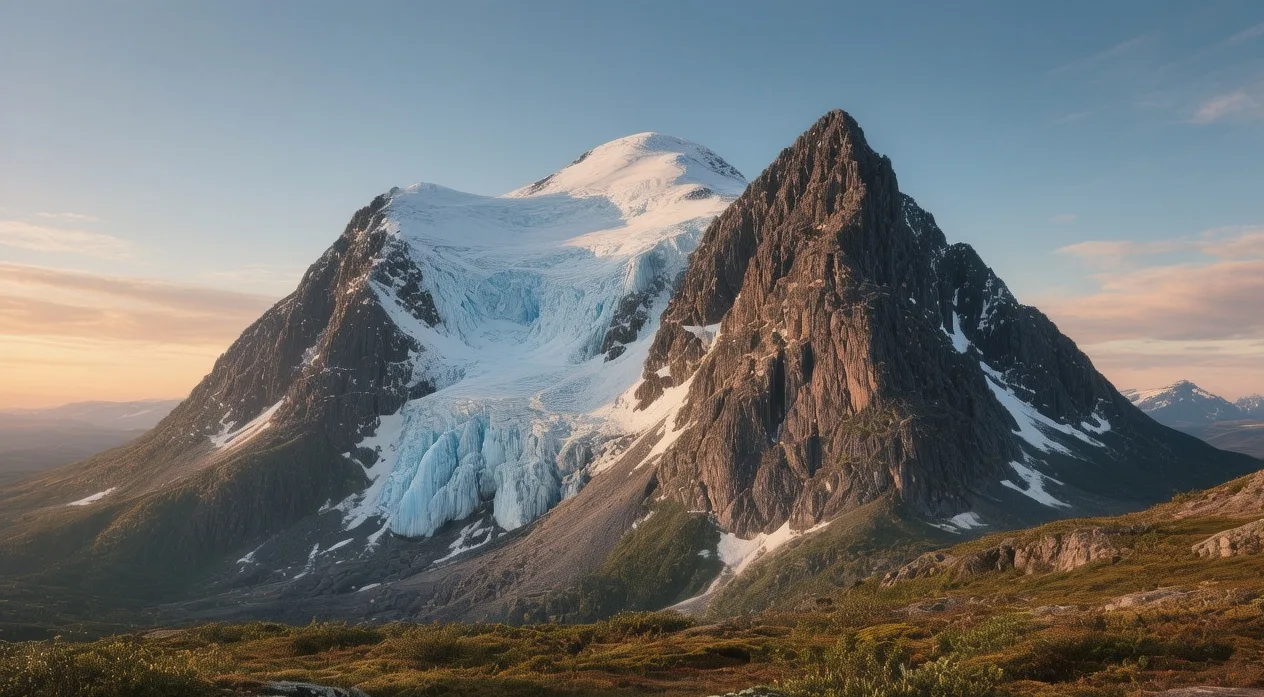
Kebnekaise Mountain: Where Arctic Summit Meets Sami Sacred Landscape
The wind whispers across the tundra—carrying the scent of crushed juniper, glacial ice, and the faint mineral tang of ancient rock. You stand at the trailhead near Nikkaluokta, 1,000 meters (3,281 feet) above sea level, gazing upward at Kebnekaise Mountain, Sweden's highest peak, whose twin summits pierce the Arctic sky at 2,097 meters (6,880 feet) and 2,076 meters (6,811 feet). The air is crisp at 8°C (46°F), thin enough to remind you of altitude yet gentle enough to invite ascent. Birch forests give way to alpine meadows carpeted in purple saxifrage and Arctic cottongrass, while the distant call of a golden plover echoes across the valley. This is not merely a mountain; it is a living monument to geological time, a sacred site for the Sami people who have traversed these slopes for millennia, and a testament to human perseverance against nature's grandest scale. Kebnekaise Mountain matters because it embodies the delicate balance between wilderness preservation and respectful exploration, inviting you to climb not to conquer, but to understand your place within an ancient, breathing landscape.
Why Kebnekaise Mountain Embodies Arctic Wilderness Heritage
Kebnekaise Mountain represents Scandinavia's most iconic alpine challenge, where geological history and cultural heritage converge at Sweden's roof. The massif consists of two primary peaks: the southern summit (Sydtoppen), historically capped by a glacier measuring 150 meters (492 feet) thick, and the northern summit (Nordtoppen), a rocky pinnacle of metamorphic gneiss and quartzite. For decades, Sydtoppen held the title of Sweden's highest point at 2,111 meters (6,926 feet), but climate change has reduced its glacier significantly—recent measurements place it at approximately 2,097 meters (6,880 feet), while the stable Nordtoppen now rivals it in elevation. This dramatic transformation solves a critical educational need: Kebnekaise serves as a visible, accessible indicator of Arctic climate impacts, drawing researchers and visitors alike to witness environmental change firsthand.
The mountain's cultural significance runs equally deep. For the Sami people, Kebnekaise—known in Northern Sami as Giebmegáisi ("the mountain with the glacier")—has long been a sacred landmark within traditional reindeer herding territories. The slopes follow ancient migration routes, and specific valleys hold spiritual meaning tied to sieidi (sacred stones) and seasonal ceremonies. The Swedish Tourist Association (STF) established the Kebnekaise Mountain Station in 1889, creating infrastructure that enables safe access while minimizing ecological disruption. Today, the station accommodates 150 guests, features a research library, and coordinates rescue operations through the Jokkmokk Mountain Rescue Group.
Technically, ascending Kebnekaise demands respect for alpine conditions: the western route (Västra leden) spans 11 kilometers (7 miles) with 1,000 meters (3,281 feet) of elevation gain, while the eastern route (Östra leden) is steeper and requires scrambling over loose scree. Both trails traverse permafrost zones where ground remains frozen beneath a thin summer thaw layer, creating unstable terrain that shifts with temperature. This combination of natural drama, cultural depth, and scientific urgency makes Kebnekaise Mountain far more than a hiking destination—it is a classroom, a sanctuary, and a call to mindful stewardship of Earth's changing poles.
The Best Time to Experience Kebnekaise Mountain
For optimal hiking conditions, visit between July 1–August 25, when snow has melted from lower trails and temperatures average 8–15°C (46–59°F) during the day, dropping to 2–8°C (36–46°F) at night. The midnight sun provides nearly 24 hours of daylight in early July, extending safe hiking windows and reducing navigation challenges. For summit attempts, start between 6:00–8:00 AM to avoid afternoon cloud buildup and potential thunderstorms. The western route is generally accessible from July 10 onward, once snowfields recede from the upper sections.
For winter mountaineering, target March 15–April 30, when temperatures range from -10°C to -20°C (14°F to -4°F) and snowpack stabilizes for ski touring or crampon ascents. The polar twilight creates ethereal blue-light conditions ideal for photography between 10:00 AM–2:00 PM. Avoid visiting during late May–June and September–October, when freeze-thaw cycles create unstable scree, unpredictable weather, and limited daylight. Also skip periods of high wind (over 15 m/s/34 mph), which make ridge sections dangerous. For current trail conditions, glacier status, and weather forecasts, verify at www.swedishlapland.com before your expedition.
Approximate Budget for a 7-Day Trip
Traveling to Kebnekaise involves premium Arctic pricing, reflecting remote logistics and specialized mountain services. This budget assumes traveling during peak summer season and balances authentic experiences with mid-range comfort. Prices reflect current rates and assume solo travel (costs decrease 25–35% per person for couples sharing accommodation).
- Accommodation: €90–€180 per night. Budget: STF Kebnekaise Mountain Station dorm (€90/night). Mid-range: Private cabin at station (€140/night). Higher-end: Guided expedition package with basecamp lodging (€180/night). Book 3–5 months ahead for July.
- Food: €40–€70 per day. Breakfast: €10–14 (station included or café with coffee, smörgås open sandwich). Lunch: €15–20 (packed trail meal: cheese, crispbread, dried fruit). Dinner: €25–35 (hearty stew or salmon at station restaurant). Self-catering reduces costs by 40%.
- Transportation: Stockholm to Kiruna: €90–130 one-way via SJ Night Train (12 hours). Kiruna to Nikkaluokta: €35 by shuttle bus (110 km/68 miles, 1.5 hours). Car rental (4WD): €75/day plus fuel (€2.05/liter).
- Attractions: Kebnekaise guided summit tour: €120. Mountain station entry: Free. Sami cultural experience: €45. Glacier interpretation walk: €25. Kungsleden hiking permit: Free. Rescue insurance (recommended): €30.
- Miscellaneous: Mountain gear rental (crampons, poles): €40/day. Sami craft souvenir: €35–75. Travel insurance (alpine coverage): €65 for week. SIM card/ €20.
Total 7-day budget: €1,000–€1,600 (excluding international flights)
7 Essential Kebnekaise Mountain Experiences
- Hike the Western Route to Summit: Begin at 7:00 AM from Kebnekaise Mountain Station, following the red-marked Västra leden trail. The 11-kilometer (7-mile) ascent gains 1,000 meters (3,281 feet) over rocky terrain and snowfields. Use trekking poles for stability on scree sections; crampons may be required above 1,800 meters (5,906 feet) depending on season. Reach the summit ridge by 1:00 PM for panoramic views of the Tarfala Valley and surrounding peaks. The final scramble to Nordtoppen requires hands-on climbing; take your time and test each foothold. Descend via the same route, allowing 4–5 hours total. This is the most accessible path to Sweden's roof.
- Visit the Glacier Interpretation Trail: Join the guided walk at 10:00 AM from the mountain station, exploring the retreating Sydtoppen glacier. Guides explain climate science using visible markers: moraines, meltwater channels, and exposed bedrock that was ice-covered a decade ago. The 2-hour walk covers 3 kilometers (2 miles) of gentle terrain, suitable for most fitness levels. You'll handle ice samples, learn about permafrost, and understand how Arctic warming affects global sea levels. Bring a notebook; the insights are profound. This experience transforms abstract climate data into tangible, emotional understanding.
- Experience Sami Cultural Storytelling: Attend the evening session at 7:00 PM in the station's communal hall, where Sami guides share traditional knowledge about Giebmegáisi. Stories cover reindeer migration patterns, sacred sites, and the spiritual relationship between people and mountain. The session includes joik (traditional song) demonstrations and Q&A about contemporary Sami life. Respectful participation is welcomed; avoid treating culture as performance. This dialogue enriches your ascent with historical depth and ethical awareness. Sessions run Tuesday and Thursday; book at the station desk.
- Photograph the Midnight Sun Summit: In early July, start your ascent at 10:00 PM to reach the summit during the midnight sun's golden glow. The light is soft and directional, casting long shadows that accentuate the mountain's dramatic contours. Use a tripod and shoot at f/11 for landscape sharpness; include foreground elements like alpine flowers or glacial ice for scale. The sky shifts through hues of pink, orange, and lavender without true darkness. This unique lighting creates images impossible at lower latitudes. Dress warmly; temperatures drop to 5°C (41°F) even in summer.
- Traverse the Tarfala Research Valley: Dedicate a day to exploring this glacial research hub 5 kilometers (3 miles) east of the station. The valley hosts Stockholm University's Tarfala Research Station, where scientists study climate impacts on Arctic glaciers. Join the public tour at 2:00 PM (Wednesday, July–August) to see equipment, meet researchers, and learn about long-term monitoring. The hike to Tarfala is moderate, crossing tundra and moraines with views of Kebnekaise's eastern face. This experience connects your visit to global scientific efforts, adding intellectual dimension to physical adventure.
- Wild Camp Under the Stars: For experienced hikers, obtain a wilderness permit (free, register at station) and camp at designated sites along the Kungsleden trail. Pitch your tent at 1,400 meters (4,593 feet) elevation in the alpine zone, where wildflowers bloom and Arctic foxes may visit at dusk. Cook a simple meal on a portable stove, then watch the sky transition from twilight to starlight without light pollution. Wake at 4:00 AM for sunrise photography. This immersive experience demands self-sufficiency but rewards with profound solitude. Follow Leave No Trace principles strictly; the ecosystem is fragile.
- Descend via the Eastern Route: For a loop hike, return via Östra leden, a steeper, more technical path that offers different perspectives. Start descent at 3:00 PM to avoid afternoon heat on exposed rock. The route features scree slopes requiring careful foot placement and a narrow ridge section with exposure. Use trekking poles for balance; consider gaiters to keep debris out of boots. The eastern approach provides dramatic views of the western glacier and Tarfala Valley. This route is best for experienced hikers with good route-finding skills. Allow 3–4 hours for descent.
3 Hidden Gems Most Travelers Miss
- Kebnekaise's Hidden Tarns: Between the western and eastern routes lie small alpine lakes—tjärnar in Swedish—that reflect the summit with mirror clarity. Access via an unmarked path 500 meters north of the main trail at the 1,600-meter (5,249-foot) elevation marker. Visit at 9:00 AM when winds are calm for perfect reflections. These tarns are overlooked because they require slight off-trail navigation; use a GPS or map to locate them. The largest tarn, 30 meters (98 feet) across, hosts Arctic char and rare aquatic plants. Bring a polarizing filter to enhance water clarity in photographs. No facilities exist; pack out all waste.
- Stuor Rea Cave: Located 2 kilometers (1.2 miles) southeast of the mountain station, this small rock shelter was used by Sami hunters for centuries. Access via a faint trail marked by stone cairns; follow the ridge line from the station's eastern parking area. The cave measures 4 meters (13 feet) deep and offers panoramic views of the Kebnekaise massif. Visit at 5:00 PM when afternoon light illuminates the interior. Why overlooked: It lacks signage and requires moderate route-finding. Insider tip: Bring a headlamp to explore the cave's rear chamber; you may find ancient charcoal marks from historic fires. Respect the site; do not remove artifacts or disturb cultural layers.
- Midnight Sun Yoga Platform: At the 1,200-meter (3,937-foot) elevation point on the western route, a flat rock outcrop serves as an impromptu meditation spot. Local guides occasionally host sunrise yoga sessions at 4:00 AM in July; inquire at the station desk for schedules. The platform faces east, offering unobstructed views of the rising sun over the Tarfala Valley. Why overlooked: It's not promoted as a formal attraction. Insider tip: Even without a class, visit solo at dawn for quiet reflection. Bring a travel mat; the rock is cold and uneven. This simple practice connects physical exertion with mental stillness—a rare gift in adventure travel.
Cultural & Practical Tips
- Respect Sami land rights: Kebnekaise lies within traditional Sami reindeer herding areas. Stay on marked trails to avoid disturbing grazing grounds or sacred sites. Never approach reindeer closer than 50 meters (164 feet); they are semi-domesticated working animals. If you encounter a sieidi (sacred stone), observe silently and do not touch or move it. The Sami have stewarded this land for over 5,000 years; their cultural sovereignty deserves reverence.
- Learn essential Swedish phrases: "Tack" (tahk = Thank you), "Hej" (hay = Hello), "Berg" (bairg = Mountain). Pronunciation matters less than effort—staff appreciate attempts at their language.
- Photography guidelines: Use a polarizing filter to reduce glare from snow and rock. For summit shots, shoot at f/8–f/11 for depth of field; include human figures for scale. Drones require permit from transportstyrelsen.se; apply 2 weeks ahead. Avoid photographing Sami individuals without explicit permission. The best light occurs during golden hour (10:00 PM–2:00 AM in July).
- Safety considerations: Always carry emergency supplies: headlamp, fire starter, emergency blanket, and high-energy food. Weather changes rapidly; check forecasts at smhi.se before every outing. Inform the mountain station of your route and expected return. Hypothermia is a risk even in summer; change out of wet clothes immediately. Avalanche risk exists in winter; consult avalanche.se for warnings.
- Equipment essentials: Sturdy hiking boots with ankle support are non-negotiable. Pack layers: moisture-wicking base, insulating mid-layer, windproof shell. Bring trekking poles for scree sections and crampons for glacier travel (rentable at station). Sunglasses and sunscreen are essential; UV radiation intensifies at altitude. A 30-liter daypack with rain cover completes your kit.
- Connectivity: Mobile coverage is limited to the mountain station and lower trails. Download offline maps before arrival. Satellite communicators (Garmin inReach) recommended for summit attempts. WiFi available at the station but unreliable during peak hours. Inform family of limited communication before departure.
- Leave No Trace: Pack out all trash, including biodegradable items like fruit peels. Use designated toilets at the station; bury human waste 15–20 centimeters (6–8 inches) deep and 70 meters (230 feet) from water sources if camping wild. Do not pick alpine flowers; they grow slowly in harsh conditions. Respect wildlife by observing from a distance.
Conclusion: Travel with Humility, Not Just Summit Fever
Kebnekaise Mountain invites you to slow down—to measure your journey not by elevation gained, but by understanding deepened. This is not a peak to conquer; it is a landscape that demands humility, asking you to feel the weight of geological time, to witness climate change etched in melting ice, to recognize that you are a guest in a realm shaped by forces far older than humanity. When you travel here with humility, you honor the Sami people whose heritage intertwines with these slopes, support conservation efforts that protect fragile alpine ecosystems, and contribute to a tourism model that values preservation over exploitation. As you leave Kebnekaise Mountain, carry forward the understanding that true adventure lies not in standing atop the highest point, but in allowing the mountain to reshape your perspective. The peaks will remain long after you depart, their glaciers receding but their majesty enduring, waiting for the next visitor willing to approach with respect, patience, and an open heart.